

A water tank level sensor is the small instrument that turns “how much water is left” into a number a pump controller, PLC, or phone app can read. The right choice depends on tank material, fluid type (potable, rain, waste, sea water), required accuracy, and whether you need a wired or wireless signal. This guide covers the five sensor technologies actually used in water tanks, how to match them to your application, and the wiring or wireless options that connect them to pump control.
Contents
- Five Types of Water Tank Level Sensors
- Selecting by Tank Material and Service
- Choosing Output: Analog vs Digital vs Wireless
- Wired vs Wireless Water Tank Level Sensors
- Installation Considerations
- Tank Level Sensor and Pump Control Logic
- Sensor Selection for Specific Applications
- Frequently Asked Questions
Five Types of Water Tank Level Sensors
Five sensing principles cover almost every water-tank installation. Each trades range, accuracy, contact with the fluid, and price.
| Sensor type | Principle | Range | Accuracy | Best for |
|---|---|---|---|---|
| Float switch | Mechanical, buoyant float closes contact | Point-level (on/off) | ±5–10 mm | Pump cut-off, high/low alarm |
| Hydrostatic / submersible | Pressure from ρgh at the bottom | 0–200 m H2O | ±0.25 % FS | Deep tanks, wells, reservoirs |
| Ultrasonic (non-contact) | Time-of-flight echo from liquid surface | 0.3–15 m | ±0.25 % range | Open tanks, dirty water, no contact |
| Radar (non-contact) | FMCW microwave reflection | 0–30 m | ±2 mm | Steam, foam, harsh chemistry |
| Capacitive (continuous) | Permittivity change between probe and tank wall | 0.1–6 m | ±0.5 % FS | Small or slim tanks |
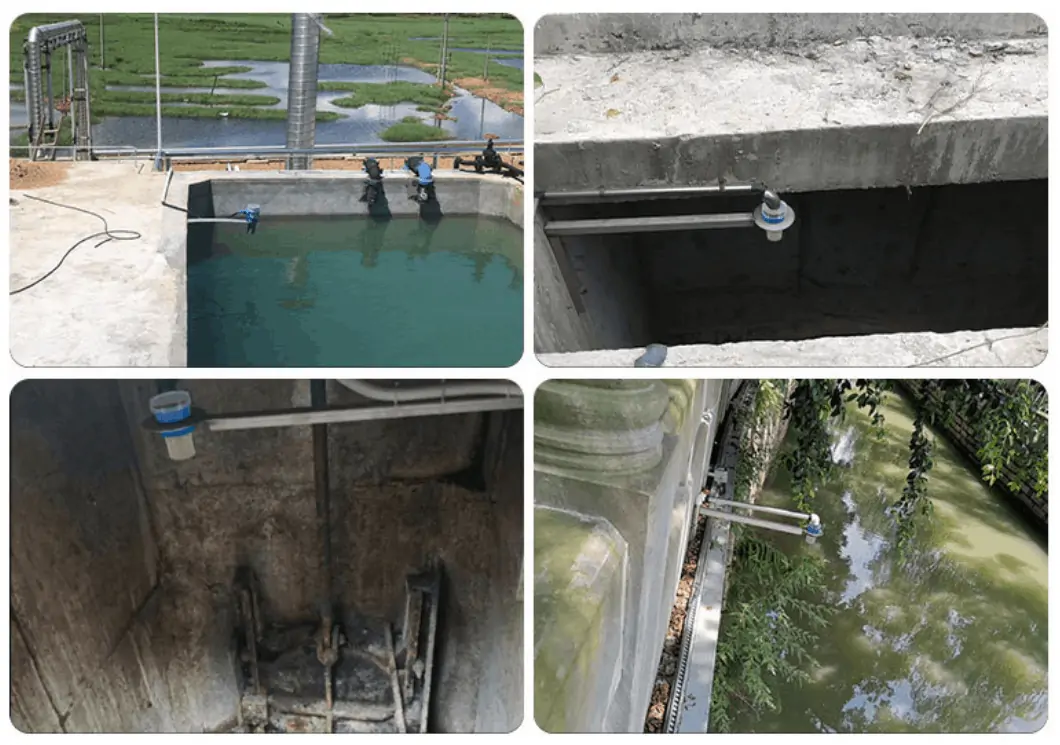
Float switches are still the cheapest and most reliable for simple pump start/stop. For continuous reading and remote monitoring, hydrostatic submersibles win on cost-per-meter and ultrasonics win when contact is undesirable. Background on how submersible pressure sensors read level via the ρgh principle is in common pressure units.
Selecting by Tank Material and Service
- Plastic / poly potable water tank — submersible 316L stainless probe or ultrasonic from the top hatch. Avoid carbon-steel float arms (corrode in soft water).
- Steel municipal reservoir — radar at the top is the modern default; it is unaffected by condensation on the dome and works on coated steel.
- Concrete fire-water tank — ultrasonic or submersible, both robust to algae. Add a float switch as a backup low-low alarm.
- Wastewater holding tank — submersible with replaceable diaphragm, or non-contact ultrasonic to avoid grease/solids fouling. See ultrasonic level basics.
- Marine / RV / caravan tank — capacitive strip or low-cost float chain; must withstand vibration and slosh.
- Chemical / acid tank — PVDF or Teflon-coated submersible, or non-contact radar. Always confirm wetted-material compatibility before purchase.
Choosing Output: Analog vs Digital vs Wireless
- 4–20 mA analog — the industrial standard, immune to long-cable voltage drop, easy to wire to any PLC or DCS.
- Modbus RTU / RS-485 — multidrop with one cable, common on cost-sensitive water and irrigation projects.
- HART overlay — digital configuration on top of the 4–20 mA loop; lets you re-range and run diagnostics from one cable.
- LoRa / NB-IoT / WiFi wireless — battery-powered, ideal for remote tanks where pulling cable is uneconomic. Battery life 3–10 years depending on report interval.
- Float-switch contact (NO/NC) — binary, drives a relay or a digital input on a small PLC.
For new builds, 4–20 mA + HART or Modbus RS-485 covers 90 % of fixed-site water tanks. Wireless wins for scattered tanks (water districts, farm reservoirs, fleet trucks). Reference 4–20 mA wiring diagrams when planning the loop.
Wired vs Wireless Water Tank Level Sensors
| Aspect | Wired (4–20 mA / Modbus) | Wireless (LoRa / NB-IoT / WiFi) |
|---|---|---|
| Install cost | Higher (cable, conduit) | Lower (battery + antenna) |
| Update rate | Continuous (1–100 Hz) | Periodic (5–60 min) |
| Range from controller | 500 m typical | 1–10 km (LoRa), unlimited (NB-IoT) |
| Power | Loop-powered | Battery 3–10 years |
| Latency sensitivity | Suitable for pump control | Best for monitoring only |
| Maintenance | Low | Battery + antenna check |
If pump start/stop is automated from the level reading, prefer a wired sensor: a 30-minute reporting interval is too slow to prevent overflow. Wireless is best for telemetry, fleet visibility, and remote rainwater harvest tanks.
Installation Considerations
- Top mount vs side mount. Top mount is easier (gravity-deploy the cable), side mount needs a sealed gland. Ultrasonics and radar are always top-mount.
- Dead band (blanking). Ultrasonics cannot read closer than 30–60 cm; mount the sensor above that minimum or the top of the tank becomes unmeasurable.
- Cable length. Submersible cable adds bottom-side dead weight; specify the exact tank depth + 2 m at order to avoid splicing on site.
- Venting. A vented-cable submersible needs its breather kept dry; install a desiccant filter at the junction box, especially in humid climates.
- Stilling well. In tanks with strong fill turbulence, a 100 mm perforated stilling well dampens waves and improves accuracy.
- Lightning / surge. Outdoor tanks: install a gas-tube surge protector on the 4–20 mA loop and on any wireless antenna feed.

Tank Level Sensor and Pump Control Logic
Most water tanks need automatic pump start/stop. The simplest control is a single float switch driving a contactor; the most flexible is a 4–20 mA continuous sensor into a PLC running a two-setpoint hysteresis loop.
- Single-float on/off. Pump runs when float drops, stops when float rises. Cheap, but pump cycles frequently if the setpoints are close.
- Two-float (start/stop). Pump starts at the lower float, stops at the upper. Reduces cycling and extends pump life.
- Continuous + PLC. 4–20 mA sensor sends 0–100 % level; PLC starts at e.g. 30 %, stops at 90 %, triggers low-low alarm below 10 %, high-high above 95 %. Easiest to tune in software.
- Cascade with VFD. Continuous sensor modulates pump speed to hold a setpoint — common in pressure-boost systems.
Always include a hardwired high-high float interlock that bypasses the PLC: software faults must not cause an overflow. For an end-to-end example wiring diagram, see DP transmitter installation — the same loop topology applies to submersible sensors.
Sensor Selection for Specific Applications
| Application | Recommended sensor | Output | Notes |
|---|---|---|---|
| Home cistern / poly tank | Ultrasonic top-mount or submersible | 4–20 mA or WiFi | WiFi smart sensor for app monitoring |
| Rainwater harvesting | Submersible 0–5 m | 4–20 mA or LoRa | Anti-fouling diaphragm for leaves/dirt |
| Municipal / fire reservoir | Radar + redundant float | 4–20 mA + relay | SIL-rated low-low for fire |
| RV / marine tank | Capacitive strip or float chain | 0–90 Ω for OEM gauge | Vibration-rated cable gland |
| Wastewater / septic | Submersible PVDF or non-contact ultrasonic | 4–20 mA | Replaceable diaphragm |
| Farm / irrigation pond | Submersible + LoRa gateway | LoRa / NB-IoT | Solar-powered telemetry node |
| Industrial process tank | Radar or DP cell | HART + 4–20 mA | SIL 2 capable |
For water districts running tens or hundreds of remote reservoirs, the most cost-effective combination is a submersible pressure sensor with an integrated LoRa or NB-IoT radio, polled hourly into a SCADA platform. Pump control still runs locally from a hardwired output.
Frequently Asked Questions
How do RV water tank level sensors work?
Most RV tanks use a capacitive strip glued to the outside of the plastic shell. The strip reads the dielectric change as water rises against the wall and reports four levels (E / 1/3 / 2/3 / F) to the panel. Modern RV monitors use a multi-electrode probe or a side-mounted ultrasonic for a continuous percentage reading.
How to install a water tank level sensor?
Submersible: lower the sensor on its cable to the bottom of the tank, dress the cable through a sealed gland on the lid, and connect the 4–20 mA pair to the PLC or display. Ultrasonic: bolt the sensor through a flange on top of the tank, leaving the dead-band distance above the maximum water level; wire the output to the controller. Range the device for the actual tank depth before commissioning.
How to wire a water tank level sensor to a PLC?
For a 4–20 mA loop-powered sensor, connect the + terminal to the PLC’s 24 VDC supply and the − terminal to the PLC analog input common, with a 250 Ω shunt across the input. The PLC scales the input to engineering units (e.g. 4 mA = 0 m, 20 mA = 5 m). For Modbus, daisy-chain the RS-485 A/B pair and configure the slave ID and baud rate.
What is the most accurate water tank level sensor?
Guided-wave radar gives ±2 mm in clean water and is unaffected by foam, condensation or vapor. Submersible pressure sensors achieve ±0.25 % FS, equivalent to ±12 mm on a 5 m tank. For most home and municipal tanks, the cheaper submersible is more than enough; radar earns its premium on tall industrial tanks and harsh chemistries.
Sino-Inst Water Tank Level Sensors

SI-302 Anti-corrosive Submersible
0–200 m H2O | 4–20 mA | PVDF body — for wastewater, sea water, mild chemicals.
Wireless Level Sensor LoRa
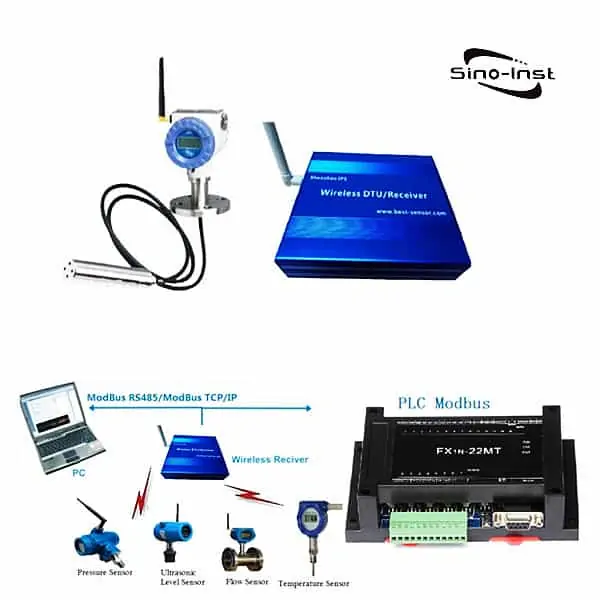
0–30 m H2O | LoRa 868/915 MHz | 5-year battery — for remote farm and water-district reservoirs.
SI-151 Hydrostatic Level Sensor
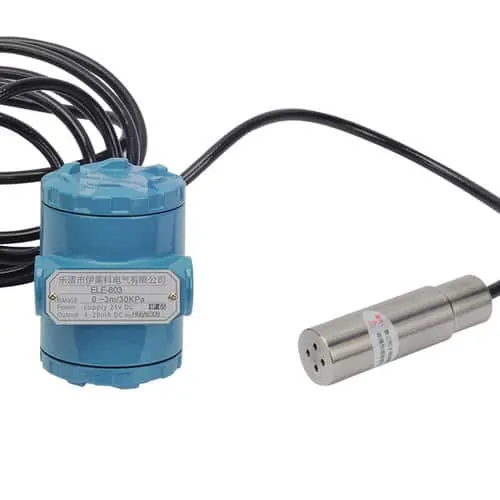
0–100 m H2O | 4–20 mA | 316L stainless — potable water, deep wells, irrigation.
Need help selecting a level sensor for a specific tank shape, fluid, or controller? Send the tank dimensions and fluid type to a Sino-Inst engineer and we will recommend a sensor and quote within one working day.
Request a Quote

Wu Peng, born in 1980, is a highly respected and accomplished male engineer with extensive experience in the field of automation. With over 20 years of industry experience, Wu has made significant contributions to both academia and engineering projects.
Throughout his career, Wu Peng has participated in numerous national and international engineering projects. Some of his most notable projects include the development of an intelligent control system for oil refineries, the design of a cutting-edge distributed control system for petrochemical plants, and the optimization of control algorithms for natural gas pipelines.