

A refrigerant flow meter must do something a water flow meter does not: handle a fluid whose density swings from 30 kg/m³ in the suction line to over 1300 kg/m³ in the liquid line of the same chiller. That density swing is why mass-flow Coriolis dominates the high-accuracy refrigerant market, why thermal-mass meters fall over on phase change, and why magnetic flow meters are simply wrong for any refrigerant — none of the common HFC, HFO, hydrocarbon, or natural refrigerants conducts electricity. This guide matches meter technology to refrigerant by chemistry and phase, names the install rules that protect the reading, and gives the buyer numbers that decide between a $3 k vortex and a $14 k Coriolis. For meter-type selection by pipe size, accuracy class, and glycol correction, see our chilled water flow meter selection guide.
Contents
- Why Refrigerant Flow Is Not Water Flow
- Match Refrigerant Type to Meter Technology
- Coriolis Mass Flow: When Spec Demands Mass Accuracy
- Vortex and Ultrasonic: Lower-Cost Volumetric Options
- Liquid Line vs. Vapor Line: Phase Decides the Meter
- Plant Types: Chiller, VRF, Supermarket, NH3
- Featured Refrigerant Flow Meters
- FAQ
Why Refrigerant Flow Is Not Water Flow
Refrigerant flow measurement breaks three assumptions that make water flow easy. First, density is a strong function of pressure and subcooling — R134a liquid at 5 °C / 350 kPa is 1295 kg/m³, but at 50 °C / 1320 kPa it drops to 1102 kg/m³, a 15% swing on a single charge cycle. Second, two-phase flow is normal: an ill-installed orifice meter sees flashing past the vena contracta and reads chaotic noise. Third, the fluid is non-conductive, ruling out the magmeter that would otherwise be the cheapest answer.
The practical consequence: any volumetric meter (vortex, turbine, ultrasonic, oval-gear) requires a corrected density input to deliver mass flow, which is what the refrigeration cycle calculation actually needs. Coriolis short-circuits this by measuring mass flow directly through the inertial deflection of an oscillating tube, independent of density and viscosity. That is why every chiller-OEM commissioning skid we have inspected uses Coriolis, even when the project budget pretends otherwise.
Match Refrigerant Type to Meter Technology
Refrigerant family decides the candidate technologies before flow rate or pipe size. Hydrocarbon refrigerants (R290 propane, R600a isobutane) demand intrinsically safe construction because charges above 150 g cross the IEC 60335-2-89 flammable threshold. CO2 (R744) at 70–110 bar in transcritical mode pushes mechanical meters off the spec sheet entirely. Ammonia (R717) corrodes copper, so any meter with brazed Cu-tube wetted parts is out.
| Refrigerant | Class | Typical pressure | Best meter | Avoid |
|---|---|---|---|---|
| R134a, R513A | HFC / HFO blend | 2–15 bar | Coriolis (liquid line); vortex (vapor) | Magmeter (non-conductive) |
| R410A, R32 | HFC | 10–35 bar | Coriolis (subcooled liquid) | Turbine in two-phase service |
| R290, R600a, R1270 | Hydrocarbon (A3) | 4–20 bar | Coriolis with ATEX Ex ia | Any non-IS sensor |
| R744 (CO2) | Natural | 40–110 bar transcritical | Coriolis rated 150–200 bar | Vortex below transcritical pinch |
| R717 (NH3) | Natural | 6–18 bar | Coriolis 316L SS; vortex SS | Any copper-bearing wetted part |
| R1234yf, R1234ze | HFO | 3–9 bar | Coriolis with low-flow tube | Orifice (high pressure-loss) |
One rule survives across all six rows: pick a meter whose pressure rating is at least 1.5 × the relief-valve setpoint of the system. CO2 transcritical service routinely rejects meters specified at 50 bar — the gas cooler outlet sits at 95 bar at 35 °C ambient, and 110 bar in summer.
Coriolis Mass Flow: When the Spec Demands Mass Accuracy
Coriolis is the default refrigerant flow meter for any application where mass accuracy decides the outcome — refrigerant charging skids, OEM performance test stands, energy-audit submetering, leak-detection mass balances, and any custody-transfer point in industrial NH3 or CO2 service. Accuracy of 0.1–0.2% of mass flow rate is achievable down to 1% of full-scale turndown.
- Mass directly, no density correction. The oscillating-tube principle reads kg/h regardless of subcooling or pressure shift, so a single calibration covers the full operating envelope.
- Built-in density measurement. Many Coriolis transmitters output fluid density (g/cm³) as a second 4–20 mA channel — useful for confirming refrigerant condition or detecting oil entrainment in the liquid line.
- Bidirectional flow. The same meter handles charge and recovery cycles without re-zeroing, valuable on heat-pump four-way valve systems.
- Wide turndown. 100:1 turndown means one meter sizes for both winter and summer load profiles on a single chiller.
The downsides are cost (a 1″ Coriolis transmitter is typically 5–8× the price of a vortex of the same line size), pressure drop (especially on small-flow models with the U-tube geometry — see our guide on viscous-fluid flow meters for the same trade-off discussion), and sensitivity to mounting vibration on packaged compressor skids. For low-flow refrigerant service (under 50 kg/h, typical of mini-split test stands), the T-series triangle Coriolis geometry beats the standard U-tube on accuracy at the bottom of the range.
Vortex and Ultrasonic Meters: Lower-Cost Volumetric Options
When the application is vapor-line metering — discharge line flow on a chiller, suction-line flow on a refrigeration rack — vortex shedding is the price-performance sweet spot. A vortex meter measures volumetric flow rate, which the DCS converts to mass using a temperature-compensated density polynomial for the refrigerant in question. Accuracy of 1.0% of rate is typical; turndown 20:1 on gas service.
| Technology | Accuracy | Turndown | Best phase | Indicative price (1″ DN25) |
|---|---|---|---|---|
| Coriolis (mass) | 0.1–0.2% rate | 100:1 | Liquid; gas with care | $8 k–$14 k |
| Vortex (volumetric) | 1.0% rate | 20:1 | Vapor / superheated gas | $2 k–$3.5 k |
| Ultrasonic (volumetric) | 1.0–2.0% rate | 50:1 | Subcooled liquid only | $3 k–$5 k |
| Turbine (volumetric) | 0.5% rate | 10:1 | Single-phase liquid | $1.5 k–$3 k |
| Thermal mass | 2–3% rate | 50:1 | Pure single-phase gas only | $2.5 k–$4.5 k |
Ultrasonic transit-time meters work on subcooled liquid refrigerant lines if the line is full and free of vapor bubbles. They struggle in two-phase service. Thermal mass meters give acceptable accuracy on dry vapor only — any liquid carryover destroys the calibration because liquid latent heat distorts the thermal-dispersion equation. For natural-gas lines on absorption chillers (LiBr/H2O machines using natural gas as fuel) the picture differs — see our straight-pipe requirements guide for the install-length rules that govern vortex and ultrasonic accuracy on gas service.
Liquid Line vs. Vapor Line: Phase Decides the Meter
The single rule we apply on every refrigerant flow project: identify the phase at the meter location first; pick the technology second. A meter sized for liquid that occasionally sees flash gas will mis-read by 30% during the flash event, then reset normally. A meter sized for superheated vapor that occasionally sees liquid carryover will deliver an accuracy band the customer never specified.
- Liquid line, post-condenser, subcooled ≥ 5 K. Coriolis or ultrasonic. Confirm subcooling at the meter — if the line runs uphill or through a low spot, install the meter at the low spot to keep the line full.
- Liquid line, post-receiver, sight-glass clear. Coriolis preferred. Turbine acceptable for single-charge custody transfer.
- Discharge vapor, post-compressor, superheated 10–40 K. Vortex for low-cost; Coriolis if the spec calls for ±0.5%.
- Suction vapor, low pressure, 5–20 K superheat. Vortex sized for the lowest density point; thermal mass only if liquid floodback is excluded by upstream protection.
- Two-phase line, expansion valve outlet to evaporator inlet. No meter type works reliably here. Move the measurement upstream to single-phase liquid or downstream to single-phase vapor.
Plant Types: Chiller, VRF, Supermarket Rack, Industrial NH3
Where the meter sits on the plant influences both the chosen technology and the certification requirement. Four common installations recur in our project files.
- Centrifugal water chiller (HFC / HFO): Coriolis on liquid line post-condenser for performance test, vortex on hot-gas bypass when present. Typical line size DN50–DN100.
- VRF / VRV (R410A, R32): Coriolis at the outdoor-unit liquid header for energy submetering by zone. Compact Z-series straight-tube preferred to keep packaging within rooftop dimensions.
- Supermarket CO2 rack (R744): Coriolis rated 150–200 bar on liquid receiver outlet for charge accountability; vortex on flash-gas bypass to MT/LT loads.
- Industrial NH3 (R717) cold storage: Coriolis 316L SS on king-valve liquid line; vortex SS on hot-gas defrost line; no copper-wetted parts. Pair with our ammonia flow meter selection guide for full ammonia-system specification rules.
Featured Refrigerant Flow Meters

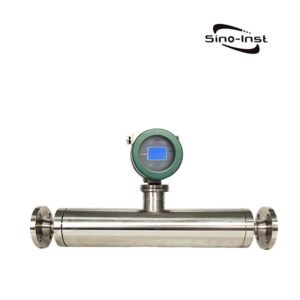
Z-Series Straight-Tube Coriolis Flow Meter
Compact straight-tube Coriolis for liquid-line refrigerant on chiller and VRF systems. 0.1% mass accuracy, 200 bar option for CO2 transcritical service, ATEX Ex ia for hydrocarbon refrigerants.

T-Series Triangle Coriolis Mass Flowmeter
Low-flow triangle-tube geometry for refrigerant charging skids and OEM mini-split test stands. Maintains 0.2% accuracy at 1 kg/h on R290, R134a, and R1234yf charging duties.
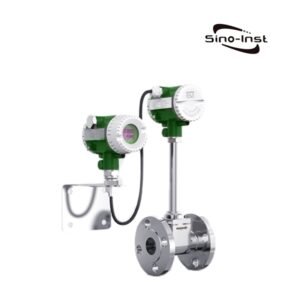
Split High-Temperature Vortex Flow Meter
Lower-cost volumetric option for discharge-line vapor metering up to 250 °C. Split design isolates the transmitter electronics from compressor-skid heat. ±1% rate, 20:1 turndown.
FAQ
Can I use a magnetic flow meter for refrigerant?
No. Magnetic flow meters need an electrolyte conductivity above 5 µS/cm; common refrigerants (HFC, HFO, hydrocarbons, CO2) are non-conductive and produce no electromotive force across the magnetic field. The meter will read zero or noise. Use Coriolis for mass-accurate refrigerant flow.
What is the most accurate refrigerant flow meter?
Coriolis mass flow meters reach 0.1% of mass flow rate on subcooled liquid refrigerant — about an order of magnitude better than vortex or ultrasonic. The accuracy holds across the full pressure and temperature range because the principle measures inertial force, not volume.
Will a Coriolis meter work on R744 (CO2) at transcritical pressures?
Yes, but only with a specifically rated body. Standard 100 bar Coriolis bodies are not safe at the 95–110 bar gas-cooler outlet pressures common in summer. Specify a 150–200 bar wetted-part rating for transcritical CO2 service, with NACE MR0175-compliant wetted parts when sour-gas trace is suspected.
Why does my vortex meter read poorly on a refrigeration suction line?
Two reasons usually combine. First, suction-line vapor density at low evaporator temperature drops below the vortex meter’s minimum Reynolds number, putting the operating point in the dropout zone. Second, liquid floodback from the evaporator (transient or chronic) lands as droplets on the bluff body and produces noise. Move the meter to the discharge line, or upsize the suction line to keep velocity in band.
Do I need an ATEX-rated meter for R290 propane?
If the system charge exceeds the IEC 60335-2-89 limit (typically 150 g for self-contained equipment, higher for split systems with leak-detection), yes. Specify Coriolis or vortex with ATEX Ex ia (intrinsically safe) certification, plus a Zener barrier or galvanic isolator at the safe-side panel. Below the charge limit the equipment is exempt, but most building-services projects still require IS construction by site policy.
Can ultrasonic flow meters measure refrigerant?
Transit-time ultrasonic meters work on subcooled, single-phase liquid refrigerant in a full pipe. They do not handle two-phase service or vapor lines reliably because acoustic propagation through bubbly or low-density media is unstable. For a chilled-water side of an absorption chiller the picture is different — see our BTU meter for chilled water guide for that case.
For a refrigerant-specific quote — chemistry, line size, pressure, and target accuracy — our application engineers respond within one working day with a sized Coriolis or vortex configuration, including ATEX certification path and pressure drop calculation.
Request a Quote


Wu Peng, born in 1980, is a highly respected and accomplished male engineer with extensive experience in the field of automation. With over 20 years of industry experience, Wu has made significant contributions to both academia and engineering projects.
Throughout his career, Wu Peng has participated in numerous national and international engineering projects. Some of his most notable projects include the development of an intelligent control system for oil refineries, the design of a cutting-edge distributed control system for petrochemical plants, and the optimization of control algorithms for natural gas pipelines.