

Cooling tower water-level control is four separate jobs in one basin: refill the evaporated water, dump the concentrated water (blowdown), guard the pump from running dry, and stop the basin from overflowing. One sensor cannot do all four reliably — the right pick depends on which job, the basin geometry, and how aggressive the water chemistry is. This guide maps the four control loops to the right sensor technology, then gives the install and wiring rules that keep cooling tower level sensors out of the maintenance log.
Contents
- The Four Water-Level Jobs in a Cooling Tower Basin
- Sensor Technology by Job: a Selection Matrix
- Float Switches for Makeup and Anti-Overflow
- DP / Hydrostatic Transmitters for Continuous Basin Level
- Ultrasonic Sensors When Scale and Spray Permit
- Capacitive and Conductivity Probes for Low-Low Alarm
- Water Chemistry: Why Cooling Tower Sensors Foul Faster
- Install Position, Baffles, and Wiring Rules
- Featured Cooling Tower Level Sensors
- FAQ
The Four Water-Level Jobs in a Cooling Tower Basin
A cooling tower basin level moves continuously, and four separate control jobs act on it. Treating them as one loop is the most common reason a sensor specification ends up over- or under-built.
- Makeup water control. Replaces water lost to evaporation, drift, and blowdown. A typical 100 ton tower evaporates roughly 1.6 USgpm at full load (≈3% of recirculation per 10 °F approach). The makeup loop only needs an on/off command between two setpoints (refill start and refill stop), so a two-stage float or a level switch with hysteresis is enough.
- Blowdown control. Dumps a fraction of the basin water to keep the cycles of concentration (CoC) below the corrosion limit — usually 4–6 cycles depending on the makeup hardness. Blowdown is triggered by conductivity, not by level, but the blowdown valve must be inhibited if level drops below the low setpoint.
- Low-low (pump protection) cutout. Prevents the circulation pump from cavitating if the makeup line fails. This is a safety interlock and must be a separate sensor from the makeup level — sharing one sensor for control and trip is a single point of failure that ASHRAE 188 explicitly flags for Legionella risk.
- Anti-overflow / high-high alarm. Stops makeup if a stuck float feeds water past the overflow weir. The overflow loss costs treatment chemicals, not just water.
Four jobs, three setpoints (low-low, refill on/off, high-high), and at least two independent sensors. The selection matrix below maps each job to the technologies that deliver the right combination of accuracy, cost, and resistance to scale.
Sensor Technology by Job: a Selection Matrix
Match the sensor to the loop, not the loop to whatever sensor is on the shelf. The following table is the short version we hand to plant engineers when they ask which technology to specify per job.
| Job | Output type | Best technology | Why | Avoid |
|---|---|---|---|---|
| Makeup on/off | 2 discrete contacts | Side-mounted reed float, multi-stage cable float | Cheapest reliable hysteresis; no analog signal needed | Continuous DP — over-spec for on/off |
| Low-low pump trip | 1 normally-closed contact | Independent float switch or vibrating fork | Must be galvanic-independent of makeup loop | Sharing the makeup float — single point of failure |
| High-high overflow | 1 normally-open contact | Vibrating fork, rod-end conductivity | Tolerates spray and foam better than reed | Top-mounted ultrasonic — spray washout |
| Continuous basin level (BMS) | 4–20 mA | Submersible piezoresistive, side-mount DP, 80 GHz radar (open basin only) | Hydrostatic types ignore foam; radar tolerates fouling | Capacitive — coating drift in 6 weeks |
| Cold-weather sump (heated) | Discrete or 4–20 mA | Magnetostrictive in stilling well | Ice on the float surface does not affect reading | External ultrasonic on a frozen sidewall |
Float Switches for Makeup and Anti-Overflow
For the on/off loops a float switch is still the right answer in 2026. The water-side electronics are sealed in the float body, the contact is magnetically actuated, and there are no electronics in the wet path that scale can corrode.
Two configurations cover almost every cooling tower:
- Side-mounted, single contact. Used as the high-high overflow guard. Mount on a 3/4″ or 1″ NPT half-coupling tapped through the basin sidewall, 25–50 mm above the overflow weir. Hysteresis is fixed by float geometry, typically 6–10 mm — fine for an alarm.
- Top-mounted, multi-stage cable float. Used as the makeup controller. Two switches on the same cable: one trips when basin drops below normal operating level (refill on), the second trips when basin recovers (refill off). The dead band is the cable distance between switches, set anywhere from 50 mm to 250 mm depending on tower size — bigger band means fewer makeup-valve cycles per hour.
Both must be installed in a stilling tube if the basin sees splash from the spray distribution headers. A 50 mm PVC tube with 6 mm holes drilled below low-low level is enough — see our stilling well design rules for the geometry.
DP / Hydrostatic Transmitters for Continuous Basin Level
For a continuous 4–20 mA reading to the BMS, a hydrostatic differential pressure (DP) transmitter is the workhorse on cooling towers. It does not care about foam, drift, or surface waves, and the sensing diaphragm sits below the worst of the scale-forming surface layer.
Two sub-types matter for cooling tower service:
- Submersible piezoresistive transmitter (cable-suspended). Range 0–1 m to 0–10 m water column, accuracy ±0.25% FS, 316L body with hydrophobic vent in the cable. Drop it into a stilling tube to keep the cable away from the recirculation suction. Cleanable in 5 minutes by lifting the cable.
- Side-mount diaphragm-seal DP transmitter. Flush flange or extended diaphragm seal mounted on the basin sidewall at the lowest point. Reads 0–500 mbar (≈0–5 m H₂O). Use this when the cooling tower is buried (no access to drop a cable from above) or when the makeup-water treatment chemistry attacks 316L over a 5-year horizon and a remote-seal Hastelloy diaphragm is justified.
Both deliver continuous level data for the building automation system without exposing electronics to the spray zone above the basin.
Ultrasonic Sensors When Scale and Spray Permit
Ultrasonic level sensors are tempting because they are non-contact, but cooling tower service has three failure modes that quietly degrade them.
- Spray and condensation on the transducer face. Even a thin water film on the piezo crystal attenuates the return echo by 6–10 dB. After 6 months on a humid tower, the loss adds up to lost lock and a frozen reading.
- Mineral scale ring on the basin wall. If the transducer is mounted flush with a wall return, the false-echo from the scale ring shows up as a steady reading at the scale height — often within 50 mm of true level, which is the worst possible failure: undetectable until calibration day.
- Wind-driven foam. Outdoor towers in summer build a foam layer that ultrasonics see as a soft reflection. The reading walks downward as foam builds.
Ultrasonic still works in two cooling tower roles: indoor closed-loop chillers with low spray carry-over, and open basin sumps where a stilling well shields the sensor from spray. Mount 300 mm minimum above maximum level, set the dead band to cover the spray-carry zone, and schedule a monthly wipe-down of the transducer face.
Capacitive and Conductivity Probes for Low-Low Alarm
Capacitive level switches and conductivity rod sensors handle the safety-interlock job — point detection of low-low for pump trip, or of high-high if a float is unreliable. They are simple, have no moving parts, and the rod can be cut to length on site.
Cooling tower water has 1000–4000 µS/cm conductivity, so both technologies see a strong wet/dry signal. The trade-off:
- Conductivity rod (2- or 3-electrode). Cheapest sensor that exists for water level. Drift comes from scale bridging the electrodes — typically 6–18 months between cleanings, depending on hardness. Use the 3-electrode version with a reference rod when the makeup is variable hardness.
- RF capacitive switch with guard driver. Tolerates a thin coating because the guard electrode rejects current through the build-up layer. Cleaning interval doubles vs straight conductivity, but the sensor cost is 4–6× higher. Use only on the low-low cutout, not the operating loop.
Avoid straight (non-RF) capacitance for cooling tower water. Untreated capacitive probes drift by 30–60 mm of indicated level after 8 weeks of carbonate scale build-up, which is enough to trip a pump that is actually running fine.
Water Chemistry: Why Cooling Tower Sensors Foul Faster
Cooling tower water is the harshest level-sensing environment in HVAC. Because the system concentrates dissolved solids by 4–6× as water evaporates, every minor problem in the makeup is amplified.
| Issue | Typical level | Effect on sensor | Mitigation |
|---|---|---|---|
| Calcium carbonate (CaCO₃) scale | 200–600 ppm as CaCO₃ | Coats wetted parts; jams floats; biases capacitive | Acid wash quarterly; scale-resistant probe geometry |
| Biological growth (algae, slime) | Visible film < 4 weeks if biocide off | Coats floats and ultrasonic faces | Continuous biocide dose; weekly visual inspection |
| Suspended solids (dust, pollen, scale fragments) | 10–80 ppm | Plugs stilling tube vent holes | 2 mm side-vent slots, no bottom plug |
| Dissolved iron (corrosion) | 0.3–2 ppm | Stains 304 SS; pits if combined with chloride | Specify 316L minimum; Hastelloy in seacoast service |
| Chloride (sea air, brine carryover) | 50–500 ppm | Stress-corrosion of austenitic SS at >200 ppm | Use 316L with cathodic protection or PTFE-clad probes |
The practical takeaway: any sensor going into a cooling tower needs a defined cleaning interval. Build a quarterly wipe-down into the operations checklist before the install date, not after the first false trip.
Install Position, Baffles, and Wiring Rules
Sensor placement on a cooling tower is constrained by spray, cold-weather freezing, and the geometry of the basin. The rules below come from field installations and apply to most square or rectangular cooling tower basins.
- Distance from spray distribution. Mount sensors at least 600 mm horizontally from the spray pan edge. Closer than that, the falling-water drag pulls floats off the wall and creates negative-pressure zones that bias DP transmitters.
- Distance from the recirculation suction. Keep sensors 1.5× suction-pipe-diameter away from the suction. Otherwise the local drawdown reads as a phantom low-low, especially during pump start.
- Stilling tube for cable-mounted sensors. 50–100 mm Schedule 40 PVC, slotted on the lower 300 mm with 6 mm vent holes, top open. The tube damps surface waves to ±2 mm and shields submersibles from cross-flow.
- Freeze-protection for outdoor towers. Heat-trace the sensor cable above 0 °C from the basin to the conduit elbow. The basin water itself stays warm during operation but freezes within 60 minutes of pump shutdown in –10 °C ambient.
- Wiring class. Discrete float and capacitive switches: 24 V DC, normally closed for fail-safe (open contact = trip). Continuous transmitters: 2-wire 4–20 mA loop powered, twisted shielded pair, shield grounded at the BMS panel only.
- Lightning and surge. Outdoor cooling towers attract surges. Add a Type 2 surge protector on the 4–20 mA cable at the BMS-panel entry. A blown sensor with a clear sky overnight is almost always a surge from a distant storm.
For piping and instrumentation drawings, the cooling tower level loop should show two physically independent sensors driving the makeup valve and the pump-trip relay, and a third sensor or float to drive the high-high overflow alarm — see also our notes on water tank level sensor selection for the wider sensor family.
Featured Cooling Tower Level Sensors
The three sensors below cover the makeup, continuous, and non-contact roles for a typical 50–500 ton cooling tower.

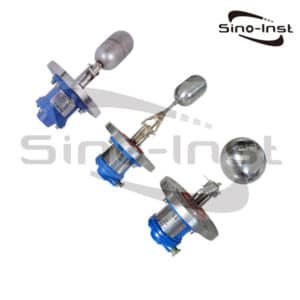
SS Float Switch Water Level Controller
Stainless steel multi-stage cable float for the makeup-water on/off loop. Two reed contacts on a single cable set the refill start and stop levels; cable length cut to suit basin depth. Direct PLC interface, no power needed at the sensor.
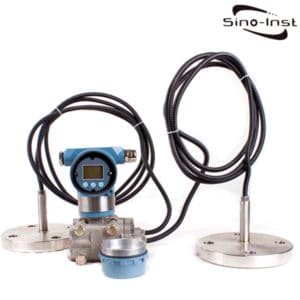
SMT3151LT DP Level Transmitter
Side-mount diaphragm-seal DP transmitter for continuous 4–20 mA basin level to the BMS. 0–500 mbar range covers most cooling tower basins; ±0.075% accuracy. Foam-immune, scale-tolerant on a flush flange.
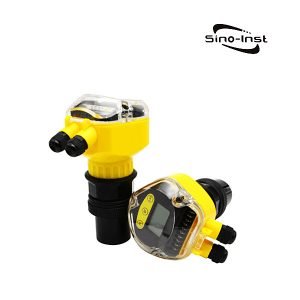
ULT-100A Ultrasonic Level Transducer
Non-contact ultrasonic for indoor closed-loop towers and stilling-well sumps. 0.5–10 m range, ±0.25% accuracy, 4–20 mA + 2 relays. Paired with a wave guide it survives the spray-carry zone for years.
FAQ
What is the most common cooling tower level sensor?
The cable-suspended multi-stage float switch is still the most common, because the makeup-water loop only needs on/off control between two setpoints. Hydrostatic DP transmitters dominate the continuous-reading role for sites with a BMS. The two technologies coexist on most modern towers.
Can one sensor do both makeup control and pump trip?
No, and ASHRAE 188 explicitly cautions against it. The makeup loop and the low-low pump-trip loop must be galvanic-independent so that a single fouled probe cannot disable both refill and protection at once. Use two physically separate sensors at different elevations.
Why does my ultrasonic level reading drift downward over time?
Three causes account for nearly all cooling tower ultrasonic drift: a water film on the transducer face from spray, a mineral-scale false echo at a fixed wall height, or a foam layer that returns a softer echo than open water. Wipe the face, then re-baseline. If drift returns within 30 days, switch to a hydrostatic DP transmitter or move the ultrasonic into a stilling tube.
What basin level should I use as the makeup setpoint?
Standard practice is to keep the operating level 50–100 mm below the overflow weir, with the refill-start setpoint 50–150 mm below the operating level and the refill-stop setpoint 25–50 mm below the operating level. Larger dead band reduces makeup-valve cycling, which extends solenoid life.
How often should cooling tower level sensors be cleaned?
Quarterly is the minimum for typical municipal-water towers (200–400 ppm hardness). Float switches and DP diaphragms can stretch to 6 months if biocide is well-controlled. Conductivity rod electrodes need monthly inspection in hard-water service. Build the interval into the cooling tower preventive-maintenance schedule from day one.
Is a guided-wave radar suitable for a cooling tower?
Guided-wave radar is overkill for an open atmospheric basin and the probe accumulates scale where the spray hits it. Reserve guided-wave radar for closed-loop chiller tanks or condensate receivers. For open cooling towers the cost-effective continuous solution is hydrostatic DP or a sealed submersible piezoresistive transmitter.
Need help specifying the right cooling tower level sensor for your basin geometry, makeup chemistry, and BMS interface? Send the basin sketch, makeup conductivity, and required outputs and our team will reply with a wired drawing within one business day.
Request a Quote


Wu Peng, born in 1980, is a highly respected and accomplished male engineer with extensive experience in the field of automation. With over 20 years of industry experience, Wu has made significant contributions to both academia and engineering projects.
Throughout his career, Wu Peng has participated in numerous national and international engineering projects. Some of his most notable projects include the development of an intelligent control system for oil refineries, the design of a cutting-edge distributed control system for petrochemical plants, and the optimization of control algorithms for natural gas pipelines.