

A PID controller takes the difference between where a process is and where you want it to be (the error), then computes a corrective output using three weighted terms — proportional, integral, and derivative — and feeds that output back to whatever heats, cools, opens, closes, or drives the process. The math is older than the transistor, but it still runs the world’s heat exchangers, autoclaves, motor speeds, and chemical reactors because nothing else combines its simplicity and stability.
This guide gives you the plain-English version of P, I, and D, the equation in symbols a working engineer can use, a worked Ziegler-Nichols tuning example on a temperature loop, the five mistakes that cause most tuning calls to escalate, and a spec-sheet decoder for buying a PID controller.
Contents
- PID Controller Defined
- What P, I, and D Each Do
- The PID Equation in Plain Language
- Open-Loop vs Closed-Loop PID Topologies
- Ziegler-Nichols Tuning: Worked Example
- Manual Fine-Tuning When Z-N Falls Short
- Industrial Applications
- 5 Common PID Tuning Mistakes
- Selecting a PID Controller: Spec Sheet Decoder
- Featured PID Controllers and Recorders from Sino-Inst
- FAQ

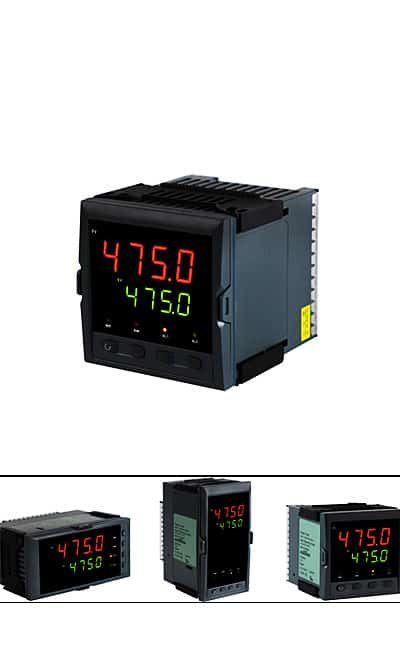
PID Controller Defined
A PID controller is a feedback controller that drives a process variable (temperature, pressure, flow, level, speed) toward a setpoint by adjusting one final control element (valve, heater, VFD, damper). It does this by combining three responses: a proportional response to current error, an integral response to accumulated past error, and a derivative response to predicted future error. “PID” simply names the three terms: Proportional, Integral, Derivative.
You will find PID inside dedicated panel-mount controllers, inside PLC function blocks, inside paperless recorders with control output cards, and increasingly inside the firmware of smart valves and VFDs. The physics doesn’t change with the box — only the user interface does.
What P, I, and D Each Do
Picture a tank with a heater and a thermometer, setpoint 80 °C. The thermometer reads 60 °C, so the error is 20 °C.
- Proportional (P) reacts to the current error. Output = Kp × error. A larger Kp means a stronger heater response per degree of error. P alone leaves a permanent offset (steady-state error) because the heater turns off only when error is zero, but stops moving toward zero when there’s no error.
- Integral (I) reacts to the sum of past errors. As long as error stays positive, the I term keeps growing, pushing the heater harder until error reaches zero. I kills the steady-state offset that P leaves behind. Too much I and the heater overshoots, then the integral has to “unwind,” causing slow oscillation.
- Derivative (D) reacts to the rate of change of error. If the temperature is rising fast, D backs off the heater early to prevent overshoot. D is a brake on aggressive P+I action. Noise on the measurement causes D to thrash, so most loops run with little or no D — temperature and slow loops use it, flow and pressure rarely do.

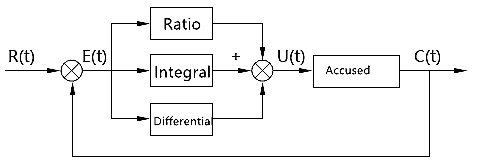
The PID Equation in Plain Language
The textbook form (parallel / ideal):
u(t) = Kp · e(t) + Ki · ∫ e(t) dt + Kd · de(t)/dt
where u(t) is controller output (often 0–100% to the valve or heater), e(t) is error (setpoint minus process variable), Kp is proportional gain, Ki is integral gain, and Kd is derivative gain.
Most industrial controllers use the standard ISA form instead, which is easier to tune by hand:
u(t) = Kp · [ e(t) + (1/Ti) ∫ e(t) dt + Td · de(t)/dt ]
where Ti is integral time (seconds per repeat — smaller means stronger I action) and Td is derivative time (seconds — bigger means stronger D action). When you read a controller’s display showing “PB 50%, Ti 120 s, Td 30 s,” that’s the ISA form. Proportional band PB is the inverse of Kp expressed as a percent of measurement span: PB = 100 / Kp.
Open-Loop vs Closed-Loop PID Topologies
A closed-loop PID feeds the measurement back to the controller, computes error, and drives the output. An open-loop controller just sets the output to a fixed value or follows a schedule — no feedback. Closed-loop is what people mean when they say “PID control.” Open-loop control is what runs a toaster timer.
Within closed-loop, two topologies matter: single-loop PID (one PV, one output) and cascade PID (an outer loop sets the setpoint of an inner loop). Cascade is common for heat exchangers — an outer temperature loop sets the setpoint of an inner steam-flow loop. Cascade handles disturbances 5–10x faster than a single loop.
Ziegler-Nichols Tuning: Worked Example on a Temperature Loop
Ziegler-Nichols is the most common starting point. Two methods exist: the ultimate-gain (closed-loop) method and the reaction-curve (open-loop) method. Here is the reaction-curve walk-through on a 200-L water tank heated by a 6 kW electric heater, setpoint 70 °C, current temperature 25 °C.
- 1. Put the controller in manual. Set output to 0% and let the tank settle.
- 2. Step the output to 50% (3 kW). Record temperature every 30 seconds.
- 3. Plot temperature vs time. Wait until the rise straightens into a line, then plateaus at a new steady-state temperature.
- 4. Measure: dead time L = 90 s (delay before any rise), reaction rate R = 0.20 °C/s (slope of the steep section).
- 5. Compute K = (steady-state temp change) / (output step) = 50 °C / 50% = 1.0 °C/%.
- 6. Apply the Z-N reaction-curve table for a PID controller: Kp = 1.2 / (R·L/K) = 1.2 / (0.20 × 90 / 1.0) = 0.067 %/°C, which is PB = 100/0.067 = 1500%… that’s clearly off for this aggressive heater.
The classic Z-N table for PID from reaction curve: Kp = 1.2 / (R·L), Ti = 2·L, Td = 0.5·L. Plugging the values: Kp = 1.2/(0.20·90) = 0.067 (output unit per °C), Ti = 180 s, Td = 45 s. In ISA terms with output in % and PV in °C, that’s about PB = 1500%, Ti = 180 s, Td = 45 s.
This is a starting point, not a finish. Z-N typically gives quarter-amplitude damping — fast response with 20–25% overshoot. For a heating loop with thermal mass, that’s often too aggressive on the I term; cut Ti in half (more I action) and increase PB (less P action) to soften the response, then re-test.
Manual Fine-Tuning When Z-N Falls Short
When Z-N gives an unstable or sluggish response, fall back to the manual procedure:
- Set Ti = max (effectively no I) and Td = 0.
- Increase Kp slowly. Step the setpoint up 5%. Repeat. Stop when the loop sustains an oscillation (Ku).
- Measure the oscillation period (Tu, seconds).
- Apply the Tyreus-Luyben softened tuning: Kp = Ku/2.2, Ti = 2.2·Tu, Td = Tu/6.3 for a PID. This gives ~10% overshoot instead of 25%.
- If derivative makes the output thrash, set Td = 0 and accept a small overshoot — PI is often the right answer for temperature loops with noisy thermocouples.
Industrial Applications
| Process Type | Typical Tuning | D Term Used? |
|---|---|---|
| Tank heating (water, slurry) | PI | Rarely |
| Furnace / kiln | PID | Yes (slow process) |
| Flow loop | PI | No (noisy) |
| Pressure loop (gas) | P or PI | No |
| Level (tank w/ outflow) | P | No |
| Motor speed (VFD) | PI | Rarely |
| Autoclave / sterilizer | PID with feedforward | Yes |
PID upgrades to model-predictive control (MPC) in large refineries and large reactors where coupled loops fight each other. For 90% of plant work, well-tuned PID still wins.
5 Common PID Tuning Mistakes
- Tuning with the process at the wrong operating point. A loop tuned at 30% output behaves differently at 80%. Tune at the typical operating point, then test at extremes.
- Adding derivative to a flow or pressure loop. D amplifies measurement noise into output thrash. Use PI for fast loops.
- Forgetting integral windup. When the output saturates (valve fully open), the integral keeps accumulating. When error finally drops, the controller hangs out at full output too long. Enable anti-windup or back-calculation on every loop.
- Tuning without bumpless transfer. Switching from manual to auto with mismatched output causes a step disturbance. Use a controller that tracks output in manual mode.
- Confusing PB with gain. Reading “PB 100%” as “high gain” — actually means Kp = 1, which is very low. Always check whether the controller displays Kp or PB.
Selecting a PID Controller: Spec Sheet Decoder
- Input type: Universal (TC + RTD + 4-20 mA) is worth the small price premium — one spare part fits everything.
- Sample rate: 10 Hz minimum for temperature, 50 Hz for flow/pressure.
- Output type: Relay (cheap, slow), SSR drive (medium-speed heater), 4-20 mA (modulating valves), or pulse (motor speed). Pick to match your final element.
- Auto-tune: Modern controllers run a step or relay test on demand and compute initial PID values. Worth having even if you’ll fine-tune by hand.
- Communications: RS-485 Modbus is the standard for panel-mount; HART for transmitters; EtherNet/IP or PROFINET if you’re in a PLC ecosystem. When a SCADA layer sits on top of the PLC, the controller still runs the tight loops while SCADA logs, trends, and supervises.
- Environmental rating: IP66 for panel-front when the panel itself isn’t sealed.
If you’re integrating PID control with a recorder for trend logging and audit trails, our paperless recorders for industrial measure & control system include PID control output cards. For matching the right temperature sensor to a PID loop, see our RTD vs Thermocouple decision matrix. For signal conversion between PID outputs and 0-10 V devices, see our 4-20 mA to 0-10 V conversion guide.
Featured PID Controllers and Recorders from Sino-Inst

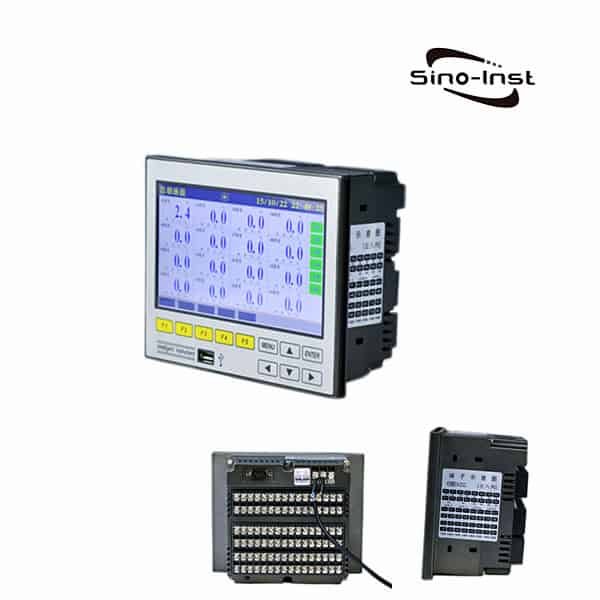
R7100 Paperless Recorder + PID
Universal input | Up to 16 channels | Built-in PID + auto-tune — recorder and controller in one DIN-rail unit.
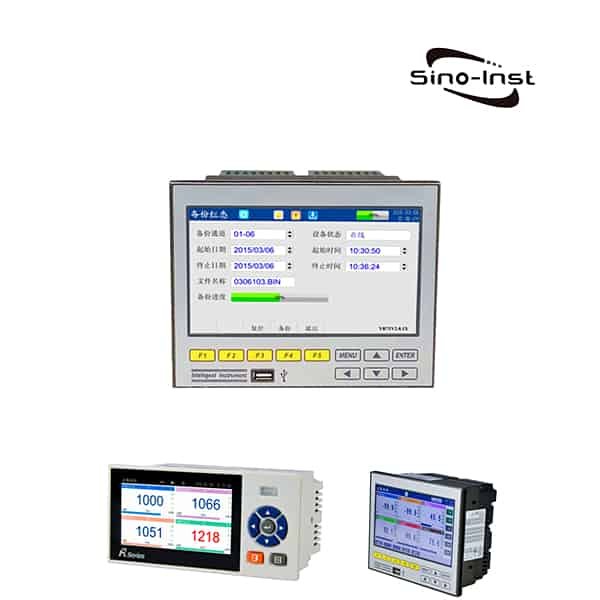
R7600 Temperature Recorder
TC + RTD input | LCD trend display | Modbus RTU — for furnace, kiln, and autoclave temperature control loops.


Emerson AMS Trex Communicator
HART + FOUNDATION fieldbus | In-loop diagnostics | Bench or field — commissions PID pressure transmitter working principle and final-element devices.
Send your loop type (temperature / flow / pressure / level), I/O requirement, and ambient environment to our engineers via the form below — we typically reply within one working day with a sized quote.
FAQ
What does PID stand for?
PID stands for Proportional-Integral-Derivative, the three weighted responses a PID controller combines: P reacts to current error, I to accumulated past error, and D to predicted future error based on rate of change.
What is a PID controller used for?
PID controllers regulate one process variable — temperature, pressure, flow, level, or motor speed — by adjusting a final control element to drive the measurement toward a setpoint. Typical uses include heat exchangers, autoclaves, motor drives, gas pressure regulation, and tank-level control.
How do I tune a PID controller?
Start with auto-tune if the controller has it. Otherwise run Ziegler-Nichols: step the output and measure dead time and reaction rate, then compute Kp, Ti, Td from the Z-N table. Fine-tune by hand using Tyreus-Luyben values for less overshoot. Always tune at the typical operating point and verify at extremes.
What is the difference between P, PI, and PID control?
P alone leaves steady-state error. PI eliminates it but can overshoot. PID adds derivative to brake the response and reduce overshoot, at the cost of noise amplification. Use P for level, PI for flow/pressure, PID for temperature and slow processes.
What is proportional band (PB) in a PID controller?
Proportional band is the inverse of proportional gain expressed as a percent of measurement span: PB = 100 / Kp. A PB of 100% means the controller swings from 0% to 100% output across the full measurement range. Smaller PB means more aggressive response.
Why is integral windup a problem?
When the controller output saturates (valve fully open or closed), the integral keeps accumulating error even though more output isn’t available. When error finally drops, the integral has to “unwind” before the controller backs off, causing severe overshoot. Anti-windup logic or back-calculation prevents this.
Where is PID control still used today?
PID still runs the majority of regulatory control in chemical plants, power stations, food and pharma manufacturing, water treatment, HVAC, and motor drives. Model-predictive control replaces PID at the supervisory level in large coupled systems, but underneath the MPC layer the field loops are almost always PID.
Request a Quote


Wu Peng, born in 1980, is a highly respected and accomplished male engineer with extensive experience in the field of automation. With over 20 years of industry experience, Wu has made significant contributions to both academia and engineering projects.
Throughout his career, Wu Peng has participated in numerous national and international engineering projects. Some of his most notable projects include the development of an intelligent control system for oil refineries, the design of a cutting-edge distributed control system for petrochemical plants, and the optimization of control algorithms for natural gas pipelines.