

The K-factor of a flow meter is the number of output pulses the meter generates per unit volume of fluid. It is the calibration constant that lets a turbine, vortex, or paddle-wheel meter convert its raw frequency into engineering units — gallons per minute, litres per minute, or m³/h. Get the K-factor right and the meter is accurate; get it wrong and the loop is off by the same percentage, every reading, every day.
Contents
- K-factor defined: pulses per unit volume
- K-factor formula and units
- K-factor chart by meter type and size
- K-factor for turbine flow meters
- K-factor for vortex flow meters
- How to calculate K-factor (step-by-step)
- Multi-point calibration for ±0.15% accuracy
- What’s a good K-factor — is higher better?
- Three worked calculation examples
- Four common K-factor settings mistakes
- FAQ
- Featured pulse-output flow meters
K-Factor Defined: Pulses Per Unit Volume
In flow measurement, the K-factor is the proportionality constant between the meter’s pulse-output frequency and the fluid’s volumetric flow rate. Symbolically:
K = pulses / volume
Examples: a turbine meter labelled K = 1000 pulses/litre means every litre of fluid passing through the rotor produces 1000 output pulses. A frequency of 500 Hz therefore corresponds to 500/1000 = 0.5 L/s = 30 LPM. A vortex meter labelled K = 25 pulses/gallon at 100 Hz corresponds to 100/25 = 4 gal/s = 240 GPM.
The K-factor is fixed by the meter’s internal geometry — rotor blade count and pitch for turbines, bluff-body width and pipe ID for vortex shedders, gear teeth count for PD meters. Different sizes and different manufacturers have different K-factors. The number is engraved on the meter body or printed on the calibration certificate.
K-Factor Formula and Units
The defining equation is:
K = f / Q
- f = output frequency (Hz, pulses per second)
- Q = volumetric flow rate (L/s, gal/s, m³/s — be consistent)
- K = K-factor in pulses per unit volume
Common K-factor units:
- pulses/litre — SI default, used on most European and Asian meters
- pulses/gallon — US default, can be US or UK gallon (always check)
- pulses/m³ — utility-scale gas and water meters
- pulses/ft³ — US gas meters
Mixing up units is the most common K-factor mistake. A K = 100 pulses/gallon entered into a transmitter that expects pulses/litre will under-read by the gallon-to-litre conversion factor — about 3.785× error. Check that the transmitter’s volume unit matches the K-factor unit before commissioning. See our LPM to GPM conversion guide if your pump curve and transmitter speak different units.

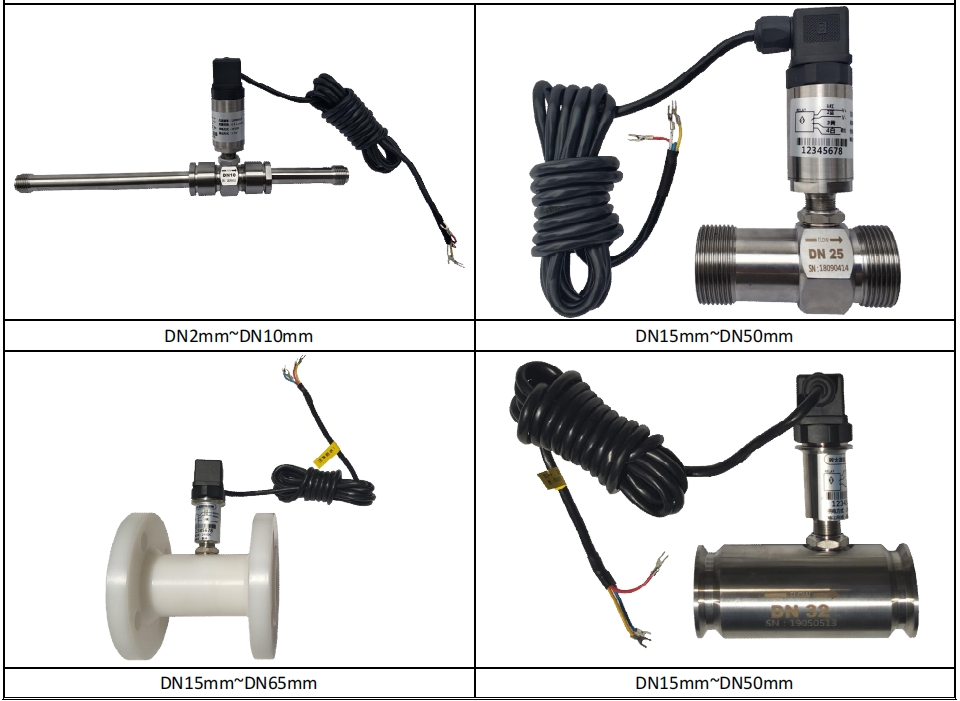
K-Factor Chart by Meter Type and Size
Approximate K-factor ranges for common pulse-output meters. Always use the calibration certificate, not these figures — meter-to-meter variation can be ±5%.
| Meter Type | Size | K-Factor (pulses/L) | K-Factor (pulses/gal US) |
|---|---|---|---|
| Turbine — liquid | DN15 (½”) | 10,000–30,000 | 38,000–113,000 |
| Turbine — liquid | DN25 (1″) | 1,500–3,000 | 5,700–11,400 |
| Turbine — liquid | DN50 (2″) | 200–500 | 760–1,900 |
| Turbine — liquid | DN100 (4″) | 20–60 | 76–227 |
| Turbine — gas | DN50–DN150 | 10–200 | 38–760 |
| Vortex (shedding) | DN25 | 200–400 | 760–1,515 |
| Vortex (shedding) | DN50 | 30–80 | 114–300 |
| Vortex (shedding) | DN150 | 2–6 | 7.6–23 |
| Paddle wheel | DN15–DN50 | 50–2,000 | 190–7,600 |
| Oval gear (PD) | DN15 | 1,000–5,000 | 3,800–19,000 |
| Oval gear (PD) | DN50 | 50–200 | 190–760 |
Notice the inverse relation to size: smaller meters produce more pulses per unit volume because the rotor or bluff body sees more cycles per unit fluid. A DN15 turbine at 30,000 pulses/L sounds huge until you realize 1 L/min through it is only 500 Hz — well within transmitter range. A DN150 vortex at 2 pulses/L would only fire 30 Hz at 1000 LPM.
K-Factor for Turbine Flow Meters
A turbine meter’s K-factor is set by the rotor — blade count, blade pitch, and the magnetic pickup geometry. The pickup generates one pulse per blade as each one passes under the coil. So a 10-blade rotor at 1000 RPM produces 10,000 pulses/min = 167 Hz. The K-factor is calibrated against a primary standard (gravimetric or piston prover) at one or more flow points and printed on the meter’s certificate.
Key facts:
- K-factor is most stable in the meter’s linear range — typically 10:1 turndown.
- Below the low-end cut-off (Re < ~4000), K-factor falls off as bearing friction dominates.
- Viscosity affects K-factor: 5 cSt vs 50 cSt can shift K by 1–3%. High-accuracy applications use viscosity correction tables or multi-point calibration.
- Bearing wear is the dominant K-factor drift source over time — schedule recalibration every 12–24 months for custody-transfer service.
For a cryogenic application, see our low-temperature turbine flowmeter page; for upstream straight-pipe rules see flow meter straight pipe requirements.
K-Factor for Vortex Flow Meters
Vortex meters shed alternating vortices behind a bluff body at a frequency proportional to flow velocity (Strouhal number ≈ 0.27 for the standard trapezoidal bluff). The K-factor depends on the bluff body width and the pipe ID:
K = St / (d × A) where St is Strouhal, d the bluff width, A the pipe cross-section.
- Vortex K-factor is largely independent of fluid type and density once Reynolds > ~20,000 — that’s the meter’s main advantage.
- Below the linear range (Re < 5,000–20,000 depending on bluff) vortex shedding becomes irregular and K-factor is meaningless.
- Vortex K-factor does not drift with bearing wear — there are no bearings. But scaling, fouling, or partial bluff blockage will shift it.
- Two-phase flow (entrained gas in liquid, condensate in steam) can corrupt vortex shedding entirely.
- Reynolds and the pressure profile across the bluff body are what set the shedding regime — see our static vs dynamic pressure note for the upstream physics.
How to Calculate K-Factor (Step-by-Step)
To calibrate a K-factor from scratch — for example, when the certificate is lost or a meter has been rebuilt — run a master-meter or volumetric prover comparison:
- Plumb the meter under test in series with a reference flow standard (master turbine, magmeter, or piston prover).
- Stabilise flow at a target point within the meter’s linear range, typically 60–80% of max.
- Record total pulses N from the meter under test over a measured volume V from the standard, over at least 60 seconds.
- K = N / V. Repeat 3–5 times at the same point, average the results.
- For multi-point calibration repeat at 5–7 flow points across the meter’s turndown, fit a polynomial or piecewise-linear correction.
- Store K (or the curve) in the flow transmitter or DCS. Document the calibration on the meter tag.

Multi-Point Calibration for ±0.15% Accuracy
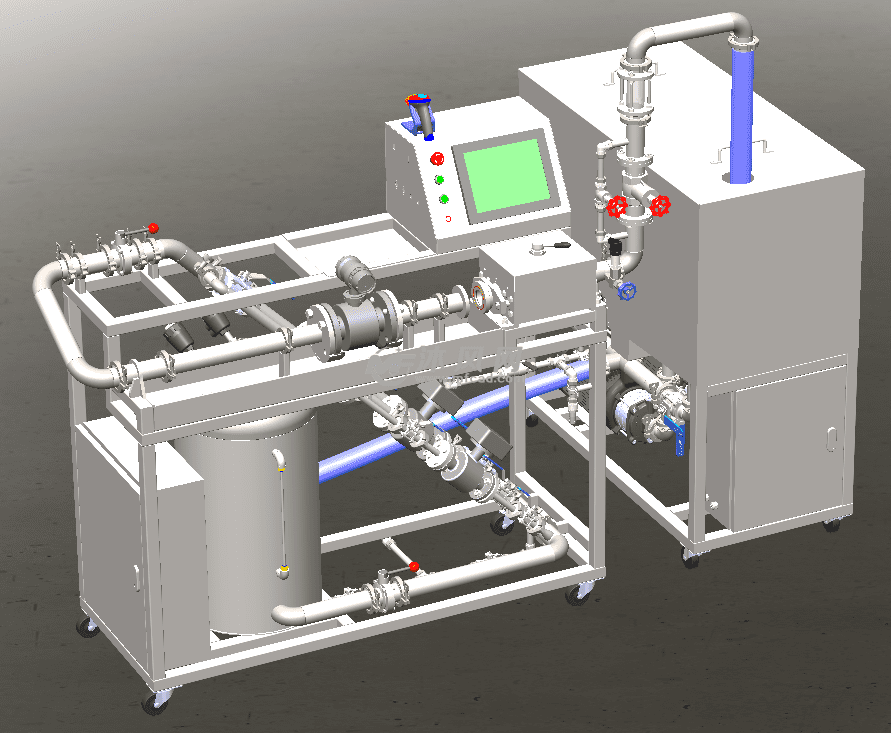
A single K-factor is good enough for ±0.5% in the meter’s linear band. For custody-transfer or fiscal metering, single-point K is not enough — the meter’s response curves slightly even within the linear range. Multi-point calibration improves the achievable accuracy to ±0.15% or better.
- 5–7 calibration points across 10:1 turndown.
- Modern transmitters store a piecewise-linear or polynomial correction; the DCS reads the corrected flow directly.
- API MPMS Chapter 5.3 (turbine meter custody transfer) and ISO 4185 specify the procedure for fiscal turbine meters.
- For pulse meters in process service (not fiscal), single-point K plus annual verification is typically sufficient.
- For DP-type flow meters (orifice, Venturi, V-cone) the square-root linearisation is part of the loop math — see our linear-to-sqrt converter tool.
What’s a Good K-Factor — Is Higher Better?
A higher K-factor (more pulses per litre) is generally better for low-flow resolution: more pulses per unit volume means finer totalisation and shorter sampling windows for the same accuracy. But there are limits:
- Above ~10 kHz the transmitter and field wiring start to drop pulses to noise. Match the transmitter’s max input frequency.
- Very high K-factors on small meters can be misleading — the meter still has a finite turndown and accuracy. A DN15 turbine at K = 30,000 pulses/L is no more accurate than a DN50 at K = 500.
- “Good” K-factor really means: the meter’s measured pulse rate falls between the transmitter’s minimum sensitivity (typically 1–10 Hz) and maximum (typically 1–10 kHz) across the application’s flow range.
- If your pipe sizing or pump curve is in different flow units, work in the same unit consistently — our flow rate and pressure note covers the cross-references.
Three Worked Calculation Examples
Example 1 — Liquid turbine, K = 2,000 pulses/L: Output frequency reads 333 Hz. Flow rate Q = f/K = 333/2000 = 0.167 L/s = 10 LPM = 2.64 US GPM.
Example 2 — Vortex meter, K = 32 pulses/L on DN50 line: Frequency reads 96 Hz. Q = 96/32 = 3.0 L/s = 180 LPM = 47.6 US GPM. For LPM↔GPM conversion details, see our LPM to GPM conversion guide.
Example 3 — Paddle wheel meter, K = 500 pulses/gal US: Output reads 250 Hz. Q = 250/500 = 0.5 gal/s = 30 US GPM. To switch the transmitter to LPM, the configuration menu just changes the volume-unit dropdown; K stays the same internally — the firmware applies the unit conversion.
Four Common K-Factor Settings Mistakes
- Mixing pulses/L and pulses/gal. A 3.785× error pops up immediately. Always verify the transmitter’s volume unit matches the K-factor’s denominator.
- Using the rotor blade count as the K-factor. A 10-blade rotor does not have K = 10 pulses/L. The blade count is just one input; rotor pitch, pickup geometry, and pipe ID all contribute.
- Applying the K-factor from a different meter size. K-factors scale roughly as 1/D³ for turbines and 1/D² for vortex meters. The DN25 K is not the DN50 K divided by 2.
- Forgetting viscosity correction on high-accuracy turbines. A turbine calibrated on 1 cSt water will read ~2% low on 50 cSt diesel without correction. For non-aqueous service, get a viscosity-specific calibration.
FAQ
What is K-factor in flow measurement?
K-factor is the calibration constant of a pulse-output flow meter, expressed as pulses per unit volume (pulses/L or pulses/gal). The meter’s output frequency divided by K gives the flow rate. It is set by the meter’s internal geometry and calibrated against a reference standard.
How do you calculate K-factor for a flow meter?
K = N/V where N is the number of pulses recorded over a known volume V from a reference standard. Run the meter and reference in series at a stable flow point in the meter’s linear range, total the pulses over 60 seconds or more, repeat 3–5 times, average.
Is a higher K-factor better?
Higher K (more pulses per litre) gives finer low-flow resolution and shorter integration windows. The practical ceiling is the transmitter’s maximum input frequency — typically 1–10 kHz. Above that, pulses are dropped. Higher K does not directly improve accuracy; meter geometry and calibration quality do.
What’s a good K-factor for a flow meter?
The K-factor should put the output frequency between the transmitter’s minimum (often 1–10 Hz) and maximum (1–10 kHz) over the application’s flow range. For most process service that means a few hundred to a few thousand pulses/L; for very small meters it can reach tens of thousands.
What is the K-factor for a turbine meter?
Typical liquid turbine K-factors range from 10,000–30,000 pulses/L at DN15 down to 20–60 pulses/L at DN100. Gas turbines are lower (10–200 pulses/L at DN50–DN150). The exact figure is engraved on the meter or printed on its calibration certificate.
Does K-factor change with viscosity?
Yes for turbine meters — viscosity shifts K-factor by 1–3% between 1 cSt and 50 cSt. For vortex meters K-factor is roughly viscosity-independent above Re ≈ 20,000. For PD meters viscosity affects slip and therefore K slightly. High-accuracy custody work uses multi-viscosity calibration.
Featured Pulse-Output Flow Meters

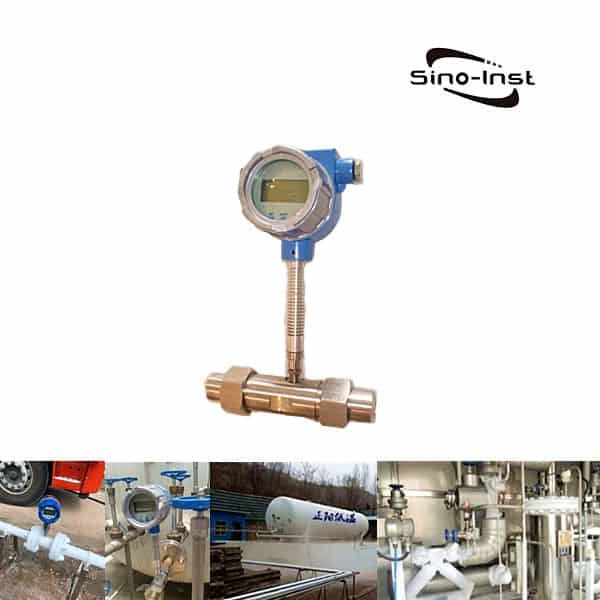
Cryogenic Turbine Flow Meter
DN6–DN200 | ±0.5% | Pulse output with stamped K-factor; calibrated for LN2/LOX and other cryogenic fluids.
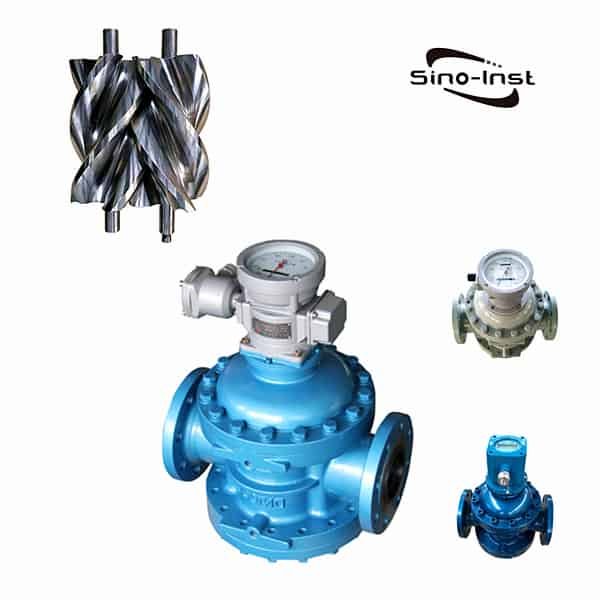
Helical Gear PD Flow Meter
DN10–DN100 | ±0.5% | High-resolution pulse output for viscous fluids; K-factor stamped on body.

Sanitary Oval-Gear PD Meter
DN15–DN50 | Tri-clamp 316L | Calibrated K-factor for filling, dosing, and sanitary CIP service.
Need a K-Factor Calibrated Meter Quoted?
Send your line size, fluid, viscosity, and flow range to our engineers — we’ll quote a meter with a single- or multi-point K-factor calibration certificate that matches your transmitter’s pulse-input spec.
K-factor matters more on some fluids than others. For ammonia in particular, where phase decides everything, see our ammonia flow meter selection guide — Coriolis avoids K-factor questions entirely by reading mass.
Request a Quote


Wu Peng, born in 1980, is a highly respected and accomplished male engineer with extensive experience in the field of automation. With over 20 years of industry experience, Wu has made significant contributions to both academia and engineering projects.
Throughout his career, Wu Peng has participated in numerous national and international engineering projects. Some of his most notable projects include the development of an intelligent control system for oil refineries, the design of a cutting-edge distributed control system for petrochemical plants, and the optimization of control algorithms for natural gas pipelines.