

Updated: April 14, 2026
A rotameter is a flow meter, not a separate instrument. It’s one specific type called a variable area flow meter. The real question most engineers ask is: how does a rotameter compare to other flow meter types like magnetic, turbine, or ultrasonic meters, and when should you choose one over the others? This guide answers exactly that.
Contents
- Is a Rotameter a Flow Meter?
- How Does a Rotameter Work?
- How Does a Rotameter Compare to Other Flow Meter Types?
- When Should You Use a Rotameter Instead of an Electronic Flow Meter?
- What Are the Limitations of a Rotameter?
- How Accurate Is a Rotameter?
- Recommended Rotameters and Alternatives
- FAQ
Is a Rotameter a Flow Meter?
Yes. A rotameter is a type of flow meter, specifically categorized as a variable area (VA) flow meter. “Flow meter” is the broad category and “rotameter” is one of about a dozen technologies inside that category.
The confusion happens because “rotameter” is a trademark-turned-generic term (originally from the Rota company, now Yokogawa Rota). People use it interchangeably with “variable area flow meter,” “float flow meter,” or just “visual flow indicator.” All four terms describe the same basic device: a vertical tapered tube with a float that rises higher as flow increases.
Where rotameters differ from most modern flow meters is that they are mechanical, direct-reading, and typically have no electrical output. You read the scale by eye. Everything else, including magnetic, ultrasonic, Coriolis, and turbine meters, produces an electronic signal (4–20 mA, pulse, HART, or digital).
How Does a Rotameter Work?
A rotameter balances two forces on a float: gravity pulling it down, and drag from the fluid flow pushing it up. The tube is tapered, wider at the top than the bottom. As flow increases, the annular area around the float grows until drag equals gravity, and the float reaches equilibrium at a specific height.
The scale is calibrated so the float’s height directly corresponds to a flow rate. Different fluids require different floats and scales because density and viscosity change the force balance. A rotameter calibrated for water will read incorrectly if you put oil through it.
Rotameters must be installed vertically with flow going up. Horizontal or inverted mounting breaks the physics. A few specialized designs (spring-loaded variants) work in any orientation, but they are not true rotameters in the classic sense.
How Does a Rotameter Compare to Other Flow Meter Types?
Here’s how a standard rotameter stacks up against the five most common alternatives for small-to-medium flow applications.
| Feature | Rotameter (VA) | Magnetic | Turbine | Ultrasonic | Coriolis |
|---|---|---|---|---|---|
| Principle | Float displacement | Faraday induction | Rotating blade | Sound transit time | Tube oscillation |
| Accuracy | ±2–5% | ±0.5% | ±0.5% | ±1% | ±0.1% |
| Electrical output | Optional | Standard | Standard | Standard | Standard |
| Power needed | None | Required | Optional | Required | Required |
| Moving parts | Yes (float) | None | Yes (rotor) | None | Vibrating tubes |
| Installation | Vertical only | Any | Horizontal preferred | Any | Any |
| Typical cost | $50–$500 | $500–$3000 | $300–$2000 | $1500–$8000 | $3000–$15000 |
| Best for | Local indication | Conductive liquids | Clean low-viscosity | Non-invasive | Mass + density |
The rotameter’s advantages are simplicity, low cost, and no power requirement. Its disadvantages are limited accuracy, vertical installation requirement, and (in the standard version) no way to feed readings into a control system.
When Should You Use a Rotameter Instead of an Electronic Flow Meter?
A rotameter is the right choice in five specific scenarios.
- Local visual indication only. Operator walks by the line once per shift and checks a flow. No PLC integration needed.
- Purge and cooling water lines. Low-flow utility lines where ±5% accuracy is fine and the main requirement is confirming flow exists.
- Small gas flows. Nitrogen blanketing, instrument air sampling, purge gas lines — rotameters handle these cleanly.
- Chemical feed systems. Adding a fixed small flow of reagent where you adjust a needle valve by watching the float.
- No-power environments. Field locations without 24 VDC, Ex-rated areas where avoiding electronics simplifies approval.
Rotameters are not the right choice for custody transfer, batch control, bidirectional flow, pulsating flow, or any application requiring better than ±2% accuracy. For those, use an electromagnetic, Coriolis, or turbine meter. See our guide on flow meter K-factor calibration for high-accuracy turbine meter setup.
What Are the Limitations of a Rotameter?
Four hard limitations to know before specifying one.
- Fluid-specific calibration. Change the fluid and the scale is wrong. Water and oil rotameters are not interchangeable without a correction factor.
- Limited turndown. Typical 10:1 ratio between max and min readable flow. Below 10% of full scale the float behavior gets erratic.
- Pressure drop. A rotameter imposes a permanent pressure drop (usually 0.1–0.5 bar). In low-head systems this is a problem.
- Glass tube fragility. Glass rotameters can shatter on thermal shock or water hammer. Metal-tube (armored) versions solve this but cost more and require a magnetic indicator to read externally.
How Accurate Is a Rotameter?
Standard glass-tube rotameters achieve ±2–3% of full scale under good conditions. Metal-tube versions with calibrated floats reach ±1–2%. Industrial precision models with temperature-compensated floats can hit ±0.5%, but at that level you are paying nearly as much as an electromagnetic meter with better overall performance.
Note that accuracy is usually stated as percent of full scale, not percent of reading. At 50% flow, a ±2% FS rotameter could be off by 4% of actual reading. At 10% flow, the same meter could be off by 20%. This is why turndown matters so much.
Recommended Rotameters and Alternatives

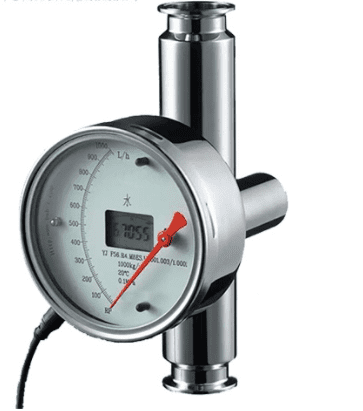
Metal Tube Rotameter
Variable-area metal-tube rotameter for liquid, gas and steam in low-flow lines. Local dial plus optional remote 4-20mA transmitter — built for small-flow chemical dosing and utility service.

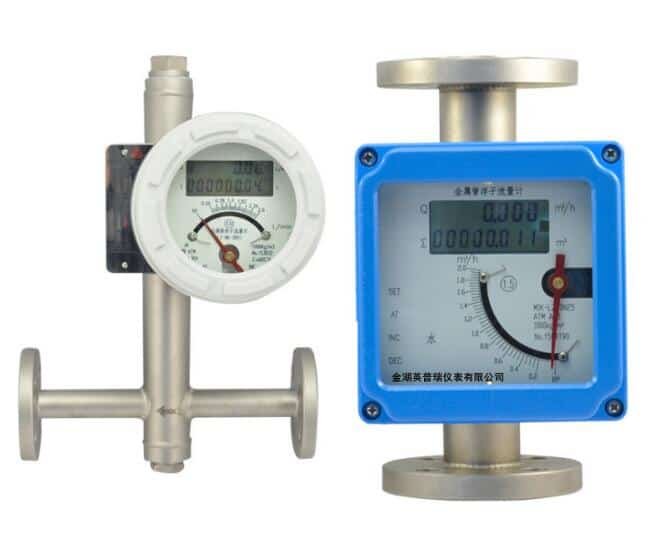
Glass Tube Rotameter
Variable-area metal-tube rotameter for liquid, gas and steam in low-flow lines. Local dial plus optional remote 4-20mA transmitter — built for small-flow chemical dosing and utility service.

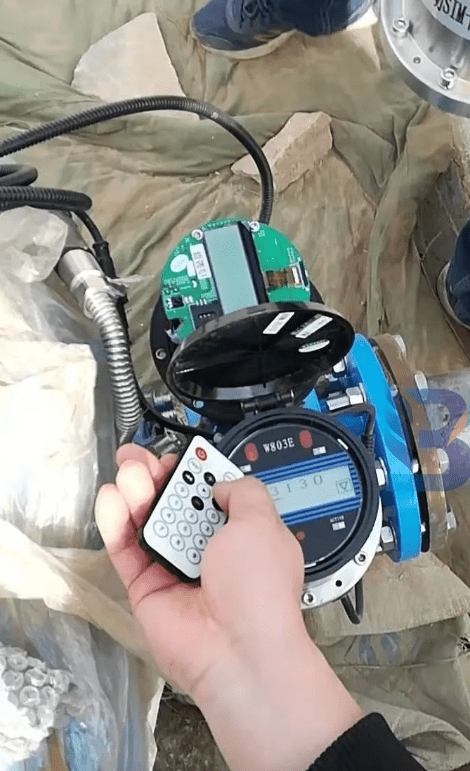
Electromagnetic Flow Meter
Electromagnetic (EMF) flow meter for conductive liquids — water, slurry, chemicals, effluent. No moving parts, zero pressure drop, DN3-DN3000 range; the gold standard for wastewater.
FAQ
Is a rotameter the same as a flow meter?
A rotameter is a flow meter. Specifically, it is a variable area flow meter, one of roughly a dozen flow meter technologies. The word “rotameter” is often used loosely to mean any simple, visual flow meter with a float in a tapered tube.
Which is better: rotameter or magnetic flow meter?
It depends on the application. For local visual indication with no power, the rotameter wins on cost and simplicity. For accurate measurement, PLC integration, or any conductive liquid at larger line sizes, the magnetic flow meter is better. Rotameters max out around DN100 while mags scale to DN3000.
Can a rotameter measure gas flow?
Yes. Gas-calibrated rotameters are common in nitrogen blanketing, air purge, and instrument gas lines. The float and scale are designed for a specific gas at a specific pressure and temperature. Changing any of those requires a correction calculation or re-calibration.
Why does a rotameter have to be installed vertically?
Because its operation relies on gravity balancing the drag force on the float. In a horizontal or angled installation, gravity no longer pulls the float back toward zero flow, and the measurement breaks. Only specialized spring-loaded variants work in any orientation, and they are not considered classic rotameters.
What is the minimum flow a rotameter can measure?
Typical rotameters have a 10:1 turndown. If the full scale is 100 L/min, the minimum readable flow is around 10 L/min. Below that the float position becomes unstable and the reading unreliable.
Can a rotameter provide 4-20 mA output?
Some metal-tube rotameters offer magnetic-coupled transmitters that convert float position into a 4-20 mA signal. This adds about 30–50 percent to the meter cost. For most remote-output applications, an electromagnetic or turbine meter is a better value than adding a transmitter to a rotameter.
Need help choosing between a rotameter and an electronic flow meter for your line? Share the fluid, flow range, pipe size, and accuracy target with our engineering team and we’ll recommend the right option within one business day.
Request a Quote


Wu Peng, born in 1980, is a highly respected and accomplished male engineer with extensive experience in the field of automation. With over 20 years of industry experience, Wu has made significant contributions to both academia and engineering projects.
Throughout his career, Wu Peng has participated in numerous national and international engineering projects. Some of his most notable projects include the development of an intelligent control system for oil refineries, the design of a cutting-edge distributed control system for petrochemical plants, and the optimization of control algorithms for natural gas pipelines.