

Updated: April 13, 2026
A diesel fuel tank level gauge measures the amount of fuel remaining in a storage tank or vehicle fuel tank. The right gauge prevents run-dry shutdowns, catches fuel theft early, and keeps inventory records accurate. Choosing the wrong type leads to drift, fouling, or false alarms — all common problems in fuel storage. For sensor-by-application selection on buried tanks, our underground tank level indicator selection by application.
This guide covers the five main types of diesel tank level gauges, where each one works best, and how to set up a monitoring system for industrial tanks and vehicle fleets.
Contents
- What Are the Types of Diesel Fuel Tank Level Gauges?
- How Do They Compare? Selection Table
- Mechanical vs Electronic: Which Is Better for Diesel Tanks?
- How to Set Up a Diesel Tank Level Monitoring System
- How Do You Monitor Fuel Level in a Vehicle Fleet?
- What Are Common Installation Mistakes?
- Featured Diesel Tank Level Gauges
- FAQ
What Are the Types of Diesel Fuel Tank Level Gauges?
Five sensor technologies cover the majority of diesel fuel level applications. Each has trade-offs in accuracy, cost, and installation complexity.
Magnetostrictive Level Transmitter
A magnetostrictive probe sits vertically inside the tank. A float carrying a magnet rides the probe as the fuel level changes. The electronics measure the float’s position by timing a current pulse along a waveguide wire. Accuracy reaches ±1 mm over ranges up to 6 m. This is the default choice for aboveground diesel storage tanks in refineries, fuel depots, and power plants where high accuracy matters for custody transfer and inventory accounting.
Float Level Gauge (Mechanical)
A float connects to a dial indicator via a cable and pulley. As diesel level rises or falls, the float moves and the dial reads out directly. No power required. Accuracy is ±5–10 mm. Simple, cheap, and reliable for small tanks (under 3 m) where a visual reading is enough. Common on generator day tanks and small bulk storage. For more on float sensors, see our water tank level sensor guide.
Ultrasonic Level Sensor
Mounted on top of the tank, an ultrasonic sensor sends a sound pulse and times the echo. No contact with the diesel. Accuracy is ±3–5 mm for ranges up to 10 m. Works well on open-top or vented tanks. Not suitable for pressurized tanks or tanks with heavy vapor above the fuel surface. For technical details, see our ultrasonic level sensor guide.
Radar Level Sensor
Radar uses electromagnetic waves instead of sound. Unaffected by temperature, vapor, or pressure changes. Accuracy is ±1–3 mm. The best option for large diesel storage tanks (10–30 m), pressurized tanks, and tanks with heavy condensation or diesel vapor. Higher cost than ultrasonic, but more reliable in harsh conditions. See our stilling well design guide for radar installation best practices.
Hydrostatic Pressure Transmitter
A pressure sensor at the bottom of the tank measures the hydrostatic head. Level = Pressure / (Density × Gravity). Accuracy depends on knowing the diesel density accurately — typically ±5–10 mm after density compensation. Good for underground tanks where top-mount access is limited. Submersible versions are rated IP68 and handle buried fuel tanks well.
How Do They Compare? Selection Table
| Type | Accuracy | Range | Power | Cost | Best For |
|---|---|---|---|---|---|
| Magnetostrictive | ±1 mm | 0.1–6 m | 24 VDC | $$$ | Bulk storage, custody transfer |
| Float (mechanical) | ±5–10 mm | 0.3–3 m | None | $ | Small tanks, generator day tanks |
| Ultrasonic | ±3–5 mm | 0.3–10 m | 24 VDC | $$ | Vented storage tanks, water treatment |
| Radar | ±1–3 mm | 0.5–30 m | 24 VDC | $$$$ | Large tanks, pressurized, harsh vapor |
| Hydrostatic | ±5–10 mm | 0.5–100 m | 24 VDC | $$ | Underground tanks, deep wells |
Mechanical vs Electronic: Which Is Better for Diesel Tanks?
Mechanical gauges (float + dial) require no power, no wiring, and no calibration. They work for decades with minimal maintenance. The trade-off: no remote reading, no alarm output, and no data logging. If you only need a local visual check on a small day tank, mechanical is hard to beat.
Electronic gauges (magnetostrictive, ultrasonic, radar, hydrostatic) provide a 4–20 mA or RS485 output that connects to a PLC, SCADA system, or cloud-based monitoring platform. They support high/low alarms, trend logging, and remote access. For any tank where fuel management, theft detection, or regulatory reporting is required, electronic is the only practical option.
Most industrial diesel installations use electronic gauges on the main storage tanks and mechanical gauges on small auxiliary tanks (generator sets, pump skids) where remote monitoring isn’t justified.
How to Set Up a Diesel Tank Level Monitoring System
A complete monitoring system has three layers: sensor, data acquisition, and display/alarm.
- Sensor layer. Install a level transmitter on each tank. Magnetostrictive for high-accuracy inventory. Ultrasonic or hydrostatic for general monitoring. Output: 4–20 mA or RS485 Modbus RTU.
- Data acquisition layer. A PLC, RTU, or IoT gateway collects signals from all sensors. For remote sites (fuel depots, cell towers, pipeline pump stations), a 4G/LTE cellular gateway transmits data to a cloud server. For on-site systems, wire the 4–20 mA signals directly to the plant DCS or SCADA.
- Display and alarm layer. The SCADA or cloud dashboard shows real-time levels, consumption trends, and fill history. Configure high-level alarms (overfill protection), low-level alarms (run-dry prevention), and abnormal consumption alerts (theft detection). Most systems log data at 1–5 minute intervals.
For tank farms with 5+ tanks, add a temperature transmitter to each tank. Diesel volume changes ~0.08% per °C. Without temperature compensation, a 30°C seasonal swing introduces ~2.4% volume error — significant for custody transfer and tax reporting.
How Do You Monitor Fuel Level in a Vehicle Fleet?
Fleet fuel monitoring uses a different approach. Vehicle tanks are small (100–500 L), move constantly, and have no fixed wiring.
The standard solution is an external clamp-on ultrasonic sensor mounted under the fuel tank. It transmits sound through the tank bottom and measures the diesel level without any drilling or tank modification. The sensor connects to a GPS tracker that reports level data via cellular network to a fleet management platform.
This setup detects fuel theft (sudden level drops), unauthorized refueling, and abnormal consumption patterns. Typical accuracy is ±5 mm, which translates to ±2–5 L depending on tank geometry. The sensor draws under 100 mA and runs off the vehicle’s 12/24 V power.
What Are Common Installation Mistakes?
Four mistakes account for most diesel tank gauge failures in the field.
- Wrong probe length. Magnetostrictive probes must be cut to match the tank depth. Too short and you miss the bottom 10–20 cm of fuel. Too long and the float bottoms out before the tank is empty. Measure the actual tank depth from the nozzle flange to the tank floor.
- Ignoring diesel density variation. Hydrostatic gauges calculate level from pressure. If the density setting is wrong (for example, using water density instead of diesel at 0.84 kg/L), the level reading will be off by 16%. Always set the density parameter to match your actual diesel grade.
- Mounting ultrasonic sensors on pressurized tanks. Sound waves need air to propagate. A nitrogen-blanketed or pressure-rated diesel tank will give no echo return with an ultrasonic sensor. Use radar or magnetostrictive instead. For more on pressure transmitter selection, see our technical guide.
- No lightning protection on outdoor tanks. Electronic level transmitters on outdoor diesel tanks are exposed to lightning. Install surge protectors on all signal cables. A single lightning event can destroy every transmitter on a tank farm.
Featured Diesel Tank Level Gauges


LD Magnetostrictive Transmitter
Magnetostrictive level transmitter with ±1 mm resolution for high-accuracy tank gauging. Preferred choice on fuel depots, API terminals and chemical inventory measurement.
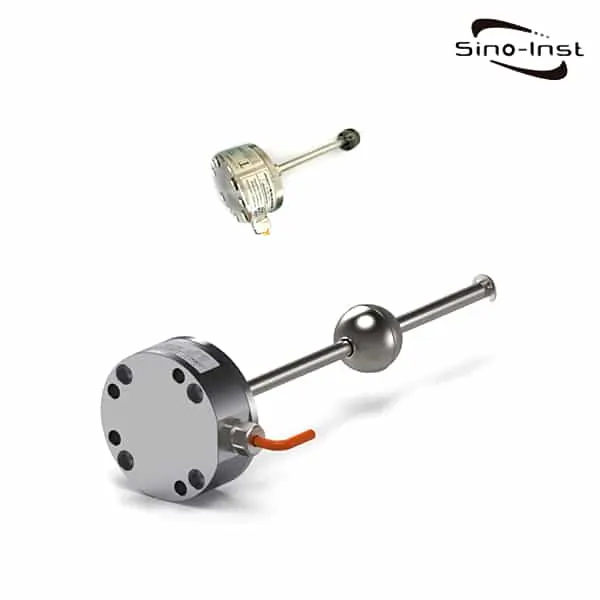
LR Flange-Mount Level Sensor
Magnetostrictive level transmitter with ±1 mm resolution for high-accuracy tank gauging. Preferred choice on fuel depots, API terminals and chemical inventory measurement.
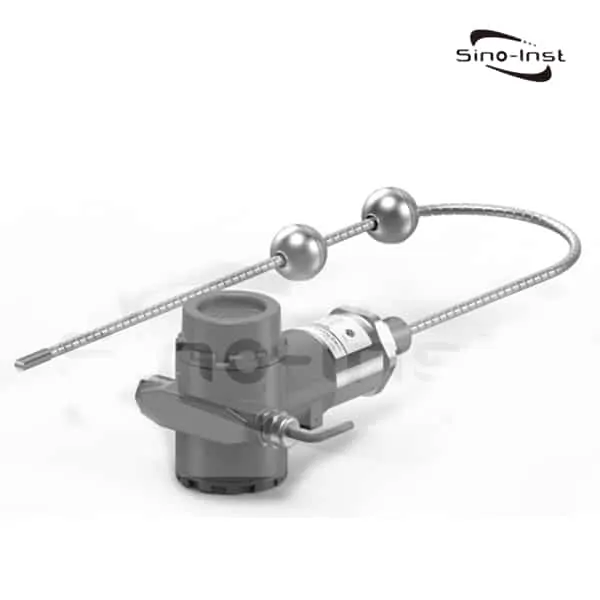
LT Digital Display Level Sensor
Magnetostrictive level transmitter with ±1 mm resolution for high-accuracy tank gauging. Preferred choice on fuel depots, API terminals and chemical inventory measurement.
FAQ
How do you measure diesel fuel level in an underground tank?
Submersible hydrostatic pressure transmitters are the standard for underground diesel tanks. The sensor is lowered to the tank bottom and measures the hydrostatic pressure of the diesel column above it. Set the density parameter to 0.82–0.86 kg/L depending on your diesel grade. Magnetostrictive probes also work if you have top access through a fill riser.
What accuracy do I need for diesel fuel inventory?
For custody transfer and tax reporting, you need ±1 mm accuracy — magnetostrictive or radar. For operational monitoring (refill scheduling, low-level alarms), ±5 mm is sufficient — ultrasonic or hydrostatic. For vehicle fleet fuel theft detection, ±5 mm (external ultrasonic) is practical and cost-effective.
Can I use a float gauge on a diesel storage tank?
Yes, for tanks under 3 m depth where you only need a local visual reading. Float gauges are reliable for generator day tanks (500–5000 L). For anything requiring remote monitoring, alarms, or data logging, switch to an electronic gauge with a 4–20 mA or digital output.
Do diesel tank level gauges need explosion-proof certification?
Yes, if the tank is in a classified hazardous area. Diesel vapor forms an explosive atmosphere above the liquid surface. Most diesel storage areas are classified as Class I, Division 1 or 2 (NEC) or Zone 1/Zone 2 (IECEx). The level gauge must carry the appropriate Ex rating. Sino-Inst offers ATEX and IECEx certified models. See our Class 1 Division 1 vs Division 2 guide for details.
How do you detect fuel theft from a diesel tank?
Set up a monitoring system that logs level at 1-minute intervals. Configure an alarm for any level drop exceeding a threshold (for example, 5 L in 10 minutes) when no scheduled dispensing is active. A sudden drop outside of normal consumption or refueling patterns triggers an alert. Combine with GPS data for vehicle fleets to correlate location with fuel events.
What is the typical lifespan of a diesel tank level gauge?
Magnetostrictive and ultrasonic gauges typically last 10–15 years with minimal maintenance. Float gauges can last 20+ years since they have no electronics. Hydrostatic sensors may need membrane replacement every 5–8 years depending on diesel quality and water contamination levels.
Need help selecting the right level gauge for your diesel tank? Our engineers specialize in fuel storage measurement. Contact us with your tank dimensions, diesel type, and monitoring requirements for a free recommendation.
Request a Quote


Wu Peng, born in 1980, is a highly respected and accomplished male engineer with extensive experience in the field of automation. With over 20 years of industry experience, Wu has made significant contributions to both academia and engineering projects.
Throughout his career, Wu Peng has participated in numerous national and international engineering projects. Some of his most notable projects include the development of an intelligent control system for oil refineries, the design of a cutting-edge distributed control system for petrochemical plants, and the optimization of control algorithms for natural gas pipelines.