

Updated: April 14, 2026
An ultrasonic water level sensor measures water level in tanks, rivers, reservoirs, and wells without touching the water. It’s the go-to choice for clean-water monitoring where a non-contact sensor is required. But it has a blind spot: foamy, turbulent, or steamy water surfaces. This guide covers when to choose ultrasonic over radar or submersible sensors, and how to install it correctly.
Contents
- What Is an Ultrasonic Water Level Sensor?
- How Does an Ultrasonic Water Level Sensor Work?
- Where Are Ultrasonic Water Level Sensors Used?
- Ultrasonic vs Radar vs Submersible: Which Is Best for Water?
- How Accurate Is an Ultrasonic Water Level Sensor?
- Installation Tips for Water Applications
- Ultrasonic Water Level Sensors for Sale
- FAQ
What Is an Ultrasonic Water Level Sensor?
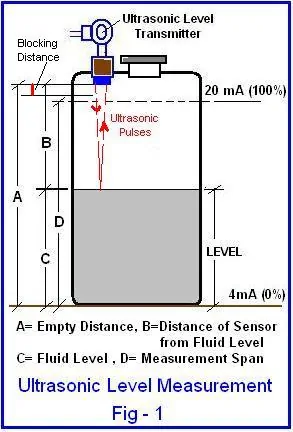
An ultrasonic water level sensor is a non-contact level transmitter that uses high-frequency sound pulses to measure the distance from the sensor face to the water surface. It then subtracts that distance from the tank or channel height to report water level, volume, or flow.
The sensor sits above the water, usually on a bracket or flange. It never contacts the water, which makes it well-suited for drinking water, treated effluent, cooling water, and open-channel flow where fouling or corrosion would damage a contact sensor. Typical ranges run from 0.3 m (short-range, for small tanks) up to 15 m (long-range, for reservoirs and open channels).
How Does an Ultrasonic Water Level Sensor Work?
The sensor transmits a sound pulse, typically at 30–70 kHz, toward the water surface. The pulse reflects off the water and returns to the sensor. The time between transmission and reception, combined with the speed of sound in air, gives the distance:
Distance = (speed of sound × time) ÷ 2
Speed of sound in air varies with temperature (roughly 331 m/s at 0°C and 343 m/s at 20°C). Good ultrasonic sensors include a built-in temperature sensor to correct for this automatically. Without temperature compensation, a 20°C swing introduces about 3.5% error.
The measured distance is then subtracted from the total tank height to give the water level. Most sensors output 4–20 mA (proportional to level, volume, or flow), with optional RS-485 Modbus or HART for digital integration.
Where Are Ultrasonic Water Level Sensors Used?
Five applications where ultrasonic is almost always the right choice.
- Elevated water storage tanks. Municipal water towers, industrial process tanks, fire-suppression reservoirs. Calm surface, clean air, clear signal.
- Wastewater sumps and lift stations. Provided the sensor is rated IP68 and uses a corrosion-resistant face (PVDF or Teflon). Non-contact is a big advantage over floats that foul.
- Open-channel flow measurement. Paired with a Parshall flume or weir, an ultrasonic sensor gives real-time flow readings for stormwater, wastewater influent, or irrigation channels.
- River and reservoir level monitoring. Mounted on a bridge or gantry, long-range sensors (up to 15 m) deliver continuous level data for flood warning and water-resource management.
- Well water level. Where the well diameter is at least 200 mm and the air column is free of obstructions, ultrasonic works well. Narrower wells favor submersible pressure sensors.
For broader non-water applications and general working principles, see our ultrasonic level sensors for liquid measurement guide.
Ultrasonic vs Radar vs Submersible: Which Is Best for Water?
For water level specifically, three technologies compete. Here’s when each one wins.
| Factor | Ultrasonic | Radar (80 GHz) | Submersible |
|---|---|---|---|
| Measurement principle | Sound pulse | Microwave pulse | Hydrostatic pressure |
| Contact with water | No | No | Yes |
| Max range | 15 m | 80 m | Up to 200 m depth |
| Accuracy | ±0.25% | ±2 mm | ±0.1–0.5% |
| Foam tolerance | Poor | Good | Excellent |
| Steam/vapor tolerance | Poor | Good | Excellent |
| Turbulence tolerance | Moderate | Good | Excellent |
| Typical cost | $200–$1500 | $1200–$4000 | $300–$1500 |
| Best for | Clean, calm water in open air | Challenging conditions | Deep wells, raw sewage |
Quick rule of thumb: if the water surface is clean, calm, and the air above it is free of steam, ultrasonic is the best value. If there’s foam, heavy steam, or strong turbulence, go radar. If you need to put a sensor in a deep narrow well or directly into raw sewage, go submersible. For treated water in towers, storage tanks, and open channels, ultrasonic is almost always the right call.
How Accurate Is an Ultrasonic Water Level Sensor?
Good ultrasonic sensors achieve ±0.25% of range under ideal conditions. For a 10-meter sensor, that’s ±25 mm. Real-world accuracy drops to ±0.5–1% when you factor in temperature gradients, wind, and mounting imperfections.
Four factors that degrade accuracy:
- Temperature stratification. A hot sensor above a cool water column creates a sound-speed gradient the sensor can’t fully compensate for. Use a shaded mount in direct sun.
- Wind. Strong wind deflects sound pulses. For outdoor installations, use a stilling tube or baffle.
- Foam or floating debris. Absorbs the ultrasonic signal and can cause loss of echo. If foam is frequent, switch to radar.
- Condensation on sensor face. Common in humid or steamy tanks. Self-cleaning transducers (with a heater element) solve this.
Installation Tips for Water Applications
- Mount perpendicular to the water surface. Even a 5° tilt can cause the echo to miss the transducer, especially at long range.
- Respect the blanking distance. Every ultrasonic sensor has a “dead zone” close to its face (typically 0.25–0.5 m) where it cannot measure. Don’t mount it so close to the maximum water level that the level enters the blanking zone.
- Keep the beam path clear. Pipes, ladders, agitators, and inlet streams inside the beam cone cause false echoes. Aim for a clear vertical path to the water surface.
- Use a stilling well in turbulent tanks. A 150 mm diameter PVC pipe suspended from the sensor down to 0.5 m above the expected minimum level calms surface motion and protects from inlet splash.
- Ground and shield cables properly. Ultrasonic signals are low amplitude and susceptible to electrical noise from nearby VFDs, pumps, and radio transmitters.
For a full installation walkthrough for stilling wells and mounting brackets, see our stilling well installation guide. For submersible alternatives in wells and deep sumps, our water tank level sensor overview compares sensor options.
Ultrasonic Water Level Sensors for Sale
Three models cover most water-level applications from small tanks to long-range reservoir monitoring.

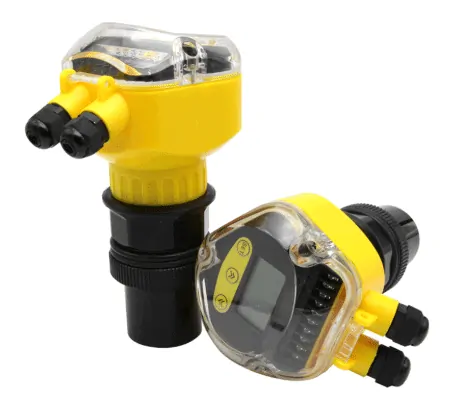
Compact 5m Water Level Sensor
Contact and non-contact capacitive water level sensor for storage tanks, wells and corrosive liquids. Resists temperature, humidity and conductivity drift for reliable readings where floats fail.

Integrated 10m Water Level Sensor
Radar water level sensor covering 0.05 m to 120 m range for reservoirs, rivers and floodgates. Non-contact technology unaffected by wind, foam, fog or temperature swings.

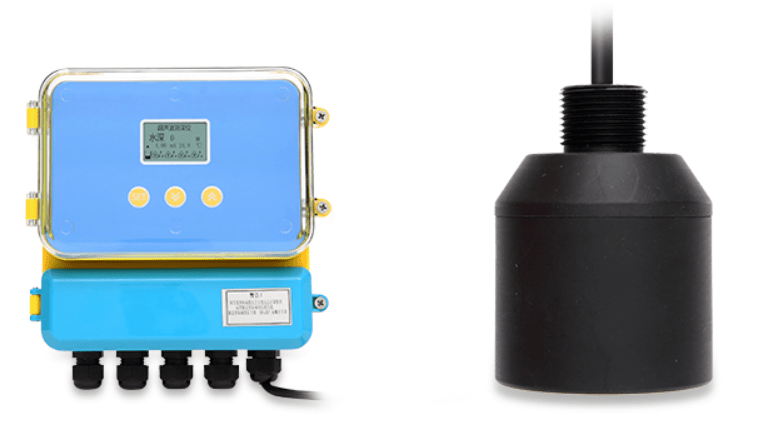
Split-Type 15m River Level Sensor
SIRD-801 radar level sensor for slightly corrosive liquids, sewage and acid/alkali sumps. PTFE antenna and non-contact design deliver years of maintenance-free service.
FAQ
Can an ultrasonic sensor detect water level?
Yes. Ultrasonic sensors are one of the most common non-contact technologies for water level measurement. They work well on clean water surfaces in tanks, reservoirs, and open channels. Accuracy is typically ±0.25% of range, with measurement distances from 0.3 m up to 15 m depending on the model.
Which sensor is best for a water level indicator?
For clean water in open tanks or channels, ultrasonic is the best value. For water with heavy foam, steam, or strong turbulence, radar (80 GHz) performs better. For deep wells or raw sewage where fouling is severe, submersible hydrostatic sensors are most reliable.
Do ultrasonic water level sensors work outdoors?
Yes, with proper specification. Outdoor sensors should be IP68-rated, temperature-compensated, and ideally mounted with a sun shield to prevent the sensor housing from overheating. Strong wind and heavy rain can cause temporary signal loss, but modern sensors handle this with signal averaging.
What’s the difference between an ultrasonic water level sensor and a radar sensor?
Ultrasonic uses sound waves; radar uses microwaves. Ultrasonic is cheaper and accurate on clean, calm water. Radar is not affected by foam, steam, pressure, or temperature changes in the air column, making it the better choice for challenging surfaces. Radar costs 2–3 times more than ultrasonic at similar ranges.
How far can an ultrasonic water level sensor measure?
Common ranges are 5 m, 10 m, and 15 m. Some specialized long-range models reach 20–30 m but with reduced accuracy. The practical upper limit is around 15 m for reliable industrial use. Beyond that, radar becomes the better choice.
How much does an ultrasonic water level sensor cost?
A compact 5 m ultrasonic water level sensor with 4-20 mA output typically costs $200–$500. A 10 m integrated sensor with RS-485 Modbus runs $600–$1200. Long-range 15 m split-type sensors with external displays cost $1000–$1500. Contact us for volume pricing and custom range models.
Need a sensor for a specific tank, channel, or river application? Share the range, ambient conditions, and output requirements with our engineering team and we’ll match you with the right model and pricing within one business day.
Request a Quote


Wu Peng, born in 1980, is a highly respected and accomplished male engineer with extensive experience in the field of automation. With over 20 years of industry experience, Wu has made significant contributions to both academia and engineering projects.
Throughout his career, Wu Peng has participated in numerous national and international engineering projects. Some of his most notable projects include the development of an intelligent control system for oil refineries, the design of a cutting-edge distributed control system for petrochemical plants, and the optimization of control algorithms for natural gas pipelines.