

Molten salt level measurement is one of the few level applications where the wetted-part metallurgy matters more than the sensor principle. At 565 °C in a concentrated solar power (CSP) cold tank — that is the cold side — solar nitrate salt is corrosive to ordinary stainless steel, hostile to PTFE-bearing radar antennas, and hot enough to melt a polymer-bonded capacitive probe. Pick the wrong probe alloy and the level signal vanishes within weeks; pick a fluoride-salt probe for a nitrate-salt service and the corrosion mechanism is reversed and equally lethal. This guide names the three salt families an engineer actually meets, the failure modes that matter at temperature, and the three transmitter technologies that survive — guided-wave radar with HT probe, air-cooled non-contact pulse radar, and remote-seal differential pressure with capillary fill.
Contents
- Three Salt Families Engineers Actually Encounter
- What Fails at 565 °C: Probe, Seal, Process Connection
- Guided-Wave Radar with HT Probe — First Choice for Nitrate
- Air-Cooled Pulse Radar — Backup for Splashing Service
- DP with Capillary Seal — When Radar Will Not Survive
- Standards, Certifications, and Acceptance Tests
- Featured Molten-Salt Level Transmitters
- FAQ
Three Salt Families Engineers Actually Encounter
Three molten-salt families dominate industrial level service today. Solar salt — a 60 wt% NaNO3 / 40 wt% KNO3 eutectic — is the workhorse of the CSP tower and trough plants commissioned since 2010, operating between 290 °C in the cold tank and 565 °C in the hot tank. Chloride salts (typically MgCl2-KCl-NaCl ternary at 500–800 °C) are the next-generation CSP and Generation IV reactor candidate, more thermodynamically efficient but also more aggressive on Ni-Cr alloys. Fluoride salts — FLiBe (LiF-BeF2) at 460–700 °C — are exotic but real in molten-salt reactor (MSR) test loops.
| Salt family | Composition | Operating range | Density | Dielectric constant εr | Compatible probe alloy |
|---|---|---|---|---|---|
| Solar salt (nitrate) | 60% NaNO3 / 40% KNO3 | 290–565 °C | 1830 kg/m³ | ~22 (estimated) | Inconel 600, Alloy 800H, 347H SS |
| Hitec / HitecXL | NaNO3-KNO3-NaNO2 ternary | 140–500 °C | ~1900 kg/m³ | ~25 | 347H SS, 321H SS |
| Chloride MgCl2-KCl | MgCl2-KCl-NaCl ternary | 430–800 °C | 1660 kg/m³ | ~6 | Hastelloy C-276, Alloy 617, Inconel 625 |
| FLiBe (fluoride) | LiF-BeF2 (66/34 mol%) | 460–700 °C | 1940 kg/m³ | ~9 | Hastelloy N (UNS N10003) only |
The dielectric constant matters because it sets guided-wave radar sensitivity. Nitrate salts at εr ≈ 22 give a strong reflection — comparable to water (εr = 80 at 20 °C, falling at high temperature). Chloride and fluoride salts at εr 6–9 give weaker reflections and demand a high-end transmitter with end-of-probe tracking enabled, otherwise the signal is lost in the noise. For a primer on how dielectric constant governs radar response, our dielectric-constant influence on level measurement guide covers the underlying physics. A related extreme-temperature deployment is the 80 GHz radar on ironworks blast furnace service, where the same flange-cooling architecture applies.
What Fails at 565 °C: Probe, Seal, Process Connection
Three components break at solar-salt cold-tank temperature, in this order: the polymer process seal, the probe centring spider, and the antenna PTFE window. The transmitter electronics, mounted on the cold side of the process connection, never see the salt and are usually fine.
- Process-connection seal. Standard FKM (Viton) and even FFKM (Kalrez) elastomer seals fail above 327 °C. A molten-salt process connection must use metal-to-metal sealing — graphite-foil with a stainless-steel jacket is the field standard, with a Belleville-stack live load to maintain seating force across thermal cycles.
- Probe centring spider. GWR coaxial probes use a centring disc to hold the inner conductor concentric in the outer tube. PTFE discs creep and lose alignment above 250 °C; the inner conductor sags, and the radar reflection scrambles. Specify a ceramic (alumina) centring disc, or switch to a single-rod probe with no centring required.
- Antenna window (non-contact radar). Pulse-radar antennas with PTFE-clad horn windows are common at lower temperature; PTFE softens and salt vapor accelerates the failure. At 565 °C use a metallic-only horn (no PTFE) with a flange-mount air purge or a sapphire window if vapor traffic is moderate.
- Process connection thermal-bridge length. The transmitter electronics are rated to about 80 °C ambient. The standoff between the salt-tank flange and the transmitter head must be long enough that conduction down the wetted-part wall does not roast the head. For 565 °C service, 250–400 mm cooling neck is typical; verify the manufacturer’s rating curve.
Guided-Wave Radar with HT Probe — First Choice for Nitrate
Guided-wave radar with a high-temperature probe is the default level technology for solar nitrate salt. The reasons are practical: nitrate’s εr ≈ 22 gives a clean top-of-liquid reflection; the alloy choice (Inconel 600 or Alloy 800H) is widely available; and a single GWR transmitter delivers ±5 mm continuous level over a 0.3–25 m measuring range with no recalibration through the daily charge–discharge cycle.
- Probe geometry. Single-rod for tanks with smooth walls and no internal obstructions; coaxial for narrow standpipes where surrounding signals would interfere. Single-rod is more forgiving on solar-salt service because the inter-tube gap of a coaxial design tends to crystallise during cool-down events.
- Probe alloy. Inconel 600 for nitrate up to 565 °C is the field standard. For Hitec ternary salts at 500 °C, 347H stainless suffices and is cheaper. Avoid 304/316 grades — sensitised in service and cracking has been documented on field returns.
- Probe-end tracking. Critical at start-up when the tank is empty and the only echo is the probe-end reflection. Disable probe-end tracking only after commissioning confirms the empty-tank fingerprint is captured. Our guided-wave radar calibration procedure covers the four-step empty/full/DK/threshold sequence.
- Cooling neck. 300 mm minimum for 565 °C service. The longer-neck variant (HT-extended) handles continuous service at the upper temperature limit; the standard neck handles 400 °C continuous and 565 °C with 50% duty.
Air-Cooled Pulse Radar — Backup for Splashing Service
Non-contact pulse radar (typically 26 GHz or 80 GHz) earns its place when GWR is mechanically impractical — for example, on a hot-tank dump line where the salt level surges during a discharge event and a probe would be subject to flow-induced vibration. The air-cooled metallic horn antenna eliminates the PTFE window failure mode; a continuous instrument-air purge keeps salt vapor and crystallised particulates off the antenna.
| Antenna design | Max temperature | Beam angle | Best for | Risk |
|---|---|---|---|---|
| Metallic horn, air-purged | 600 °C | 10–15° | Open-tank dump/recovery | Loss of purge = blocked horn |
| Metallic horn, sapphire window | 800 °C | 8–12° | Closed tanks, low vapor traffic | Sapphire fracture under thermal shock |
| Air-cooled drop antenna | 500 °C | 4–6° | Narrow standpipes, side mount | Side-wall echoes, requires false-echo mapping |
| 80 GHz parabolic, air-cooled | 450 °C | 3–5° | Long-range silos/towers | Cost, parabola fouling |
The frequency × aperture trade-off matters here too — a 26 GHz horn gives a 12° beam at the 6-inch standard aperture; an 80 GHz parabolic compresses to 4°. For a deep, narrow molten-salt charging silo, the narrow 80 GHz beam clears the inner agitator without false echoes; for the wide hot tank with no internals, 26 GHz is cheaper and equally accurate. The trade-offs are similar to those discussed in our radar antenna types selection guide.
Differential Pressure with Capillary Seal — When Radar Will Not Survive
Some molten-salt installations rule out radar entirely — vacuum-blanketed receiver tanks where probe penetrations cannot be tolerated; closed pressurised loops where vapor turbulence destroys non-contact echoes; chloride salts at 700+ °C where GWR probe alloys fall outside reliable service. The fallback is differential pressure with remote diaphragm seals and a capillary fill suitable for the temperature.
- Diaphragm material. Hastelloy C-276 for chloride salts; Inconel 600 for nitrate; tantalum for the most corrosive fluoride-salt service if the budget allows.
- Capillary fill fluid. Standard silicone oil (DC-704) is rated to 315 °C and fails on prolonged 400+ °C service. Use Syltherm 800 (Dow) or KN-86 (Solutia) for 400 °C continuous; for 500 °C+ continuous, NaK alloy or Galinstan liquid-metal fill is the only option, with a sealed bellows isolator.
- Capillary length. Long capillaries respond slowly and amplify ambient temperature error. Keep capillaries under 6 m where possible; insulate and trace-heat them in cold-climate installations to prevent fill-fluid solidification at the cold side.
- Span calibration. Recalibrate at process temperature, not in the workshop, because the fill-fluid density changes with temperature and the tank pressure at the diaphragm shifts accordingly. Document the calibration temperature on the tag.
Standards, Certifications, and Acceptance Tests
Two standards are routinely cited in molten-salt level specifications. ASME BPVC Section II Part D defines allowable stress for the wetted-part alloys at temperature — the engineer must verify Inconel 600 at 565 °C is rated for the design pressure of the tank flange; the standard tables show stress allowables falling sharply above 540 °C. NACE MR0175 / ISO 15156 governs sour-service material selection where the salt loop has trace H2S or sulfide contamination; this matters in next-generation chloride loops where corrosion products can include sulfide species.
Acceptance tests for a new molten-salt level transmitter typically include: (1) pre-installation calibration on a cold dummy tank with the actual probe, (2) a hot-side commissioning test recording empty / quarter / half / three-quarter / full readings across one full thermal cycle, (3) probe inspection after 1000 hours service for crystallised salt deposit and alloy attack at the centring discs.
Featured Molten-Salt Level Transmitters

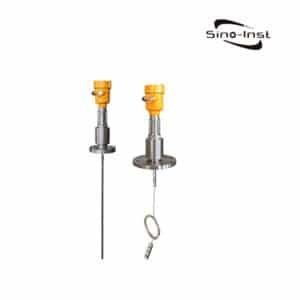
SIRD-705 High-Temperature GWR Level Sensor
Guided-wave radar transmitter for solar nitrate salt to 565 °C continuous. Inconel 600 single-rod or coaxial probe options, ceramic centring discs, 300 mm cooling neck, ±3 mm accuracy.
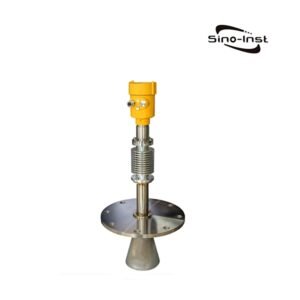
SIRD-806 High-Temperature Pulse Radar
Non-contact 26 GHz pulse radar for splashing-service molten salt to 600 °C. Air-purged metallic horn antenna, no PTFE wetted parts. Ideal for hot-tank dump lines and recovery loops.
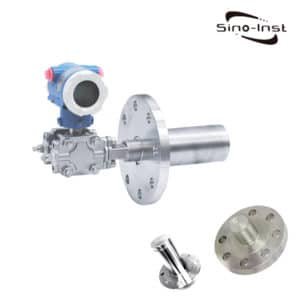
Extended-Diaphragm-Seal DP Level Transmitter
Remote-seal differential-pressure transmitter for closed pressurised molten-salt loops where radar penetrations are not permitted. Hastelloy C-276 diaphragm, Syltherm 800 capillary fill.
FAQ
What is the maximum temperature for guided-wave radar on molten salt?
Continuous service to 565 °C is achievable with an Inconel 600 single-rod probe, ceramic centring discs, and a 300 mm cooling neck. Above 600 °C the probe alloy creep rate accelerates and frequent recalibration is required. For chloride-salt service above 700 °C, switch to non-contact pulse radar with a metallic horn or to a remote-seal DP transmitter.
Can capacitive level sensors handle molten salt?
No, not reliably above 250 °C. Polymer-bonded probe insulators (typical PEEK or PTFE) creep and lose dielectric integrity at solar-salt temperatures. Some ceramic-insulated capacitive probes are rated to 400 °C, but their accuracy drifts as crystallised salt deposits change the effective dielectric path.
Why is solar salt usually 60% NaNO3 / 40% KNO3 specifically?
That eutectic composition gives the lowest melting point (around 220 °C) of the binary nitrate system, maximising the operating temperature window between freeze and decomposition (~600 °C). It is also low-cost and abundant. Hitec ternary salt (NaNO3-KNO3-NaNO2) extends the lower limit to 140 °C but trades against thermal stability above 500 °C.
What dielectric constant does molten nitrate salt have?
Solar salt at 290–565 °C shows a dielectric constant in the range εr ≈ 18–25, close to that of water at room temperature. This is high enough that guided-wave radar gives a clean top-of-liquid reflection without needing the high-end transmitter modes. Chloride salts at εr ≈ 6 require probe-end tracking and a more sensitive transmitter.
How do I prevent salt freezing in the probe assembly?
Three measures combine. First, electric trace-heating on the cooling neck and any horizontal pipework, set to at least 50 °C above the salt freezing point. Second, insulation on all wetted-part standoff sections, with the trace heater under the insulation. Third, a documented start-up procedure that pre-heats the probe assembly before the salt is melted into the tank — bringing the salt up around a cold probe is the most common cause of cracked probes and lost commissioning weeks.
Is bubbler level measurement still used on molten salt?
Rarely, and only as a backup. The bubbler injects an inert purge gas (nitrogen or argon) at the bottom of the tank and measures the back-pressure. The hot purge gas accelerates salt freezing in the dip-tube tip, and the pressure transmitter at the cold side requires a long capillary that is itself failure-prone. Modern installations use GWR as primary and a DP capillary system as backup; bubblers persist only on legacy installations and on metallurgical melt furnaces with much higher temperature than CSP.
What is the typical accuracy specification for a CSP molten-salt level transmitter?
Project specifications normally call for ±10 mm or 0.1% of measured level, whichever is greater, on a 12 m tall hot tank. Modern HT-GWR transmitters meet ±5 mm; pulse radar meets ±10 mm; DP with long capillaries meets ±15 mm at best because of the capillary thermal-error budget. For inventory accountability the spec tightens to ±0.05% of full scale, typically only met by GWR plus an independent verification reading via load-cell weighing.
For a salt-specific selection — chemistry, temperature range, tank geometry, and standards alignment — our application engineers will scope the probe alloy, antenna or capillary configuration, and acceptance-test plan within one working day.
Request a Quote


Wu Peng, born in 1980, is a highly respected and accomplished male engineer with extensive experience in the field of automation. With over 20 years of industry experience, Wu has made significant contributions to both academia and engineering projects.
Throughout his career, Wu Peng has participated in numerous national and international engineering projects. Some of his most notable projects include the development of an intelligent control system for oil refineries, the design of a cutting-edge distributed control system for petrochemical plants, and the optimization of control algorithms for natural gas pipelines.