

A Type K thermocouple chart converts the millivolt output of a chromel/alumel junction into a temperature reading at 0 °C cold-junction reference. The chart is the IEC 60584-1 reference table — the same numbers used inside every Type K transmitter and recorder for cold-junction compensation. To use the chart correctly you need the formula Thot = chart−1(Vmeasured + Vcold-junction), the IEC tolerance class for your wire, and the regional color code so you do not reverse polarity.
Contents
- How to Read the Chart with Cold-Junction Compensation
- Type K mV Reference Table (−200 to +1372 °C)
- Eight Thermocouple Types Compared at a Glance
- IEC 60584 and ASTM E230 Tolerance Classes
- Color Codes: ANSI, IEC, JIS, BS
- Five Common Mistakes Reading a Thermocouple Chart
- Featured Thermocouples and Temperature Transmitters
- FAQ
How to Read the Chart with Cold-Junction Compensation
A Type K thermocouple does not directly measure the hot junction temperature — it measures the difference between the hot junction and the cold (reference) junction. The chart assumes the cold junction is at exactly 0 °C. In practice it is at room temperature, so the measurement procedure has three steps.
- Measure the thermocouple voltage Vtc with a high-impedance meter (>1 MΩ).
- Measure the cold-junction (terminal-block) temperature Tcj with a separate sensor — typically an internal RTD on the recorder or transmitter.
- Look up Vcj from the chart at Tcj, add to Vtc, then look up the temperature for the corrected mV. Thot = chart−1(Vtc + Vcj).
Worked example. The wire reads Vtc = 8.000 mV. The terminal block is at Tcj = 25 °C, which on the chart is Vcj = 1.000 mV. Total = 9.000 mV. From the Type K chart, 9.000 mV corresponds to about 221 °C. That is the hot-junction temperature. Skipping the cold-junction step in this example would have given 196 °C — 25 °C low, exactly the terminal-block error. Modern transmitters and recorders perform this correction automatically; if you ever read a Type K with a bench multimeter, do it manually.
For the broader comparison between resistance and voltage-based temperature sensors, see when to choose RTD over a Type K thermocouple.
Type K mV Reference Table (−200 to +1372 °C)
The full IEC 60584-1 chart for Type K covers 1572 °C of range in 1 °C steps. The condensed reference points below cover most engineering reads.
| Temp (°C) | EMF (mV) | Temp (°C) | EMF (mV) | Temp (°C) | EMF (mV) |
|---|---|---|---|---|---|
| −200 | −5.891 | 200 | 8.138 | 800 | 33.275 |
| −100 | −3.554 | 250 | 10.153 | 900 | 37.326 |
| −50 | −1.889 | 300 | 12.209 | 1000 | 41.276 |
| 0 | 0.000 | 400 | 16.397 | 1100 | 45.119 |
| 25 | 1.000 | 500 | 20.644 | 1200 | 48.838 |
| 50 | 2.023 | 600 | 24.905 | 1300 | 52.410 |
| 100 | 4.096 | 700 | 29.129 | 1372 | 54.886 |
The Seebeck coefficient (slope of the curve, dV/dT) is approximately 41 µV/°C across the working range — the highest among the base-metal types. That is why Type K is the workhorse of industrial temperature measurement: high signal-to-noise and a 41 µV resolution per 1 °C, comfortably above the ~10 µV input noise of any decent transmitter. For long-term recording on a multi-channel system see our paperless recorder selection guide.
Eight Thermocouple Types Compared at a Glance
The IEC standard defines eight letter-coded thermocouple types. Type K covers most general industry; the others fill out the high-temperature, vacuum, and precision corners.
| Type | Conductors (+ / −) | Range (°C) | Sensitivity at 25 °C (µV/°C) | Best fit |
|---|---|---|---|---|
| K | Chromel / Alumel | −200 to +1372 | 41 | General industry; oxidising atmosphere up to 1100 °C |
| J | Iron / Constantan | −210 to +1200 | 52 | Vacuum, inert, reducing atmospheres; sensitive to oxidation above 540 °C |
| T | Copper / Constantan | −270 to +400 | 43 | Cryogenic and food-process service; resists moisture corrosion |
| E | Chromel / Constantan | −270 to +1000 | 68 | Highest sensitivity of the base-metal types; cryogenic precision |
| N | Nicrosil / Nisil | −270 to +1300 | 39 | Drift-resistant alternative to K above 800 °C; aerospace and metallurgy |
| S | Pt-10%Rh / Pt | 0 to +1768 | 10 | Calibration standard; clean oxidising atmospheres up to 1450 °C |
| R | Pt-13%Rh / Pt | −50 to +1768 | 11 | Industrial high-temperature reference; petrochemical, glass |
| B | Pt-30%Rh / Pt-6%Rh | 0 to +1820 | 10 (above 600 °C) | Steel-mill, glass-melt; insensitive below 50 °C — no cold-junction compensation needed |
Read the comparison this way: K is default, T for sub-zero, E for highest sensitivity, N when K drifts, S/R/B for very high temperatures. For the deeper trade-off vs platinum RTDs see our RTD vs thermocouple comparison.
IEC 60584 and ASTM E230 Tolerance Classes
Tolerance is the maximum permitted deviation between the actual emf and the standard table emf. IEC 60584-2 and ASTM E230 define three classes; the figure quoted on a thermocouple datasheet is the worst-case error before any in-house calibration.
| Class | Type K tolerance | Application |
|---|---|---|
| Class 1 (IEC) / Special (ASTM) | ±1.5 °C up to +375 °C, then ±0.4 % of reading | Lab, calibration, precision process |
| Class 2 (IEC) / Standard (ASTM) | ±2.5 °C up to +333 °C, then ±0.75 % of reading | Default industrial spec, most commercial wire |
| Class 3 (IEC, sub-zero only) | ±2.5 °C up to −167 °C, then ±1.5 % of reading | Cryogenic service; not a US-recognised class |
A 1000 °C process measured with a Class 2 K thermocouple has up to ±7.5 °C tolerance from the wire alone. Add the transmitter’s ±0.1 % FS, the cold-junction compensation error of ±0.5 °C, and the cable termination drift, and the loop accuracy is around ±10 °C in the worst case. Class 1 wire halves the wire-side error to about ±4 °C and is worth the price premium for furnace control loops where a 5 °C swing changes the metallurgical result.
Color Codes: ANSI, IEC, JIS, BS
Color code is the most common cause of installation error. Type K wire is yellow under ANSI MC96.1 (US) but green under IEC 60584-3 (Europe). The negative leg is red under ANSI but white under IEC. Crossing the standards results in a polarity reversal and an apparent negative reading.
| Standard | Region | Type K positive | Type K negative | Outer jacket |
|---|---|---|---|---|
| ANSI MC96.1 | USA | Yellow | Red | Yellow |
| IEC 60584-3 | Europe, IEC countries | Green | White | Green |
| BS 1843 | UK (legacy) | Brown | Blue | Red |
| JIS C 1610 | Japan | Red | White | Blue |
| DIN 43710 | Germany (legacy, replaced by IEC) | Red | Green | Green |
Two practical rules. First, always check the printed standard on the cable jacket before terminating; assume nothing from color alone. Second, the negative leg of every magnetic-iron type (K, J) is the magnetic conductor — alumel and constantan are weakly attracted to a small magnet, while chromel and iron-positive K are not. A field magnet test resolves polarity confusion in seconds.
Five Common Mistakes Reading a Thermocouple Chart
- Skipping cold-junction compensation. Reading the chart with only the field mV ignores the terminal-block temperature and produces an error equal to the room temperature in °C. Always add Vcj before the lookup.
- Using the wrong thermocouple type’s chart. Confusing K with J or N looks identical on a multimeter. Identifying by color or jacket print is mandatory; “looked like K” loses 5–10 % accuracy.
- Reversed polarity on extension wire. Connecting K-positive (yellow/green) to the transmitter’s negative input swings the reading symmetrically — a 200 °C source reads as if at the cold-junction temperature. Drift suddenly looks like the process is cold.
- Using copper extension wire on a Type K loop. Copper introduces a parasitic junction at the terminal block. The reading is right at room temperature and wrong everywhere else. Always use matching K extension wire (KX) up to the cold-junction reference point.
- Ignoring the upper limit. Type K above 1100 °C in oxidizing atmosphere drifts +1 to +2 °C per 100 hours from “green-rot” of the chromel leg. The chart is mathematically correct; the wire is not. For continuous service above 1100 °C use Type N or platinum-rhodium types.
Most of these errors are hidden by a transmitter’s burnout-protection and CJC logic; on a bench multimeter they are exposed. If a junior engineer is building a calibration rig from a multimeter and a thermocouple, walk through these five with them on day one. For the wiring side see our 4–20 mA transmitter wiring types guide.
Featured Thermocouples and Temperature Transmitters

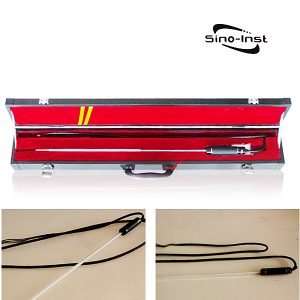
Pt-Rh Type S/R/B Thermocouple
Standard platinum-rhodium element for service above 1300 °C. Type S/R/B options, ceramic or metal sheath, calibration certificate to IEC 60584 Class 1. Used where Type K drifts: glass-melt, steel ladle, gas-turbine combustor.

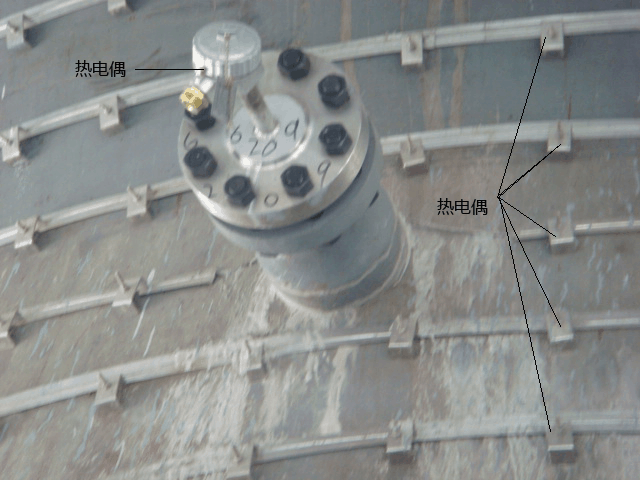
Furnace Thermocouple Assembly
Type K mineral-insulated assembly for kiln, furnace, and heat-treat service to 1200 °C. Inconel 600 sheath, optional alumina protection tube for atmosphere isolation, AMS 2750E calibration option for aerospace heat-treat lines.
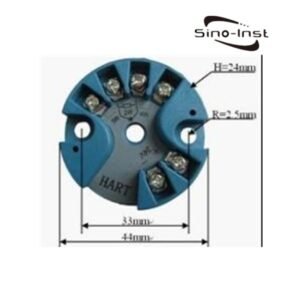
Integrated Temperature Transmitter
Head-mounted 4–20 mA / HART transmitter for K, J, N, T, E, R, S, B thermocouples and Pt100/Pt1000 RTDs. Built-in cold-junction compensation, burnout detection, and IEC 60584 chart linearization. ATEX intrinsically safe option.
FAQ
How do you read a Type K thermocouple table?
Measure the thermocouple millivolts with a high-impedance meter, then add the cold-junction compensation millivolts read from the same chart at the terminal-block temperature. Look up the corrected total in the table to get the hot-junction temperature. Modern transmitters do this automatically; for a bench multimeter you do it by hand.
What is the temperature range of a Type K thermocouple?
−200 to +1372 °C per IEC 60584-1. Continuous service in oxidising atmosphere is rated to 1100 °C; intermittent service to 1300 °C. In reducing or sulfurous atmospheres the upper limit drops to about 800 °C because of green-rot drift in the chromel leg.
What is the millivolt output of a Type K at 100 °C?
4.096 mV at 100 °C with a 0 °C cold-junction reference, per the IEC 60584-1 table. Sensitivity is approximately 41 µV/°C across the working range, so each 1 °C change moves the output 41 µV — easily resolvable by a 16-bit transmitter.
Why is my Type K reading negative when the process is hot?
Polarity is reversed at the terminal block. The Type K positive leg is yellow under ANSI MC96.1 (US) and green under IEC 60584-3 (Europe). Connecting the wrong leg to the positive input swings the reading symmetrically. Swap the leads and verify with a small magnet — the alumel (negative) leg is magnetic.
What is the difference between Type K and Type J thermocouples?
Type K is chromel/alumel, range −200 to +1372 °C, sensitivity 41 µV/°C, default for general industry. Type J is iron/constantan, range −210 to +1200 °C, sensitivity 52 µV/°C, but the iron leg oxidises rapidly above 540 °C and so is restricted to vacuum, reducing, or inert atmospheres.
Do I need extension wire matching the thermocouple type?
Yes. Use Type KX extension wire on Type K loops, JX on Type J, and so on. Copper extension wire introduces a parasitic junction at the terminal block; the reading is right at room temperature and wrong everywhere else. The KX wire has lower-grade alloys than KP/KN element wire but matches the Seebeck curve over 0–200 °C.
What is “green-rot” in a Type K thermocouple?
Selective oxidation of the chromium in the chromel (positive) leg above 800–1100 °C. The leg turns greenish, the Seebeck coefficient drops, and the reading drifts low. Use Type N (nicrosil/nisil) above 1100 °C continuous service or platinum-rhodium types (S/R/B) for atmospheres rich in chromium-attacking species.
Need a thermocouple, transmitter, or paperless recorder configured for your temperature range and accuracy class? Send the temperature range, atmosphere, output requirement, and certification target — our engineering team will quote within 24 hours.
Request a Quote


Wu Peng, born in 1980, is a highly respected and accomplished male engineer with extensive experience in the field of automation. With over 20 years of industry experience, Wu has made significant contributions to both academia and engineering projects.
Throughout his career, Wu Peng has participated in numerous national and international engineering projects. Some of his most notable projects include the development of an intelligent control system for oil refineries, the design of a cutting-edge distributed control system for petrochemical plants, and the optimization of control algorithms for natural gas pipelines.