

Updated May 28, 2026 · Sino-Inst Engineering Team
A residential water meter looks simple from the outside — a brass body, a glass face, a few rolling digits. Inside, it is doing one of three jobs: filling and emptying a fixed-volume chamber (positive displacement), counting impeller spins (velocity), or timing an ultrasonic pulse across the pipe. Which one the utility installed at the curb decides how accurate your bill is at 0.5 GPM and whether the meter can talk to an AMI radio.
This guide walks the technology, the dial, the accuracy class, how to size the right meter for a single-family home, and how to use the meter itself as a leak detector.
Contents
- What Is a Residential Water Meter?
- How Does a Residential Water Meter Work?
- What Are the Main Types of Residential Water Meters?
- How to Read a Residential Water Meter
- How Accurate Are Residential Water Meters?
- How to Choose the Right Residential Water Meter
- Using Your Water Meter for Leak Detection
- Residential and Light-Commercial Water Meters from Sino-Inst
- FAQ
What Is a Residential Water Meter?
A residential water meter is a legal-for-trade flow totalizer installed on the cold-water service line of a house or small apartment. It measures cumulative volume — typically in gallons or cubic meters — so the utility can bill the property. Most US single-family meters are sized 5/8″ × 3/4″ or 3/4″, which corresponds to roughly DN15–DN20. Larger homes with irrigation may run a 1″ service.
The body is usually bronze or a lead-free copper alloy (NSF/ANSI 372 compliant in the US). The register on top can be analog (rolling dials and a wheel) or digital (an LCD with an LED). The newest installs are AMI smart meters — see our digital and smart water flow meters overview for the radio-equipped variants.
How Does a Residential Water Meter Work?
A residential water meter works by sensing every unit of water that passes through it and accumulating the count on the register. Three sensing methods dominate the residential market: positive displacement, velocity, and ultrasonic.
Positive displacement (PD). Water enters a sealed chamber of known volume. A nutating disc — a flat disc canted off its axis — wobbles as water flows through, scooping one chamber-volume per wobble. The disc spindle rotates a magnet coupled to the register, which counts every cycle. PD meters are accurate at very low flows (down to 0.1 GPM) and are the standard choice for single-family service.
Velocity. A small impeller (single-jet or multi-jet) spins inside the meter body. Its rotation rate is proportional to water velocity, which the register multiplies by the pipe cross-section to get volume. Velocity meters tolerate dirty water better than PD, but they lose accuracy below about 0.5 GPM — a problem for residential drip flows. They are similar in principle to the turbine-style velocity meter used in industrial lines.
Ultrasonic. Two piezo transducers mounted on opposite sides of the pipe send and receive an ultrasonic pulse. The difference in upstream and downstream transit times maps to flow velocity. Ultrasonic residential meters have no moving parts, retain accuracy across a 250:1 turndown, and are the technology of choice for new AMI rollouts. The same transit-time principle underlies industrial ultrasonic transit-time flow meters.
What Are the Main Types of Residential Water Meters?
The main residential water meter types are nutating disc, single-jet, multi-jet, ultrasonic and electromagnetic. The table below compares them on the criteria that actually matter at the curb stop.
| Type | Principle | Min. flow | Best for | Weak spot |
|---|---|---|---|---|
| Nutating disc (PD) | Wobbling disc displaces fixed volume | ~0.1 GPM | Single-family home, clean water | Wear on sandy water; replace at ~15 yr |
| Single-jet velocity | One tangential jet spins impeller | ~0.5 GPM | Apartments, light commercial | Poor low-flow accuracy |
| Multi-jet velocity | Several jets balance the impeller | ~0.25 GPM | Medium-size homes, EU residential standard | Strainer clogs over time |
| Ultrasonic | Transit-time across pipe | ~0.03 GPM | AMI smart-meter networks | Higher upfront cost |
| Electromagnetic | Faraday’s law, no moving parts | ~0.02 GPM | Reclaim/recycled water with conductivity | Needs power; rarely used residential |
Industrial-scale variants — full-bore electromagnetic — like our full-bore magnetic flow meter are common in irrigation district mains and water treatment plants, but they are oversized for a single home service.
How to Read a Residential Water Meter
To read a residential water meter, find the number on the main dial or LCD and record it in the units printed on the face — usually gallons (US) or cubic meters (EU/AU). Subtract the previous reading from the current one to get usage over that period. Most utilities convert flow rate in GPM into your billing volume automatically.
The exact procedure depends on the dial type:
- Straight-reading analog (rolling digits). Read left to right, like a car odometer. Most US utilities only bill on full units (gallons, cubic feet), so ignore the smaller decimal sweep hand unless you are leak-checking.
- Round-reading analog (multiple sub-dials). Each sub-dial represents a different decade (×1, ×10, ×100, ×1000). Start from the largest and read whichever number the pointer has passed.
- Digital LCD. Shine a flashlight at the meter to wake it. The display alternates between cumulative read and instantaneous flow rate. Record the cumulative value.
- Leak-check. Shut every fixture in the house, then watch the low-flow indicator (a small red triangle, star or wheel). If it still moves, you have a leak. A persistent 0.05 GPM creep is enough to fail.
How Accurate Are Residential Water Meters?
Residential water meters are accurate to about ±1.5 % over their declared flow range, with tighter limits at intermediate flow. The legal standards are ISO 4064 / OIML R49 internationally and AWWA M6 in North America. Both define accuracy classes based on a meter’s turndown (Q3:Q1 ratio) — the higher the class, the better the low-flow performance.
| Accuracy class | Q3:Q1 turndown | Typical technology | Tolerance Q1 ≤ Q < Q2 | Tolerance Q2 ≤ Q ≤ Q4 |
|---|---|---|---|---|
| Class 1 (R 80) | 80:1 | Older nutating disc | ±5 % | ±2 % |
| Class 2 (R 160) | 160:1 | Multi-jet velocity | ±5 % | ±2 % |
| Class 2 (R 400) | 400:1 | Modern PD / electromagnetic | ±5 % | ±2 % |
| Class 2 (R 800) | 800:1 | Ultrasonic smart meter | ±3 % | ±1 % |
A meter loses accuracy over time. Worn nutating-disc bearings drift low (under-billing the utility). Stuck or fouled velocity impellers can drift either way. A field accuracy check is straightforward:
- Shut every fixture in the home.
- Record the meter reading.
- Draw a known volume — 5 gallons in a calibrated bucket is enough — through one tap.
- Read again; the delta should match within 1.5 %.
If the meter is using a pulse output for sub-metering or a custom controller, verify the pulse K-factor calibration the same way industrial meters are checked.


How to Choose the Right Residential Water Meter
Choose a residential water meter by matching its sizing to the home’s peak and minimum flow, then by the AMI/AMR requirement. A 5/8″ × 3/4″ PD meter is the default for 1–4 bath single-family homes; jumping a size hurts low-flow accuracy more often than it helps capacity.
| Household type | Peak demand | Recommended meter size | Recommended technology |
|---|---|---|---|
| 1–2 bath, 2–4 occupants | ~10 GPM | 5/8″ × 3/4″ | Nutating disc PD or ultrasonic |
| 3–4 bath, 4–6 occupants | ~15 GPM | 3/4″ | PD or multi-jet |
| Large home, irrigation | 20–30 GPM | 1″ | Multi-jet or compound meter |
| Small apartment building | 30+ GPM | 1.5″–2″ | Multi-jet or ultrasonic |
Install upstream of any softener or filter, with a strainer if local water has grit. Honor the straight-pipe length requirements printed on the spec sheet — usually 5 pipe diameters upstream and 2 downstream for velocity meters, less for PD. For systems that feed gravity tanks rather than direct service, see our notes on tank-fed plumbing systems for the level-and-flow split.
Using Your Water Meter for Leak Detection
Most residential water meters carry a small low-flow indicator on the dial face — a red triangle, a blue snowflake, or a small star. It spins faster than the main register, so it picks up the slow creep of a 0.05 GPM leak that the cubic-foot wheel cannot resolve.
- Shut every fixture in the home — taps, dishwasher, washer, ice maker, irrigation timer.
- Watch the low-flow indicator for two full minutes. Any motion equals a leak somewhere downstream of the meter.
- Isolate by zone: close the main shutoff to the irrigation system first and watch again. Then the water heater. Then individual bath stacks. The indicator will stop when you have closed the zone containing the leak.
- For toilet leaks specifically, drop a dye tablet in the tank and wait 15 minutes — color in the bowl confirms the flapper seal is leaking past.
- For septic and sewage backflow paired with a sump, a continuous-monitoring wastewater level sensor can flag a stuck or slow-draining sump before it backs up.
An AMI ultrasonic meter automates this — the utility’s portal will flag continuous low-flow above 24 hours as a probable leak and email or SMS the customer. Mechanical meters need manual reading and comparison every 1–2 weeks to catch the same pattern.
Residential and Light-Commercial Water Meters from Sino-Inst

Hot Water Flow Meter
PD or turbine-based meter rated for water up to 130 °C — radiator loops, solar circuits, district heating. Pulse and 4-20 mA outputs available for sub-metering.
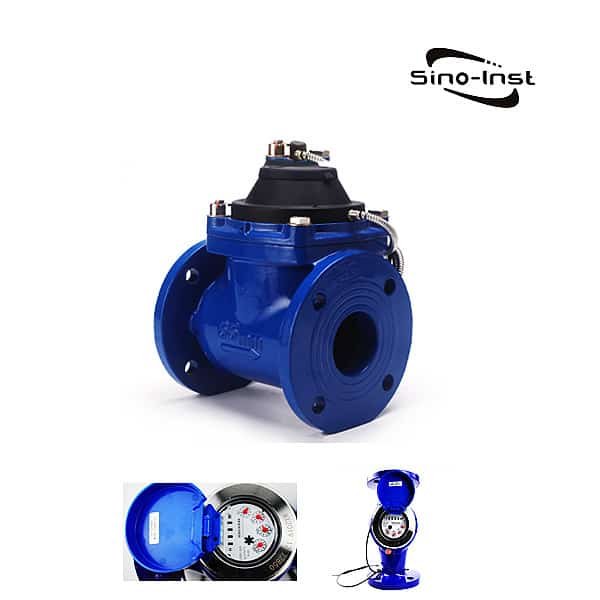
3-inch Water Meter
Multi-jet DN80 totalizer for apartment building services and small irrigation mains. Brass body, mechanical register, optional pulse contact for AMR.

Dual-Channel Ultrasonic Water Meter
No moving parts, 250:1 turndown, MBus/LoRa output ready for AMI rollouts. Reads down to 0.03 GPM — the right pick for leak-aware utility programs.
FAQ
How can I tell if my residential water meter is working correctly?
Shut every fixture, then watch the low-flow indicator on the meter face for two minutes. If it does not move, draw a measured 5-gallon bucket through one tap and confirm the meter delta is within ±1.5 %. A drifting indicator with all fixtures off means a leak; a meter that under-reads the bucket has worn internals.
What is the difference between a positive displacement and velocity water meter?
A positive displacement meter counts fixed-volume chamber cycles, which makes it accurate at the very low flows residential homes generate (toilet refill, slow leaks). A velocity meter counts impeller revolutions, which gives it better dirt tolerance and higher capacity but worse accuracy below 0.5 GPM. PD is the default for single-family service; velocity wins in larger multi-unit settings.
How long does a residential water meter last?
A nutating-disc PD meter typically reaches the end of its accuracy spec after 12–20 years, depending on water quality. Hard or sandy water shortens that. Ultrasonic meters have no wear parts and are usually retired only when the battery ends — about 15–20 years on most LoRa or MBus units.
Can a residential water meter be too small for my house?
Yes, but more often it is oversized. An undersized meter drops pressure when several fixtures run together (≥10 GPM peak through a 5/8″ body). An oversized meter under-reads slow drips because the impeller stalls below its Q1 flow. Match the meter Q3 rating to peak demand, not headroom.
What is a smart water meter?
A smart meter pairs an electronic flow sensor — usually ultrasonic — with a low-power radio (LoRa, MBus, NB-IoT or cellular). It reports cumulative volume and flow rate to the utility on a fixed schedule, flags leaks automatically, and removes the meter-reader truck visit. Most US AMI rollouts since 2022 default to ultrasonic for the low-flow accuracy.
How do I use my water meter to detect leaks?
Close every fixture in the home and watch the low-flow indicator (the small red triangle or blue snowflake on the dial face) for two minutes. Any motion means water is flowing somewhere downstream of the meter. Isolate by zone — irrigation, water heater, individual bath stacks — to find the leak. An AMI smart meter does this automatically and emails the customer when continuous flow exceeds 24 hours.
Where can I get help sizing a meter for my project?
Send the property’s pipe size, peak demand and number of fixtures to our Sino-Inst engineering team, or fill in the form below. Our application engineers will return a sizing sheet and a quote — usually inside a business day. You can also reach us through the contact our engineers page.
Need help selecting or sizing a residential or light-commercial water meter? Send the home’s pipe size, peak flow and AMI requirement using the form below and our application engineers will respond within one business day.
About This Article
This guide was researched and drafted by the Sino-Inst engineering team with AI-assisted drafting under engineer review, then technically reviewed for accuracy on 2026-05-28. References include ISO 4064 / OIML R49 / AWWA M6 metering standards and field commissioning experience across positive-displacement, multi-jet velocity and ultrasonic AMI meter installations. The PD-vs-velocity-vs-ultrasonic comparison reflects how our application engineers actually triage residential and light-commercial meter selection. Technical questions or sizing requests: reach our application engineers.
Request a Quote


Wu Peng, born in 1980, is a highly respected and accomplished male engineer with extensive experience in the field of automation. With over 20 years of industry experience, Wu has made significant contributions to both academia and engineering projects.
Throughout his career, Wu Peng has participated in numerous national and international engineering projects. Some of his most notable projects include the development of an intelligent control system for oil refineries, the design of a cutting-edge distributed control system for petrochemical plants, and the optimization of control algorithms for natural gas pipelines.