

An underground tank level indicator measures the liquid depth inside a buried tank — fuel, potable water, septic, or chemical — and shows it on a gauge, panel, or remote dashboard. The right indicator depends on the fluid, tank depth, regulatory framework, and whether continuous monitoring or simple level alarms are needed. This guide breaks the choice down by tank application, lists the install constraints that bite specifically on buried tanks, and points to product matches for each scenario.
Contents
- Sensor Types Used in Underground Tanks
- Indicator Choice by Tank Application
- Install Challenges Unique to Buried Tanks
- EPA UST Monitoring Rules for Fuel Tanks
- Cost of Ownership Comparison
- Featured Underground Tank Level Indicators
- FAQ
Sensor Types Used in Underground Tanks
Five sensor families dominate buried-tank service. Each makes specific trade-offs around the wet, dark, sometimes-corrosive conditions inside a buried vessel. For tanks above ground, see our overview of water tank level sensors and how to pair them with pump control.
| Sensor type | How it senses level | Best for | Watch out for |
|---|---|---|---|
| Submersible hydrostatic | Pressure at the bottom converted to head: h = P / (ρ·g) | Water, fuel, mild chemicals up to ~50 m depth | Cable kinks; needs vent tube for atmospheric reference |
| Magnetostrictive rigid probe | Float position on a stainless rod, measured by a magnetic pulse | Diesel, gasoline, custody-transfer fuel tanks | Probe length must fit tank depth; rigid install via manhole |
| Ultrasonic non-contact | Time-of-flight from sensor face to liquid surface | Septic, sewage, water — non-contact preferred | Foam, vapor, condensation distort the echo; needs clear cone |
| Capacitive | Dielectric change between probe and tank wall | Fuels, oils, dry-clean low-conductivity liquids | Coating from sludge or biofuel residues drifts the reading |
| Radar (guided-wave) | Microwave pulse on a probe, unaffected by vapor or temperature | Aggressive chemicals, hot or volatile fluids | Higher cost; install through manhole flange only |
For most water and fuel underground tanks the choice narrows to submersible hydrostatic or magnetostrictive. For septic and sewage, ultrasonic non-contact wins because it never touches the corrosive liquid. The deep background on how a submersible pressure probe converts head into level is in our pressure transmitter working principle reference, and the capacitive fuel level sensor page covers when capacitive beats other options.
Indicator Choice by Tank Application
The single most useful filter is what’s actually inside the tank.
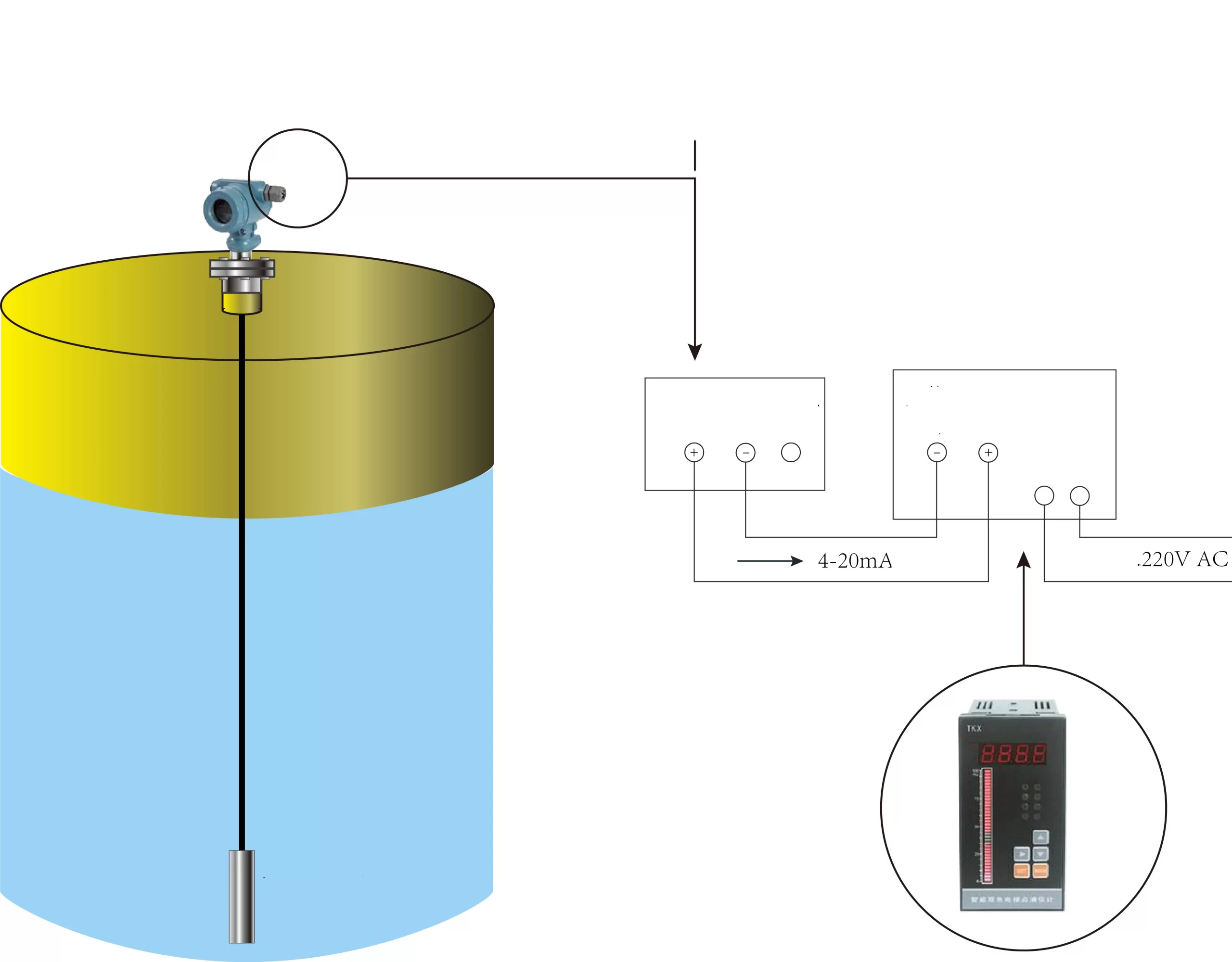
- Underground water tank (rainwater, fire reserve, well storage): submersible hydrostatic with vented cable, 4–20 mA output to a panel meter or PLC. Add a float switch for water tank as a backup high-level alarm. Continuous reading lets the operator schedule deliveries instead of physically dipping.
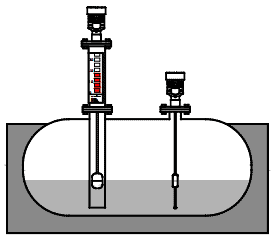
- Underground diesel or gasoline tank: magnetostrictive probe with HART or RS-485 output. Required for EPA UST automatic tank gauging (ATG) compliance; magnetostrictive resolves to ±0.005 in (0.13 mm) which is precise enough for leak detection.
- Septic / sewage holding tank: ultrasonic non-contact mounted on the manway lid. Anti-fouling design prevents contact with effluent. Add SMS or cellular telemetry to alert before overflow on remote sites.
- Underground chemical tank (acid, caustic, brine): guided-wave radar through a PTFE-lined probe. Capacitive is a cheaper alternative for stable dielectric chemicals like brine but not for variable-density acids. For sulfuric acid specifically, see our acid tank sensor comparison.
- Buried propane / LPG tank: magnetostrictive with rotary or dial gauge head. Spark-rated electronics to Class I Div 1.

Install Challenges Unique to Buried Tanks
Buried tanks introduce four problems an above-ground install never sees. Skipping any of these is what shortens a sensor’s life from ten years to two.
- Cable corrosion at the soil/air boundary. The first inch of cable above the manhole rim sees the most water-air cycling. Use polyurethane- or PE-jacketed sensor cable, never standard PVC. Apply a heat-shrink boot at the rim entry.
- Vent tube on submersible sensors. Hydrostatic sensors need atmospheric reference. The integral vent tube cannot be sealed by potting, ice, or condensation, or readings drift with barometric pressure. Run a desiccant capsule at the cable termination.
- Manhole access only. Sensors must drop through a 4-inch or 6-inch manway. Magnetostrictive probes assemble in segments; rigid sensors must be specified with a top-mount flange matching the manway gasket. Confirm the install gap before ordering.
- Lightning and induced surge. A buried sensor with a long cable run to a remote panel acts as an antenna. A two-stage surge protector at the panel side, plus a buried ground rod within 2 m of the manhole, prevents 80% of dry-season failures.
Indoor pressure-transmitter installation practices that translate over are covered in our DP transmitter installation guide; the impulse-line philosophy maps onto sensor cable routing. If the output is a standard 4–20 mA loop running to a remote panel, the wiring conversion guide explains receiving-side options.

EPA UST Monitoring Rules for Fuel Tanks
Buried fuel tanks in the United States fall under 40 CFR 280 — the EPA’s Underground Storage Tank (UST) rule. Three monitoring options are accepted:
- Automatic tank gauging (ATG): a continuous level + temperature probe that runs a static leak test during low-flow hours. Magnetostrictive probes are the dominant choice. Pass criterion: 0.2 gal/h static test, 0.1 gal/h precision option.
- Statistical inventory reconciliation (SIR): manual or automated reconciliation of inventory, deliveries, and dispensed volume. Lower equipment cost, higher labor.
- Interstitial monitoring: a sensor in the annular space of a double-wall tank that alarms on liquid presence. Often paired with ATG.
State agencies may add stricter rules — California’s UST regulations under Title 23 require continuous statistical leak detection (CSLD) on most sites. Confirm with the local Authority Having Jurisdiction before specifying.
Cost of Ownership Comparison
| Indicator type | Up-front cost (USD) | Typical service life | Recurring cost |
|---|---|---|---|
| Mechanical dial / float gauge | $80–$250 | 5–8 years | Float replacement; manual reading labor |
| Submersible hydrostatic | $250–$600 | 8–12 years | Desiccant capsule yearly |
| Ultrasonic non-contact | $400–$1,200 | 7–10 years | Sensor face cleaning quarterly on septic |
| Magnetostrictive ATG probe | $1,200–$3,500 | 12–15 years | EPA compliance audit support; calibration every 3 yr |
| Guided-wave radar | $2,500–$6,000 | 15+ years | Probe inspection on heavy-coating service |
For a single 5,000-gallon residential water tank, a submersible sensor + panel meter often wins on TCO. For a 20,000-gallon commercial fuel tank with EPA reporting, magnetostrictive ATG is mandatory and the extra cost is recovered in avoided fines and detected leaks. See our diesel fuel tank level gauge comparison for the fuel side, and the wastewater level sensor selection guide for septic.
Featured Underground Tank Level Indicators


Diesel Fuel Tank Level Gauge
Mechanical-electronic dual readout | EPA-friendly ATG | rigid probe up to 6 m — for buried diesel and gasoline storage tanks.

SI-100 Magnetostrictive Level Transmitter
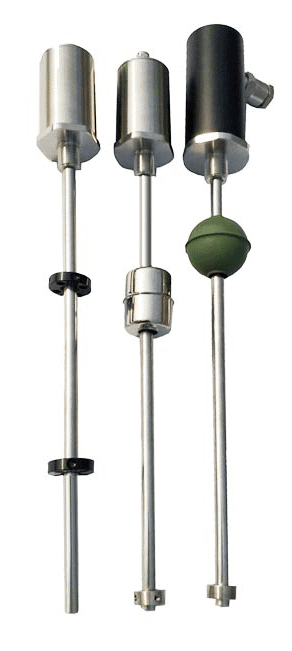
±0.05% accuracy | 4–20 mA HART | rigid stainless probe — buried chemical, oil and industrial water tanks with strict reading precision.
Wastewater Level Sensor (Septic / Sewage)
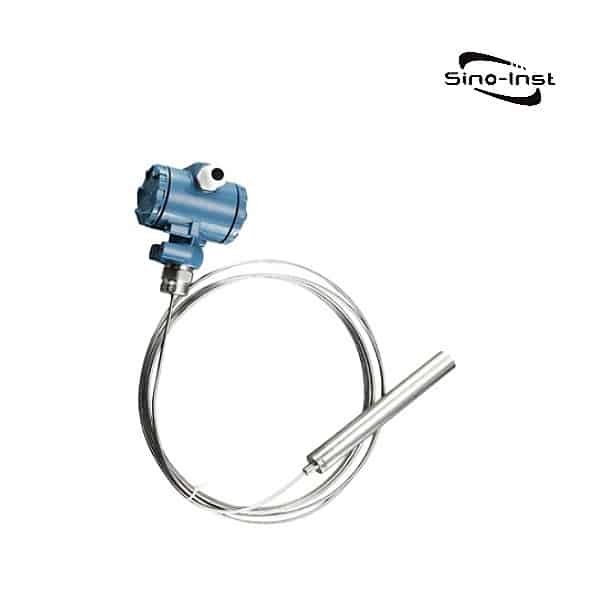
316L stainless | anti-fouling jacket | cellular telemetry option — purpose-built for septic and sewage holding tanks underground.
FAQ
What is the easiest level indicator for an underground water tank?
A submersible hydrostatic sensor with 4–20 mA output to a wall-mount panel meter is the simplest reliable choice. Drop the probe through the manhole, route the vented cable to the panel, and read level continuously in inches, feet, or percent. Add a high-level float for a pump cut-in alarm.
How accurate are underground tank level sensors?
Submersible hydrostatic typically reaches ±0.25% of full scale. Magnetostrictive ATG reaches ±0.005 inch (0.13 mm), which is required for EPA leak-detection precision. Ultrasonic non-contact runs ±0.25% in clean tanks and falls back to ±1% with foam. Capacitive depends on dielectric stability.
Do underground fuel tanks require continuous level monitoring?
Yes for most commercial USTs under EPA 40 CFR 280. The accepted options are automatic tank gauging (ATG), statistical inventory reconciliation, or interstitial monitoring of a double-wall tank. Single-wall residential heating-oil tanks under 1,100 gallons are usually exempt, but state rules can be stricter.
Can one sensor work in both septic and water tanks?
Not safely. Water sensors use a wetted diaphragm that fouls fast in sewage; septic-rated sensors use anti-fouling materials and a different protection rating. Spec the sensor to the fluid; the cost difference is small relative to a sensor failure.
Need help choosing between magnetostrictive, hydrostatic, or ultrasonic for a specific buried tank? Send the tank dimensions, fluid, regulatory framework, and required output to our engineering team for a sized quote.
Request a Quote


Wu Peng, born in 1980, is a highly respected and accomplished male engineer with extensive experience in the field of automation. With over 20 years of industry experience, Wu has made significant contributions to both academia and engineering projects.
Throughout his career, Wu Peng has participated in numerous national and international engineering projects. Some of his most notable projects include the development of an intelligent control system for oil refineries, the design of a cutting-edge distributed control system for petrochemical plants, and the optimization of control algorithms for natural gas pipelines.