

Sulfuric acid storage tanks combine three measurement obstacles: corrosive vapor in the headspace, concentration-dependent material compatibility, and regulated overfill protection. Direct-contact float and capacitance probes corrode within months. Non-contact 80 GHz radar with the right antenna material handles 96-98% concentrated H2SO4 indefinitely. This guide covers the technology decision, the antenna material matrix, and the install rules that pass EPA/SPCC inspection.
Contents
- Why Sulfuric Acid Tank Level Is Hard to Measure
- Radar vs Ultrasonic vs DP vs Magnetostrictive: Decision Matrix
- Antenna Material Selection by Concentration
- Acid Mist Handling and Antenna Sealing
- Installation Rules for H2SO4 Tanks
- Overfill Protection and EPA / SPCC Compliance
- Common Measurement Errors on Acid Tanks
- Related Products
- FAQ
Why Sulfuric Acid Tank Level Is Hard to Measure


Three properties of stored H2SO4 fight standard level sensors. The concentrated acid (typically 93-98% commercial grade) is hygroscopic and pulls water from the atmosphere, releasing dense acid mist into the tank headspace. The mist condenses on any metallic part above the liquid — including the antenna and flange of a standard radar. The acid itself attacks 316 stainless, PVC, and most elastomer seals within weeks at > 60 °C. And acid storage is regulated: SPCC (40 CFR 112) and many state EPA rules require independent overfill protection beyond the primary level reading.
Non-contact radar handles all three obstacles when the antenna and process seal are specified correctly. The radar mounts above the maximum liquid level, so only the antenna face and the wetted seal see acid mist. Pick the wrong antenna material and corrosion eats it in a year; pick PTFE or PVDF and the unit runs 10+ years. The same lens architecture that survives blast furnace radar level service applies here, just with a chemical-resistant material swap.
Radar vs Ultrasonic vs DP vs Magnetostrictive: Decision Matrix
| Technology | Wetted parts | 98% H2SO4 suitable? | Acid-mist tolerant? | Notes |
|---|---|---|---|---|
| 80 GHz radar (PTFE/PVDF/Hastelloy) | Antenna face only | Yes | Yes (sealed cavity) | Recommended default |
| Ultrasonic (PVDF) | Transducer face | Borderline (acid mist degrades sensor) | Poor | Avoid in concentrated service |
| DP / hydrostatic (PTFE diaphragm) | Diaphragm seals on impulse lines | Yes | N/A (sees acid directly) | Reliable but plumbing intensive |
| Magnetostrictive (PTFE float) | Probe in tank | Yes (PTFE rated) | Yes | Float can stick on viscous oleum |
| Capacitance (uncoated) | Probe in tank | No | No | Corrodes in months |
| Float / level switch (uncoated) | Mechanical | No | No | Use only as overfill backup, PTFE only |
Most modern installations use 80 GHz radar as the primary measurement plus a PTFE magnetostrictive or float switch as independent overfill backup. The two technologies satisfy SPCC requirements for redundancy without duplicating wear-path components.
Antenna Material Selection by Concentration
| H2SO4 concentration | Temperature | Recommended antenna | Lifetime |
|---|---|---|---|
| < 30% | Ambient | PVDF or PTFE lens | 10+ years |
| 30-70% | Ambient | PVDF lens, sealed cavity | 5-10 years |
| 70-98% | Ambient | PTFE lens with metal back-shield | 5-10 years |
| 98% (concentrated) | > 150 °C | Hastelloy C-276 horn or lens | 5+ years |
| Oleum (fuming H2SO4) | Any | Hastelloy C-276 + dedicated purge | 5+ years |
PVDF (polyvinylidene fluoride) covers most ambient-temperature service economically. PTFE (Teflon) handles up to 98% acid but loses mechanical strength above 150 °C. Hastelloy C-276 is the only commonly available metallic antenna that survives both concentrated H2SO4 and oleum — expect a 3-5x cost premium over PVDF.
Acid Mist Handling and Antenna Sealing


Acid mist condenses inside any cavity that drops below the dewpoint of the tank vapor. On a 60 °C summer day with 95% H2SO4 storage, that dewpoint hovers around 40-50 °C. The antenna housing internals can fall below this if mounted in shade. Mist condenses, drips back onto the antenna face, and over weeks etches the lens. The fix is a fully sealed metal cavity with PTFE shielding between the wave-guide and the housing electronics. Specify on the data sheet:
- Metal cavity behind the antenna face (typically PVDF or Hastelloy)
- PTFE diaphragm or seal isolating the wave-guide from electronics
- O-ring material: Viton for < 70% H2SO4, Kalrez for > 70%
- Optional purge port for periodic dry-N₂ cleanout (low flow, < 0.1 Nm³/h)
On open vented tanks where mist concentration is highest, consider a stilling-well-style nozzle extension to keep the antenna face physically above the worst of the mist plume. The same logic applies on stilling-well radar installations in water service, just with chemical-grade materials.
Installation Rules for H2SO4 Tanks
- Mount the radar 200-500 mm above the maximum fill level so the antenna face never dips into the acid during sloshing.
- Use a DN80 or larger nozzle to keep the beam clear of the nozzle wall (avoid internal reflections).
- Tilt 0-3° off vertical only if the tank has significant agitation surface waves.
- Run the cable in PVC conduit or acid-resistant cable trays — standard PVC jacket softens in continuous acid-vapor exposure.
- Provide a Ball-valve isolation under the radar flange so the unit can be removed without venting the tank.
- Tighten flange bolts to spec with PTFE-impregnated gasket; standard graphite gaskets carbonize in concentrated acid service.
For multi-tank farms, mount each radar with identical orientation and nozzle geometry so spare units are interchangeable. Wiring conventions for the 4-20 mA HART signal follow standard practice; the special handling is in the mechanical install.
Overfill Protection and EPA / SPCC Compliance
SPCC plans (40 CFR 112) require for any oil tank, and most state programs extend the rule to acid storage: two independent level measurements when capacity exceeds 1320 US gallons. Best practice is one continuous radar level transmitter for control + one independent high-level switch wired directly to a shutoff valve. The switch must be on a separate power feed and a separate transmitter loop so radar failure does not disable the overfill protection.
- Primary: 80 GHz radar, 4-20 mA to control system
- Secondary: PTFE-coated float switch at 95% capacity, wired to inlet valve solenoid
- Independent power supplies (instrument bus + UPS-backed)
- Annual function test logged per calibration record requirements
- Audible/visual high-high alarm on the local panel
Common Measurement Errors on Acid Tanks
- Wrong antenna material. 316SS antennas show pitting within 90 days in 98% H2SO4 service. Switch to PTFE or Hastelloy.
- Standard graphite flange gaskets. Carbonize in concentrated acid; switch to PTFE-impregnated.
- Mounting too close to fill nozzle. Splashing on the antenna causes echo loss during fill. Move to opposite end of the tank.
- Ignoring 4 mA ↔ 0 mm calibration drift. Acid stratification (heavier at bottom) shifts apparent density on DP backup — re-zero on a quiet tank.
- No bund-level sensor. Secondary containment for acid storage is mandatory in most jurisdictions; a separate low-cost underground / bund level indicator catches spills before they migrate.
Related Products

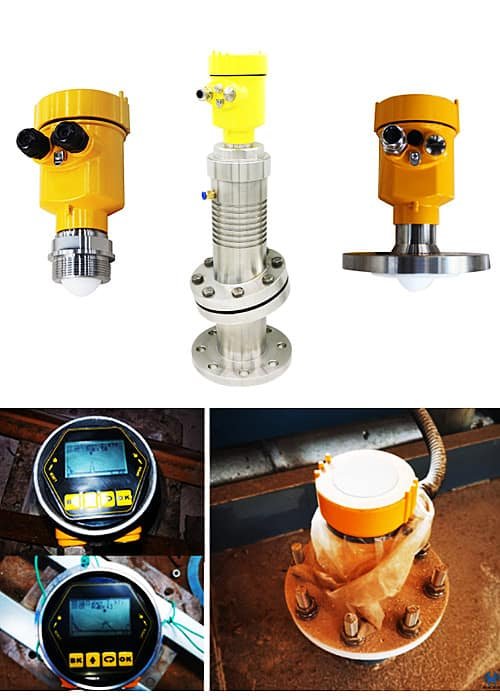
80 GHz Radar Level Transmitter
Non-contact 80 GHz radar | PTFE or Hastelloy antenna option | 4-20 mA HART — recommended for 70-98% H2SO4 storage with acid-mist headspace.

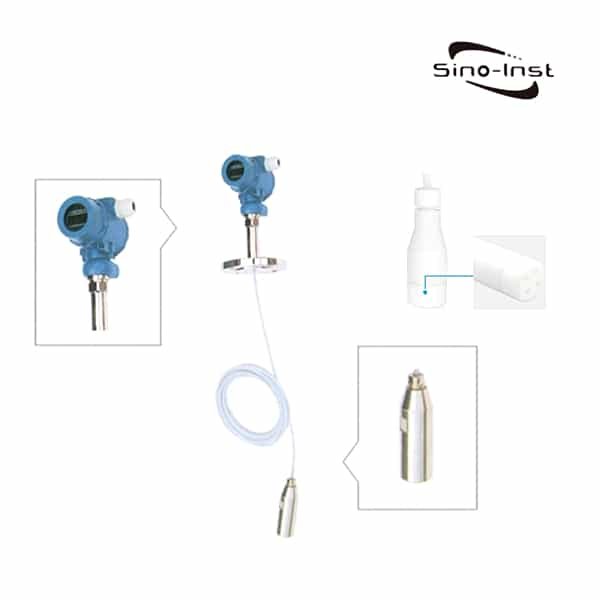
SI-302 Anti-Corrosive Submersible Transmitter
PTFE-coated diaphragm | Range 0-200 m H2O | for dilute acid < 30% where direct-contact submersion is acceptable. Not for concentrated H2SO4.
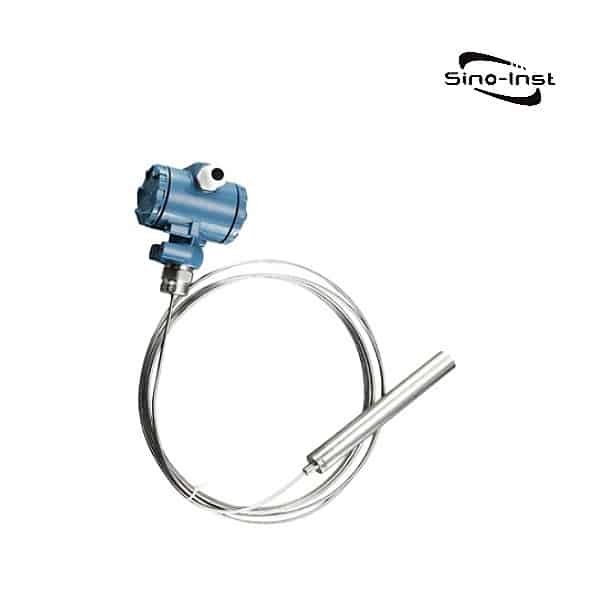
Stainless-Steel Hydrostatic Level Sensor
316L wetted parts | Optional Hastelloy / PTFE upgrades | DP head measurement for tanks where top-mounting radar is impractical.
FAQ
What sensor measures sulfuric acid tank level?
Non-contact 80 GHz radar with a PTFE or Hastelloy antenna is the current standard for concentrated H2SO4 (70-98%) storage. Dilute acid (< 30%) accepts PVDF radar or PTFE-coated submersible pressure level transmitters.
Does sulfuric acid corrode radar antennas?
Standard 316SS or PVC antennas pit and crack within months in 98% acid. PVDF resists dilute acid; PTFE handles up to 98% at ambient; Hastelloy C-276 covers concentrated and hot service (> 150 °C) and oleum.
Why is a metal cavity needed inside the radar?
Acid mist condenses inside any cavity below the headspace dewpoint and drips onto the antenna face. A sealed metal cavity with a PTFE diaphragm isolates the antenna from the electronics, so condensation cannot reach the wave-guide internals.
Do I need overfill protection separate from the radar?
Yes for tanks > 1320 US gal under SPCC and most state EPA rules. Install one continuous radar level transmitter plus an independent PTFE float switch at the high-high level, on separate power feeds and wired to an automatic shutoff.
Sizing a radar for 98% H2SO4 storage, oleum service, or a mixed-concentration tank farm? Send the tank diameter, fill rate, and acid concentration — our chemical instrumentation engineers reply with antenna material, nozzle spec, and overfill scheme within one business day.
Request a Quote


Wu Peng, born in 1980, is a highly respected and accomplished male engineer with extensive experience in the field of automation. With over 20 years of industry experience, Wu has made significant contributions to both academia and engineering projects.
Throughout his career, Wu Peng has participated in numerous national and international engineering projects. Some of his most notable projects include the development of an intelligent control system for oil refineries, the design of a cutting-edge distributed control system for petrochemical plants, and the optimization of control algorithms for natural gas pipelines.