

Updated May 27, 2026 | Sino-Inst Engineering Team
For pressure transducer wetted parts, the choice between 316L and 17-4PH stainless steel is the single most important spec you put on the RFQ. 316L is the default for clean liquid, hydrogen, marine, and biocompatible service. 17-4PH is the default for high-cycle hydraulic and surge-prone systems. Get this wrong and you either lose accuracy under transient pressure (under-spec’d 316L on a pulsing hydraulic line) or burn money on stainless that fails in chloride service (17-4PH on sea water). This guide walks both, plus when to step up to Duplex or Hastelloy.
Contents
- Where stainless steel sits in a pressure transducer
- 316L vs 17-4PH: head-to-head comparison
- When to specify 316L
- When to specify 17-4PH
- Escalation grades: 304, Duplex 2205, Hastelloy C-276, Monel
- RFQ checklist — five questions before you order
- Stainless steel pressure transducer products
- FAQ

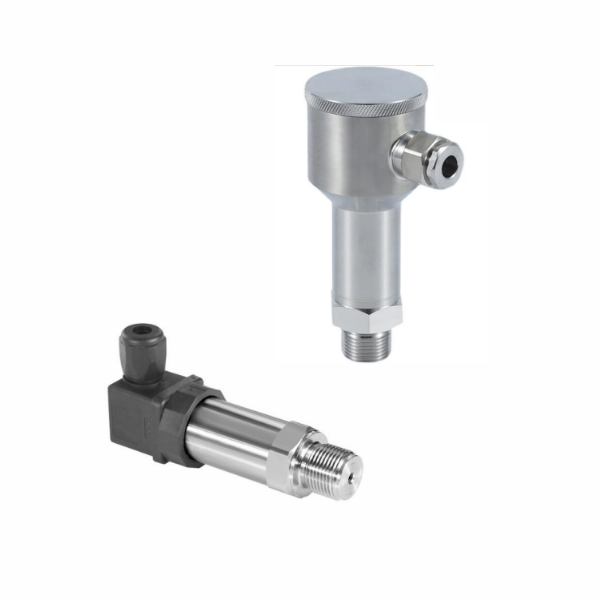
Where stainless steel sits in a pressure transducer
A pressure transducer has three metallic zones that may or may not see the process media:
- Wetted parts — the diaphragm, process port, and any internal cavity that contacts the media. Material here decides corrosion resistance, hydrogen embrittlement, and biocompatibility. UNS S31603 (316L) and UNS S17400 (17-4PH) cover ~95% of industrial pressure transducer designs.
- Sensor body — the structural casing that houses the electronics, behind the isolation diaphragm. Usually 304 or 316; never sees process media.
- Process connection — the threaded or flanged fitting (1/4″ NPT, G1/2, ANSI flange). Same material as the wetted side, machined to ASME B1.20.1 for NPT or DIN 3852 for G-thread.
When a datasheet says “316L wetted parts,” it means the diaphragm and process port. The body shell is a separate spec and may downgrade to 304 to save cost. The diaphragm is the part that fails first — pick its material against the worst-case media chemistry the loop will see, not the steady-state nominal. Background on diaphragm failure modes is covered in our pressure transmitter working principle page.
316L vs 17-4PH: head-to-head comparison
| Property | 316L (UNS S31603) | 17-4PH (UNS S17400) |
|---|---|---|
| Family | Austenitic | Precipitation-hardened martensitic |
| Magnetic? | No (non-magnetic) | Yes (magnetic) |
| Tensile strength (MPa) | 485 | 1100+ (H900 condition) |
| Yield strength (MPa) | 170 | 1000+ (H900 condition) |
| Corrosion resistance | Excellent (chlorides, hydrogen, marine) | Moderate (avoid chlorides, sea water, hydrogen) |
| High-cycle fatigue performance | Adequate | Excellent — preferred for pulsing hydraulics |
| Typical max temperature | +200 °C continuous | +300 °C continuous |
| Hydrogen embrittlement resistance | Yes — suitable for H₂ service | No — avoid hydrogen and cryogenic |
| Biocompatible (food, pharma) | Yes (FDA, USP Class VI compatible grades) | No |
| Relative cost (raw) | 1.0× | 1.1–1.3× |
The trade-off is mechanical strength vs corrosion resistance. 17-4PH is roughly twice as strong as 316L, so the diaphragm can be thinner for the same rated pressure — which means better dynamic response and lower fatigue at high cycle counts. The cost is corrosion: 17-4PH pits in chloride environments, embrittles in hydrogen, and is not suitable for sanitary or cryogenic use.
For the same rated 60 MPa working pressure, both materials can be specified — but the failure mode is different. 316L will lose accuracy as repeated cycling fatigues the diaphragm. 17-4PH stays accurate longer but corrodes if the process chemistry sneaks outside spec.
When to specify 316L
Default to 316L when any of the following are true:
- Hydrogen service — H₂, hydrogen-rich syngas, refinery hydrocrackers. 17-4PH will embrittle within months.
- Marine or chloride-bearing media — sea water, brine, coastal-air installations. The molybdenum in 316L (2.1%) buys pitting resistance that 17-4PH does not have.
- Cryogenic service — LN₂, LOX, LNG, LAr below −100 °C. 17-4PH becomes brittle and shatters; 316L retains ductility down to LHe temperatures.
- Sanitary / food / pharma — 316L is the EHEDG and 3-A baseline. 17-4PH is not on the list.
- Clean water, mild acids, lubricating oils — the default service envelope where 316L is more than adequate.
Steady-state ratings — 316L handles continuous service up to ~200 °C and most ranges from 10 kPa to 60 MPa. For high-purity applications, specify “316L low-carbon” rather than 316 (the L matters — it prevents weld decay). Clean-water service is the largest 316L use case; see our water pressure transducer family for water pipe / tank / well configurations. For air, nitrogen, hydrogen, and other gas applications, our industrial gas pressure sensors default to 316L wetted parts.
When to specify 17-4PH
Switch to 17-4PH (typically heat-treated to H900 or H1025 condition) when these conditions exist:
- High-cycle pressure pulsing — hydraulic press feeders, fuel injection rails, paint sprayers running at >100,000 cycles per day. The diaphragm fatigue life of 17-4PH is 5–10× that of 316L.
- Frequent pressure transients above rated — water hammer in pipework, surge spikes during pump start/stop. 17-4PH stays linear after a 1.5× over-range event; 316L starts drifting.
- High working pressure with thin diaphragm — 100 MPa and above. The strength of 17-4PH allows a thinner diaphragm with the same burst rating, improving sensitivity at high range.
- Service media that is benign chemistry — clean hydraulic oil, deionized water, instrument air, nitrogen (gaseous, not cryogenic). No chlorides, no hydrogen, no acids.
⚠ NACE MR0175 / ISO 15156 oil & gas warning: 17-4PH is NOT an accepted material under NACE MR0175 / ISO 15156 for sour service (H₂S-containing oil & gas equipment). If your spec calls out NACE compliance — every offshore, upstream, and refinery hydrocarbon service does — you must use 316L, Duplex 2205, Inconel 625, or another NACE-listed grade. Do not propose 17-4PH on these projects, even if the hydraulic-cycle argument seems to favor it.
17-4PH is also commonly chosen when machinability matters. It can be machined to tighter tolerances and threaded reliably, without the work-hardening problems of 316L. Our high-pressure product line uses 17-4PH for the diaphragm and 316 for the housing as a standard configuration. When troubleshooting transducers that drift after pressure surges, see our pressure transmitter calibration guide for the zero-trim procedure that often recovers 316L units before requiring replacement.
Escalation grades: 304, Duplex 2205, Hastelloy C-276, Monel
Outside the 316L / 17-4PH default, four grades come up on RFQs:
- 304 (UNS S30400) — austenitic, no molybdenum, lower cost than 316L. Acceptable for clean water and air; avoid for any chemical service. Sometimes specified for transducer housings (non-wetted) but rarely for diaphragms.
- Duplex 2205 (UNS S32205) — austenitic-ferritic blend, ~2× the chloride pitting resistance of 316L, stronger and cheaper than super-austenitics. Used for offshore oil, hot brine, and concentrated chloride brines (>50,000 ppm). Specify when 316L pits within 12 months in service.
- Hastelloy C-276 (UNS N10276) — nickel-molybdenum-chromium alloy, near-immune to hot mineral acids (HCl, H₂SO₄, HF) and aggressive chlorides. ~5× the cost of 316L. Specified when service media includes >20% mineral acid at elevated temperature.
- Monel 400 (UNS N04400) — copper-nickel alloy, specific resistance to hydrofluoric acid (HF) and seawater. Specified for HF alkylation units and submarine pressure ports.
For really aggressive media, a 316L transducer with a diaphragm seal is often cheaper than a Hastelloy transducer — the diaphragm seal isolates the transducer from the media using a chemically inert oil-fill and a sacrificial wetted membrane. See our wetted materials of pressure sensors reference for the full matrix.
RFQ checklist — five questions before you order
Before sending a pressure transducer RFQ, the procurement team should have answers to these five:
- What is the actual media chemistry? Not “water” — clean DI water, raw river water, sea water, brine concentration X%? Chlorides above 500 ppm rule out 17-4PH.
- What is the pressure cycle profile? Steady, slow-ramping (< 100 cycles/day), or pulsing (>1,000 cycles/day)? High cycles push toward 17-4PH.
- What is the maximum service temperature? Above 200 °C continuous → 17-4PH or step up to Inconel. Below −50 °C → 316L only.
- Hydrogen content in the media? Any H₂ presence above trace → 316L only. 17-4PH embrittles.
- What is the over-range / burst-pressure expectation? If 1.5× rated pressure is expected (water hammer, surge), 17-4PH gives margin. If steady, 316L is enough.
Once these five answers are in, the material choice usually becomes obvious. Our standard quote includes the recommended grade per service — see the underground tank level guide for an example of how grade affects sensor life in buried installations. For chemical-service tanks, the sulfuric acid storage tank guide shows when stainless transducers should be avoided entirely in favor of a non-contact radar.
Stainless steel pressure transducer products


SI-703 Flush Diaphragm Pressure Sensor
316L flush diaphragm for viscous, slurry, and sanitary service. Sub-flush profile prevents process build-up. Range 0–10 kPa to 60 MPa, ±0.1% accuracy, 4–20 mA output.
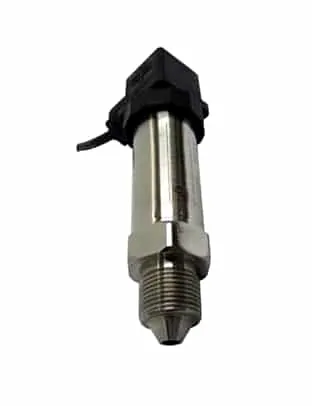
SI-702 High Pressure Sensor
17-4PH H900 diaphragm for high-cycle hydraulic and ultra-high pressure service. Ranges to 600 MPa, fatigue life >10 million cycles. Best for hydraulic presses and surge-prone loops.
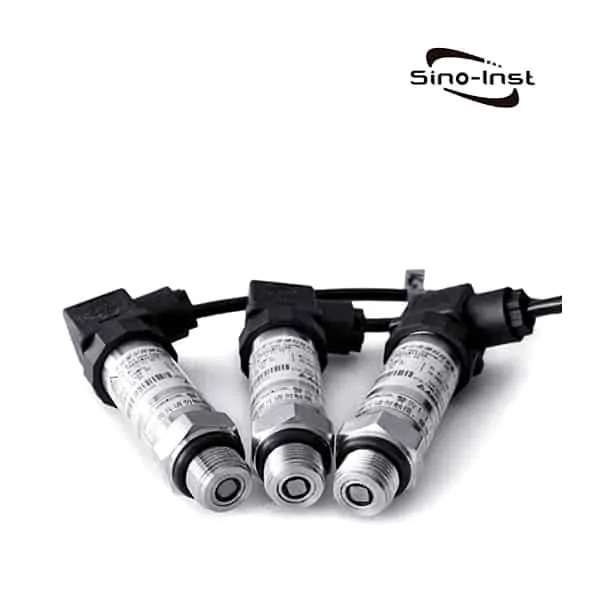
High-Frequency Dynamic Pressure Sensor
Piezoelectric high-frequency sensor for combustion, shock, and pulsation studies. 316L wetted parts, response up to 100 kHz, ranges to 100 MPa. Used in engine test cells and ballistics.
FAQ
What is the difference between 316L and 17-4PH stainless steel pressure transducers?
316L is austenitic, non-magnetic, and resistant to chlorides and hydrogen — the default for water, marine, and biocompatible service. 17-4PH is precipitation-hardened martensitic, magnetic, twice as strong, and preferred for high-cycle hydraulic systems and pressure surge applications. 17-4PH should not be used for hydrogen, sea water, or cryogenic service.
Is 316L suitable for hydrogen pressure transducer service?
Yes. 316L is the standard wetted material for hydrogen service because it resists hydrogen embrittlement, which is the failure mode that destroys 17-4PH and other high-strength steels in H₂ environments. For trace-H₂ or hydrogen-rich syngas, always specify 316L low-carbon.
Why is 17-4PH used in hydraulic pressure transducers?
17-4PH has roughly twice the tensile strength of 316L. For a hydraulic system that cycles thousands of times per day with frequent pressure spikes, the thinner diaphragm in a 17-4PH transducer survives 5–10× longer than the equivalent 316L unit, while staying linear after over-range events. Clean hydraulic oil is benign chemistry, so corrosion is not a concern.
When should I specify Hastelloy or Duplex instead of stainless?
Switch to Duplex 2205 when chloride concentration exceeds ~10,000 ppm and 316L pits within a year. Switch to Hastelloy C-276 for hot mineral acid service (HCl, H₂SO₄, HF above 20% concentration at elevated temperature). For HF specifically, Monel 400 is the targeted choice. A 316L transducer with a diaphragm seal is often cheaper than a Hastelloy transducer for borderline cases.
What is the wetted material on a pressure transducer datasheet?
“Wetted material” refers to the surfaces that contact the process media — the diaphragm, the process port, and any internal cavity exposed to the fluid. The transducer body shell is separate and may be a lower grade. When comparing transducer datasheets, match wetted-material specs against the actual service chemistry, not against transducer cost.
Is 17-4PH stainless steel NACE MR0175 / ISO 15156 compliant?
No. 17-4PH is not on the accepted-materials list in NACE MR0175 / ISO 15156, which governs metallic materials in H₂S-containing oil & gas environments (sour service). For any project that calls out NACE compliance — offshore, upstream, refining hydrocarbon — specify 316L, Duplex 2205, Inconel 625, or another NACE-listed grade. 17-4PH is fine for clean hydraulics outside oil & gas, but cannot be substituted on NACE-spec’d jobs.
Need help picking grade for your service? Send process media composition (including trace species), pressure cycle profile, and temperature range — our engineers will recommend 316L, 17-4PH, or an escalation grade and quote accordingly. For installation context, our pressure transmitter installation guide covers torque specs and gasket selection by material.
Request a Quote


Wu Peng, born in 1980, is a highly respected and accomplished male engineer with extensive experience in the field of automation. With over 20 years of industry experience, Wu has made significant contributions to both academia and engineering projects.
Throughout his career, Wu Peng has participated in numerous national and international engineering projects. Some of his most notable projects include the development of an intelligent control system for oil refineries, the design of a cutting-edge distributed control system for petrochemical plants, and the optimization of control algorithms for natural gas pipelines.