

Updated May 29, 2026 · Sino-Inst Engineering Team
You cannot tell how much CO2 is left in a fire-suppression cylinder by looking at its pressure gauge. A full cylinder and a half-empty one read almost the same pressure. The practical, non-invasive way to verify contents is a portable ultrasonic liquid level gauge that finds the liquid-to-gas boundary on the cylinder wall in under a minute — no weighing, no shutdown.
This guide explains what a portable CO2 cylinder level gauge is, why pressure cannot tell you the level, how the ultrasonic method works, the step-by-step field procedure, and how to choose the right gauge by couplant, accuracy and hazardous-area rating.
Contents
- What Is a CO2 Cylinder Portable Liquid Level Gauge?
- Why Can’t You Use Pressure to Check a CO2 Cylinder?
- How Does a Portable Ultrasonic Level Gauge Work?
- How to Check a CO2 Cylinder Level Step by Step
- How to Choose a Portable CO2 Level Gauge
- Where Portable Cylinder Gauges Are Used
- Common Mistakes When Checking Cylinder Level
- Portable Level Gauges from Sino-Inst
- FAQ
What Is a CO2 Cylinder Portable Liquid Level Gauge?
A CO2 cylinder portable liquid level gauge is a handheld ultrasonic instrument that detects the liquid level inside a sealed pressurized cylinder from the outside. You hold its transducer against the cylinder wall, move it up or down, and it tells you whether the spot in front of it is liquid or gas. Where the reading changes is the liquid surface — the contents level.
It is the standard tool for checking CO2, Halon and clean-agent (FM-200, NOVEC) fire-suppression cylinders without removing them or breaking the seal. The same handheld approach covers beverage CO2 tanks, marine CO2 rooms and lab gas cylinders. For built-in continuous monitoring rather than a handheld spot check, the same physics drives our ultrasonic CO2 level indicator.
Why Can’t You Use Pressure to Check a CO2 Cylinder?
You cannot use pressure because CO2 in the cylinder is a saturated liquid-vapor mix, and its pressure stays nearly constant regardless of how much liquid remains. As long as any liquid CO2 is present, the vapor above it sits at its saturation pressure for the current temperature — about 57 bar at 20 °C — whether the cylinder is 90% full or 10% full.
The pressure only starts to fall once the last of the liquid has boiled off and only gas is left — at which point the cylinder is already nearly empty and useless for fire suppression. So a healthy-looking pressure gauge tells you the cylinder is pressurized, not that it still holds enough agent. That is exactly why codes require a contents check by weight or by ultrasonic level, not by pressure.

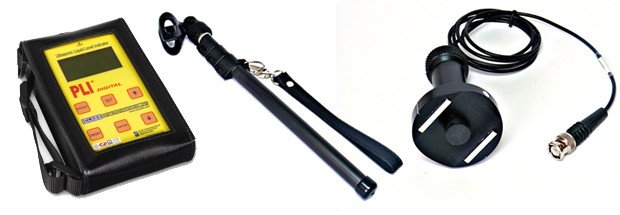
How Does a Portable Ultrasonic Level Gauge Work?
A portable ultrasonic level gauge works by sending an ultrasonic pulse through the cylinder wall and reading how the signal reverberates inside. Against liquid, the sound couples into the dense medium and the echo pattern is one way; against gas, the wall rings differently because gas barely carries the pulse. The instrument turns that difference into a clear liquid-or-gas indication for the exact spot under the transducer.
Moving the transducer down the cylinder, you find the height where the indication switches — that is the liquid surface. The method is non-invasive, non-destructive and works without shutting down the system, typically resolving the boundary to about ±1.5 mm and completing a cylinder in under 30 seconds. It is the same transit principle behind ultrasonic liquid level sensors, packaged for handheld spot checks.
How to Check a CO2 Cylinder Level Step by Step
Checking a cylinder takes well under a minute once you have the gauge and couplant ready. Follow these steps for a reliable reading.
- Clean the contact band. Wipe a vertical strip on the cylinder wall with a damp cloth so the transducer sits on bare, smooth metal — paint flakes and grime scatter the pulse.
- Apply couplant. Smear a strip of ultrasonic gel (or petroleum jelly) down the cleaned band. Couplant removes the air gap between transducer and wall; without it the pulse never enters the cylinder. In hot environments water works but evaporates and must be reapplied.
- Start low and scan upward. Press the transducer to the cylinder near the bottom (expected liquid) and slide it slowly upward, watching the liquid/gas indication.
- Find the switch point. The height where the reading flips from liquid to gas is the surface. Mark it.
- Compare to the fill mark. Measure that height against the cylinder’s full-fill reference. A drop below the minimum means the cylinder needs refilling or replacing.
For tanks and vessels too large for a handheld pass, switch to a mounted sensor — see ultrasonic tank level sensors or, for very cold service, a cryogenic level sensor.
How to Choose a Portable CO2 Level Gauge
Choose on four practical points rather than price, because a cheap gauge that fails in your environment costs more than it saves.
- Accuracy and readout. A boundary resolution around ±1.5 mm is the practical target. A digital readout is easier to judge than an analog needle when the boundary is faint.
- Single-point vs continuous. A handheld single-point gauge is right for periodic inspection rounds. If you need permanent monitoring on a critical cylinder, fit a continuous indicator instead.
- Couplant and surface. Confirm the gauge works on your cylinder’s wall thickness and curvature, and that the couplant you can source on site suits the ambient temperature.
- Hazardous-area rating. For engine rooms, offshore or flammable-storage areas, specify an intrinsically safe (ATEX/IECEx) model. A standard unit is not permitted in a classified zone.
Where Portable Cylinder Gauges Are Used
Portable ultrasonic gauges are used anywhere liquefied gas sits in a sealed cylinder that must be verified without opening it. The biggest use is fire protection — CO2, Halon and clean-agent banks in server rooms, engine spaces and machinery rooms — where regulations require periodic proof of contents.
Beyond fire systems, the same gauge checks marine CO2 flooding cylinders during surveys, beverage and brewery CO2 tanks, laboratory gas cylinders, and refrigerant drums. When a site grows past spot checks into permanent dashboards, the data ties into a tank level monitoring system for logging and alarms.
Common Mistakes When Checking Cylinder Level
Most bad readings come from technique, not the instrument. Four mistakes account for the majority.
- Trusting the pressure gauge. The classic error — assuming a normal pressure means a full cylinder. It does not, because saturation pressure is flat until the liquid is gone.
- No couplant or a dry strip. Without gel the pulse never enters the wall and every spot reads “gas.” In heat, water couplant dries out mid-scan and must be refreshed.
- Scanning over paint or a weld seam. Coatings and seams scatter the signal and create false boundaries. Use a clean band of bare metal away from welds.
- Reading at the wrong temperature reference. Cylinder fill marks assume a reference temperature. After a hot or cold soak, let the cylinder equilibrate or correct for it. For buried or hard-to-reach vessels, see how to check level in underground tanks.
Portable Level Gauges from Sino-Inst

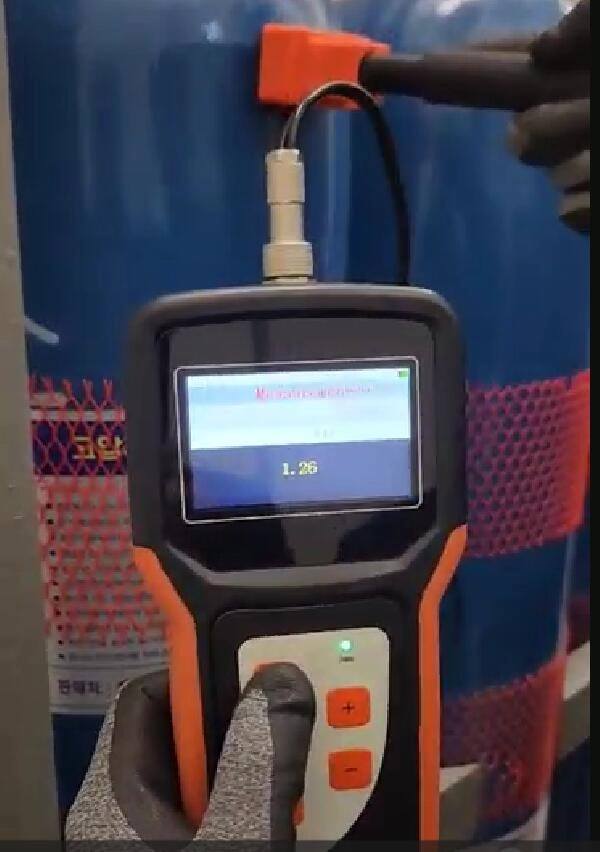
Ultrasonic CO2 Level Indicator
Non-invasive liquid/gas boundary detection for CO2 and clean-agent fire cylinders. Portable spot check or fixed monitoring, ±1.5 mm, results in under 30 seconds.

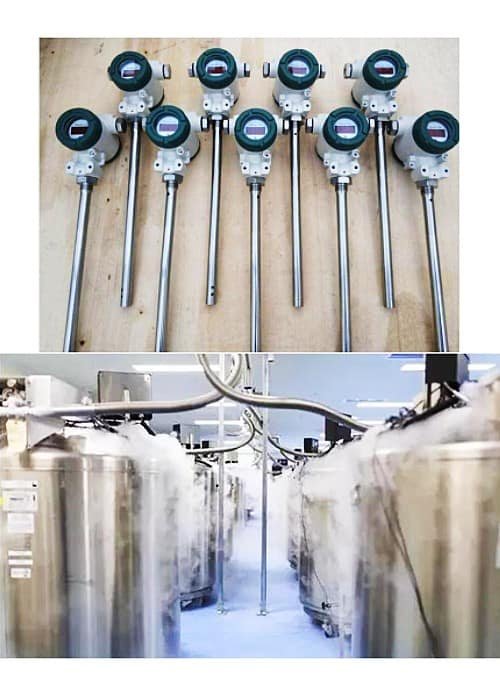
Cryogenic Level Sensor
For liquid nitrogen, LNG and other cryogenic tanks where ultrasonic spot checks do not reach. Continuous level output for very low temperature service.

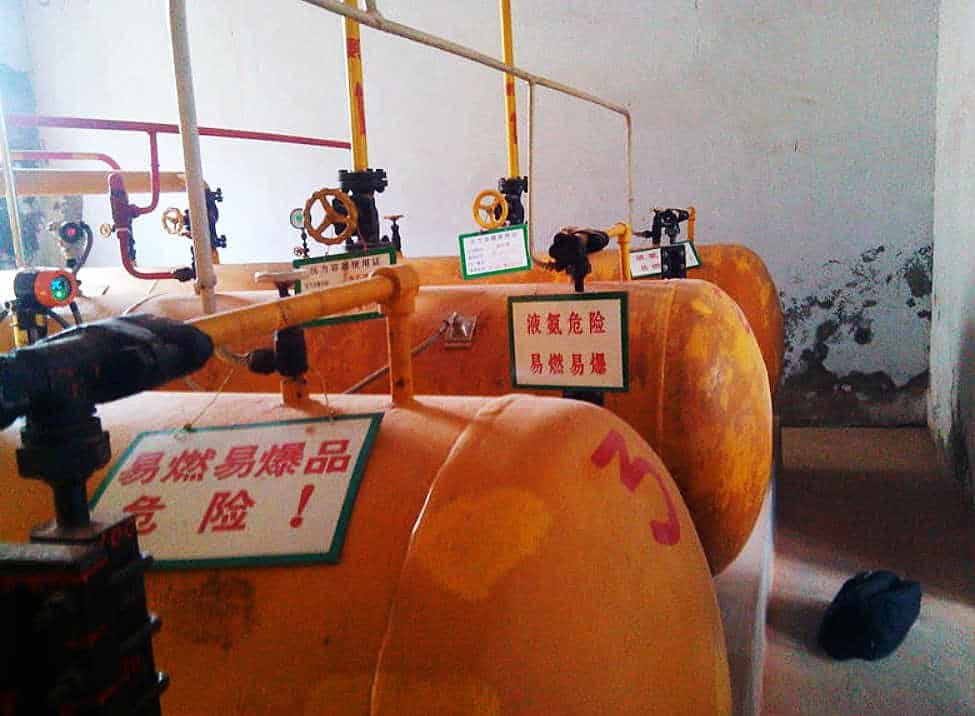
External Tank Level Indicator
Clamp-on ultrasonic level indication for sealed tanks and drums — ammonia, LPG, crude oil. No tapping, no shutdown, reads through the wall.
FAQ
How do you check the level of a CO2 cylinder?
Use a portable ultrasonic liquid level gauge. Clean a vertical strip on the cylinder, apply couplant, press the transducer to the wall near the bottom and slide it upward. The height where the reading flips from liquid to gas is the contents level. It takes under 30 seconds and does not require removing the cylinder.
Why can’t I use the pressure gauge to check CO2 level?
Because CO2 is a saturated liquid-vapor mix, the pressure stays roughly constant (about 57 bar at 20 °C) as long as any liquid remains, regardless of how much is left. Pressure only drops once the cylinder is nearly empty, so it cannot tell you the contents level.
How accurate is ultrasonic cylinder level testing?
A portable ultrasonic gauge typically resolves the liquid/gas boundary to about ±1.5 mm, which is more than enough to confirm whether a cylinder is above or below its minimum fill. Accuracy depends on a clean contact surface and proper couplant.
What couplant should I use for ultrasonic cylinder testing?
Standard ultrasonic coupling gel is best. Petroleum jelly works as a substitute, and water works in a pinch but evaporates quickly and must be reapplied in hot conditions. The couplant fills the air gap so the pulse can pass into the cylinder wall.
Is ultrasonic testing an approved alternative to weighing cylinders?
Ultrasonic liquid level testing is a widely accepted non-invasive method for verifying fire-suppression cylinder contents without removing them for weighing. Always follow the standard and authority having jurisdiction, but ultrasonic checks are commonly used to meet periodic contents-verification requirements.
Can one portable gauge check different cylinder sizes?
Yes, within its wall-thickness and diameter range. The same handheld gauge typically covers a range of CO2 and clean-agent cylinders. Confirm the gauge’s rated wall-thickness window matches your cylinders, and choose an intrinsically safe model for classified areas.
How do I choose and source the right portable level gauge?
Send your cylinder type, agent (CO2, FM-200, Halon), wall thickness, area classification and whether you need handheld or continuous monitoring to our Sino-Inst engineering team, or reach our application engineers through the contact page. We will recommend a model and reply within one business day.
Need a portable ultrasonic gauge for CO2 or clean-agent fire cylinders, or continuous cylinder monitoring? Send your cylinder details and area classification through the form below. Our level engineers will respond within one business day with a recommendation and quote.
About This Article
Written and technically reviewed by the Sino-Inst engineering team — last reviewed 2026-05-29 (AI-assisted drafting). Based on liquid-CO2 saturation behavior and ultrasonic non-invasive testing, plus field cylinder inspections. Questions? reach our application engineers.
Request a Quote


Wu Peng, born in 1980, is a highly respected and accomplished male engineer with extensive experience in the field of automation. With over 20 years of industry experience, Wu has made significant contributions to both academia and engineering projects.
Throughout his career, Wu Peng has participated in numerous national and international engineering projects. Some of his most notable projects include the development of an intelligent control system for oil refineries, the design of a cutting-edge distributed control system for petrochemical plants, and the optimization of control algorithms for natural gas pipelines.