

Updated 2026-05-31 by the Sino-Inst Engineering Team
There is no single best density meter. The right one is set by your medium and your industry. Coriolis gives custody-transfer accuracy on clean liquids. A vibrating fork is the rugged workhorse for tanks and chemicals. A gamma densitometer is the only thing that survives an abrasive slurry. This guide maps the main density meter types to the industries that use them, with the accuracy you can expect. It also flags the one mistake that quietly ruins every reading: skipping temperature compensation.
Contents
- Why density measurement matters across industries
- Density meter types at a glance: accuracy and best fit
- Oil & gas: API gravity and custody transfer
- Mining & minerals: slurry density and % solids
- Chemical processing: concentration and corrosive media
- Food & beverage: Brix and blending
- How to choose: medium, inline vs lab, temperature compensation
- Featured density meters
- Frequently asked questions
Why Density Measurement Matters Across Industries
Density tells you what is actually in the pipe. It converts to percent solids in a slurry, to API gravity for crude oil, to Brix for a sugar solution, and to concentration for an acid. Because those numbers drive blending, billing, and quality, a density error becomes a money error. The catch is that density changes with temperature, so the same fluid reads differently hot and cold. Every method below depends on measuring that out, and every density unit — kg/m³, g/cm³, SG, °API, or °Brix — assumes a reference temperature.

Density Meter Types at a Glance: Accuracy and Best Fit
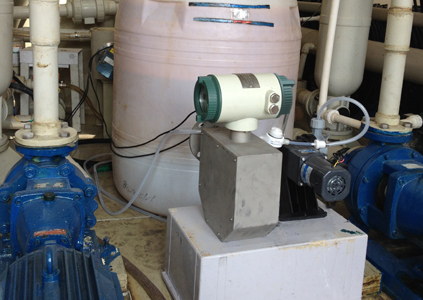
Five technologies cover almost every industrial job. They differ most in accuracy and in how well they tolerate dirty, abrasive, or corrosive media. This table is the quick map; the sections after it put each type into its industry. For the working principles in detail, see our guide to density meter types.
| Type | Typical accuracy | Best fit |
|---|---|---|
| Coriolis (vibrating tube) | ±0.0005–0.001 g/cm³ | Clean liquids, custody transfer, concentration |
| Oscillating U-tube | Lab-grade, high | Laboratory API, Brix, assay |
| Vibrating (tuning) fork | ±0.01–0.02 g/cm³ | Tanks, blending, chemicals, rugged in-line |
| Gamma (radiometric) | ±0.005–0.02 g/cm³ | Abrasive slurry, non-contact, heavy duty |
| Hydrostatic ΔP | ±0.02–0.05 g/cm³ | Open tanks, simple level-and-density |
Oil & Gas: API Gravity and Custody Transfer
Oil is bought and sold on API gravity, which is just density expressed on the petroleum scale and corrected to 15°C (60°F) per ASTM D1250. That correction is not optional: crude read at line temperature without it can be off by a full API point, and that moves the invoice. For custody transfer on clean refined product, a Coriolis meter gives the accuracy and the simultaneous mass-and-density reading that fiscal metering needs. The lab confirms it with an oscillating U-tube. For field spot checks, a portable petroleum density meter does the job with built-in temperature compensation. We cover the math in our note on crude oil density and how to measure it.
Mining & Minerals: Slurry Density and % Solids
In a concentrator, slurry density is the real-time signal for percent solids, and it controls grinding, cyclones, and thickener feed. The problem is abrasion. A Coriolis tube or a fork in the line wears out fast in mill discharge. The rugged answer is a gamma densitometer clamped to the outside of the pipe. It never touches the slurry and survives what destroys vibrating cells. Where the slurry is less aggressive, an anti-corrosion vibrating fork works inline. Either way you back-calculate percent solids from the slurry density and the known solids and liquid densities; our guide to industrial slurry density measurement walks through it.
Chemical Processing: Concentration and Corrosive Media
In chemical plants, density stands in for concentration — sulfuric acid strength, caustic, brine, or liquid ammonia. The fluid is usually the enemy, so wetted-material choice matters more than the last decimal of accuracy. A vibrating fork in tantalum or PEEK handles aggressive acids in-line. A Coriolis density meter in the right alloy gives concentration plus flow when you need both. Watch for entrained gas: bubbles make a vibrating sensor read low, so degas the sample or pick a method that tolerates it.
Food & Beverage: Brix and Blending
Here density becomes °Brix, Plato, or percent solids — the quality number for juice, syrup, beer, and spirits. Labs use an oscillating U-tube for the certified Brix or alcohol reading. An in-line vibrating fork or an online alcohol density meter trims a blend in real time, so a batch hits spec before it moves on. Sanitary, cleanable wetted parts are the requirement that overrides almost everything else in this industry.
How to Choose: Medium, Inline vs Lab, and Temperature Compensation
- Match the type to the medium first. Clean and accurate → Coriolis or U-tube. Rugged and in-tank → fork. Abrasive slurry → gamma. Simple open tank → hydrostatic.
- Inline or lab? Inline controls the process live; a lab U-tube certifies the number. Many plants run both.
- Temperature compensation is mandatory. Density is strongly temperature-dependent; use a meter with built-in ATC or correct to a reference temperature, or the reading is meaningless.
- Watch entrained gas. Bubbles bias vibrating sensors low — degas or choose gamma.
- Certification. Oil, gas, and solvent duty needs a hazardous-area rating.
- Calibrate against a known standard. Verify with a reference fluid of known density, not against another suspect meter.
Featured Density Meters

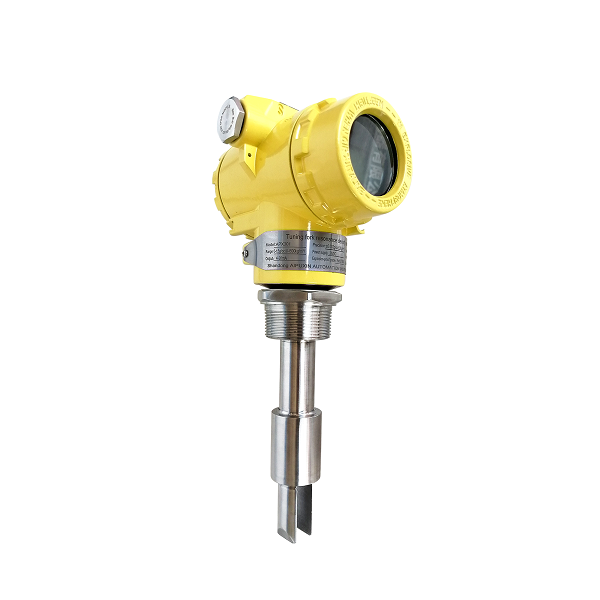
Tuning Fork Density Meter
Rugged in-line fork for tanks, blending, and chemical duty. Anti-corrosion and threaded/flanged options, with stable density output where vibration and solids defeat finer sensors.

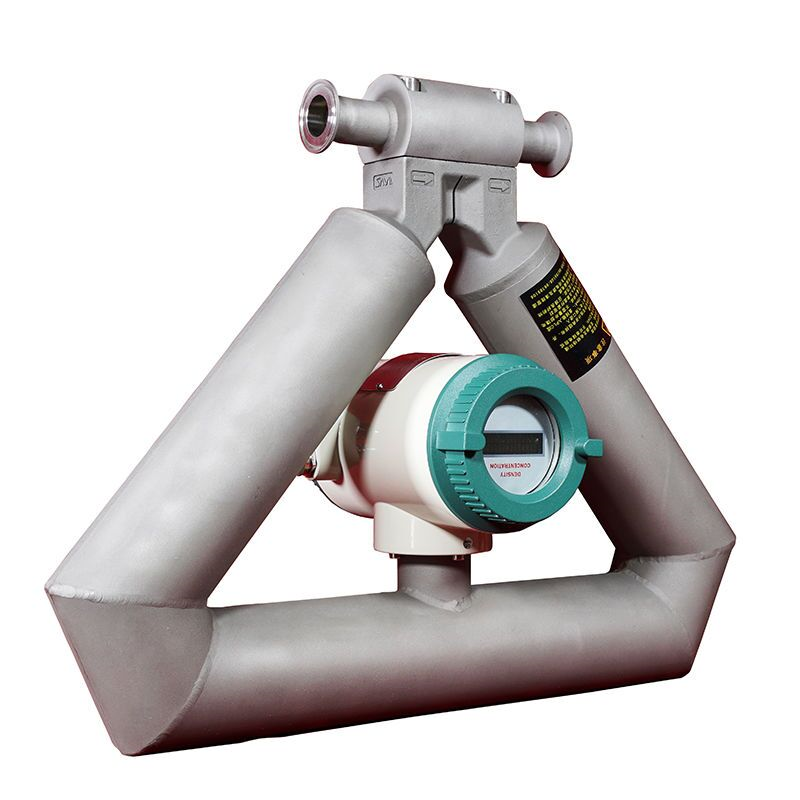
Coriolis Density Meter
Highest-accuracy vibrating-tube meter for clean liquids, custody transfer, and concentration. Simultaneous mass, flow, and density with tight repeatability for fiscal metering.

Portable Petroleum Density Meter
Handheld micro-vibrator meter for density, API gravity, and SG of petroleum products, with built-in temperature compensation for field and lab spot checks.
Frequently Asked Questions
How does a density meter work?
Most industrial density meters vibrate a tube or fork; the fluid changes the resonant frequency, and the frequency shift is proportional to density. Others measure the gamma absorbed through a slurry or the pressure of a liquid column. All convert a physical effect into density at a reference temperature.
How does a Coriolis meter measure density?
A Coriolis meter vibrates its measuring tube at a resonant frequency that depends on the total mass of tube plus fluid. As fluid density rises, the resonant frequency falls, and the meter calculates density from that frequency — alongside mass flow from the Coriolis phase shift.
Which density meter is best for slurry?
A gamma (radiometric) densitometer, because it is non-contact and survives the abrasion that destroys vibrating tubes and forks. For milder slurries, an anti-corrosion vibrating fork can work in-line. Use the slurry density to back-calculate percent solids.
How do you measure oil density or API gravity?
Measure density with a Coriolis meter inline or an oscillating U-tube in the lab, then convert to API gravity corrected to 15°C (60°F) per ASTM D1250. The temperature correction is essential, since crude read at line temperature can be off by a full API point.
How do you calibrate a density meter?
Verify against a reference fluid of known density at a known temperature — commonly air and degassed water for vibrating meters — and adjust the offset and span. Calibrate at the temperature you operate at, and never trust a calibration against another uncertified meter.
Do density meters need temperature compensation?
Yes. Density is strongly temperature-dependent, so a reading without compensation is meaningless for billing or quality. Use a meter with built-in automatic temperature compensation, or correct every reading to a reference temperature such as 15 or 20°C.
About this article
Written and technically reviewed by the Sino-Inst engineering team — last reviewed 2026-05-31 (AI-assisted drafting). Based on ASTM D1250 API correction, published accuracy ranges for Coriolis, fork, gamma, and hydrostatic methods, plus field experience selecting density meters for oil, mining, chemical, and food applications. Questions? Reach our application engineers.
Request a Quote
Tell us your medium, industry, and whether you need inline or lab measurement. A Sino-Inst engineer will recommend the right density meter type, wetted material, and temperature compensation.
Request a Quote


Wu Peng, born in 1980, is a highly respected and accomplished male engineer with extensive experience in the field of automation. With over 20 years of industry experience, Wu has made significant contributions to both academia and engineering projects.
Throughout his career, Wu Peng has participated in numerous national and international engineering projects. Some of his most notable projects include the development of an intelligent control system for oil refineries, the design of a cutting-edge distributed control system for petrochemical plants, and the optimization of control algorithms for natural gas pipelines.