

A Karman vortex air flow sensor measures the frequency of vortices shed behind a bluff body in a moving air stream. Frequency is proportional to flow velocity, so counting vortices gives a direct, moving-parts-free reading of mass air flow. Automotive engineers use them on certain Mitsubishi, Toyota, and Mazda engines from the 1980s through the early 2000s; process engineers use larger versions for compressed air, gas billing, and HVAC ducts. This page walks through the physics, lists the cars that use one, compares it against hot-wire and vane sensors, and covers cleaning and failure diagnosis.
Contents
- Karman Vortex Air Flow Sensor: Definition and Operating Principle
- From Vortex Frequency to Mass Flow Rate
- Karman Vortex vs Hot-Wire vs Vane MAF: Three-Way Comparison
- Vehicles That Use a Karman Vortex MAF Sensor
- Industrial Karman Vortex Flow Applications
- Symptoms of a Failing Karman Vortex Sensor
- Cleaning, Inspection, and Replacement Rules
- Recommended Industrial Vortex Flow Solutions
- FAQ
Karman Vortex Air Flow Sensor: Definition and Operating Principle
Drop a fishing line in a river behind a rock and you see the water peel off in alternating swirls. Theodore von Kármán described the same pattern in 1911. Behind any bluff body in flow above a critical Reynolds number, the wake separates into a regular street of vortices — clockwise on one side, counter-clockwise on the other — shed at a frequency proportional to flow velocity.
A Karman vortex air flow sensor uses this. A triangular or trapezoidal bluff body sits in the inlet tract. As air flows past, vortices peel off both sides. A downstream detector — usually an ultrasonic transmitter and receiver pair, sometimes a piezo crystal or a piezoelectric pressure sensor — counts the alternating vortices. Each vortex produces one electrical pulse, so output frequency rises linearly with flow velocity over the working range.
The sensor has no moving mechanical parts in the air stream. That matters in two ways: it does not drift mechanically over time, and it does not need recalibration on a clean intake. It also tolerates pulsating flow from a four-cylinder engine better than a vane-type MAF, which is one reason — alongside ECU-friendly digital output — Mitsubishi adopted it for the 3000GT VR-4 and the Eclipse turbo platforms.
From Vortex Frequency to Mass Flow Rate
The vortex shedding frequency follows the Strouhal relation: f = St · v / d, where f is the shedding frequency (Hz), St is the dimensionless Strouhal number (≈ 0.27 for a triangular bluff body), v is the flow velocity (m/s), and d is the bluff body width (m). For a fixed geometry the ratio f/v is constant — so the ECU only needs the K factor (pulses per unit volume) and the air temperature to compute mass flow.
That last detail is important. The sensor itself measures volumetric flow, not mass. To convert, the engine controller pairs the vortex pulse stream with an intake air temperature sensor (see transmitter signal processing for the broader analog-to-digital chain) and (sometimes) a barometric pressure sensor to derive density and compute true mass flow. A failed IAT or a clogged crankcase vent throws the whole calculation off even when the vortex sensor itself is fine. The same volumetric-to-mass conversion logic shows up in the industrial guide on flow meter K factor.
Karman Vortex vs Hot-Wire vs Vane MAF: Three-Way Comparison


Three sensor types dominate mass air flow measurement on combustion engines. Each trades different things for different things.
| Aspect | Karman Vortex | Hot-Wire / Hot-Film | Vane (Flap Door) |
|---|---|---|---|
| Measures | Vortex frequency (volumetric, ECU converts to mass) | Mass flow directly (cooling rate of heated wire) | Volumetric (deflection angle of spring-loaded vane) |
| Moving parts | None | None | Yes (spring + flap) |
| Output signal | Square-wave frequency | 0–5 V analog or PWM | Analog voltage from potentiometer |
| Sensitivity to contamination | Low (no exposed heated element) | High — oil mist kills it | Moderate (vane sticks) |
| Pulsation tolerance | Good — averages over many cycles | Good | Poor — induced flutter |
| Pressure drop | Moderate (bluff body) | Low | Highest |
| Typical era | 1980s – mid-2000s Japanese | 1990s – present | 1970s – early 1990s |
| Cleanable? | No (no fouling element) | Yes (specific MAF cleaner) | Mechanical adjustment only |
The hot-wire sensor became dominant by 2005 because it is cheaper to manufacture, smaller, and outputs mass flow directly. The Karman vortex survives in industrial gas metering where its no-moving-parts robustness justifies the slightly higher pressure drop.
Vehicles That Use a Karman Vortex MAF Sensor
Karman vortex MAFs appear almost exclusively on Japanese-platform engines from roughly 1985 to 2005. The factory unit is normally a Mitsubishi MD or MR-prefix part number. If you are sourcing one, this is the list to check against.
- Mitsubishi 3000GT / GTO / Dodge Stealth — 1990–1999 (both NA and twin-turbo VR-4)
- Mitsubishi Eclipse 1G / 2G turbo — 1990–1999 (4G63T)
- Mitsubishi Galant VR-4, Lancer Evo I-III — early 1990s 4G63T
- Mitsubishi Pajero / Montero — 1990s gasoline platforms
- Toyota Supra MA70 7M-GE / 7M-GTE — 1986–1992
- Toyota Cressida MX83, Crown — late 1980s 7M-GE
- Mazda RX-7 FC3S (some Series 4/5) — 13B turbo II
- Some Nissan VG30E platforms — 300ZX Z31 export markets
If your vehicle is on this list and the intake plenum has a roughly 5 cm × 8 cm rectangular housing with an electrical connector and no exposed wire inside, you have a Karman vortex sensor. If you see two thin metal filaments through a window, that is a hot-wire MAF — different sensor, different cleaning rules.
Industrial Karman Vortex Flow Applications
The same physics drives industrial vortex flow meters — only larger and built for higher pressure and temperature. They run on pipe sizes from 15 mm to 600 mm, accept gas, steam, and conductive or non-conductive liquid via the industrial vortex flow meter family, and need 10D of straight pipe upstream and 5D downstream. The minimum velocity threshold is typically 5–10 m/s for gas; below that the vortex street is unstable. The same upstream-pipe rule applies to differential and turbine meters — see straight-pipe requirements for the full chart.
- Compressed air audit — measure CFM at point-of-use to find leaks and right-size compressors
- Nitrogen / argon / CO₂ billing — bulk gas custody transfer in process plants
- Saturated and superheated steam — temperature-compensated to convert mass flow
- HVAC chilled-water and air-handler duct flow — energy monitoring for ISO 50001
- Biogas and natural gas to small boilers — where a Coriolis flow meter is overkill
For the steam and BTU side of plant metering, the same vortex principle underpins the chilled-water BTU meter family — paired with two temperature sensors to compute thermal energy delivered.
Symptoms of a Failing Karman Vortex Sensor
A degraded Karman vortex sensor on a car shows up in four ways. None of them is unique to this sensor type, but the combination on a vehicle from the list above is diagnostic.
- Rough idle that smooths above 2000 RPM. At low flow the vortex street barely forms; signal noise pushes the ECU into open-loop with a default map.
- Hesitation under part-throttle, not full-throttle. Vortex linearity is worst at the bottom 10% of range.
- Check Engine Light with DTC P0100 / P0101 / P0103. Generic MAF codes — apply to vortex units the same way.
- Black exhaust + poor fuel economy. Reported flow lower than actual; ECU runs rich.
An oscilloscope on the signal output line is the fastest test: a healthy sensor produces a clean square wave from about 30 Hz at idle to 2 kHz at full throttle. A weak or noisy waveform means the bluff body is fouled or the ultrasonic detector has aged out.
Cleaning, Inspection, and Replacement Rules
This is where Karman vortex parts company with hot-wire MAFs. The standard “spray MAF cleaner on the sensing element” routine does not apply.
- Do not use brake cleaner or carb cleaner. Solvents attack the plastic bluff body and any plastic ultrasonic horn. The unit is dead afterward.
- Do not spray MAF cleaner directly into the sensor body. The ultrasonic transmitter and receiver are sealed; flushing dislodges the alignment.
- Inspect the bluff body visually. Wipe oil mist off with a soft cloth and isopropyl alcohol on a Q-tip, never a brush. A clean bluff body has sharp edges; a fuzzy or rounded edge has aged.
- Replace the air filter and PCV valve first. Most fouling cases are upstream contamination from a tired PCV dumping oil mist into the intake.
- If signal is still dirty, replace the unit. OEM parts run $250–$700 depending on platform; aftermarket Hitachi and Bosch alternatives exist for the Mitsubishi platform.
Recommended Industrial Vortex Flow Solutions

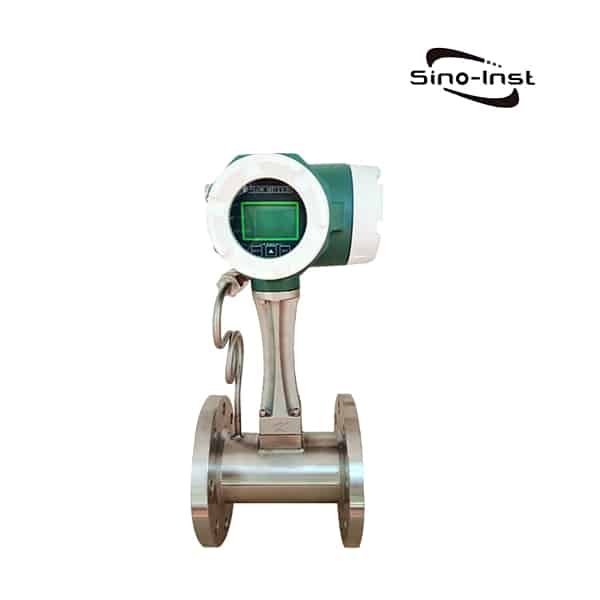
Vortex Compressed Air Flow Meter
DN15–DN300 | 0.5–80 m/s | ±1% accuracy — leak audits, point-of-use metering, plant-air ISO 50001 monitoring.
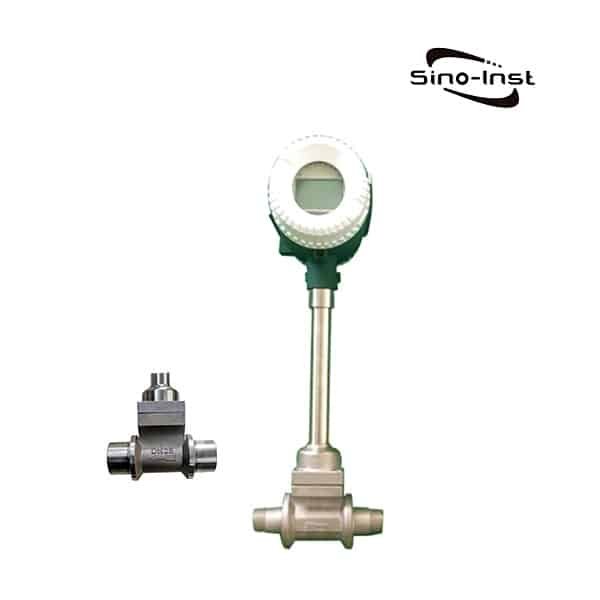
Threaded Vortex Nitrogen Gas Meter
DN15–DN50 NPT | Nitrogen / Argon / CO₂ | Built-in T+P comp — bulk gas custody and small-bore process loops.
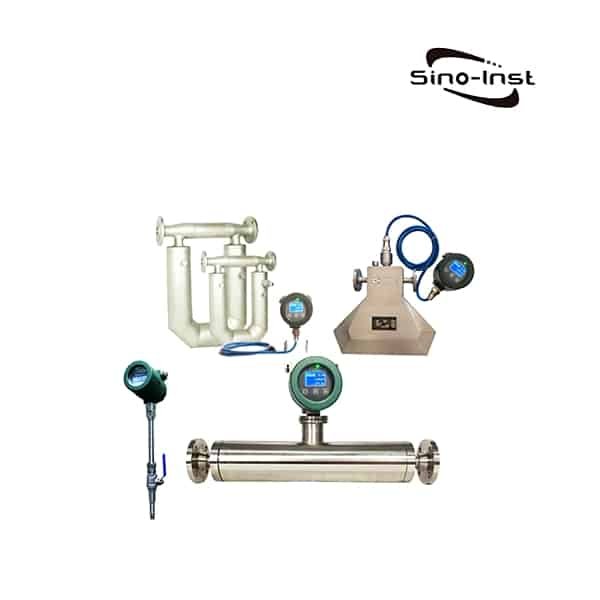
Mass Flow Meter Range (Coriolis & Thermal)
Direct mass flow output | No volumetric-to-mass conversion needed — for custody transfer and high-accuracy custody.
FAQ
What cars have a Karman Vortex air flow sensor?
Primarily 1985-2005 Mitsubishi (3000GT, Eclipse turbo, Galant VR-4, Lancer Evo I-III), Toyota Supra MA70, Cressida MX83, Mazda RX-7 FC3S Series 4/5, and select Nissan VG30E export markets. Western European and most modern Japanese cars use hot-wire MAFs instead.
How do I know if I have a Karman Vortex air flow sensor?
Open the air intake between the air filter and throttle body. A Karman vortex unit is a rectangular box about 5 × 8 cm with an electrical connector and no exposed wire inside. A hot-wire MAF has two thin filaments visible through a window. Vane MAFs have a moving flap door — easy to feel by hand with the engine off.
Can a Karman Vortex sensor be cleaned with MAF cleaner?
No. MAF cleaner is formulated for the wire of a hot-wire sensor. A Karman vortex unit has no fouling element — it has a bluff body and a sealed ultrasonic detector. Solvents damage the plastic. Wipe the bluff body with isopropyl alcohol on a cotton swab, no spray.
What is the disadvantage of a Karman Vortex sensor?
Three. The bluff body adds pressure drop compared to a hot-wire sensor. Linearity is poor at very low flow (below 10% of range). And the sensor outputs volumetric flow, so the ECU must combine it with intake air temperature to compute true mass flow — meaning a failed IAT sensor mimics a failed MAF.
For industrial vortex sizing — pipe diameter, minimum flow, gas density — send our engineers your line conditions and we will return a model recommendation within 24 hours.
Request a Quote


Wu Peng, born in 1980, is a highly respected and accomplished male engineer with extensive experience in the field of automation. With over 20 years of industry experience, Wu has made significant contributions to both academia and engineering projects.
Throughout his career, Wu Peng has participated in numerous national and international engineering projects. Some of his most notable projects include the development of an intelligent control system for oil refineries, the design of a cutting-edge distributed control system for petrochemical plants, and the optimization of control algorithms for natural gas pipelines.