

Contents
- What is a piezoelectric pressure sensor
- Working principle: stress to voltage
- Why static pressure cannot be measured
- Charge mode vs IEPE/ICP signal conditioning
- Sensor materials: quartz, PZT, PVDF
- Operating temperature limits and thermal shock
- Piezoelectric vs piezoresistive: decision matrix
- Industrial applications with real parameters
- Featured Sino-Inst pressure sensors
- FAQ
What Is a Piezoelectric Pressure Sensor?
A piezoelectric pressure sensor uses a quartz or ceramic crystal that produces an electric charge when mechanical stress is applied. No external excitation is needed. The crystal acts as both the sensing element and the source of the signal, governed by the relation Q = d × F, where d is the charge coefficient of the crystal (about 2.3 pC/N for quartz along the d11 axis) and F is the applied force.
The defining characteristic is dynamic response. Piezoelectric sensors handle pressure transients in the microsecond range and resonant frequencies in the hundreds of kHz. They cover ballistic shocks, engine in-cylinder combustion, hydraulic pulsations, and blast events that strain-gauge or capacitive sensors cannot follow. They are not the right choice for measuring a steady tank pressure — see the next two sections for why.
Working Principle: From Mechanical Stress to Voltage Signal
The direct piezoelectric effect, discovered by the Curie brothers in 1880, makes certain crystal lattices polarize under stress. Pressure acting on a quartz disc displaces positive and negative charge centers along the crystal axis. Surface electrodes collect the resulting charge, typically a few picocoulombs per Newton.
That raw charge cannot drive a long cable or a data logger directly. The signal chain is: pressure → diaphragm → crystal → charge → conditioning amplifier → voltage output (typically 0–5 V or 0–10 V). The conditioning step is where most selection mistakes happen. We cover the two paths in the charge mode vs IEPE section.
The terminology overlaps with related instruments. Some vendors label the same hardware as a transmitter, transducer, or sensor depending on whether the conditioning electronics sit inside the housing or in a separate amplifier box.
Why Piezoelectric Sensors Cannot Measure Static Pressure
The crystal generates charge only when stress changes. Once the load is steady, the charge sits on the electrodes and slowly leaks through the cable insulation, the amplifier input, and the crystal’s own internal resistance. The leak rate is set by the discharge time constant DTC = R × C.
For a typical charge-mode setup with a 10 GΩ amplifier input and 1 nF cable capacitance, DTC ≈ 10 seconds. The signal drops to 37% of its initial value in one DTC, so anything slower than a few Hz is unreliable. IEPE sensors with built-in amplifiers commonly have a DTC of 0.5 to 2 seconds, giving a low-frequency cutoff around 0.1 Hz.
For true static measurement (a pressurized hydraulic accumulator at rest, a sealed tank, a regulated pneumatic line), use a piezoresistive transmitter or capacitive transmitter. The distinction between static and dynamic pressure is fundamental to sensor selection — see our static vs dynamic vs total pressure guide.
Charge Mode vs IEPE/ICP: Two Signal Conditioning Paths
Piezoelectric pressure sensors come in two electrical configurations. The choice is binding for the entire measurement chain.
| Parameter | Charge Mode (PE) | IEPE / ICP |
|---|---|---|
| Built-in electronics | None | Source follower or charge amp |
| Output signal | Picocoulombs (pC) | Voltage on 4 mA constant current line |
| Cable type | Low-noise coaxial only | Standard 2-wire |
| Practical cable length | < 10 m | Up to 100 m |
| Operating temperature | Up to 350 °C standard, 500 °C+ specials | Capped at ~120 °C by IC junction |
| Cost | Higher (external amp + low-noise cable) | Lower (built-in conditioning) |
| Best for | High temperature, custom amplifier needs | Plant-floor instrumentation, long cables |
A common installation mistake is using a standard signal cable on a charge-mode sensor. Triboelectric noise from cable flexing will swamp the picocoulomb signal. Always use the dedicated low-noise cable supplied with charge-mode sensors, and route it away from vibration sources.
Sensor Materials: Quartz vs PZT Ceramic vs PVDF
Three crystal classes dominate piezoelectric pressure sensing. Each trades sensitivity for stability or temperature range.
| Material | Charge coeff (pC/N) | Max temp | Linearity | Best application |
|---|---|---|---|---|
| Quartz (SiO2) | ~2.3 (d11) | 500 °C+ | Excellent, < 0.5% | Reference and high-temperature dynamic |
| PZT ceramic | 100–600 (d33) | 250–350 °C | Good, hysteresis 1–3% | High-sensitivity general purpose |
| PVDF polymer film | 20–30 (d33) | 80–100 °C | Moderate | Flexible, large-area, biomedical |
| Tourmaline | ~2 (volumetric) | 900 °C | Excellent | Underwater blast, hydrostatic shock |
Quartz is preloaded mechanically inside the housing for linearity. PZT delivers two orders of magnitude more charge per unit force, but loses polarization above its Curie point (around 350 °C for common PZT formulations). PVDF film is the choice when the sensor must wrap around a curved surface or cover a large area cheaply.
Operating Temperature Limits and Thermal Shock
Two separate temperature limits apply to a piezoelectric pressure sensor. The crystal Curie point sets the absolute ceiling — quartz holds piezoelectricity up to 573 °C, PZT loses it around 250–350 °C. The signal conditioning electronics impose a lower limit. IEPE sensors are capped by the silicon junction at about 120 °C ambient. Charge-mode sensors with no built-in electronics reach the crystal limit.
Thermal shock is a separate failure mode that causes a transient zero shift even when the sensor stays within its temperature rating. A sudden flame or exhaust pulse expands the sensor case faster than the crystal stack, reducing the mechanical preload on the quartz disc. The output drops by a few percent for the duration of the thermal event, then recovers. Mitigations include thermal isolation sleeves, recessed mounting with a passage filled with silicone grease, or cooled adapters for engine combustion measurement. The same conditioning concerns apply to RTD and thermocouple choices when planning the surrounding instrumentation.
Piezoelectric vs Piezoresistive: Decision Matrix
Despite the similar names, these are two unrelated sensing technologies. Picking the wrong one wastes weeks of bench testing.
| Property | Piezoelectric | Piezoresistive |
|---|---|---|
| Sensing mechanism | Charge from stressed crystal | Resistance change of strained silicon |
| Static pressure | Cannot measure | Designed for it |
| Dynamic response | Microsecond, kHz to MHz | Millisecond, typically < 1 kHz |
| Excitation needed | None (self-generating) | Bridge supply (5 V or current source) |
| Output signal | Charge or voltage after amp | mV bridge, 4–20 mA after amp |
| Accuracy at process pressure | 0.5–1% FS dynamic | 0.05–0.1% FS static |
| Operating temperature | 120 °C to 500 °C+ | −40 to 150 °C typical |
| Cost (system) | Higher (charge amp, low-noise cable) | Lower (standard 4–20 mA loop) |
| Use it for | Combustion, blast, ballistics, vibration | Tank level, hydraulic pressure, process control |
Industrial Applications With Real Parameters
The applications below show the kind of dynamic event that justifies choosing piezoelectric over a slower technology.
- Internal combustion engine cylinder pressure — 0–250 bar with 5 kHz components from valve closure and combustion knock. Charge-mode quartz sensors with cooled adapters survive the >500 °C exhaust gas environment.
- Blast and explosion testing — peak pressures up to 100 MPa with rise times below 0.1 ms. Tourmaline volumetric sensors handle the spherical wave loading without directional bias.
- Hydraulic pulsation in injection molding — base pressure 10–50 MPa with 100–500 Hz pulsations from pump-stroke modulation. IEPE sensors with 0.1–10 kHz bandwidth filter out the slow fill pressure and leave only the pulsation.
- Ballistic and projectile impact — microsecond pressure pulses from primer ignition and propellant burn. Resonant frequencies above 200 kHz are required to avoid waveform distortion.
- Pipeline water-hammer and surge analysis — pressure transients from valve closures, where a slow capacitive transmitter would average the spike and miss the peak.
Featured Sino-Inst Pressure Sensors

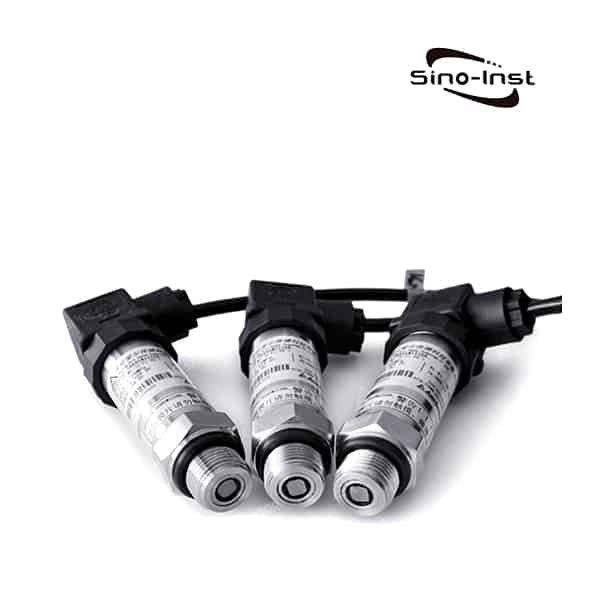
High-Frequency Dynamic Pressure Sensor
150 kHz–2 MHz response | 0–100 MPa | charge-mode quartz — for engine combustion, blast, and ballistics.
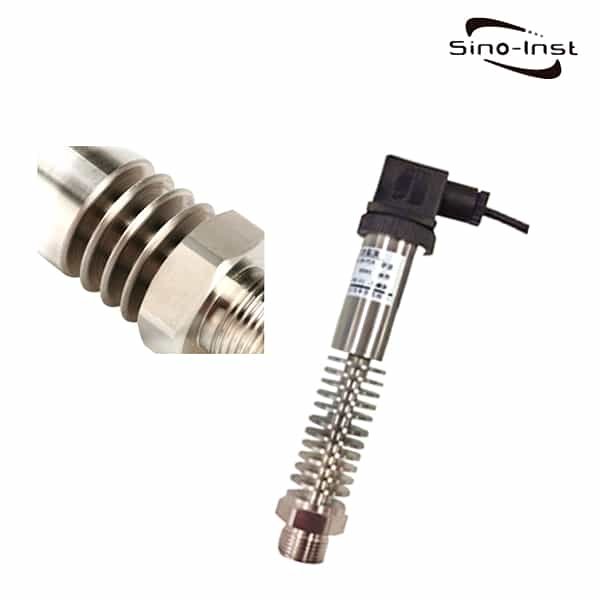
SI-512H High Temperature Pressure Sensor
Up to 800 °C process media | 0–60 MPa | for furnace, exhaust, and high-temperature steam lines.
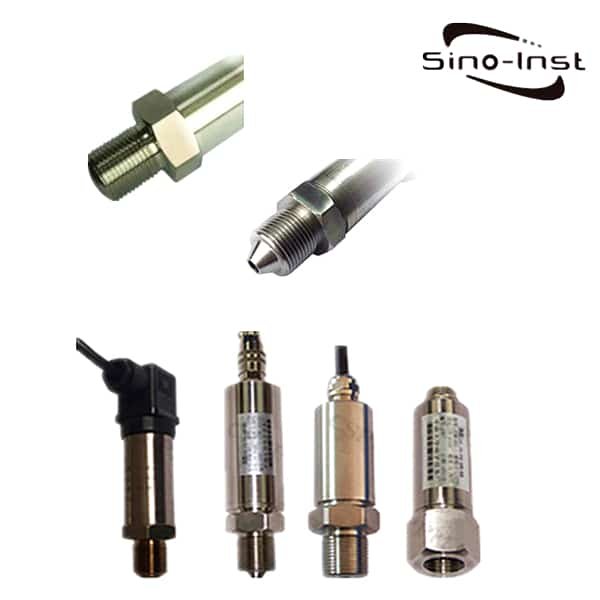
SI-702S Ultra High Pressure Transducer
Up to 1500 MPa | 0.25% accuracy | 4–20 mA — for hydraulic test rigs and ultra-high-pressure research.
FAQ
What is the output of a piezoelectric pressure sensor?
A raw piezoelectric crystal outputs a charge in picocoulombs proportional to the applied force. After signal conditioning, the field-deliverable output is a voltage (0–5 V or ±5 V common) for IEPE sensors, or a charge that an external charge amplifier converts to voltage for charge-mode sensors. Some integrated designs offer a 4–20 mA loop output, but only over their dynamic bandwidth.
Can a piezoelectric pressure sensor measure pull (tension) force?
Yes, but only if the crystal is mechanically preloaded. The preload puts the sensor in compression at rest, so a tensile force reduces the compression rather than reversing the sign. Without preload, a single crystal slice produces opposite-polarity charge under tension, and the diaphragm coupling typically prevents tension transfer altogether. Specialized force washers and load cells use this preload technique for tension and compression on the same channel.
How does a piezoelectric sensor differ from a piezoresistive one?
The names share a Greek root but the physics are unrelated. A piezoelectric sensor generates its own charge from a crystal under stress and only responds to changes in pressure. A piezoresistive sensor uses a Wheatstone bridge of silicon resistors whose resistance changes with strain; it needs an excitation voltage and reads true static pressure. Use piezoelectric for fast dynamic events; use piezoresistive for steady or slow process pressure.
Why don’t we use piezoelectricity for power generation in a serious way?
The energy density is very low. A square centimeter of PZT under modest stress produces microwatts. Useful sensing ranges down to femtowatts, but useful power generation needs orders of magnitude more, which would require either huge crystal areas or extreme stress amplitudes that fracture the material. Piezoelectric harvesting works for milliwatt-class wireless sensor nodes, not for replacing batteries or grid power.
Need Help Selecting a Pressure Sensor for a Dynamic Application?
Tell us the pressure range, frequency content, mounting interface, and process temperature. Our engineers will recommend a charge-mode or IEPE configuration with the right material and thermal protection. Most replies are sent within one working day.
Request a Quote


Wu Peng, born in 1980, is a highly respected and accomplished male engineer with extensive experience in the field of automation. With over 20 years of industry experience, Wu has made significant contributions to both academia and engineering projects.
Throughout his career, Wu Peng has participated in numerous national and international engineering projects. Some of his most notable projects include the development of an intelligent control system for oil refineries, the design of a cutting-edge distributed control system for petrochemical plants, and the optimization of control algorithms for natural gas pipelines.