

Updated: May 10, 2026 — by Sino-Inst Engineering Team
A zirconia oxygen sensor reads the O₂ partial pressure in a hot gas stream by exploiting yttria-stabilised zirconia, an oxide ceramic that becomes an O²⁻-ion conductor above ~600 °C. In flue-gas combustion control it is the only practical technology that survives 700–1,400 °C duct temperatures while still responding in seconds. This page lays out the working principle, the in-situ versus extractive decision, the cross-sensitivity to CO and H₂ that biases low-O₂ readings, a spec-sheet decoder, and a short comparison with titania sensors that comes up in every replacement-parts question.
Contents
- Working Principle: How a Zirconia Cell Generates a Millivolt Signal
- Material and Temperature: Why Zirconia, Why 700 °C, and What the Platinum Does
- In-Situ Probe vs Extractive Sampling: Decision Matrix by Duct
- Zirconia vs Titania O₂ Sensors: When Each Wins
- Cross-Sensitivity to CO and H₂: Quantitative Bias Numbers
- Spec-Sheet Decoder for Zirconia O₂ Analysers
- Calibration and Reference-Air: Four Mistakes That Drift the Reading
- Featured Products
- FAQ
Working Principle: How a Zirconia Cell Generates a Millivolt Signal
The cell follows the Nernst equation. One face of a heated zirconia disc sees the process gas, the other face sees reference air at 20.9 % O₂. When ZrO₂ is doped with Y₂O₃ and held above ~650 °C, oxygen vacancies in the lattice carry O²⁻ ions across the disc. Platinum-paste electrodes on each face dissociate O₂ on the high-O₂ side and recombine it on the low-O₂ side. The voltage that develops is logarithmic in the O₂ ratio.
For a boiler running 3 % O₂ wet against 20.9 % reference air at 750 °C, the cell outputs roughly 50 mV. Drop the process O₂ to 0.5 % and the output rises to about 95 mV. The transmitter linearises this on a log scale and converts it to a 4-20 mA signal — usually 0–25 % O₂ for combustion duty.
Material and Temperature: Why Zirconia, Why 700 °C, and What the Platinum Does
Below ~600 °C the ZrO₂ lattice does not move O²⁻ fast enough to give a usable signal — cell impedance climbs and response time drags. Above ~850 °C the platinum electrodes start to volatilise and the cell ages noticeably faster. The 700–750 °C operating window is the compromise between conductivity and electrode life. Every industrial probe carries an internal heater and a thermocouple feedback loop to hold this window.
The platinum is not just a contact pad. It catalyses three reactions on the cell surface: O₂ dissociation, recombination of any combustibles (CO, H₂, hydrocarbons) that reach the surface, and the back-reaction with adsorbed O²⁻. The middle one drives the cross-sensitivity covered below. For an adjacent example of how surface electrochemistry shapes a 4-20 mA signal, see our note on static, dynamic and total pressure measurement.
In-Situ Probe vs Extractive Sampling: Decision Matrix by Duct
The first install decision is not the brand. It is whether the cell sits inside the duct or in a sample cabinet several metres away. The two architectures fail in completely different ways.
| Architecture | How it works | Strengths | Weaknesses | Best for |
|---|---|---|---|---|
| In-situ probe | Probe and cell inserted directly into the duct, heated to ~750 °C | Response < 5 s; no sample lag; reads wet O₂ | Cell exposed to fly ash, SO₂, alkali; cannot be hot-removed | Boilers, kilns, process heaters at duct temp 200–700 °C |
| Extractive (sampling) | Heated sample line draws gas to a remote analyser cabinet | Cell stays clean; can pre-condition (filter, dry) before measuring | 30–90 s sample lag; condensation if heat trace fails; reads dry O₂ | Cement, waste-to-energy, corrosive gases, multi-point manifolds |
| Close-coupled extractive | Short eductor pulls gas through a probe-mounted cell within 0.5 m of the duct | Faster than full extractive; cell still removable | Eductor air consumption; in-service calibration is awkward | Process heaters where in-situ access is blocked but lag must stay < 30 s |
Above 800 °C duct, or with heavy alkali (cement preheater, glass melter), the extractive route usually wins because in-situ probes will not survive a 12-month interval. For clean natural-gas boilers under 700 °C, in-situ is the default — sub-5-second loop response in exchange for field-replaceable cells. Plants that change feedstock often also prefer in-situ, because long sample lines blur the signal and make trim control sluggish.
Zirconia vs Titania O₂ Sensors: When Each Wins
Both technologies are solid-state and operate at high temperature, but the physics is different. Zirconia gives a Nernst voltage from an O²⁻ ion gradient. Titania changes its bulk resistance when O₂ adsorbs on the lattice surface — it is a resistive sensor, not a voltage source. That single difference drives every other trade-off.
| Property | Zirconia (ZrO₂) | Titania (TiO₂) |
|---|---|---|
| Output type | Voltage (Nernst, log-scaled) | Resistance change |
| Reference air | Required | Not required |
| Operating temp | 650–850 °C | 700–900 °C |
| Response time (t90) | 1–5 s | 0.1–1 s (faster) |
| Accuracy across range | Excellent for 0.1–25 % O₂ | Drifts above 5 % O₂ |
| Typical use | Combustion trim, lab gas analysis | Automotive lambda (some Toyota / Nissan), narrow-band only |
For industrial combustion control the answer is almost always zirconia — the wider range and reference-air anchor make it the only useful option for trim work. Titania kept a foothold only in narrow-band automotive lambda sensors where speed mattered more than wide-range accuracy.
Cross-Sensitivity to CO and H₂: Quantitative Bias Numbers
A zirconia cell does not measure free O₂. It measures net O₂ — whatever survives after the platinum surface has burned off any combustibles diffusing through. In a boiler near stoichiometric combustion the flue carries small free-O₂ and small CO/H₂ at the same time. The hot platinum oxidises CO and H₂ on the cell, consuming O₂ before it can produce a Nernst voltage.
Numbers worth memorising: 1,000 ppm CO biases the reading by ≈ 0.05 % O₂; 1,000 ppm H₂ biases it by ≈ 0.025 % O₂; a smoke event with 0.5 % CO drops the apparent O₂ by half a percent. Any combustion-trim loop targeting sub-1 % excess O₂ should pair the zirconia cell with a CO analyser to detect this regime — otherwise the trim controller will keep adding fuel while the actual flue is already air-starved.
Spec-Sheet Decoder for Zirconia O₂ Analysers
- Accuracy at low O₂. Most data sheets quote ±0.75 % of reading or ±0.1 % O₂, whichever is greater. Below 1 % O₂, the floor term dominates — a 0.3 % O₂ reading with that spec is really ±33 % of value.
- Response time t90 vs t63. t90 reaches 90 % of a step change, t63 reaches 63 %. Vendor sheets that quote only t63 (“< 3 s”) look faster than they are. Compare on t90.
- Reference-air specification. Some probes use ambient air drawn into the head; others need plant instrument air at 1–3 L/min, ≤ 1 ppm hydrocarbons. Solvent vapour or turbine seal-leak in plant air will bias the reading.
- Cell life vs cycling. “5-year cell life” assumes continuous operation. Plants that cycle the heater off every shift see life drop 30–50 % from thermal-shock cracking of the platinum.
- Combustibles correction. Some analysers (Yokogawa ZR22, AMETEK Thermox, ABB Endura) ship a paired CO sensor that compensates the bias. If the duty is sub-stoichiometric or fuel-rich at any point, this is not optional.
Rule of thumb: the cheaper unit is rarely cheaper after you add reference-air conditioning, the heated sample line, the spare cell, and the engineer time. We use the same logic in our pressure transmitter installation guide — the headline price is a small fraction of the loop cost.
Calibration and Reference-Air: Four Mistakes That Drift the Reading
- Skipping the two-point cal. Span on instrument air (20.9 % O₂), zero on a certified low-O₂ gas (0.4 % or 1 % O₂ in N₂). Single-point span hides electrode aging.
- Calibrating cold. Wait until the heater PID is stable and the cell has held temperature for ≥ 30 minutes. Calibration on a still-warming cell drifts back overnight.
- Plumbing reference air with copper. Solder-flux residue contaminates the reference side and biases zero. Use stainless 1/4″ tubing with no flux joints.
- Ignoring the impedance trend. Modern transmitters log cell impedance. A doubling over 6 months is the leading end-of-life indicator — replace before it spikes and trips a heater fault.
Featured Products

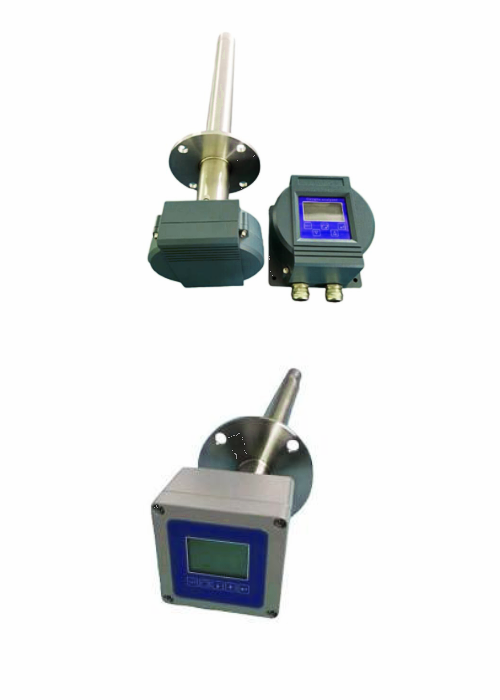
Integrated Zirconia Oxygen Analyzer
In-situ probe with built-in heater. 0–25 % O₂ range, 4-20 mA + Modbus, response t90 < 4 s. Designed for boiler and process-heater combustion trim.


Dew-Point Transmitter 608 Series
Pairs with O₂ measurement on dryer outlets. −80…+20 °C dew-point range, 4-20 mA, polymer capacitance sensor, ATEX option for hazardous gas streams.

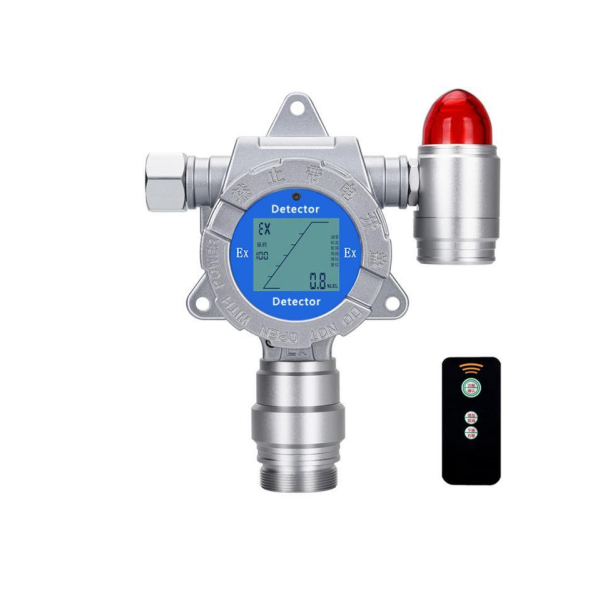
Single / Multi-Gas Industrial Detector
Pairs with the zirconia analyser for combustible-gas safety. 1–6 channel, electrochemical / catalytic / IR cells, IECEx Ex d certification.
FAQ
What is the lifespan of a zirconia oxygen sensor in a boiler?
Three to five years on continuous duty for a clean fuel (natural gas, light oil). One to two years on cement, glass or biomass duty where alkali and dust attack the platinum. The cell impedance trend on the transmitter is the most reliable predictor — replace when it has roughly doubled from commissioning.
How does a zirconia type sensor work?
It generates a Nernst voltage from the O₂ partial-pressure difference across a heated yttria-stabilised zirconia disc. Above ~650 °C the disc conducts O²⁻ ions; platinum electrodes catalyse the surface reactions on each face. The output mV is logarithmic in the O₂ ratio.
What is the difference between zirconia and titania oxygen sensors?
Zirconia outputs a voltage from an O²⁻-ion gradient and needs reference air. Titania changes its bulk resistance when O₂ adsorbs on the surface and needs no reference. Zirconia covers 0.1–25 % O₂ with high accuracy; titania is faster but drifts above ~5 % O₂. Industrial combustion trim almost always uses zirconia.
How many wires does a heated zirconia oxygen sensor have?
Automotive heated zirconia (HEGO) sensors are usually 4-wire: two for the heater (12 V), one signal, one ground. Wide-band industrial probes add 2–4 wires for the cell-impedance feedback loop and a thermocouple, giving 6–8 wires total. Always cross-check against the analyser terminal diagram before connecting.
Why does my zirconia analyser read lower O₂ than my portable analyser?
Combustibles are present. The portable instrument typically uses an electrochemical cell that ignores CO; the zirconia cell oxidises CO on the platinum surface and reports the resulting net O₂. A 1,000 ppm CO bias drops the zirconia reading by ≈ 0.05 % O₂ — small absolute, large at low setpoints.
Does the zirconia sensor read wet or dry O₂?
In-situ probes read wet O₂ — the cell is exposed to bulk flue including water vapour. Extractive systems read dry O₂ because the sample is cooled and water condenses out before reaching the cell. The two readings differ by 1–3 percentage points in a typical boiler.
Where can I get a quote for a zirconia oxygen analyser?
Use the form below or visit our integrated zirconia oxygen analyser product page. Send duct temperature, expected O₂ range, fuel type, and ATEX requirement — those four data points let our engineers quote a probe length and material grade in one round trip.
Send your duct conditions and the form below routes directly to a Sino-Inst combustion-instrumentation engineer. Typical reply within one business day with probe length, materials, and a per-cell life estimate based on your fuel.
Request a Quote


Wu Peng, born in 1980, is a highly respected and accomplished male engineer with extensive experience in the field of automation. With over 20 years of industry experience, Wu has made significant contributions to both academia and engineering projects.
Throughout his career, Wu Peng has participated in numerous national and international engineering projects. Some of his most notable projects include the development of an intelligent control system for oil refineries, the design of a cutting-edge distributed control system for petrochemical plants, and the optimization of control algorithms for natural gas pipelines.