

A transformer oil level indicator monitors mineral or ester insulating oil inside a power transformer’s main tank, conservator, or on-load tap changer (OLTC). It is the single most important piece of low-voltage instrumentation on the asset — a 10 % drop in conservator oil exposes the active part to atmospheric moisture, which raises moisture-in-paper above the IEEE C57.106 limit of 2 % and starts the insulation-degradation clock years before the planned replacement date.
This guide is structured the way oil-level indicators are actually selected on substation projects: by location on the transformer first, then by indicator type. Each location has a different set of constraints — the conservator wants a wide-angle dial, the OLTC wants a remote alarm, the radiator headers want a binary switch — and a single sensor type does not fit all three.
Contents
- Why Transformer Oil Level Matters
- Three Indicator Locations on a Power Transformer
- Magnetic Liquid-Level Indicator (MLI)
- Prismatic Sight Glass
- Capacitive and Magnetostrictive Indicators
- Standards: IEEE C57, IEC 60076, GOST
- Alarm Wiring and SCADA Integration
- Featured Indicators
- FAQ
Why Transformer Oil Level Matters
The insulating oil in a power transformer does three jobs: dielectric insulation between windings, heat removal from the core, and physical protection of the cellulose paper from oxygen and water. When oil level falls — through a leaking gasket, an over-temperature event that opened the pressure-relief valve, or simple seasonal contraction below design minimum — all three protections degrade simultaneously.
- Dielectric strength loss. Air gaps in the upper main tank reduce phase-to-tank withstand by 30–50 % per IEC 60076-3 — a slow-burn fault path waits for the next switching surge.
- Cooling loss. A 10 % drop in radiator-header oil raises winding hotspot temperature by 8–12 K under full load — paper aging accelerates per the Arrhenius law (doubling for every 6 K above 98 °C).
- Moisture ingress. Conservator under-fill draws atmospheric humidity through the silica-gel breather; the silica becomes saturated, and free water enters the oil at 30–60 ppm — well above the 20 ppm IEEE C57.106 alarm.
The oil level indicator is a $200–$2000 device protecting a $500k–$50M asset. Spending an extra 10 % on a contact-output indicator that wires into SCADA — instead of a pure visual dial — pays for itself the first time it catches a slow gasket leak before maintenance walks the yard.
Three Indicator Locations on a Power Transformer
A typical oil-immersed power transformer has up to five oil compartments needing level supervision. Three of them carry an indicator on every modern unit; the other two are on units above 200 MVA or with multi-radiator banks. Each compartment has different geometry, oil expansion behaviour, and alarm logic — so the indicator type changes with location, not with manufacturer preference.
| Location | Geometry | Indicator type (typical) | Output | Critical alarm |
|---|---|---|---|---|
| Conservator | Horizontal cylinder | Magnetic liquid-level (MLI) dial | 2 SPDT contacts | Min & max |
| Main tank | Rectangular box | Prismatic sight glass + thermometer pocket | Visual + 1 contact | Min only |
| OLTC compartment | Small cylinder | Compact MLI or magnetic float switch | 1 SPDT | Min |
| Radiator header | Pipe | Binary float switch | 1 SPDT | Min |
| Bushing turret (oil-filled bushing) | Vertical small reservoir | Capacitive or float | 1 SPDT or 4–20 mA | Min |
The conservator indicator drives day-to-day decisions because the conservator absorbs all the thermal expansion of the entire oil mass — its level swings ±15 % between 0 °C ambient empty load and 40 °C ambient full load. The dial therefore needs a wide angular range and clear MIN / MAX bands sized to the design oil volume, not a generic 0–100 %.
Magnetic Liquid-Level Indicator (MLI)
The magnetic liquid-level indicator (also called magnetic oil-level gauge, MOG) is the workhorse on transformer conservators. A toroidal float inside the conservator carries a magnet; outside the tank wall, an isolated dial pointer follows the float magnetically through the steel wall. There is no penetration of the tank, no gland to leak, and the dial is hermetic to weather.
Two SPDT (single-pole-double-throw) reed-switch contacts sit at MIN and MAX positions on the dial scale. The MIN contact wires into the substation alarm panel and SCADA — typically as “Transformer T1 Conservator Oil Low”. The MAX contact catches over-fill during oil top-up and is normally a maintenance alarm only. The contacts are rated 230 VAC / 1 A typical, which is fine for direct relay coil drive.
- Strengths. Hermetic dial, no electronics, 30+ year service life, ±2 % accuracy on the dial scale, immune to oil dielectric variation, ATEX-compatible variants for marine duty.
- Weaknesses. Mechanical — the float pivot can stick after long stagnation; reed contacts can weld on inductive loads; no continuous output without an additional 4–20 mA transmitter module.
For continuous remote monitoring, look for an MLI with an integrated 4–20 mA potentiometer transmitter — the dial pointer drives a precision pot, and the loop signal is brought out on a separate gland. Cost premium is typically 30–40 % over a contact-only MLI, and it eliminates the need for a separate magnetostrictive transmitter.
Prismatic Sight Glass
On the main tank, a prismatic sight glass is still standard — even on units with full SCADA. The glass is a wedge-shaped sodium-silicate prism that totally internally reflects light when oil is in contact (looks dark), and transmits light when it sees vapour space (looks bright). No moving parts, no electronics, and a quick visual check from the substation walk-down platform is enough to confirm oil is above the gasketed bushing flanges.
Sight glasses are usually 50–100 mm wide and 200–400 mm tall, mounted at the level of the upper bushing flanges. They are not sized for the full oil swing; they only show whether oil is above the safety minimum during a walk-down. Pair every sight glass with a discrete-contact float switch wired to SCADA — the visual check is the secondary diagnostic, not the primary alarm.
Capacitive and Magnetostrictive Indicators
For OLTC compartments and bushing turrets where space is tight and the contact dial of an MLI does not fit, capacitive and magnetostrictive transmitters are the alternatives.
Capacitive. A short rod (200–400 mm) inserted through a top flange. Mineral oil εr≈2.2; ester oil (Midel 7131, FR3) εr≈3.2 — the transmitter must be wet-calibrated to the actual fluid. Best for OLTC compartments because the rod is small, robust, and survives the small but frequent oil flushes during tap-change events.
Magnetostrictive. An external float ring rides up and down a stainless tube; a magnetostrictive wire inside reports the float position with ±0.05 % resolution. The accuracy is overkill for a conservator alarm, but on a shunt reactor or HVDC converter transformer where oil-level trending is part of asset-health analytics, magnetostrictive feeds into PI / OSI-Soft historians and supports leak-detection algorithms by correlating level rate-of-change with ambient temperature.
The deeper trade-offs between magnetostrictive and float technologies are covered in our magnetostrictive tank level measurement guide; for general oil-level engineering across storage, transformer, and lubrication contexts, see the oil level measurement overview.
Standards: IEEE C57, IEC 60076, GOST
Three standards govern oil-level indicator specification on power transformers, and the spec changes with the asset’s destination market.
- IEEE C57.12.10 (US, Canada). Requires a magnetic liquid-level gauge on the conservator with two contacts (MIN, MAX) and a visual dial visible from ground level. Sight glass on the main tank optional but typical.
- IEC 60076-1 (Europe, Asia, Australia). Same intent; differences are mostly mechanical (DIN flange dimensions vs ANSI, M-thread vs NPT). IEC 60076-22-1 covers prismatic gauges for distribution-class units.
- GOST 11677 (CIS countries). Adds a third “AVR” (high-high level) contact and stricter shock-test requirements (50 g for 11 ms) for seismic-zone substations.
For OEM transformer manufacturers building for multi-region export, an MLI specified for IEEE C57.12.10 with a third optional contact is a common compromise — the third contact is left unwired for IEC delivery and wired for CIS delivery without a dial change.
Alarm Wiring and SCADA Integration
Three wiring patterns cover 95 % of substation oil-level integrations. The right one depends on whether the gauge has a continuous transmitter or only contacts, and how many compartments share a marshalling box.
- Pure contact (MLI). Two SPDT contacts wired to the substation alarm-panel relay, then to SCADA via a digital input (potential-free dry contact). Each contact gets its own SCADA point (“T1 Conservator Oil Low”, “T1 Conservator Oil High”) for clear diagnostics.
- Contact + 4–20 mA. Both signals brought to the marshalling box on the transformer; the analog goes to a SCADA RTU analog input, the contacts feed the alarm panel. Allows trending in the EMS historian and threshold change without re-mounting.
- Smart transmitter (HART / Modbus). Magnetostrictive or capacitive transmitter with HART. Brings position, status, and self-diagnostic in a single 4–20 mA loop. Pairs well with our LP-series magnetostrictive tank level indicator on HVDC converter transformers.
Featured Indicators


LP-series Magnetostrictive Indicator
±0.05 % magnetostrictive transmitter for asset-health trending on shunt reactors, HVDC converter transformers, and large-MVA generator step-ups. PFA / PTFE float for ester oils; HART output.
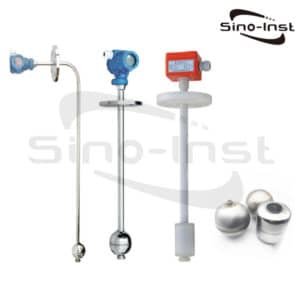
SI-U04 Magnetic Float Reed Switch
Compact float switch for OLTC compartments and radiator headers. 1–4 SPDT contacts on a single stem, oil-rated viton seals, 250 VAC / 1 A contact rating direct into substation alarm panels.

Oil Level Measurement Overview
Cross-application oil-level engineering — substation transformers, oil-storage farms, lubricant day tanks, and bunker fuel — including selection between magnetic, capacitive, magnetostrictive, and radar technologies.
FAQ
What is the most common transformer oil level indicator?
The magnetic liquid-level indicator (MLI) on the conservator. It is required by IEEE C57.12.10 and IEC 60076 for utility-class transformers and provides a hermetic dial plus two SPDT alarm contacts. A prismatic sight glass on the main tank usually accompanies it for visual confirmation.
How much can transformer oil level vary with temperature?
Mineral oil expands roughly 0.07 %/°C. Across a 60 °C swing (cold start at −10 °C, full load at +50 °C top oil), conservator oil level changes by about 4.2 %. The conservator is sized to absorb the swing without ever falling below the air-cell connection or rising above the breather.
Can I retrofit a 4–20 mA transmitter onto an old MLI?
Often yes. Many MLI manufacturers offer a bolt-on retrofit kit that adds a precision potentiometer and a 4–20 mA loop converter behind the existing dial. Retrofit takes 30 minutes and does not require a transformer outage.
Is the same indicator used on a Buchholz-protected transformer?
Yes. The Buchholz relay sits on the conservator inlet pipe and detects gas accumulation or oil surge — it is independent of the MLI. The MLI catches slow leaks (gasket weep, valve drip) that don’t generate gas; the Buchholz catches sudden faults. Both are required on transformers above 1 MVA per IEC.
What level indicator works on natural-ester (FR3, Midel 7131) transformers?
Magnetic / float-based indicators work without modification — the indicator reads geometry, not fluid properties. Capacitive transmitters need a recalibration because ester εr≈3.2 vs mineral εr≈2.2. Magnetostrictive floats use the same hardware but with a slightly heavier float to match ester’s lower density.
How do I check if a transformer oil level alarm is genuinely low or just a stuck float?
Three checks before a costly outage. First, compare the conservator MLI dial reading with the prismatic sight glass on the main tank — agreement rules out a stuck dial. Second, check ambient temperature against last 24-hour load; a real low alarm tracks load drop. Third, look for fresh oil weep at the bushing flanges and tap-changer base — the most common slow-leak path.
Does the OLTC need its own oil-level indicator?
Yes — the OLTC oil is separate from the main tank oil for contamination reasons (arc by-products from tap operations stay isolated). A small dedicated MLI or float switch on the OLTC compartment is mandatory under IEEE C57.131 and IEC 60214.
Request a Quote


Wu Peng, born in 1980, is a highly respected and accomplished male engineer with extensive experience in the field of automation. With over 20 years of industry experience, Wu has made significant contributions to both academia and engineering projects.
Throughout his career, Wu Peng has participated in numerous national and international engineering projects. Some of his most notable projects include the development of an intelligent control system for oil refineries, the design of a cutting-edge distributed control system for petrochemical plants, and the optimization of control algorithms for natural gas pipelines.