Contents
- What a Venturi Tube Does
- The Venturi Effect and Bernoulli Equation
- Anatomy of a Classical Venturi Tube
- Five Venturi Tube Designs by Geometry
- Worked Flow Calculation: From ΔP to Q
- Venturi vs Orifice Plate vs Flow Nozzle
- ASME MFC-3M and ISO 5167-4 Standards
- Installation: Straight Runs and Tap Orientation
- Pressure Recovery: Venturi’s Energy Advantage
- Cleaning Venturi Tubes (Industrial + BBQ Grill)
- Venturi Flow Meters from Sino-Inst
- FAQ

What a Venturi Tube Does
A venturi tube is a short pipe section with a narrowed middle, used to measure fluid flow rate by sensing the pressure drop across the constriction. The device was described by Italian physicist Giovanni Battista Venturi in 1797 and remains one of the most accurate primary elements for measuring water, steam, oil, and gas flow.
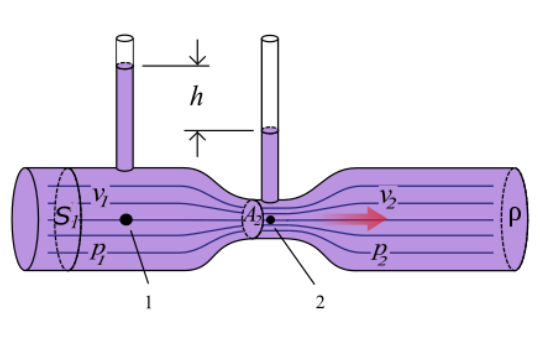
Three sections do all the work: a converging inlet that accelerates the fluid, a cylindrical throat where pressure reaches its lowest value, and a diverging outlet that recovers most of the kinetic energy as static pressure. Two pressure taps — one upstream, one at the throat — feed a differential pressure transmitter that outputs a 4–20 mA signal proportional to the square root of flow.
You will see venturi tubes in municipal water mains, power plant feedwater lines, chiller plants, custody-transfer crude oil headers, and wherever pumping cost makes the pressure loss of an orifice plate unacceptable.
The Venturi Effect and Bernoulli Equation
The physics is one equation. For an incompressible, steady, frictionless flow along a streamline, Bernoulli’s equation between the upstream tap (section 1) and the throat (section 2) gives:
P₁ + ½ρv₁² = P₂ + ½ρv₂²
Combine with continuity (A₁v₁ = A₂v₂) and you get the working form most engineers use day-to-day:
Q = Cd · A₂ · √[ 2·ΔP / (ρ · (1 − β⁴)) ]
Where Q is volumetric flow (m³/s), A₂ is throat area (m²), ΔP is the measured pressure differential (Pa), ρ is fluid density (kg/m³), β is the throat-to-pipe diameter ratio (d/D), and Cd is the discharge coefficient — typically 0.984 for a classical Venturi with machined convergent and rough cast iron throat per ISO 5167-4. The β⁴ term in the denominator is the velocity-of-approach correction; you cannot ignore it when β > 0.3.


Anatomy of a Classical Venturi Tube
Three sections by length and angle:
- Convergent cone: total included angle 21° ± 1°. Length about 2.7 × (D − d).
- Throat: length equal to the throat diameter d. Two diametrically opposed pressure taps (or four equispaced taps connected to a piezometer ring) sit at the midpoint.
- Divergent cone: total included angle 7° to 15°. Shorter angles recover more pressure but add cost and weight; 7° is the textbook value for maximum recovery.
The upstream pressure tap sits at a distance of ½D from the start of the convergent section. This is the geometry of the “classical” Venturi tube as defined in ASME MFC-3M. Get the cone angles wrong and the discharge coefficient drifts outside the standard’s ±0.7% tolerance, requiring individual calibration.
Five Venturi Tube Designs by Geometry
| Design | Construction | Typical β | Cd | Use case |
|---|---|---|---|---|
| Classical machined | Bronze or stainless, machined convergent | 0.4–0.75 | 0.995 | Lab, custody transfer |
| Classical rough cast | Cast iron, as-cast convergent | 0.3–0.75 | 0.984 | Large water mains |
| Classical welded sheet | Fabricated steel, β-ring throat | 0.4–0.7 | 0.985 | Power plant feedwater |
| Short-form (Herschel) | Shortened divergent, 21° angle | 0.4–0.7 | 0.97–0.99 | Tight installations |
| Rectangular | Flat-sided, non-circular | varies | 0.95–0.99 | HVAC ducts, open channels |
The short-form (Herschel) Venturi trades 5–10% of pressure recovery for half the lay length. That tradeoff often makes sense in retrofit jobs where there is no room for a 5-meter classical tube. The rectangular variant shows up in HVAC supply ducts and water canals where a circular flow element does not fit. For more on duct-mounted DP sensing, see our guide on static vs dynamic pressure.
Worked Flow Calculation: From ΔP to Q
Water at 20 °C flows through a 200 mm classical Venturi with a 100 mm throat. The DP transmitter reads 25 kPa. What is the flow rate?
- D = 0.200 m, d = 0.100 m, so β = 0.5
- A₂ = π × (0.100)² / 4 = 0.007854 m²
- ρ = 998 kg/m³ (water at 20 °C)
- ΔP = 25,000 Pa
- Cd = 0.984 (rough cast convergent per ISO 5167-4)
- 1 − β⁴ = 1 − 0.0625 = 0.9375
Plug in: Q = 0.984 × 0.007854 × √[ (2 × 25,000) / (998 × 0.9375) ] = 0.984 × 0.007854 × √(53.45) = 0.984 × 0.007854 × 7.311 = 0.0565 m³/s ≈ 203 m³/h.
Throat velocity v₂ = Q / A₂ = 0.0565 / 0.007854 = 7.2 m/s, which is well inside the 1.5–10 m/s sweet spot for Venturi tubes. Below 1.5 m/s, DP gets noisy. Above 10 m/s, you start seeing cavitation risk on the throat for liquids. For the DP side of the math, our explainer on how DP transmitters work covers signal conditioning.
Venturi vs Orifice Plate vs Flow Nozzle
| Parameter | Classical Venturi | Orifice Plate | Flow Nozzle |
|---|---|---|---|
| Permanent pressure loss | 5–20% of ΔP | 40–95% of ΔP | 30–80% of ΔP |
| Discharge coefficient | 0.984–0.995 | 0.60–0.62 | 0.93–0.99 |
| Accuracy (uncalibrated) | ±0.7% | ±0.6% | ±1.0% |
| Turndown ratio | 3:1 to 5:1 | 3:1 to 5:1 | 3:1 to 4:1 |
| Straight pipe upstream | 5–10 D | 10–44 D | 10–30 D |
| Capital cost (200 mm) | $$$ (high) | $ (low) | $$ (mid) |
| Best for | Large lines, slurries | Clean fluids, retrofit | Steam, high temperature |
The orifice plate wins on price and is fine when you do not care about pump head. The Venturi wins when permanent pressure loss costs real money — a 1000 mm water main saving 20 kPa year-round is worth tens of kilowatts of pump power. Flow nozzles fit in between, popular for high-temperature steam where orifice edge wear becomes a calibration problem. For thicker comparison content, see our piece on flow meter K-factor.
ASME MFC-3M and ISO 5167-4 Standards
Two documents govern Venturi tube design and calibration:
- ASME MFC-3M-2004: “Measurement of Fluid Flow in Pipes Using Orifice, Nozzle, and Venturi.” Defines convergent angle 21° ± 1°, divergent angle 7° to 15°, throat surface roughness, and the Cd equations.
- ISO 5167-4:2022: “Measurement of fluid flow by means of pressure differential devices — Part 4: Venturi tubes.” Sets the diameter range 50 mm ≤ D ≤ 1200 mm and Reynolds number range 2×10⁵ ≤ Re ≤ 2×10⁶ for uncalibrated use.
Outside those bounds — small lines, low flows, high-temperature gas, or β below 0.3 — you cannot use the tabulated Cd. The tube must be wet-calibrated on a flow rig traceable to NIST. Calibration adds about $3,000–$8,000 to a 200 mm classical Venturi.
Installation: Straight Runs and Tap Orientation
The Venturi is forgiving compared with an orifice plate, but it still needs straight pipe:
- 5 D upstream of a single 90° elbow
- 10 D upstream of two elbows in perpendicular planes
- 20 D upstream of a partly closed valve
- 4 D downstream before any disturbance
Pressure tap orientation depends on the fluid. For clean liquids, taps at 3 and 9 o’clock (horizontal pipe). For gas with possible condensate, taps at 12 o’clock. For steam, taps at 3 and 9 with condensate pots installed below. Get this wrong and you get either a slugged transmitter or a permanently water-logged impulse line. Our DP transmitter installation guide covers impulse line slopes and 3-valve manifold sequencing.
For straight-pipe rules of thumb on every meter type, see our flow meter straight pipe guide.
Pressure Recovery: Venturi’s Energy Advantage
The diverging cone is where Venturi tubes earn their cost. By gradually expanding the flow from throat to pipe diameter at a 7° included angle, the fluid decelerates without turbulent separation and most of the kinetic energy converts back to static pressure. Typical permanent pressure loss is 10% of the measured ΔP at β = 0.5, dropping to 5% at β = 0.7. Compare that with an orifice plate at the same β, which dumps 70–95% of ΔP as friction loss.
Over a year, a 600 mm Venturi at 0.5 m/s saving 15 kPa of pump head represents roughly 4 kW of continuous pump power. At $0.12/kWh that is about $4,200 per year — payback on the Venturi premium often inside 2 years. This is the math behind every chilled water plant retrofit replacing orifices with Venturis.
Cleaning Venturi Tubes (Industrial + BBQ Grill)
Two completely different cleaning jobs share the name. The industrial Venturi flow meter rarely needs cleaning if the fluid is clean; for slurries or scaling water, a yearly inspection and high-pressure rinse of the throat are normal. Pressure taps are the failure point — they plug with debris and bias the reading low. Most modern Venturis include flush connections on the tap legs.
Gas grills are the other context. Each burner has a small Venturi tube where propane or natural gas accelerates and pulls in primary air. Spiders love these tubes; webs and egg sacs block airflow and produce yellow flames or backfiring. To clean a grill Venturi: shut off gas, remove the burner, slide the Venturi off the orifice spud, push a pipe cleaner or bottle brush through the tube, blow out with compressed air, reassemble. Inspect every spring before first use.
Venturi Flow Meters from Sino-Inst

Venturi Flow Meter
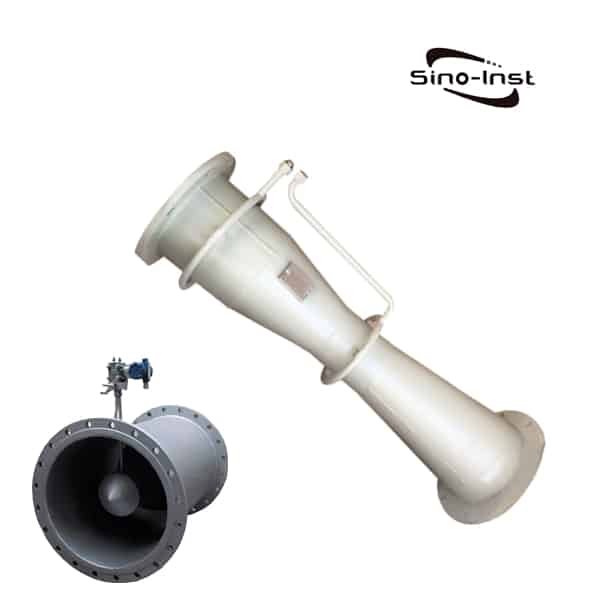
DN50 to DN1200 | β 0.4–0.75 | ±0.5% — classical and short-form geometries for water, oil, gas service.

Verabar Flow Meter
Averaging pitot | hot tap insertion | low pressure loss — alternative to Venturi for large pipes with retrofit constraints.
V-Cone Flow Meter
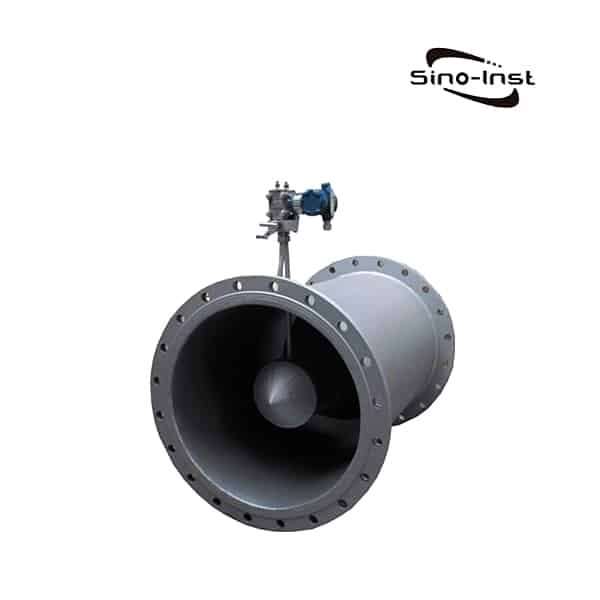
Conditioning DP element | 0–3D straight run | tolerates swirl — compact replacement for Venturi in tight installations.
For sizing help or a quotation on any of these flow elements, contact our engineering team using the form below. Provide pipe size, fluid, design flow, and operating pressure-temperature; we typically reply within one business day.
FAQ
What is a venturi tube used for?
Measuring flow rate by sensing the pressure drop across a constricted throat. Common applications are municipal water, power plant feedwater, chilled water HVAC, oil custody transfer, and grill burner air entrainment.
How does a venturi tube work?
The fluid accelerates through a converging cone, causing static pressure to drop in the throat (Bernoulli’s equation). A DP transmitter reads the pressure difference between upstream and throat taps; volumetric flow is proportional to the square root of that differential.
How do you clean venturi tubes on a gas grill?
Shut off the gas, lift out the burner, slide the Venturi tube off the orifice spud, push a long-handled bottle brush or pipe cleaner through the tube to remove spider webs and debris, blow clean with compressed air, and reassemble. Inspect every spring before the first cookout.
What is the difference between a venturi tube and an orifice plate?
Both create a differential pressure for flow measurement. A Venturi recovers most of the pressure (5–20% permanent loss) thanks to its diverging cone; an orifice plate dumps 40–95% as turbulent loss. Venturi costs 5–10× more but pays back in pump energy on large lines.
What pressure recovery does a venturi tube achieve?
About 80–95% of the differential pressure is recovered as static pressure downstream, depending on β (throat/pipe diameter ratio) and divergent cone angle. A β = 0.7 classical Venturi with 7° divergent angle gives roughly 95% recovery, while β = 0.4 at 15° recovers about 80%.
Request a Quote


Wu Peng, born in 1980, is a highly respected and accomplished male engineer with extensive experience in the field of automation. With over 20 years of industry experience, Wu has made significant contributions to both academia and engineering projects.
Throughout his career, Wu Peng has participated in numerous national and international engineering projects. Some of his most notable projects include the development of an intelligent control system for oil refineries, the design of a cutting-edge distributed control system for petrochemical plants, and the optimization of control algorithms for natural gas pipelines.