Paperless recorders are data loggers that record and trend measurement data over time — replacing strip-chart and circular recorders with a touchscreen, internal flash storage, and Ethernet/Modbus TCP/OPC UA export.

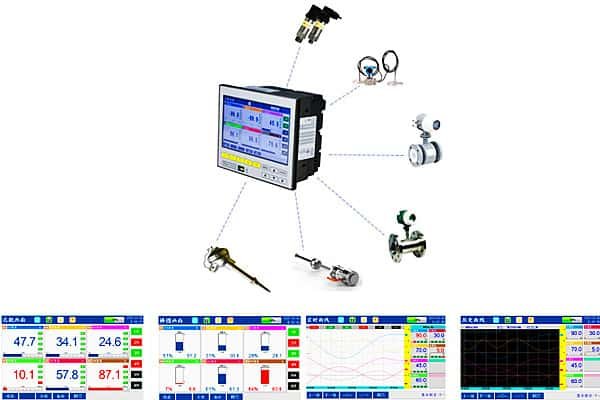
Sino-Inst supplies industrial paperless recorders with 4 to 64 universal-input channels (thermocouple, RTD, mV, 4–20 mA, 0–10 V, pulse). Models cover general-process duty (R7100), temperature-focused heat-treat / pharmaceutical service (R7600), and dedicated flow-totalizer applications (F3000X). 21 CFR Part 11 audit trail and AMS 2750E compliance options are available, with Modbus TCP, OPC UA, and MQTT for SCADA / MES integration.
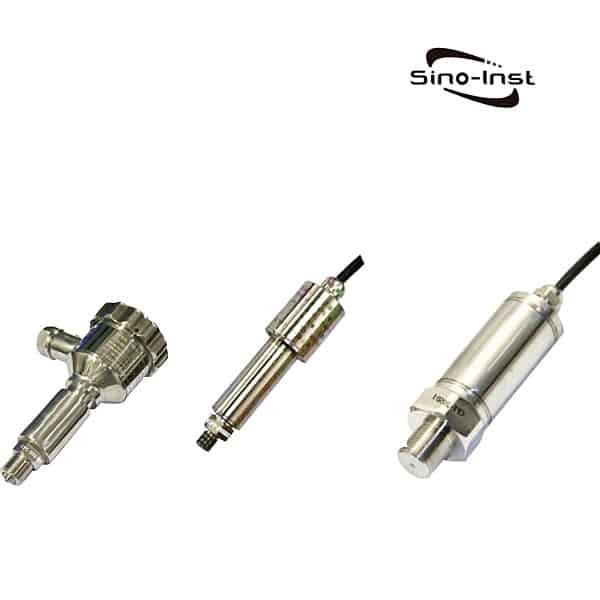
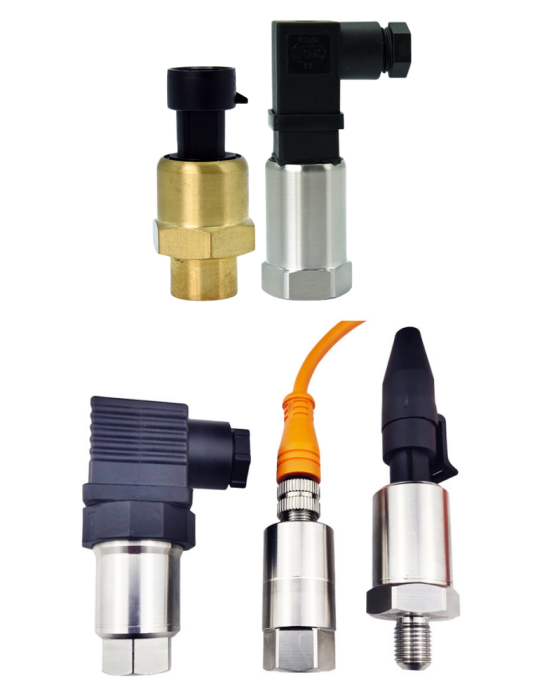
Sino-Inst offers a variety of low pressure transducers for industrial pressure measurement. If you have any questions, please contact our sales engineers.
For the underlying control algorithm running inside this recorder, see our explainer on the PID controller working principle and Ziegler-Nichols tuning.
Description
The paperless recorder is an electronic instrument that samples industrial process signals through a 24-bit ADC, applies the standard linearization (IEC 60584 for thermocouples, Callendar-Van Dusen for RTDs, scaled engineering units for 4–20 mA), and writes the result to internal flash storage. Up to 64 channels per chassis with 3-way galvanic isolation between channel-channel, channel-power, and channel-comms.
Front-panel touchscreen for live trend, alarm history and configuration. Trend stored as a tamper-evident binary file plus CSV; signed-PDF export available for 21 CFR Part 11 batch reporting. Communications include Ethernet 10/100, Modbus TCP slave, OPC UA server, MQTT publisher, USB host, and RS-485 Modbus RTU.
Features of Paperless Recorder
- Universal input: K/J/T/E/N/S/R/B thermocouple, Pt100/Pt1000 RTD, 4–20 mA, 0–10 V, ±100 mV, pulse 0.1 Hz–10 kHz.
- 4 / 8 / 16 / 32 / 48 / 64-channel models — pluggable hot-swap input cards.
- 24-bit sigma-delta ADC, 100 ms–1 s sampling, configurable per-channel storage interval.
- 3-way galvanic isolation (channel-channel, channel-power, channel-comms).
- 21 CFR Part 11 audit trail, AMS 2750E heat-treat, GAMP 5, IEC 61010-1 compliance options.
- Communications: Ethernet, Modbus TCP, OPC UA, MQTT, RS-485 Modbus RTU, USB host/device.
- Front-panel IP65 for wash-down food and pharmaceutical service.
- 3.5" / 5.6" / 7" / 10.4" / 12" TFT touchscreen, 4 GB flash + SD card.
Specifications of Paperless Recorder
| Parameter | R7100 Universal | R7600 Temperature | F3000X Flow Totalizer |
|---|---|---|---|
| Channels | 4 / 8 / 16 / 32 / 64 | 8 / 16 / 32 | 2 / 4 (pulse + 4–20 mA) |
| Display | 5.6" / 7" / 10.4" | 7" / 10.4" | 5.6" |
| Memory | 4 GB + SD card | 4 / 8 GB + SD | 2 GB + SD |
| Sampling | 100 ms / 200 ms / 1 s | 200 ms / 1 s | 100 ms (pulse) / 1 s |
| Compliance | 21 CFR Part 11 | AMS 2750E + 21 CFR Part 11 | OIML R117 (custody) |
| Communications | Ethernet, Modbus TCP, OPC UA, MQTT | Ethernet, Modbus TCP, OPC UA | Ethernet, Modbus TCP, RS-485 |
| Power | 90–264 VAC / 24 VDC | 90–264 VAC / 24 VDC | 90–264 VAC / 24 VDC |
| Panel cutout | 144 × 144 / 144 × 288 mm | 144 × 144 / 288 × 288 mm | 96 × 96 / 144 × 144 mm |
| Front panel rating | IP65 | IP65 | IP65 |
Read more about: Common Units Of Pressure
Applications of Paperless Recorder
- Heat-treat furnace AMS 2750E TUS — 9 thermocouples + 1 control = 16-channel R7600 with Class 1 calibration.
- Pharmaceutical sterilizer / autoclave — 21 CFR Part 11 mode, F0 calculation, signed batch report.
- Food retort cook-cool validation — 1-minute storage, F0 trend, IP65 wash-down front.
- HVAC and energy monitoring — temperature + flow + pulse from kWh, Modbus TCP to BMS.
- Boiler / CHP plant — steam temperature, drum level, fuel-flow trending.
- Custody flow measurement — F3000X with density/temperature compensation, batch totalizer.
What is a paperless recorder?
The paperless recorder is a stand-alone process data logger that replaces a strip-chart or circular recorder. Where the older instrument drew an ink trace on paper as the chart wheel rotated, the paperless recorder samples the same inputs at 100 ms–1 s, displays the trend on a touchscreen, and stores the values to internal flash for compliance and audit retrieval.
The recorded data are written as a tamper-evident binary file plus a CSV companion. The binary is the legally defensible record (signed checksum); the CSV is the convenience export for spreadsheets. Trend data and configuration changes are timestamped against an NTP-synced clock so the audit trail satisfies FDA 21 CFR Part 11 and AMS 2750E requirements for pharmaceutical and aerospace heat-treat work.
How does a paperless recorder work?
The paperless recorder is built around an industrial microprocessor, a 24-bit sigma-delta ADC, RAM and flash storage, and a touchscreen front. Each input channel is multiplexed through the ADC at the configured sampling rate (typical: 1 s per channel for compliance work, 100–200 ms for combustion and compressor monitoring).
The microprocessor applies the appropriate linearization curve (IEC 60584-1 for thermocouples, Callendar-Van Dusen for Pt100/Pt1000 RTDs, scaled engineering units for 4–20 mA inputs), computes alarm logic (HiHi / Hi / Lo / LoLo with deadband and on-delay), and writes the storage-interval-averaged value to internal flash. On alarm, a burst-capture routine stores the full sampling-rate data around the event so post-incident analysis sees the raw waveform.
Q&A
Is a paperless recorder the same as a data logger?
Closely related but not identical. A data logger is typically a small standalone unit with battery power and limited inputs; a paperless recorder is panel-mounted, plant-powered, with a touchscreen, more channels, built-in alarms, and SCADA integration.
How many channels do I need for a typical heat-treat furnace?
AMS 2750E TUS (temperature uniformity survey) calls for 9 thermocouples on a 60-225 cubic-foot furnace plus the control thermocouple – 10 channels active. Allow one card-slot of headroom and pick a 16-channel R7100 or R7600.
What protocols are available for SCADA integration?
Modbus TCP slave is standard. OPC UA server, MQTT publisher, and Modbus RTU (RS-485) are option keys. USB host accepts a flash drive for ad-hoc CSV export; Ethernet web server allows browser-based trend download.
Do paperless recorders need calibration?
Yes – annually for compliance work, every 2 years for non-critical applications. Calibration is per channel and includes the cold-junction reference for thermocouple inputs. Field calibrators (Fluke 754, Ametek MC) inject known signals and write the verification result to the audit trail.
What if I lose power mid-batch?
Internal flash memory is non-volatile, so the recorded data up to the power-off instant is preserved. The recorder reboots and resumes; a power-loss event is logged in the audit trail. For absolute continuity, a small UPS or 24 VDC battery backup is the recommended add-on.

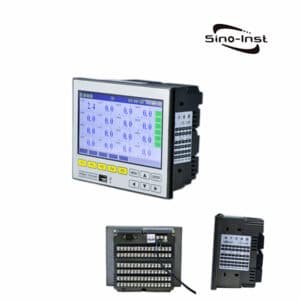
R7100 Universal-Input Recorder
4 to 64 channels, universal input (TC/RTD/mA/V), 7″ or 10.4″ touchscreen, 4 GB internal + SD, Ethernet + Modbus TCP.
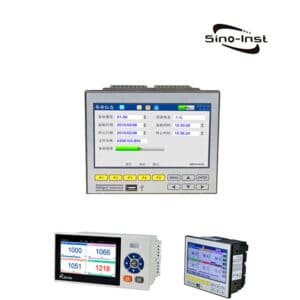
R7600 Temperature Recorder
8 / 16 / 32-channel temperature-focused recorder. 24-bit ADC, 3-way galvanic isolation, AMS 2750E-ready trend export.
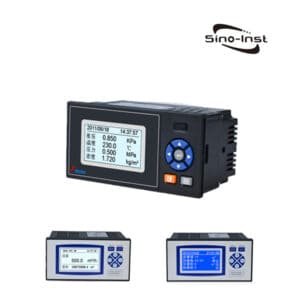
F3000X Flow Totalizer
Specialized flow-totalizer recorder: pulse + 4–20 mA input, density/temp compensation, batch totalizer, RS-485 Modbus.
Sino-Inst supplies paperless recorders globally — heat-treat, pharma, food, HVAC, boiler, custody flow.
Channel counts from 4 to 64. Universal-input cards. 21 CFR Part 11 / AMS 2750E compliance options. Modbus TCP, OPC UA, and MQTT for modern SCADA / MES / IIoT integration.
Sino-Inst is a Chinese manufacturer with a global distribution network. Paperless recorders are most popular in heat-treatment, pharmaceutical, food, HVAC, and boiler / CHP markets across North America, Europe, India, and Southeast Asia. Send your channel mix, panel cutout, communication protocol and certification target — our team will configure and quote within 24 hours.
Request a Quote


Wu Peng, born in 1980, is a highly respected and accomplished male engineer with extensive experience in the field of automation. With over 20 years of industry experience, Wu has made significant contributions to both academia and engineering projects.
Throughout his career, Wu Peng has participated in numerous national and international engineering projects. Some of his most notable projects include the development of an intelligent control system for oil refineries, the design of a cutting-edge distributed control system for petrochemical plants, and the optimization of control algorithms for natural gas pipelines.