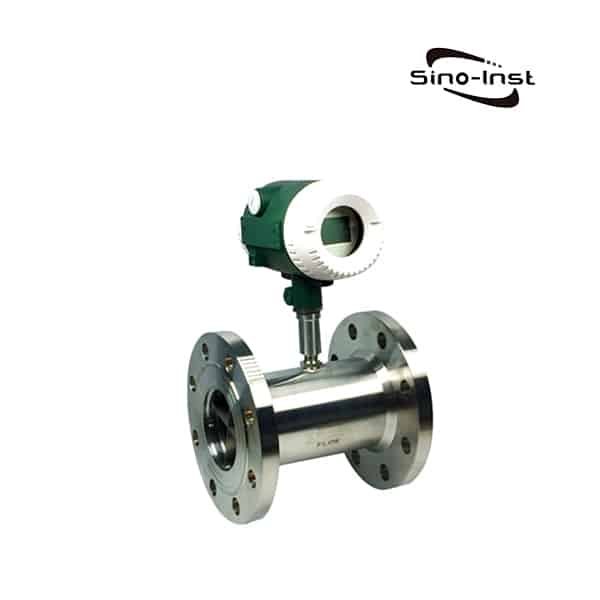
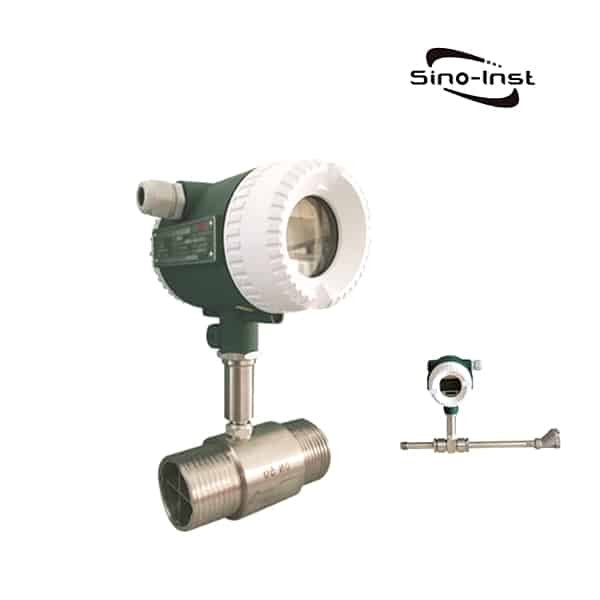
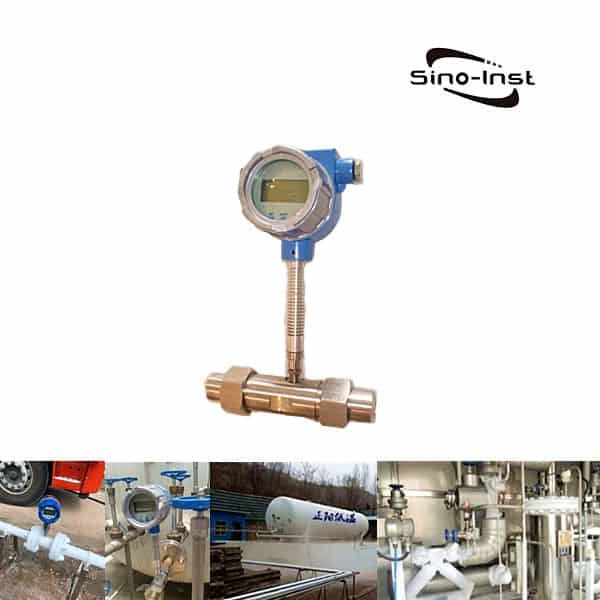
Turbine Sanitary flow meter

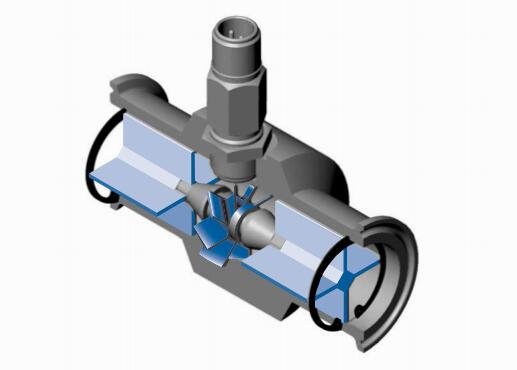
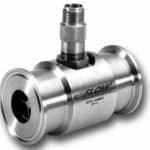
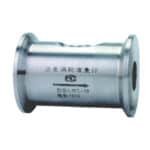
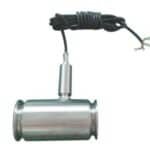
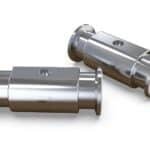
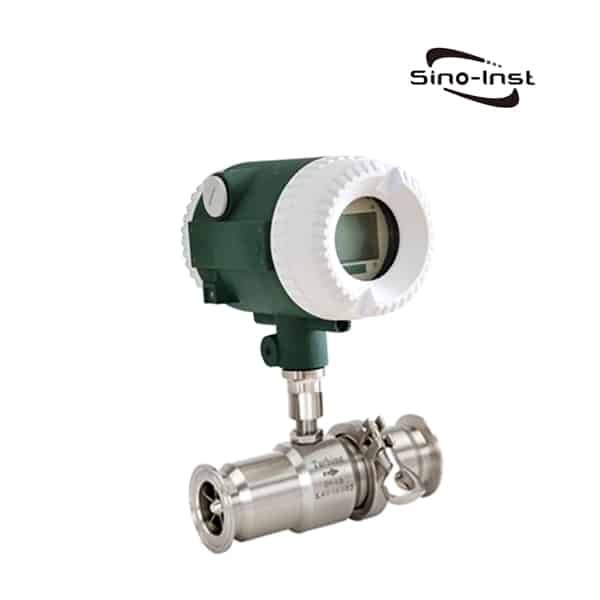
Sanitary Flow Meter, also called sanitary turbine flow meter or Hygienic turbine flowmeter. Ensure Accurate Flow Measurement in Sanitary food-processing and bio-technology industries.

Turbine Sanitary flow meter

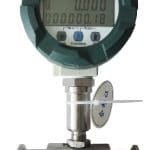
Sanitary turbine flow meters have stainless steel bodies and come standard with Tri-Clover fittings. Sanitary flow meter is suitable for measuring liquid without impurities. It can output pulse frequency signal. It is used to detect instantaneous flow and total integrated flow. Sanitary flow meter can be used in food, sport drink, liquor and other beverage industries, in preprocess applications.

Sanitary Turbine Flow Meter reference price: DN100USD 300-700/pc.

Sino-Inst offers a variety of  Turbine flow meters for flow measurement. If you have any questions, please contact our sales engineers.

Features of Turbine Sanitary flow meter

  • Meets the requirements of 3-A Sanitary Standard number 28-04
  • 316L stainless steel body and internal wetted parts
  • Consistent, reliable gas flow measurement
  • Wafer mounting configuration for limited space requirements
  • Anti-corrosion and anti-rust materials, suitable for the health industry;
  • Quick-load structure, easy to install and maintain;
  • High precision and good repeatability;
  • High-quality turbine, beyond the conventional range;

Benefits of sanitary turbine flow meter

The lightweight, balanced rotor provides instantaneous response to changes in the flow;

No mating flange design allows for quick and easy install;

Superior material of construction for high performance in aggressive environments.

The SI-LWGY Series Sanitary Turbine Flowmeters feature 316 stainless steel construction. And have a smooth finish. Which is designed to eliminate cracks and crevices where bacteria breed.

Standard flowmeters are available in sizes from 1/2″ to 2″ with sanitary clamps.

Flow rates range from 0.1 to 250 gallons per minute (0.38 to 946 LPM).

Extended reading: Food grade flow meters for Food & Beverage industry

Specifications of Hygienic turbine flowmeter.

Measuring range0.04-40m³/h
Applicable mediumClean liquid without impurities (water, water solution, beer beverage, glycerin, glycol)
Nominal pipe diameterDN4-50mm
Accuracy level±0.2%FS, ±0.5%FS, ±1.0%FS, ±1.5%FS
Repeatability error±0.5% of measured value; ±1.0%
Linearity1%
displayWide screen LCD display, parameters and variables can be set through the buttons on the panel
Instantaneous flow display, cumulative total display, percentage display, frequency display
l/min, m³/h, Hz
Resolution0.1 l/min, 0.005 m³/h
Operating temperature-35-60℃ (standard type)
-20-180℃ (high temperature type)
-40-80℃ (explosion-proof type)
Allowable viscosity0.8-30cm²/s
Work pressure1.6MPa, 2.5MPa, 4.0MPa, special can be customized
shell materialStainless steel 316L
Turbine materialStainless steel 316L
Head materialAluminum alloy
BearingTungsten carbide bearings, ruby bearings are optional
Entrance: 10*DN
Exit: 5*DN
Signal output4~20mA, pulse, RS485, MODBUS protocol, HART output
Power supply 220V AC, 24V DC
Electrical connectionsIntelligent type: M20*1.5 terminal wiring,
Digital display type: aviation plug wiring
Ordinary type: direct outlet
Connection methodChuck
Protection levelIP65 (optional IP68)
Ambient temperature-20℃…80℃
Relative humidity 5%~95%
Explosion-proof markIntrinsically safe ExiaIICT6
Power consumption<20W
Diameter(mm)Normal flow range(m3/h)Extended flow range(m3/h)Regular pressure(MPa)
DN 40.04~0.250.04~0.41
DN 60.1~0.60.06~0.61
DN 100.2~1.20.15~1.51
DN 150.6~60.4~81
DN 200.8~80.45~91
DN 251~100.5~101
DN 321.5~150.8~151
DN 402~201~201
DN 504~402~401

Extended reading: Vortex Hygienic Flow Meter

SI-LWGY Sanitary flow meter applications

Typical applications include measuring or batch controlling water, WFI, USP water, deionized water, vaccines, clean pharmaceuticals, milk, cream, vegetable oil, wine, beer, spirits, soft drinks, juices (without pulp)and any other clean, consumable liquid.

Application Examples:

  • Sanitary
  • Food Processing
  • Pharmaceutical
  • Industries Process or Industrial
  • Pharmaceutical industry:
    • filling and metering of infusion products such as saline and glucose water;
  • Food and beverage industry:
    • filling and metering of liquid foods such as vegetable juice, juice, beer, and refined oil.

Extended reading: Turbine Insertion Flow Meter for Large Diameter Pipeline

Magnetic Sanitary Flow Meter

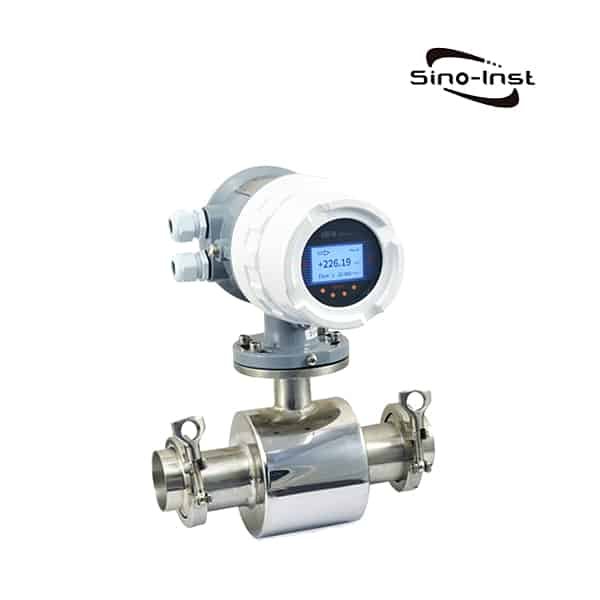
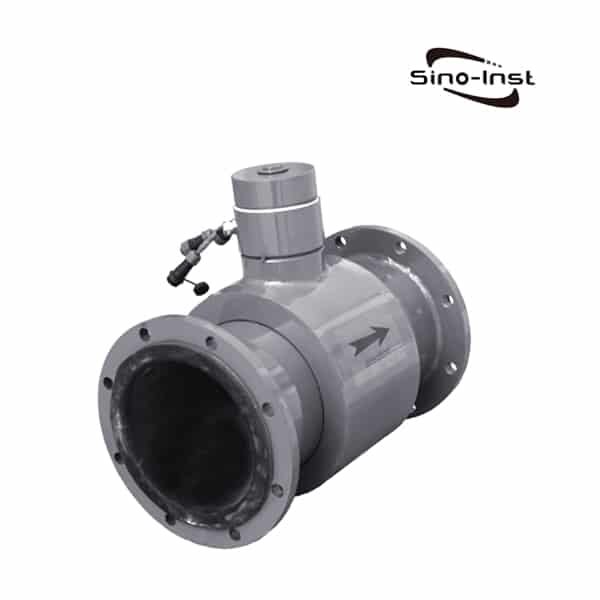
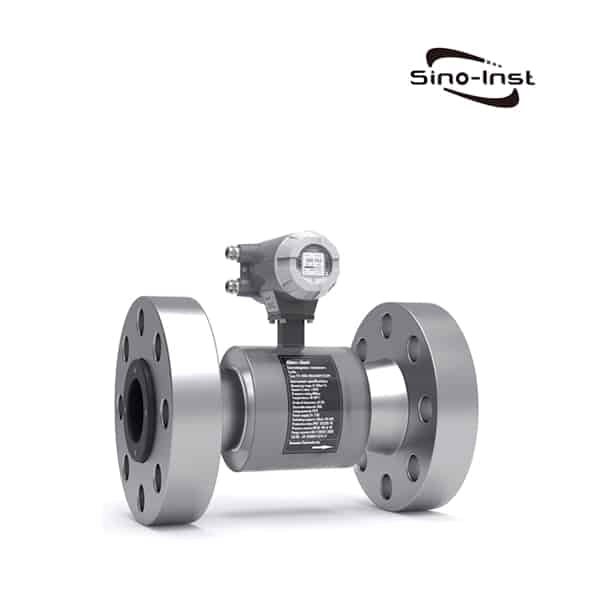
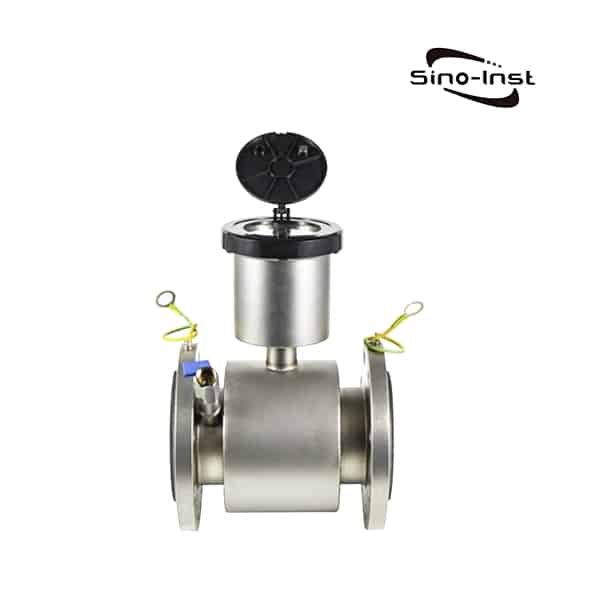
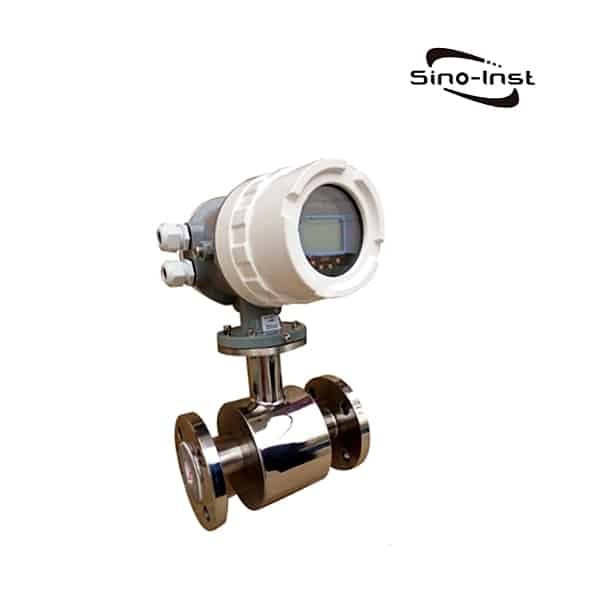
Magnetic Sanitary Flow Meter measures the flow of conductive liquids.

Sanitary Flow Meter uses a new type of sanitary lining material and lining technology, which meets the sanitary requirements of the food industry. It uses a stainless steel shell and stainless steel clamp connection. It is convenient for the quick disassembly and cleaning of the electromagnetic flow meter. Magnetic flow meter in a sanitary version which meets the strict requirements of the food-processing and bio-technology/ pharmaceutical industries.

Clamp on ultrasonic flow meter is also a good choice for the health industry. Because the external clamp sensor does not need to destroy the pipe.

Read more about: Sanitary Flow Meters-316SS,Tri clamp-Pulse- for Brewery

More about Turbine Flow Meters

What is a turbine flow meter?

A turbine flow meter is a volume sensing device. As liquid or gas passes through the turbine housing, it causes the freely suspended turbine blades to rotate. The velocity of the turbine rotor is directly proportional to the velocity of the fluid passing through the flow meter.

The external pickoff mounted on the body of the flow meter, senses each rotor blade passing, causing the sensor to generate a frequency output. The frequency is directly proportional to the volume of the liquid or gas.

Extended reading: Quantitative control with turbine flowmeter

What is the principle of turbine flow meter?

Gas turbine flow meter working principle

The gas turbine flowmeter uses a turbine for measurement. It first converts the flow rate into the rotational speed of the turbine, and then converts the rotational speed into an electrical signal proportional to the flow rate.

Gas turbine flowmeter is used to detect instantaneous flow and total integrated flow. Its output signal is frequency, which is easy to digitize.

The induction coil and the permanent magnet are fixed on the housing together. When the ferromagnetic turbine blade passes the magnet, the reluctance of the magnetic circuit changes, thereby generating an induction signal.

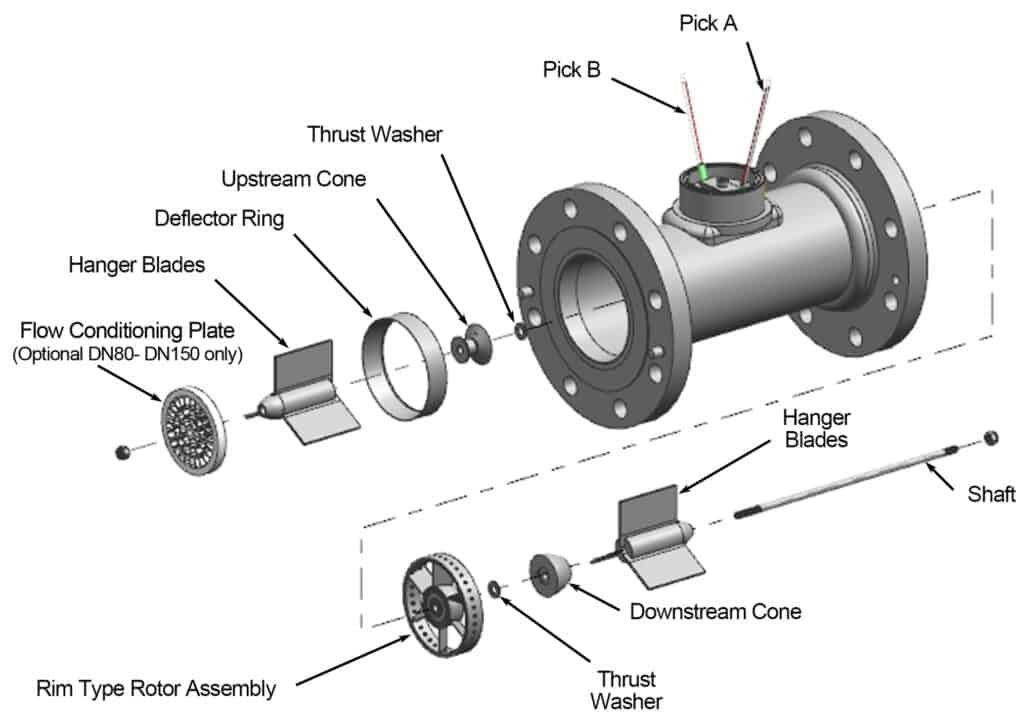
The signal is amplified and reshaped by the amplifier and sent to the counter or frequency meter. The total accumulated flow is displayed. At the same time, the pulse frequency undergoes frequency-voltage conversion to indicate instantaneous flow.

The speed of the impeller is proportional to the flow, and the number of revolutions of the impeller is proportional to the total amount of flow. The output of the turbine flowmeter is a frequency modulated signal. It not only improves the anti-interference of the detection circuit, but also simplifies the flow detection system.

The gas turbine flowmeter has a turndown ratio of up to 10:1, and the accuracy is within ±0.2%. The time constant of the turbine flowmeter with small inertia and small size can reach 0.01 second.

Liquid Turbine Flow Meter Working Principle

Liquid Turbine Flow Meter is a speed type flow meter based on the principle of torque balance.

The fluid flows through the sensor housing. Because the blades of the impeller have a certain angle with the flow direction. The impulse of the fluid makes the blades have a rotational torque. After the friction torque and fluid resistance are overcome, the blades rotate. The speed is stable after the torque is balanced.

Under certain conditions, the speed is proportional to the flow rate.

Due to the magnetic permeability of the blade, it is in the magnetic field of the signal detector (composed of permanent magnets and coils). The rotating blade cuts the magnetic lines of force. The magnetic flux of the coil is periodically changed. Electrical pulse signals are induced at both ends of the coil.

This signal is amplified and reshaped by an amplifier. A continuous rectangular pulse wave with a certain amplitude is formed. It can be transmitted to the display instrument remotely. The instantaneous flow or total amount of the fluid is displayed.

Within a certain flow range, the pulse frequency f is proportional to the instantaneous flow Q of the fluid flowing through the sensor. The flow equation is:

Where:
f——Pulse frequency [Hz]
k——The meter coefficient of the sensor [1/m3], which is given by the calibration sheet.
Q——The instantaneous flow of fluid (under working condition) [m3/h]
3600-conversion factor in seconds

The meter coefficient of each sensor is filled in the verification certificate by the manufacturer. The k value is set in the matching display instrument. The instantaneous flow and cumulative total can be displayed.

Turbine flow meter advantages and disadvantages

Turbine Meter Advantages

  • The cost is moderate.
  • Very good at clean, low viscosity fluids of moderate velocity and a steady rate.
  • Turndown is very good as it can read very low compared to the greatest flow.
  • They are reliable if put in a clean fluid especially if it has some lubricity.
  • AGA and API approved for custody transfers.
  • They do cause some pressure drop where that may be a factor such as gravity flows.
  • High accuracy. Among all flowmeters, it is the most accurate flowmeter.
  • No zero drift, good anti-interference ability.
  • High accuracy. Among all flowmeters, it is the most accurate flowmeter.
  • No zero drift, good anti-interference ability.

Turbine Meter Disadvantages

  • Not reliable for steam.
  • Bearings wear out.
  • Requires constant backpressure to prevent cavitation.
  • Accuracy adversely affected by bubbles in liquids.
  • Turbine meters can be used with clean liquids and gases only (may need to install a strainer upstream to prevent damage from particulates).
  • Not applicable for measuring corrosive fluids.
  • May not function properly with high viscosity fluids where the flow profile is laminar.
  • Cannot maintain calibration characteristics for a long time.

Types of turbine flow meter

Generally speaking, according to the measuring medium, we can divide the turbine flowmeter into liquid turbine flowmeter and gas flowmeter.

Of course, according to the function of the turbine flowmeter, we can divide the turbine flowmeter into a basic turbine flowmeter and an intelligent turbine flowmeter.

  1. Basic turbine flowmeter

The turbine sensor itself does not have the on-site display function, and only transmits the flow signal remotely.
The flow signal can be divided into pulse signal or current signal.
Low price, high integration, small size, especially suitable for use with secondary display, PLC, DCS and other computer control systems.

  1. Intelligent turbine flowmeter

Intelligent turbine flowmeter, a display integrated instrument developed by combining turbine flow sensor and advanced ultra-low power single-chip microcomputer technology.
It has the advantages of compact structure, high reliability, resistance to external power supply interference, lightning protection, and low cost.
Three-point correction of instrument coefficients can be carried out on site, and nonlinearity of instrument coefficients can be intelligently compensated.
Simultaneously display instantaneous flow, cumulative flow, temperature, pressure and other measurement parameters.
It has real-time data storage function and explosion-proof function.
Especially suitable for use with PLC, DCS and other computer control systems.

What is k factor in turbine flow meter?

K-factor (K value) is a factor calculated by calibrating and comparing the meter with other measuring devices that meet the accuracy requirements before putting it into use.
This coefficient is a fixed value, which is the actual coefficient obtained by the flowmeter manufacturer for each meter after verification, and has nothing to do with the initial design.

There are two kinds of different manufacturers k:
One is k=f/Q, which is the number of vortices generated by du unit flow;
The other k=Q/f, that is, each vortex corresponds to the flow rate of Zhuan.
The k value is calibrated with factory water. The sensor measures the vortex number of the instrument and compares it with the volume flow measured by the calibration device to obtain the k value.

The k value is actually related to the internal mechanical structure of the flow meter measuring tube.
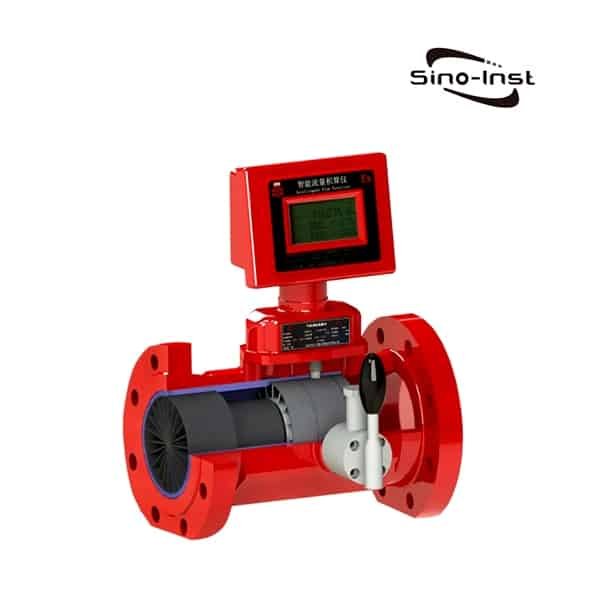
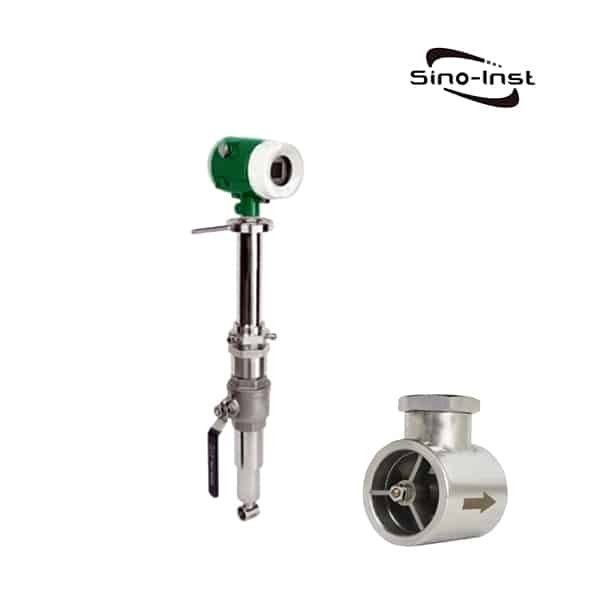
Sino-Inst, Manufacuturer for Turbine Sanitary flow meterrs, like: gas turbine flow meter, liquid turbine flow meter, sanitary turbine flow meter, insertion turbine flow meter, steam turbine flow meter, and natural gas turbine flow meter.

Sino-Inst’s Turbine Sanitary flow meters, made in China, Having good Quality, With better price. Our flow measurement instruments are widely used in China, India, Pakistan, US, and other countries.

Request a Quote

Please enable JavaScript in your browser to submit the form

Liquid Turbine Flow Meter

Liquid turbine flow meter is the main type of impeller flow meter. Turbine flow meter sensor uses a multi-blade rotor to sense the average flow rate of the fluid. Belongs to speed flow meter.

Liquid turbine flow meter is the main type of impeller type flow (velocity) meter. It is composed of sensors and conversion display. The sensor uses a multi-blade rotor to sense the average flow rate of the fluid, thereby deriving the flow or total amount. Liquid turbine flow meter is suitable for measuring liquids that are not corrosive to stainless steel 1Cr18Ni9Ti, 2Cr13 and corundum Al2O3 in closed pipelines and are free of impurities. For milk, soybean oil, edible oil, diesel, purified water.

Liquid Turbine Flow Meter reference price: DN100. USD 400-500/pc.

Sino-Inst offers a variety of  Turbine flow meters for flow measurement. If you have any questions, please contact our sales engineers.

Features of Liquid Turbine Flow Meter

  1. The repeatability is good, and the short-term repeatability can reach 0.05%~0.2%. It is precisely because of the good repeatability, such as frequent calibration or online calibration can get extremely high accuracy. It is the preferred flow meter in trade settlement;
  2. High precision, generally up to ±1%R, ±0.5%R, high-precision type up to ±0.2%R;
  3. Output pulse frequency signal. No zero drift, strong anti-interference ability;
  4. Can get very high frequency signal (3~4kHz). Strong signal resolution;
  5. Wide range. Medium and large diameters can reach 1:20, and small diameters are 1:10;
  6. The structure is compact and light. It is convenient to install and maintain, and has a large circulation capacity;
  7. Suitable for high-pressure measurement. No holes are required on the meter body, and it is easy to make a high-pressure meter;
  8. It can be made into an insert type, suitable for large-caliber measurement. The pressure loss is small, the price is low. It can be taken out continuously, and the installation and maintenance are convenient.

Turbine Flow Meter Advantages and Disadvantages

Advantages:
(1) High precision, among all flowmeters, it is the most accurate flowmeter;
(2) Good repeatability;
(3) Element zero drift, good anti-interference ability;
(4) The range is wide;
(5) The structure is compact.

Disadvantages:
(1) The calibration characteristics cannot be maintained for a long time;
(2) The physical properties of the fluid have a great influence on the flow characteristics.

Liquid Turbine Flow Meter Datasheet

Instrument caliber and connection methodDN4, 6, 10, 15, 20, 25, 32, 40 use threaded connection;
(DN15, 20, 25, 32, 40) DN50, 65, 80, 100, 125, 150, 200 use flange connection
Executive standardTurbine flow sensor (JB/T9246-1999)
Accuracy class±1%R, ±0.5%R, ±0.2%R (specially required)
Range ratio1:10; 1:15; 1:20
Instrument material304 stainless steel, 316 (L) stainless steel, etc.
Measured medium temperature (℃)-20~+80℃;-20~+120℃; -20~+150℃;
Environmental conditionsTemperature -10~+55℃, relative humidity 5%~90%, atmospheric pressure 86~106kPa
output signalSensor: pulse frequency signal, low level≤0.8V, high level≥8V
Transmitter: two-wire 4~20mADC current signal
Power supplyA. External power supply: +24VDC±15%, ripple ≤±5% for 4-20mA, pulse output, R485, etc.
B. Internal power supply: 1 set of 3.0V10AH lithium battery, the battery voltage is normal when the battery voltage is 2.0-3.0V
Signal transmission lineSTVPV3×0.3 (three-wire system), 2×0.3 (two-wire system)
Transmission distance≤1000m
Signal line interfaceBasic type: Hausmann connector, explosion-proof type: internal thread M20×1.5
Explosion-proof gradeExiaIICT4 or ExdIIBT6
Protection levelIP65
Diameter (mm)Normal flow range (m3/h)Extended flow range(m3/h)Routine stress tolerance (MPa)Special pressure rating (MPa) (MPa)
DN 40.04-0.250.04-0.46.312、16、25
DN 60.1-0.60.06-0.66.312、16、25
DN 100.2-1.20.15-1.56.312、16、25
DN 150.6-60.4-86.3、2.5(Flange)4.0、6.3、12、16、25
DN 200.8-80.45-96.3、2.5(Flange)4.0、6.3、12、16、25
DN 251-100.5-16.3、2.5(Flange)4.0、6.3、12、16、25
DN 321.5-150.8-156.3、2.5(Flange)4.0、6.3、12、16、25
DN 402-20 1-206.3、2.5(Flange)4.0、6.3、12、16、25
DN 504-402-402.54.0、6.3、12、16、25
DN 657-704-702.54.0、6.3、12、16、25
DN 8010-1005-1002.54.0、6.3、12、16、25
DN 10020-20010-2001.64.0、6.3、12、16、25
DN 12525-25013-2501.62.5、4.0、6.3、12、16
DN 15030-30015-3001.62.5、4.0、6.3、12、16
DN 20080-80040-8001.62.5、4.0、6.3、12、16

Know more about: Turbine type Flow Meter for Liquid & Gas technology

Turbine Flow Meter PDF

Liquid Turbine Flow Meter Order Guide

LWGY Explain
Classify LWGY         Basic model,+5-24DCV power supply
LWGYA         Two-wire system current output,
remote transmission
LWGYB         Battery powered field display
LWGYC         field display/Two-wire system current output
LWGYD         RS485 communication output
Inside nominal
 diameter
4       4mm,general turbine flow range 0.04~0.25m3/h
6       6mm,general turbine flow range 0.1~0.6m3/h
10       10mm,general turbine flow range 0.2~1.2m3/h
12       12mm,general turbine flow range 0.2~2m3/h
15       15mm,general turbine flow range 0.6~6m3/h
20       20mm,general turbine flow range 0.7~7m3/h
25       25mm,general turbine flow range 1~10m3/h
32       32mm,general turbine flow range 1.5~15m3/h
40       40mm,general turbine flow range 2~20m3/h
50       50mm,general turbine flow range 4~40m3/h
65       65mm,general turbine flow range 7~70m3/h
80       80mm,general turbine flow range 10~100m3/h
100       100mm,general turbine flow range 20~200m3/h
125       125mm,general turbine flow range 25~250m3/h
150       150mm,general turbine flow range 30~300m3/h
200       200mm,general turbine flow range 80~800m3/h
Anti-explosion A     No mark, non – explosive type
B     Anti-explosion
Accuracy class A   Accuracy 0.5 grade
B   Accuracy 1 grade
Turbine type A Wide range turbine
B  Ordinary turbine
  • DN4-DN40 caliber sensor is a threaded connection, the maximum working pressure is 6.3Mpa;
  • DN50-DN200 caliber sensor is a flanged connection, the maximum working pressure is 2.5Mpa;
  • The DN4-DN10 caliber sensor has straight pipe sections and filters.
  • Sensors with a diameter above DN15 can be supplied with straight pipe sections.
  • Sensors with DN25-DN40 caliber can also be made as flanged connections, but this must be stated when ordering.

Liquid Turbine Flow Meter Applications

Turbine flowmeter is a kind of speed meter. It has the advantages of high precision, good repeatability, simple structure, few moving parts, high pressure resistance, wide measurement range, small volume, light weight, small pressure loss, and convenient maintenance.

Applications for turbine flowmeters can be found in the water, petroleum and chemical industries. Water applications include distribution systems within and between water bodies. Petroleum applications include custody transfer of hydrocarbons. Other applications can be found in the food and beverage and chemical industries.

When measuring diesel oil, a liquid turbine flowmeter can generally be selected for measurement.

Why is the liquid turbine flowmeter suitable for measuring diesel? Liquid turbine flowmeter has high anti-electromagnetic interference and anti-vibration ability. In addition, it has a wide range. Not only can measure medium and small calibers, but also large calibers can be measured.

Liquid turbine flowmeters can be divided into flange connection, threaded connection, plug-in type and clamp type sanitary type according to the installation method. The specific installation method needs to be selected according to the on-site selection.

Read more about: Diesel Fuel Flow Meters

Turbine flowmeters are also a good choice when you need to measure water flow.

Perhaps, you would say, an electromagnetic flowmeter is a better choice. Yes, in most cases, we will choose electromagnetic flowmeter to measure water flow. However, if the electromagnetic flowmeter cannot measure it. For example, raw water, non-conductive aqueous solution, etc. Then, we can consider using a turbine flowmeter.

Read more about: 10 Ways to Water Flow Measurement

Read more Turbine Flow Meter Application Case: Demineralized Water.

Turbine Flow Meter for Gas

Gas turbine flow meter is a velocity flow meter that measures gas flow. For natural gas, nitrogen, and gas trade measurement.

The gas turbine flowmeter integrates temperature, pressure, flow sensors and intelligent flow totalizers. The gas turbine flowmeter has high accuracy and good repeatability, so it is suitable for trade measurement and industrial process detection. It is widely used in many kinds of gas in petroleum, chemical, metallurgy, aviation, scientific research and other sectors and industrial fields. Such as natural gas, city gas, propane, butane, air, nitrogen and other gases measurement.

Gas Turbine Flow Meter reference price: USD900-2500/pc

Gas turbine flowmeters are widely used in petroleum, chemical, metallurgy, aviation, scientific research and other departments and various gases in industrial fields, such as natural gas, city gas, propane, butane, air, nitrogen and other gases. The instrument has high accuracy and good repeatability, and is suitable for trade measurement and industrial process detection.

Extended reading: Quantitative control with turbine flowmeter

Turbine Flow Meter Technology

Sino-Instrument standard piping liquid turbine flowmeter, indicate the flow rate and measure total throughput of a liquid line.

As liquid flows through the meter and over the rotor, the rotor turns at a speed that is directly proportional to the flow rate.

A magnetic pickup senses the rotor blades, as they pass and generates an electrical (sine wave) signal.

These electrical pulses are then transmitted to the flow measurement readout equipment.

Extended reading: Turbine Insertion Flow Meter for Large Diameter Pipeline

Liquid Turbine Flow Meter Working Principle

Liquid Turbine Flow Meter is a speed type flow meter based on the principle of torque balance.

The fluid flows through the sensor housing. Because the blades of the impeller have a certain angle with the flow direction. The impulse of the fluid makes the blades have a rotational torque. After the friction torque and fluid resistance are overcome, the blades rotate. The speed is stable after the torque is balanced.

Under certain conditions, the speed is proportional to the flow rate.

Due to the magnetic permeability of the blade, it is in the magnetic field of the signal detector (composed of permanent magnets and coils). The rotating blade cuts the magnetic lines of force. The magnetic flux of the coil is periodically changed. Electrical pulse signals are induced at both ends of the coil.

This signal is amplified and reshaped by an amplifier. A continuous rectangular pulse wave with a certain amplitude is formed. It can be transmitted to the display instrument remotely. The instantaneous flow or total amount of the fluid is displayed.

Within a certain flow range, the pulse frequency f is proportional to the instantaneous flow Q of the fluid flowing through the sensor. The flow equation is:

Where:
f——Pulse frequency [Hz]
k——The meter coefficient of the sensor [1/m3], which is given by the calibration sheet.
Q——The instantaneous flow of fluid (under working condition) [m3/h]
3600-conversion factor in seconds

The meter coefficient of each sensor is filled in the verification certificate by the manufacturer. The k value is set in the matching display instrument. The instantaneous flow and cumulative total can be displayed.

Extended reading: water meter installation details

Common Liquid Turbine Flow Meter Applications

The liquid turbine flowmeter is a precision flow measuring instrument. The liquid turbine flowmeter and the corresponding flow totalizer can be used to measure the flow and total amount of liquid.

Liquid turbine flowmeters are widely used in metering and control systems in the fields of petroleum, chemical industry, metallurgy, scientific research, etc.

Liquid turbine flow meters equipped with sanitary joints can be used in the pharmaceutical industry.

Filling measurement of pure water produced by reverse osmosis desalination method

In the application of reverse osmosis equipment, it can be used to supply process pure water in the pharmaceutical, chemical, electronic, electroplating and other industries. It can also be used as a production line for drinking bottled and bottled water, as well as food and beverage.

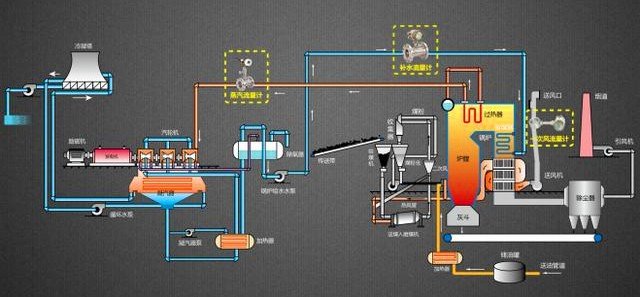
Field Application of Flowmeter in Thermal Power Plant System

The instruments and meters used in thermal power plants mainly include temperature, pressure, liquid level, and flow. There are many types of flowmeter instruments in this system. Depending on the nature of the medium, different flow rates have different effects.

Boiler water supply process

The treatment of boiler make-up water plays a vital role in the overall operation of the boiler. The application of liquid turbine flow meters directly affects the health and smooth operation of the process.

Extended reading: Turbine Flow meter Vs Gear Flow meter

More Featured Liquid Flow Meters

Extended reading: Vortex Hygienic Flow Meter

Sino-Inst, Manufacuturer for liquid turbine flow meters. Like: gas turbine flow meter, gpi turbine flow meter. liquid turbine flow meter. Sanitary turbine flow meter. Insertion turbine flow meter, steam turbine flow meter. And natural gas turbine flow meter.

Sino-Inst’s turbine flow meters, made in China. Having good Quality, With better price. Our flow measurement instruments are widely used in China, India, Pakistan, US, and other countries.

Request a Quote

Please enable JavaScript in your browser to submit the form

Magnetic Water Flow Meter

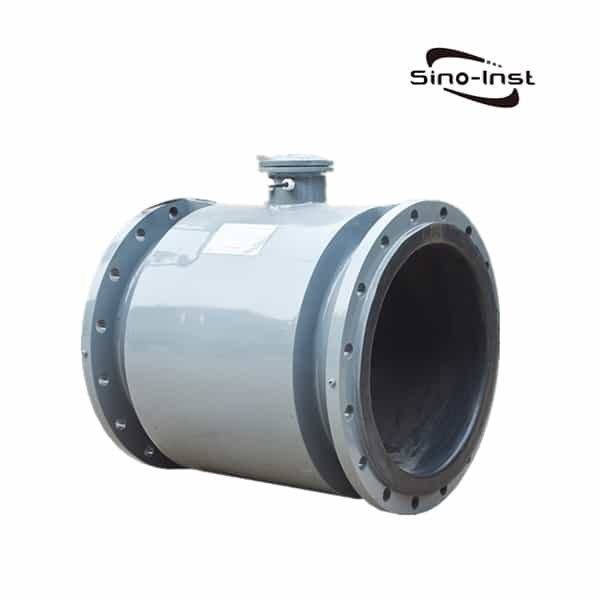
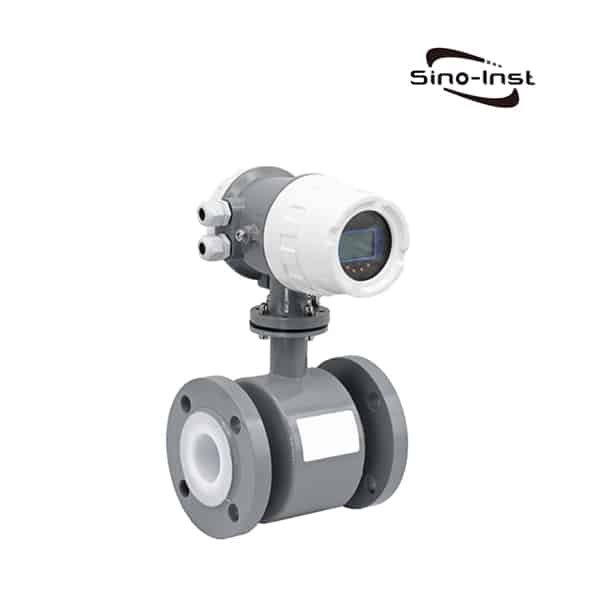
Magnetic Water Flow Meter is an electromagnetic flowmeter used to measure conductive fluids. Conductive liquids such as drinking water, sewage, wastewater, seawater, ammonia, cement slurry, etc.

Magnetic Water Flow Meter provide highly accurate flow measurement for a wide variety of conductive fluid applications. Magnetic Water Flow Meter is a volumetric flow meter that measures liquids or liquid slurries that have a minimum conductivity of 5 µS/cm. Based on Faraday’s law of electromagnetic induction. Magnetic Water Flow Meter is ideal for wastewater applications or any dirty liquid which is conductive or water based. It is widely used in water treatment, environmental protection sewage measurement and control, papermaking and other industrial and agricultural production processes for flow measurement and control.

Sino-Inst offers a variety of  Magnetic Flow Meters for flow measurement. If you have any questions, please contact our sales engineers.

Features of Magnetic Water Flow Meter

  • Not affected by changes in fluid density, viscosity, temperature, pressure and conductivity. The linear measurement principle can achieve high-precision measurement;
  • There are no flow blocking parts in the measuring pipe. The pressure loss is small, and the requirements for straight pipe sections are low;
  • Nominal diameter DN6-DN3000 covers a wide range. There are many choices of lining and electrodes. It can meet the requirements of measuring a variety of conductive fluids;
  • The converter adopts programmable frequency low frequency rectangular wave excitation. It improves the stability of flow measurement and has low power loss;
  • The converter adopts 16-bit embedded microprocessor. Full digital processing, fast calculation speed. Strong anti-interference ability, reliable measurement. High accuracy, flow measurement range up to 1500:1;
  • High-definition backlit LCD display. Easy to use, simple to operate, easy to learn and understand;
  • With RS485 or RS232 digital communication signal output;
  • With conductivity measurement function, it can judge whether the sensor is empty or not. With self-check and self-diagnosis function;
  • Adopt SMD devices and surface mount (SMT) technology. High circuit reliability;
  • Can be used in corresponding explosion-proof occasions.

Guess you like: What is Reynolds number?

Specifications of Magnetic Water Flow Meter

Measuring medium:Conductive liquids
Diameter(mm)DN15~DN3000
Pressure(MPa)DN15-DN300, PN<1.6MPa; DN350-DN800, PN<1.0MPa;
above DN900, PN<0.6MPa;
Measuring tube materialCarbon steel,304 stainless steel
The sensor measures the head materialABS/Polypropylene
Electrode materialSUS316,hastelloy B,hastelloy C
Accuracyflow velocity≤0.5m/s,±1.5%,Full range velocity>1m/s,±1.0%
Medium temperature(ºC)ABS:+80ºC, Polypropylene:+80ºC
Environmental conditions-25ºC~+60ºC
relative humidity5%~95%,
Atmospheric pressure86~106kPa
Straight pipe section requirementsupstream 15D,downstream 10D
Ingress protectionIP65,Optional IP68
Connectionflange connection,threaded connection
Power supply mode:24V power supply or 220V power supply, 3.6V lithium battery power supply
Explosion-proof grade:intrinsically safe ExdⅡia CT2-T5 flameproof ExdⅡCT2-T5
Transmission distance:Two-wire 4-20mA standard current output: ≤1500m;
485 output and HART output: ≤1200m

Take a quick look: How electromagnetic flowmeters work ?

Magnetic Water Flow Meter Applications

KLD electromagnetic water flowmeter can be used to measure the volume flow of conductive fluid in a closed pipeline. It is widely applied in the flow measurement and control in the fields of chemical and petroleum industry, metallurgy industry, water and wastewater, agriculture and irrigation, paper making, food and beverage industry and pharmaceutical industry.

The premise of using Magnetic Water Flow Meter is that the measured liquid must be conductive. The conductivity of the liquid cannot be lower than the threshold, the lower limit. If the conductivity is lower than the threshold, it will cause measurement error until it can not be used.

It can be measured even if the value exceeds the threshold, and the indication error does not change much. The threshold value of general electromagnetic flowmeter is between 10-4~(5×10⁻⁶)S/cm, depending on the model. It also depends on the length of the flow signal line between the sensor and the converter and its distributed capacitance. The product manual usually stipulates the signal line length corresponding to the conductivity.

Read more about: Digital Water Flow Meters

Magnetic Water Flow Meter to Measure Waste Water

The sewage treatment process is mainly through biological oxidation, flocculation, precipitation and other processes to achieve the purpose of sewage purification. At each stage, a certain gauge is needed to measure.

In the sewage industry, according to the characteristics of the corrosiveness, abrasiveness, temperature and condensation of the tested substance and the price tolerance. Different lining and electrode materials should be selected.

In the sewage treatment process, it is necessary to configure corresponding detection instruments according to the process requirements to form a reliable control system.

Generally, sewage treatment plants are equipped with flow meters in the following process inspection procedures:

  1. Water inlet pipe.
  2. Detection of mud volume from primary settling tank to mud storage tank.
  3. Detection of surplus and sludge flow in the sludge pump room.
  4. Detection of the return sludge flow in the sludge pump room.
  5. Detection of the effluent flow of the secondary settling tank distribution well.
  6. Detection of the sludge intake of the digestion tank.
  7. Digestion tank Mud output detection. 8. Flocculation tank reagent input detection, etc.

More about: Sewage Flow Meter Selection

Magnetic Water Flow Meter to Measure Industrial Water

The conductivity of industrial water and its aqueous solution is greater than 10-4S/cm. The conductivity of acid, alkali and salt solution is between 10-4~10-1S/cm, so there is no problem in use. Low distilled water is 10-5S/cm and there is no problem.

The electromagnetic flowmeter cannot measure liquids with very low conductivity. Such as petroleum products and organic solvents. Cannot measure gas, steam and liquids containing more and larger bubbles.

It is found from the data that some pure liquids or aqueous solutions have low conductivity and are considered unusable. However, in actual work, we will encounter examples that can be used because of impurities. Such impurities are beneficial to increase conductivity.

For aqueous solutions, the conductivity in the data is measured in the laboratory with pure water ratio. The actual aqueous solution may be proportioned with industrial water. The conductivity will be higher than found, which is also conducive to flow measurement.

Extended reading: Industrial VS Residential inline water flow meters

Magnetic Flow Meter Price

Electromagnetic flowmeter selection table
KLD               SENSOR
Nominal
diameter
15             DN15 0.19-3.18m³/h
            … Unit:mm
3000             DN3000 
Pressure rating 6           0.6Mpa
10           1.0Mpa
16           1.6Mpa
40           4.0Mpa
          Special requirements
160           16.0Mpa
Connection mode F         Flange
I         plug-in
C         Sanitary type-clamping connection
ST         Sanitary-thread connection
Lining material 1       Polytetrafluoroethylene(PTEE)
2       Polychloroprene
3       Polyurethane rubber
4       F46
5       Fluorosilicone gum
6       PFA
Electrode material Y     One body
F     Separate type
L     Separate type/immersion
Structure of flowmeter 1   SUS316L
2   Hastelloy b 2B
3   Hastelloy b 2C
4   Titanium
5   Tantalum
6   Platinum iridium alloy
7   Stainless steel coated tungsten carbide
Output signal P Volume flow4-20mA/pulse
B Volume flow4-20mA/RS232
M Volume flow4-20mA/RS485
H Volume flow HART protocal output

Extended Reading: LORA water meter

Main performance of lining material:

Lining materialMain performanceScope of application
Polytetrafluoroethylene (PTFE)1. A material with relatively stable chemical properties in plastics can withstand boiling hydrochloric acid, sulfuric acid and aqua regia, but also resistant to concentrated alkalis and various organic solvents, and is not resistant to chlorine trifluoride, high-flow liquid fluorine, liquid oxygen, and ozone. corrosion.
2. Poor wear resistance
Strong corrosive media
such as concentrated acid and alkali
PFACorrosion resistance is the same as PTFE, strong resistance to negative pressureCan be used in negative pressure state
F461. Corrosion resistance is the same as PTFE 2. Low abrasion resistance 3. Strong negative pressure resistance1. Same as PTFD
2. Can be used for low-wear media
Neoprene1. Excellent elasticity, high breaking force, good wear resistance
2. Resistant to the corrosion of a certain low concentration of acid, alkali, and salt media, and not resistant to the corrosion of oxidizing media
Water, sewage, ore slurry, weak abrasive mud
Polyurethane1. Excellent abrasion resistance (equivalent to 10 times of natural rubber)
2. Poor acid and alkali resistance
3. Cannot be used for water mixed with organic solvents
Neutral and strong abrasion slurry, coal slurry, mud, etc.

Corrosion resistance of electrode material:

Electrode materialCorrosion resistance
SUS316Used for industrial water, domestic water, and weak alkali corrosive media,
Widely used in petroleum, chemical, urea, vinylon and other industries
Stainless steel coated tungsten carbideFor non-corrosive, strong abrasive media
Hastelloy B (HB)It has good corrosion resistance to all concentrations of hydrochloric acid below the boiling point, and it is also resistant to sulfuric acid, phosphoric acid, hydrofluoric acid, organic acids, etc.
Corrosion of oxidizing acid, alkali, and non-oxidizing salt solution
Hastelloy C (HC)It is resistant to oxidizing acids, oxidizing salts or other oxidizing agents.
Titanium (Ti)It is resistant to corrosion by sea water, various chlorides and hypochlorites, oxidizing acids, organic acids, alkalis, etc., but not resistant to corrosion by purer reducing acids. But if the acid contains an oxidant, the corrosion is greatly reduced
Tantalum (ta)It has excellent corrosion resistance, which is very similar to glass, except for hydrofluoric acid, fuming sulfuric acid and alkali, it can withstand the corrosion of almost all chemical media.
Platinum-iridium alloyAlmost suitable for all chemical substances, but not suitable for aqua regia and ammonium salt.

Extended Reading: 3 inch (3″) Water Flow Meter

The price of electromagnetic flowmeter is determined by the selection of electromagnetic flowmeter. The Magnetic Water Flow Meter reference price is USD550.00-3000.

The key questions which need to be answered before selecting a magnetic flow meter are:

  • Is the fluid conductive or water based?
  • Is the fluid or slurry abrasive?
  • Do you require an integral display or remote display?
  • Do you require an analog output?
  • What are the minimum and maximum flow rate for the flow meter?
  • What are the minimum and maximum process pressure?
  • What are the minimum and maximum process temperature?
  • Is the fluid chemically compatible with the flow meter wetted parts?
  • What is the size of the pipe?
  • Is the pipe always full?

How much is a 2 inch water flow meter? Let’s find out.

If you have question about Magnetic flow meter,

Please contact us, our engineer will offer help.

Extended Reading: Guide: Magnetic Flowmeter Installation

Featured Water Flow Meters

Extended reading: Sludge flow meter for sewage treatment return activated sludge system

Sino-Inst offers over 50 magnetic water flow meter for flow measurement. About 50% of these are wastewater flow meters, 40% is the liquid flow sensor. And 20% are Ultrasonic Flow Transmitter and mass flow meter.

A wide variety of flow meters options are available to you, such as free samples, paid samples.

Sino-Inst is a globally recognized supplier and manufacturer of flow measurement instrumentation, located in China.

Request a Quote

Please enable JavaScript in your browser to submit the form

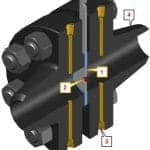
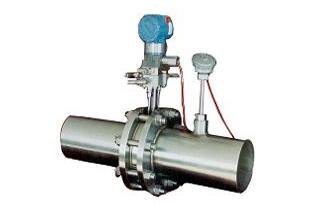
SI-LG Orifice Plate Flow Meter

Orifice plate flow meter also called orifice flow meter or orifice plate. Orifice plate flow meter is a kind of differential pressure flow meter.

Orifice plate flow meter works together with an orifice plate, differential pressure transmitter, with Differential Pressure Measurement principle. Easy installation. Orifice plate flow meters can be used with gases, liquids, corrosive, and high temperature fluids. Orifice flow meters can measure steam, gas, liquids, and many industrial areas. Applications include steam flow, boiler feedwater, and fluid flow rates in building water lines.

Sino-Inst, Manufacturer for differential pressure flow meters. Including the Orifice plate, Venturi, Annubar, etc. Suitable for liquid, gas, and steam flow measurement. Please contact our sales engineers for technical support!

Features of Orifice Plate Flow Meter

  • The structure of the throttling device is easy to copy, simple, firm, stable and reliable in performance, long in service life, and low in price.
  • Orifice flowmeter calculation adopts international standards and processing
  • Wide application range, all single-phase flows can be measured, and some mixed-phase flows can also be applied.
  • The standard throttling device can be put into use without real flow calibration.
  • The integrated orifice plate is simpler to install, no pressure pipe is needed, and it can be directly connected to a differential pressure transmitter and a pressure transmitter.
  • It has a wide range of applications, including all single-phase fluids (liquid, gas, steam) and partial mixed-phase flows. The pipe diameter and working conditions (temperature, pressure) of the general production process can be measured;

Orifice Plate Flow Meter Specification

SI-LG integrated orifice flowmeter is a high-range ratio differential pressure flow device. Composed of standard orifice plate and multi-parameter differential pressure transmitter (or differential pressure transmitter, temperature transmitter and pressure transmitter).

It can measure the flow of gas, steam, liquid and natural gas, and is widely used in process control and measurement in petroleum, chemical, metallurgy, electric power, heating, water supply, and other fields.

Execution standardDesign, manufacture, and installation in accordance with international standard ISO5167-1(1991)(national standard GB/T2624-93),
British standard BS1042 and other standards
Precision level(1)Standard orifice plate, standard nozzle: there are many factors that affect the measurement error.
If the installation and use meet the relevant provisions of international standard ISO5167-1 (1991), the accuracy level can generally reach level 1 ~1.5.

(2) For non-standard orifice plates (such as double orifice plates, circular missing orifice plates, small orifice plates, etc.).
Due to insufficient test data, there is no “standard” to check, so calibration should be conducted after the design and manufacture is completed. (liquid flow is usually calibrated with water. And the air calibrates the gas flow.
The level of accuracy (basic error) can be achieved after calibration: level 1 ~1.5, if not calibrated.
Only by empirical data calculation, design, accuracy in ±2.5%.
Diameter(mm)25,40,50,65,80,100,125,300,350,400, 450,500,600,700,800,900,1000,1200
Nominal working pressure(MPa)0.6,1.0,1.6,2.5,4.0,6.3,10.0,16.0, ≤40Mpa.
(when ≥20Mpa ,it can use high pressure lens orifice plate or welding type)
Conditions of useThe environment temperature:-30ºC~60ºC
Medium temperature:-30ºC~550ºC
Working power supply24VDC/220VAC
Singal remote output4~20mA
Communication outputRS485 communication(Modbus-RTU);
Hart protocol
Signal interfaceInternal thread M20*1.5
(NPT1/2 needs to be customized, long delivery time)
Protection levelIP65 (customized  IP68 for basic model)
Explosion-proof levelExdIICT6 GB
DisplayDifferential pressure, instantaneous flow, cumulative flow

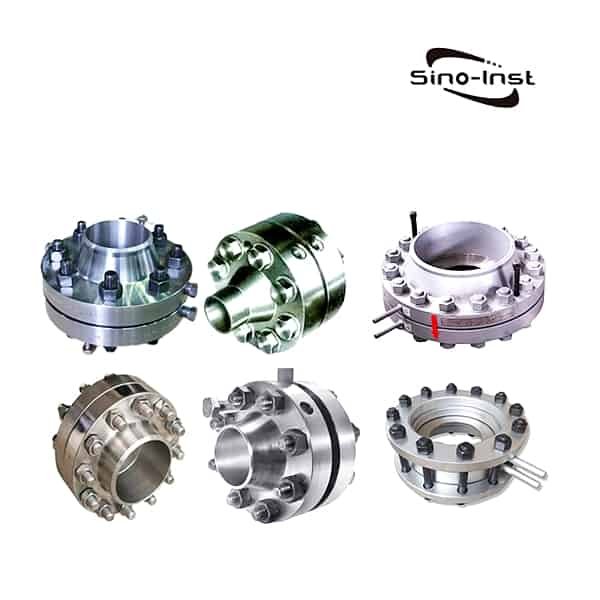
Orifice Plate Types

Sino-Inst supplies all kinds of the orifice plate, for differential applications.

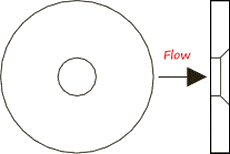
SQUARE EDGE (STANDARD) BORE

For the common square edge concentric bore orifice, the bore and bevel is the standard method of limiting the plate edge thickness.

Unless otherwise specified, plates will be beveled to the currently accepted standards.

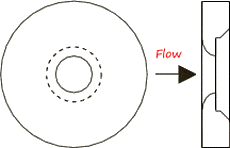
QUADRANT EDGE BORE

The quadrant edge bore is an orifice with the inlet edge rounded. Instead of beveling, the plate is counterbored to the desired edge thickness.

The radius of the quarter circle bore is a function of the orifice-to-pipe ratio (d/D). Thickness at the throat is equal to the radius.

This bore is specifically designed for viscous fluids such as heavy crudes, syrups, and slurries with Reynolds Numbers below 100,000.

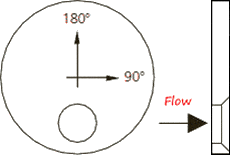
ECCENTRIC BORE

Eccentrically bored orifice plates are plates, with the orifice off-center, or eccentric, as opposed to concentric.

The bore of the eccentric orifice normally is inscribed in a circle, which is 98% of the pipe diameter, so that solids or slurries may pass through.

Eccentric orifice plates are used in many industries, including heavy and light chemicals, steel, paper, nuclear and petrochemicals.

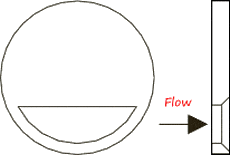
SEGMENTAL BORE

Segmentally bored orifice plates are provided for measurement, where solids are entrained in a gas or liquid flow stream.

The circular portion of the bore is inscribed within a circle, which is normally 98% of the pipe diameter.

The segmental opening may be placed either at the top or bottom of the pipe.

Industries using these bores include sewage treatment, steel, chemical, water conditioning, paper, and petrochemical.

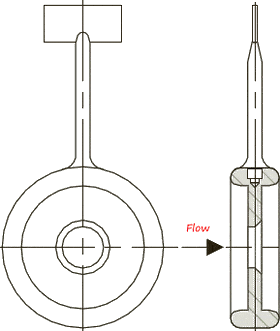
RTJ Type Orifice Plates

The RTJ type orifice plate incorporates an integral gasket, either oval or octagonal ring, for mounting between ring type joint flanges.

It is based on proven technology, has no moving parts and is suitable for high temperature and pressure applications.

RTJ type orifice plates can be supplied complete with ANSI B16.36 orifice flanges.

Orifice plates are recommended for clean liquids, gases, and low-velocity stream flows.

Plate thicknesses depend on line size and differential pressure and should be sufficient, to prevent the plate from bending under operating conditions. Orifice plates can be made in accordance with customer drawings as required.

If you still have questions about orifice plate flow meters, Just contact us. Our engineers will offer help.

Advantages of Orifice Plate Flow Meter

  • The Orifice meter is very cheap as compared to other types of flow meters.
  • Less space is required to Install and hence ideal for space-constrained applications
  • The operational response can be designed with perfection.
  • Installation direction possibilities: Vertical / Horizontal / Inclined.

Orifice Flow Meter Applications

  • Natural Gas
  • Water Treatment Plants
  • Oil Filtration Plants
  • Petrochemicals and Refineries

Of course, in the water supply or wastewater treatment industry, in addition to orifice flowmeters, electromagnetic flowmeters are also the first consideration for many users in the measurement of water flow.
For example, if you need to measure the flow of wastewater in a 2-inch pipe. Then you may refer to: Magnetic Flow Meters Guides.

How much is a 2 inch water flow meter? Let’s find out.

Orifice Plate Flow Meter Installation

1. Meter manifold piping should always be installed to enable calibration as well as to protect the differential element against overage.

2. The meter should be installed as close as possible to the orifice fitting.

3. Always slope the manifold lines gently from the orifice fitting to the meter to eliminate any high or low points in the manifold lines.

4. Use condensate chambers or air traps to remove either liquid from a gas system or gas from a liquid system if lows or highs in the manifold piping cannot be avoided.

It is important when pressurizing or depressurizing differential measuring devices to apply or release pressure to or from the high and low meter chambers uniformly, so as not to impose excessive overage.

What is an Orifice Meter?

An orifice meter is a conduit and a restriction to create a pressure drop.

An hourglass is a form of the orifice.

A nozzle, venturi or thin sharp-edged orifice can be used as the flow restriction.

In order to use any of these devices for measurement, it is necessary to empirically calibrate them.

That is, pass a known volume through the meter and note the reading in order to provide a standard for measuring other quantities.

Due to the ease of duplicating and the simple construction, the thin sharp-edged orifice has been adopted as a standard and extensive calibration work has been done, so that it is widely accepted as a standard means of measuring fluids.

Provided the standard mechanics of construction are followed no further calibration is required.

The minimum cross-sectional area of the jet is known as the “vena contract”.

How does an orifice flow meter work?

I guess most people wondered: What is the working principle of orifice meter?

As the fluid approaches the orifice the pressure increases slightly and then drops suddenly as the orifice is passed.

It continues to drop until the “vena contract” is reached, and then gradually increases, until at approximately 5 to 8 diameters downstream, a maximum pressure point is reached, that will be lower than the pressure upstream of the orifice.

The decrease in pressure as the fluid passes thru the orifice, is a result of the increased velocity of the gas passing thru the reduced area of the orifice.

When the velocity decreases as the fluid leaves the orifice the pressure increases, and tends to return to its original level (To level transmitters).

All the pressure loss is not recovered because of friction, and turbulence losses in the stream.

The pressure drop across the orifice increases when the rate of flow increases.

When there is no flow there is no differential.

The differential pressure is proportional to the square of the velocity, it thus follows that if all other factors remain constant, then the differential is proportional to the square of the rate of flow.

Video source: https://www.youtube.com/embed/oUd4WxjoHKY?rel=0

Equations used in this orifice plate Calculator

Qv = 218.527*Cd*Ev*Y1*(d2 )*[Tb/Pb]*[(Pf1*Zb*hw)/(Gr*Zf1*Tf)]0.5 (3-6)

Where

Cd = Orifice plate coefficient of discharge

d = Orifice plate bore diameter calculated at flowing temperature (Tf) – in.

Gr = Real gas relative density (specify gravity)

hw = Orifice differential pressure in inches of water at 60 degF

Ev = Velocity of approach factor

Pb = Base pressure – psia

Pf1 = Flowing pressure (upstream tap – psia

Qv = Standard volume flow rate – SCF/hr.

Tb = Base temperature – degR

Tf = Flowing temperature – degR

Y2 = Expansion factor (downstream tap)

Zb = Compressibility at base conditions (Pb,Tb)

Zf1 = Compressibility (upstream flowing conditions – Pf1, Tf)

Orifice Plate Flow Meter Calculation

Converters for conversion and calculation of flow. Or a calculation tool that requires flow measurement to obtain other measurement parameters. Help users choose the right flow sensor and transmitter!

DP Flow Meter Output CalculatorFlow Meter 4-20mA Current Output CalculatorFlow Velocity & Pipe Diameter to Volumetric Flow Rate Calculator
Mass Flow & Density to Volume Flow CalculatorMass Flow Rate Unit ConverterVolume Flow Rate Converter
Volume Flow & Density to Mass Flow CalculatorVolumetric Flow Rate & Pipe Diameter to Flow Speed Calculator

Venturi Flow Meter

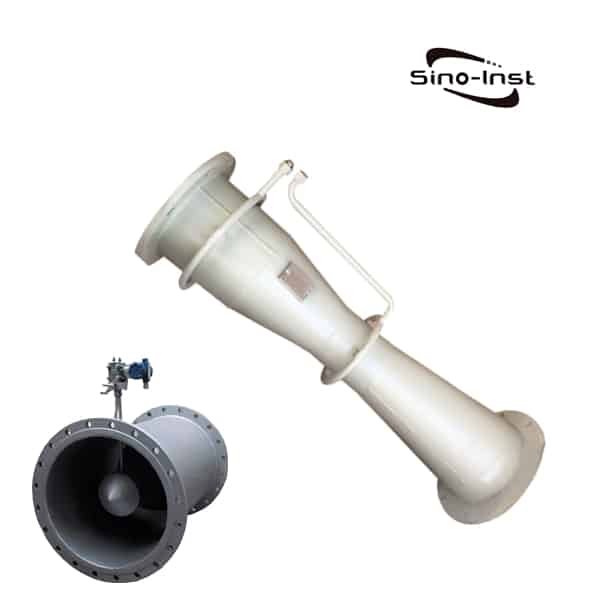
Venturi flow meter is also called classical venturi, and is used to call venturi meter, standard venturi. It is used to measure the flow of single-phase stable fluid in closed pipelines.
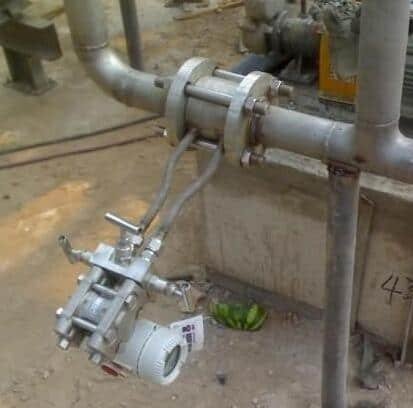
Venturi flow meter is a flow measurement method based on the principle of differential pressure. Commonly used to measure the flow of fluids such as air, natural gas, coal gas, and water. In the standard throttling device, the upstream and downstream straight pipe sections required by it are short. The lasting pressure loss is small, the performance is stable, and the maintenance is convenient.

What is the difference between Venturimeter and orifice meter?

The difference between venturi flowmeter and orifice flowmeter:

Orifice flow meters and Venturi flow meters are very different in many aspects.

In order to reduce the loss of the kinetic energy of the fluid mechanics flowing through the saving components, the Venturi flowmeter uses each section of tapered and divergent tubes to replace the orifice.

The orifice flowmeter is equipped with an interchangeable orifice plate with a small circular hole on the upper side, which is much smaller than the diameter of the pipe. The orifice plate is placed on the side of the fluid mechanics pipe.

More about: Venturi Tube Flowmeter

1.The orifice flowmeter is similar to the Venturi flowmeter in the working principle. But some of the main differences are: the orifice plate can be easily replaced to accommodate a wide range of different flow rates.
The throat diameter of the venturi is fixed, so that the measured flow rate range is limited by the actual pressure difference.

Due to the vortex on the downstream side of the orifice, the permanent loss of the orifice flowmeter is very large.

The structure and shape of the Venturi flowmeter can avoid the formation of vortices, which can greatly reduce permanent losses.

2.The energy loss of Venturi flowmeter in measuring flow is much smaller than that of orifice flowmeter.
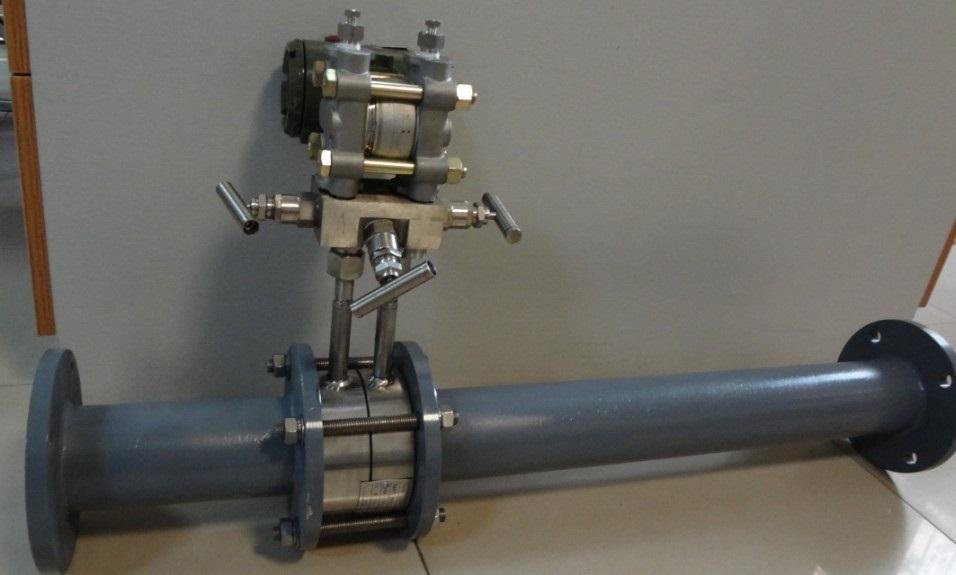
However, because the venturi flowmeter is more time-consuming in manufacturing and processing than the orifice flowmeter, and the price is high, the orifice flowmeter has the least trouble and the lowest cost during pipeline installation.

3.In terms of fluid measurement, Venturi flowmeters are generally used for low-velocity gas flow measurement.

The flow coefficient of the orifice plate in the orifice flowmeter is significantly affected by the fluid disturbance, and this disturbance comes from the influence of the valves, elbows and other pipe fittings installed upstream of the orifice plate. The value of its discharge coefficient is less affected by downstream disturbances. Generally, this kind of flowmeter should be installed at a distance of 50 times and 10 times the pipe diameter from the upstream and downstream disturbance components, respectively. Obviously the required distance is related to the nature of the disturbance.

Therefore, when measuring with an orifice flowmeter, the orifice flowmeter must be installed correctly according to the disturbance of the fluid.

The above is a detailed introduction to the question of “What is the difference between a venturi flowmeter and an orifice flowmeter”, I hope to help everyone.
If you have any other questions about this issue, please click Online Consultation and consult online customer service.

Extended reading:  Flow Nozzle for Steam Flow Measurement

Orifice flow meter

Frequently
Asked
Questions

Orifice Meter is a liquid and gas flow measuring instrument. It is mainly used in high temperature and high pressure measurement conditions. Orifice Meter has the characteristics of high temperature resistance, the temperature can reach 700 degrees, and the pressure is 30MPa. In the field of high temperature and high pressure measurement, Orifice Meter is Use more differential pressure flowmeters.

What is the calibration accuracy of the orifice flowmeter?
The orifice flowmeter is a flow measuring instrument. The accuracy of the orifice flowmeter is within the range of ±0.5% to 1.5%. The orifice flowmeter has the characteristics of high temperature and high pressure. It is mainly used to measure steam and hot air. , Measurement conditions of heat transfer oil.

DPT meter is also a differential pressure transmitter.

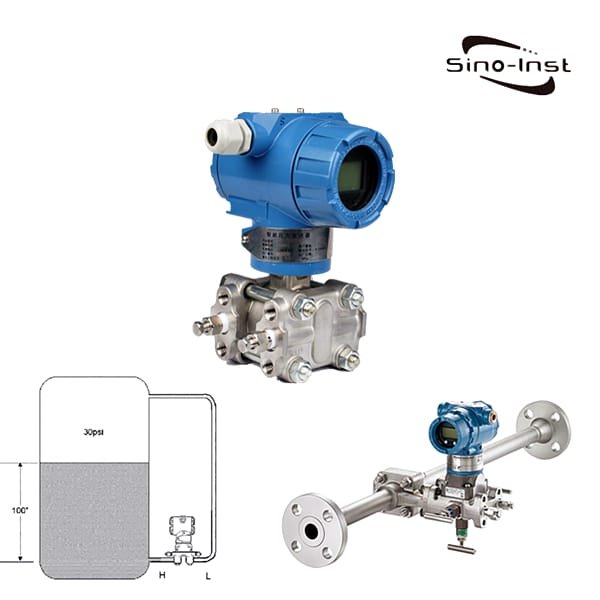
DP transmitters are Differential Pressure Transmitters. DP transmitter measures the pressure difference between the gas or liquid at both ends of the transmitter. Output 4~20mA, 0~5V. Used for liquid level, density and pressure of liquid, gas and steam.

DP transmitters are different from pressure transmitters as they have 2 pressure interfaces. With flanges, capillaries, valve, brackets, throttle devices. Differential pressure transmitters are used to measure the level, density, and flow of liquids, gases, and vapors. Then convert it into 4–20mADC current signal output.

More Featured Products

Related Blogs

  • Digital Flow Meter for Argon Gas

    What is Digital Flow Meter for Argon Gas? Digital flow meter for argon gas refers to a flow meter that can be used for detection, display, transmission, and signal output…
  • What Is a BTU Meter?

    What is a BTU Meter? A BTU meter is a special instrument that measures the thermal energy transferred in a heating or cooling system. BTU meters are also known as…
  • Guide for Digital Fuel Flow Meter

    Digital Fuel Flow Meter is a flow meter dedicated to measuring fuel, diesel, gasoline, and petroleum. Digital Fuel Flow Meter generally has a digital display or signal output. Such as…
  • Water Flow Measurement for Pipes and Open Channels

    Water flow measurement is common in both industry and life. You may often hear about the use of electromagnetic flowmeters to measure wastewater. The clamp-on ultrasonic flowmeter measures large water…
  • Mechanical Water Flow Meters

    Mechanical water flow meters refer to a type of flow meter suitable for clean water processes or applications. The working principle of a mechanical water flow meter is to measure…
  • Flow Totalizer Meter vs Flow Meter

    A flow totalizer meter is sometimes referred to as a flow meter or flow totalizer. flow totalizer meter displays the flow rate from either an analog or pulse output flow…
  • Explore Oil and Gas Flow Meters

    An oil and Gas Flow Meter is A device installed in a pump manifold or treating line to measure the fluid flow rate. Oil and Gas Flow Meters can be…
  • Velocity Flow Meters

    Flow Meter Types There are many types of flow meters. Basically, there are the following types of flow meters Why are there so many types of flow meters? This starts…
  • Strap on Ultrasonic Flow Meters

    What is Strap on Ultrasonic Flow Meters? Strap on Ultrasonic Flow Meter is also often called Clamp On Type Flow Meter. The unique feature of Strap on Ultrasonic Flow Meter…
  • 4-20ma Flow Meters

    What is 4-20ma Flow Meter? 4-20mA Flow Meters are those flow meters with 4-20mA current signal output function. The signal current of general instruments is 4-20mA. This means that the…

Sino-Inst offers 12 orifice plate flow meter products. About 90% of these are flow meters.

A wide variety of orifice flow meter options are available to you, such as brass, carbon steel. You can also choose from free samples.

Sino-Inst is an orifice plate flow meter supplier. Orifice plate flow meter products are most popular in Domestic Market, Southeast Asia, and Mid East.

You can ensure product safety by selecting from certified suppliers, including 375 with ISO9001, ISO14001, and Other certification.

Request a Quote

Please enable JavaScript in your browser to submit the form