
Level Transmitter Types: 8 Technologies Compared
Updated April 2026 — By Sino-Inst Engineering Team
A level transmitter measures the height of liquid, slurry, or solids in a tank and outputs a proportional signal (typically 4–20 mA or digital protocol) for process control. Your choice of technology directly affects measurement accuracy, maintenance cost, and system uptime.
This guide compares the 8 most common types side-by-side with working principles, real-world tradeoffs, and a practical selection framework.
Quick Comparison
| Type | Contact? | Accuracy | Max Range | Best For | Cost |
|---|---|---|---|---|---|
| Radar | No | ±1–3 mm | 70 m | Harsh, foam, vapor | $$$ |
| Guided Wave Radar | Yes | ±2–5 mm | 30 m | Interface measurement | $$$ |
| Ultrasonic | No | ±0.15–0.25% FS | 15 m | Clean liquids, low cost | $$ |
| Hydrostatic | Yes | ±0.1–0.5% FS | 200 m | Water, clean liquids | $ |
| Capacitive | Yes | ±0.5–1% FS | 20 m | Corrosive, solids | $$ |
| Magnetostrictive | Yes | ±0.5–1 mm | 15 m | Custody transfer | $$$ |
| Magnetic Float | Yes | ±6–12 mm | 6 m | Simple point detection | $ |
| Differential Pressure | Yes | ±0.075–0.1% FS | Varies | Closed vessels, steam | $$–$$$ |
FS = Full Scale. Specifications vary by manufacturer.
1. Radar Level Transmitters
Radar transmitters emit microwave pulses (6, 26, or 80 GHz) downward from a top-mounted antenna. The pulse reflects off the liquid surface; the transmitter calculates distance from time-of-flight: D = c × t / 2.
Range reaches 70 meters for low-frequency models. Accuracy is ±1 to ±3 mm depending on frequency. High-temperature versions handle 250°C continuously. The sensor is non-contact—no medium contamination and minimal maintenance.
Radar struggles with heavy foam, which absorbs microwave energy. Use 6 GHz for foamy liquids; 80 GHz for precision. Internal baffles or agitators create false echoes—use a stilling well if needed. Cost is $800–$3,000+, but long operating life justifies it for critical applications.
2. Guided Wave Radar (GWR)
Guided wave radar sends the microwave pulse along a metal probe immersed in the medium. When the pulse hits the boundary between oil and water (different dielectric constants), part reflects—revealing the interface level simultaneously with the total level.
Accuracy is ±2 to ±5 mm over ranges up to 30 m. Probe contact means coating, crystallization, or very viscous fluids can degrade performance. GWR is excellent for small tanks and interface measurement in closed vessels.
3. Ultrasonic Level Transmitters
An ultrasonic transducer (20–200 kHz) sends a sound pulse that reflects off the liquid surface. Distance is calculated from time-of-flight with temperature compensation for the speed of sound in air.
Accuracy is ±0.15–0.25% of full scale. Cost is 30–50% less than radar—the default choice for clean liquid applications. Temperature range is narrow (-20 to +60°C), and foam, dust, and turbulence create measurement noise. Dead band is typically 0.3–0.6 m.
4. Hydrostatic (Submersible) Level Transmitters
A hydrostatic transmitter measures the pressure exerted by the liquid column: P = ρ × g × h. A submersible unit is lowered into the tank with a vented cable for atmospheric reference.
Range is exceptional—up to 200 m water column. Cost is the lowest of any technology ($150–$400). Accuracy degrades if liquid density changes. Periodic cleaning is needed in dirty applications. Not suitable for solids or slurries.
5. Capacitive Level Transmitters
Capacitive sensors (also called RF admittance) measure the capacitance change between a probe and tank wall as the medium rises. The medium’s dielectric constant—much higher than air—causes capacitance to increase with level.
They handle corrosive chemicals well with PTFE-coated probes and work with both liquids and solids. Temperature range is -40 to +200°C. Accuracy depends on the dielectric constant staying consistent—composition changes cause drift.
6. Magnetostrictive Level Transmitters
A magnetostrictive transmitter has a rigid probe with an internal wire. A float with a permanent magnet rides on the surface. Electronic pulses interact with the float’s magnetic field, producing a torsional strain wave that reveals the exact position. Accuracy reaches ±0.5 mm—the highest of any level technology.
Ideal for custody transfer and fuel inventory where every millimeter matters. Simultaneous level and interface measurement is possible with two floats. Max range is about 15 m. Viscous or crystallizing media prevent free float movement.
7. Magnetic Float Level Sensors
A buoyant float with a permanent magnet triggers hermetically sealed reed switches along a stem. Multiple switches provide point-level detection or stepped continuous measurement. These are the simplest and lowest-cost technology ($50–$200).
Accuracy is ±6–12 mm. The float must match the liquid’s specific gravity. Moving parts can jam in viscous or foaming liquids. Some models operate without external power. Read more about magnetic level gauges.
8. Differential Pressure (DP) Level Transmitters
DP transmitters measure the pressure difference between the tank bottom and a reference point: ΔP = ρ × g × h. For closed vessels, both high and low pressure taps are required—the transmitter cancels vessel overpressure.
Accuracy is ±0.075–0.1% FS—the industry standard for steam drums, reactors, and pressurized vessels. Limitations include sensitivity to density changes and complexity of impulse piping.
Featured Level Transmitters from Sino-Inst
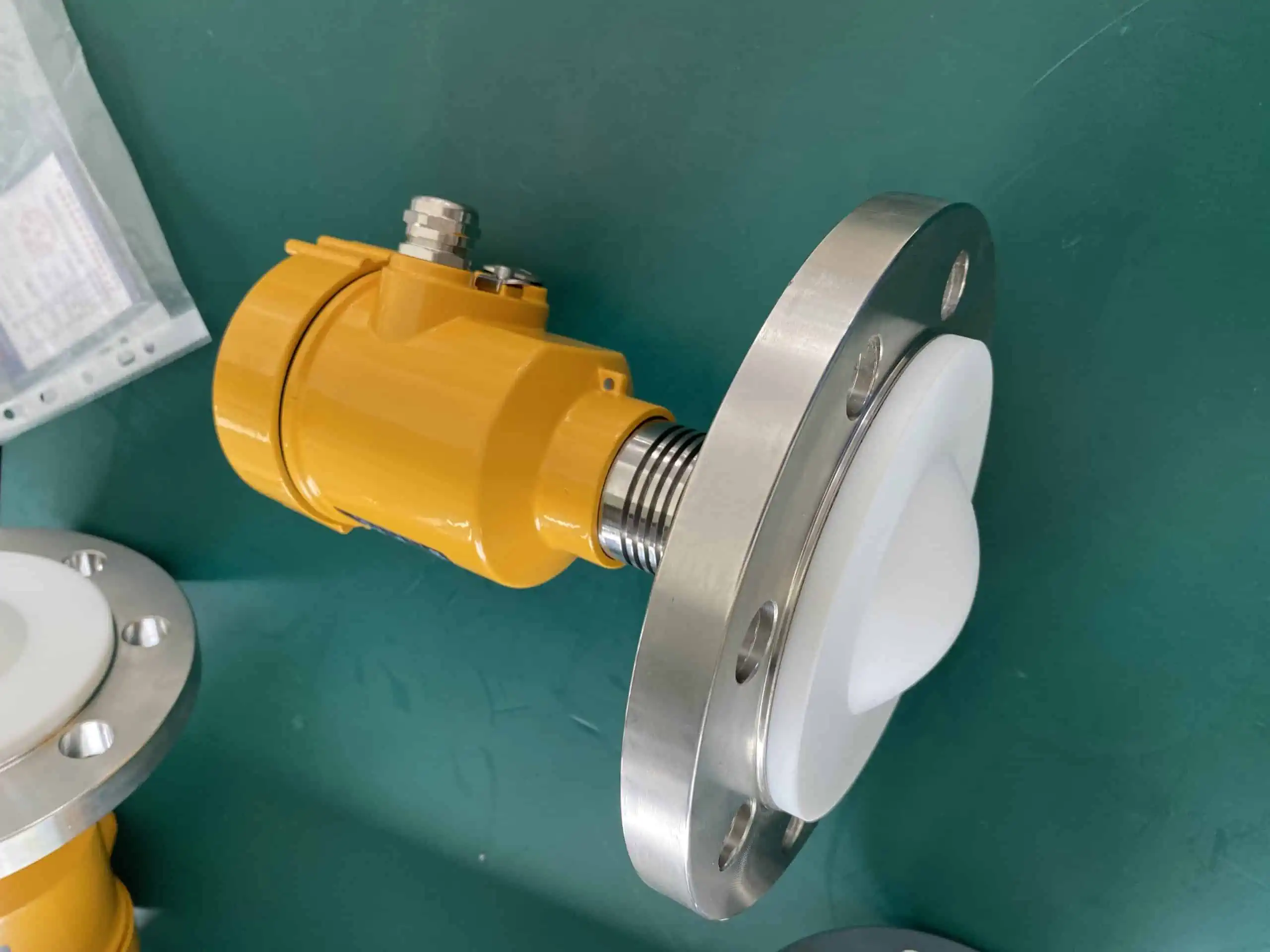

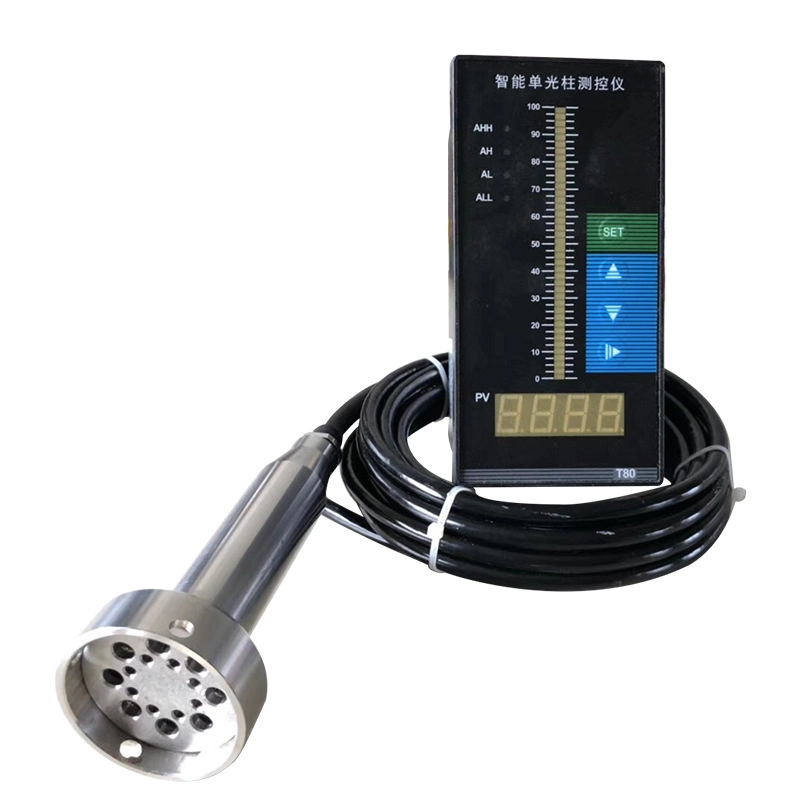
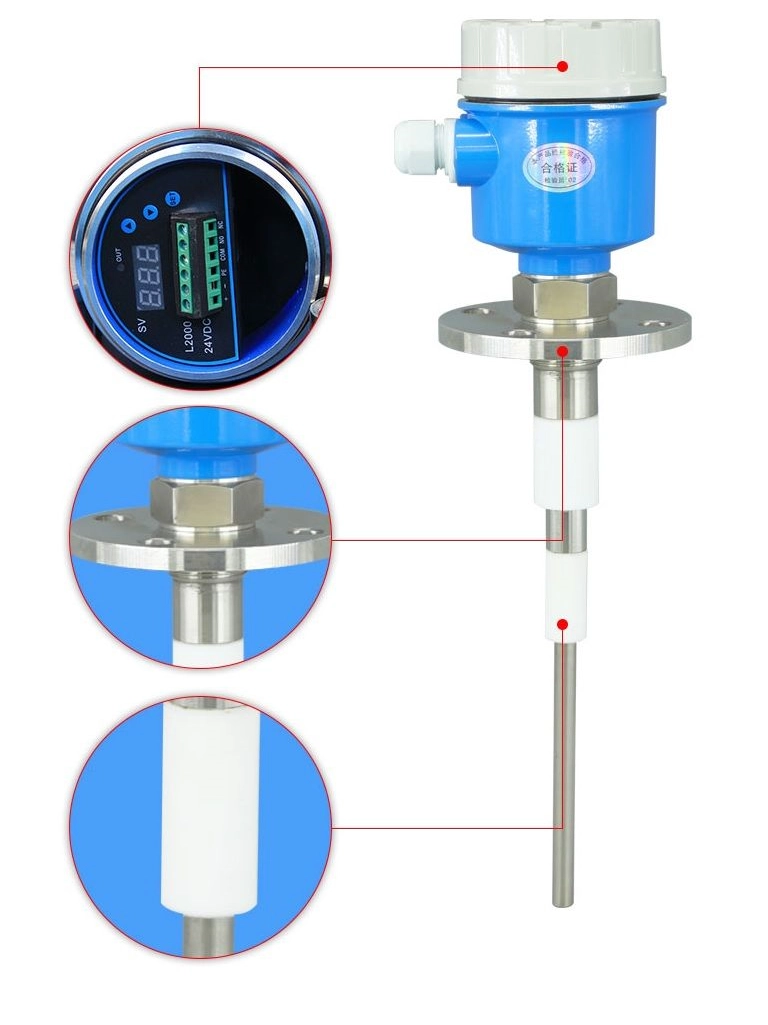
Range: 0–6 m | Output: 4–20 mA
Liquids & solids, corrosion-resistant
Range: 0–15 m | Non-contact
Open channels, tanks & wells
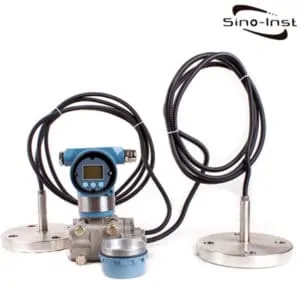
Accuracy: ±0.075% FS | HART
Steam drums & pressurized vessels
How to Select a Level Transmitter
Define your measurement need: Continuous (4–20 mA for PLC) or point-level alarm (on/off)?
Characterize the medium: Liquid, slurry, or powder? Check dielectric constant, chemical compatibility, coating tendency, and density range.
Check process conditions: Temperature, pressure, and hazardous-area classification (ATEX, NEC). Extreme heat (>200°C) eliminates ultrasonic; high pressure limits non-contact options.
Evaluate tank geometry: Tall tanks (>20 m) favor radar, hydrostatic, or magnetostrictive. Internal agitators call for GWR or stilling wells. See our tank level measurement guide for more.
Budget: Lowest upfront: hydrostatic ($150–$400). Best long-term for harsh environments: radar ($800–$3,000). Highest precision: magnetostrictive ($1,000–$4,000). Browse all measurement technologies.
FAQ
What is the difference between a level transmitter and a level switch?
A transmitter outputs a continuous proportional signal (4–20 mA, 0–10 V, or digital) for real-time monitoring. A switch activates at a single preset level—used for high/low alarms or pump start/stop. Most installations use both.
Which transmitter is best for water tanks?
For clean water in open tanks, a submersible hydrostatic transmitter gives the best balance of accuracy, reliability, and cost ($150–$400). For tanks with sediment, an ultrasonic transmitter works well.
Can radar work through foam?
Low-frequency radar (6 GHz) penetrates moderate foam. High-frequency (26, 80 GHz) loses signal through thick foam. For persistent heavy foam, use 6 GHz or install a stilling well.
What is the most accurate level technology?
Magnetostrictive transmitters achieve ±0.5 mm with 0.01 mm resolution. Among non-contact options, 80 GHz radar achieves ±1 mm.
How do I measure corrosive chemicals?
Use non-contact radar with a PTFE or ceramic antenna, or a capacitive transmitter with fully PTFE-encapsulated probe. For extreme corrosion, use a DP transmitter with PTFE-lined diaphragm seal.
Should I choose 4–20 mA or digital output?
4–20 mA is universal and works with every PLC. HART adds diagnostics while keeping the 4–20 mA backbone. Modbus RS485 is fully digital and allows multi-drop wiring. WirelessHART suits remote sites.
Request a Quote for Level Transmitters
Tell us your application requirements. Our engineers will recommend the right level transmitter and provide a competitive quote within 24 hours.
Request a Quote