
Most flow meter accuracy problems trace back to one root cause: not enough straight pipe before and after the meter. Get the upstream and downstream lengths right and a $3,000 magmeter holds its ±0.5% spec. Get them wrong and even a $30,000 ultrasonic meter drifts 5% or worse. This guide gives you the rule of thumb, the by-meter-type table you can paste into a P&ID review, and the ISO / ASME standards that back every number.
Contents
- The 10D/5D Rule of Thumb — Quick Reference
- Why Upstream and Downstream Lengths Matter
- Straight Pipe Requirements by Meter Type
- Orifice and DP Meters: Beta Ratio Drives Length
- Magnetic Flow Meters: 5D Upstream, 3D Downstream
- Vortex Flow Meters: The 35D Reality
- Turbine and Ultrasonic Meters
- Coriolis, Rotameter, and Positive Displacement
- Flow Conditioners and Plate Packs
- ISO and ASME Standards You Can Cite
- 5 Common Installation Mistakes
- FAQ
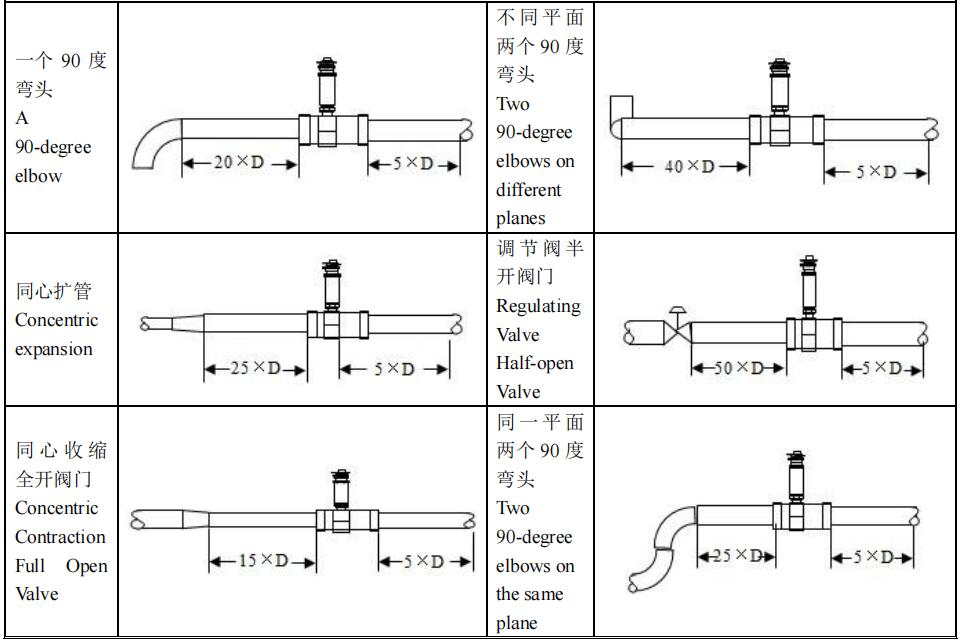
The 10D/5D Rule of Thumb — Quick Reference
The generic field rule is 10 pipe diameters upstream and 5 downstream measured from the nearest disturbance — elbow, valve, reducer, or T. D is the internal pipe diameter. For a 2" nominal Schedule 40 pipe (ID ≈ 1.94"), that gives 19.4" before the meter and 9.7" after.
10D/5D is a starting point, not a universal truth. Magmeters tolerate 5D/3D. Vortex meters routinely need 25–35D. Coriolis meters need none. Treat 10D/5D as your default when you do not yet know the meter type — then refine against the master table below.
Why Upstream and Downstream Lengths Matter
A flow meter measures velocity (or differential pressure proportional to velocity squared). Both depend on a stable, axisymmetric velocity profile across the pipe cross-section. An elbow installed close to the meter throws a swirl into the pipe; a half-open valve creates a jet biased to one side; a reducer accelerates flow non-uniformly.
The numbers are not trivial. Field studies and the Missouri S&T flow meter piping bulletin show errors up to 50% of reading when meters sit immediately downstream of two perpendicular elbows. Straight pipe is how the disturbed profile dissipates and reverts toward fully developed flow.
The upstream length matters more than downstream because that is where the meter sees the flow. The downstream length is shorter because what comes after the sensor cannot retroactively bias the reading — it only matters because pressure recovery can propagate back upstream at low Reynolds numbers.
Straight Pipe Requirements by Meter Type
Use this as your P&ID review cheat sheet. Numbers are typical manufacturer guidance for a single elbow upstream. Two elbows in different planes can double the upstream requirement.
| Meter Type | Upstream | Downstream | Notes |
|---|---|---|---|
| Orifice / DP (β = 0.5) | 15D | 5D | β-ratio dependent; ISO 5167 |
| Orifice / DP (β = 0.7) | 10D | 5D | Lower β tolerates less |
| Magnetic | 5D | 3D | Most forgiving; keep pipe full |
| Vortex | 15–35D | 5D | 35D for two elbows in different planes |
| Turbine | 15–20D | 5D | Include strainer in upstream length |
| Ultrasonic (transit-time) | 10–15D | 5D | 10D for inline; 20D for clamp-on |
| Coriolis | 0D | 0D | Insensitive to flow profile |
| Insertion / averaging Pitot | 20–50D | 5D | Probe creates its own disturbance |
| Thermal mass | 10D | 5D | Sensitive to swirl, not profile |
| Variable area (rotameter) | 0D | 0D | Must be vertical, flow up |
| Positive displacement | 0D | 0D | Mechanical measurement |
Orifice and DP Meters: Beta Ratio Drives Length
ISO 5167-1 and ASME MFC-3M govern orifice plate installations. The required upstream length is a function of two things: the beta ratio (orifice bore / pipe ID) and the type of upstream fitting.
At β = 0.5 with a single 90° elbow upstream, ISO 5167-2 Table 3 requires 14D minimum and 28D for zero additional uncertainty. At β = 0.7, the requirement climbs to 26D minimum (and 44D for zero added uncertainty) because the contraction is sharper and disturbances bias the discharge coefficient more. Conditioning orifice plates with four-hole or perforated patterns cut this to 2–6D regardless of β.
For wedge and Venturi meters, the requirements relax — Venturi can tolerate 4–6D upstream with a single elbow. A wedge flow meter is a useful drop-in when retrofitting limited straight runs in slurry service (see our companion guide on flow meter K-factor chart).
Magnetic Flow Meters: 5D Upstream, 3D Downstream

Magnetic flow meters are the most forgiving major technology. Faraday’s law measures average velocity directly across the cross-section, so a moderately distorted profile averages out. Industry guidance is 5D upstream and 3D downstream from the electrode plane.
Two installation rules trump the straight-pipe number for magmeters. First, the pipe must remain full at the electrode plane — install in a vertical line with flow up, or in a horizontal line with the electrode axis horizontal. Second, grounding rings (or PTFE-lined grounding electrodes) carry signal noise away; missing grounding does more damage than missing straight pipe. For a deeper installation walkthrough see our magnetic flow meter installation guide.
Vortex Flow Meters: The 35D Reality
Vortex shedding requires a stable, axisymmetric inlet profile. Yokogawa’s tutorial for the YEWFLO vortex line and Cross Company’s bulletin both put the typical upstream requirement at 35 pipe diameters and downstream at 5D. That is uncomfortably long for most real plants.
Three practical relaxations: (1) some vendors allow K-factor recalibration trims for 15–20D installations; (2) a tube-bundle flow conditioner ~7D upstream cuts the requirement to 10D; (3) reducer-vortex meter designs include an integral conditioning section. For steam metering where straight runs are scarce, the reducer-vortex variant from our vortex flow meter line is the standard fix.
Turbine and Ultrasonic Meters
Turbine flow meters need 15–20D upstream with the strainer counted as part of that length. Two elbows in different planes push the requirement to 50D. Industrial turbines for custody transfer typically ship with a paired conditioner section to make the total skid 15D. Always specify a strainer with mesh ≤ 0.5 × the smallest moving-part clearance.
Ultrasonic transit-time meters measure path-averaged velocity, so they tolerate more profile distortion than vortex but less than magmeters. Inline ultrasonic spool-piece meters need 10D upstream; clamp-on retrofit installations need 20D because the transducer cannot compensate for swirl. AGA Report No. 9 governs custody-transfer ultrasonic installations for gas; API MPMS Chapter 5.8 covers liquid.
Coriolis, Rotameter, and Positive Displacement
Three technologies sidestep straight-pipe constraints entirely. Coriolis meters measure mass flow via Coriolis force on a vibrating U-tube; the measurement is insensitive to inlet profile. Rotameters use a float in a tapered vertical tube — they must be vertical with flow upward, but elbow proximity does not change the reading. Positive displacement meters trap a known volume per rotation; profile is irrelevant.
When straight pipe is truly impossible, jump to one of these three. Coriolis is the default for high-accuracy low-flow chemical injection; rotameters dominate visual local-readout duty; positive displacement remains standard for viscous fuel oil and lubricant batching.
Flow Conditioners and Plate Packs
A flow conditioner installed in the upstream run cuts the required straight pipe by 50–80% for most profile-sensitive meters. The three common types are tube bundles (4–7D long, 70% reduction), perforated plates such as the CPA 50E or NEL Mitsubishi (1D long, 60% reduction), and vane-type Etoile straighteners (3D long, 50% reduction).
Conditioners add 0.05–0.15 bar flow rate and pressure relationship drop and a procurement cost roughly 30–60% of the meter itself. They pay back when retrofitting metering into a piping run with two close elbows or when meter accuracy is more important than head loss — chemical injection skids, allocation metering, and any custody-transfer station.
ISO and ASME Standards You Can Cite
- ISO 5167-1 through -4 — orifice plate, nozzle, Venturi installation requirements
- ISO 6817 — electromagnetic flow meter installation
- ISO 10790 — Coriolis installation, calibration, performance
- ISO/TR 12764 — vortex shedding flow meter
- ISO 2715 — turbine flow meter
- ISO 17089 — ultrasonic gas flow meter
- ASME MFC-3M-2004 — DP measurement of fluid flow in pipes
- ASME MFC-11-2006 — Coriolis
- AGA Report No. 9 — multipath ultrasonic for custody gas
- API MPMS Chapter 5.8 — ultrasonic liquid hydrocarbon metering
5 Common Installation Mistakes
- Measuring upstream length from the wrong reference. The reference is the centerline of the last disturbance (elbow weld, valve seat, reducer face), not the flange. Off by one fitting and you halve the actual length.
- Counting strainer mesh as part of the straight pipe. A strainer creates its own disturbance. Treat it as a fitting and add 5D after it.
- Installing a magmeter on a horizontal line that drains partially empty. The 5D upstream is wasted if the electrodes see air at low flow. Orient the line vertical with flow up, or pump always-full.
- Skipping the downstream straight run because the meter is "already calibrated". Pressure-recovery effects propagate back to the sensor at low Reynolds numbers.
- Trusting K-factor corrections without re-proving the meter. Field correction works only if you prove against a calibrated reference in service.
FAQ
What does upstream and downstream mean in piping?
Upstream is the pipe run before the device — where the fluid is coming from. Downstream is the pipe run after the device — where the fluid is going. For a flow meter, the upstream side is the inlet face; the downstream side is the outlet.
What is 10D and 5D in flow meter installation?
10D and 5D are shorthand for "ten pipe diameters of straight pipe upstream and five downstream". D is the internal pipe diameter. The 10D/5D rule is the default starting point when meter type is unknown.
Can a flow conditioner replace straight pipe entirely?
No. A conditioner reduces the required straight length by 50–80%, but the meter still needs the conditioner to sit at least 1–7D upstream (depending on conditioner type) and 2–4D between conditioner and meter. For vortex meters, even with a tube bundle you still need 10D total.
Do Coriolis meters really need no straight pipe?
Yes — ISO 10790 confirms Coriolis meters have no upstream or downstream straight-pipe requirement for accuracy. The constraint shifts to keeping the sensor tubes full of liquid and avoiding misalignment that the meter is forced to correct.
Featured Flow Meters from Sino-Inst
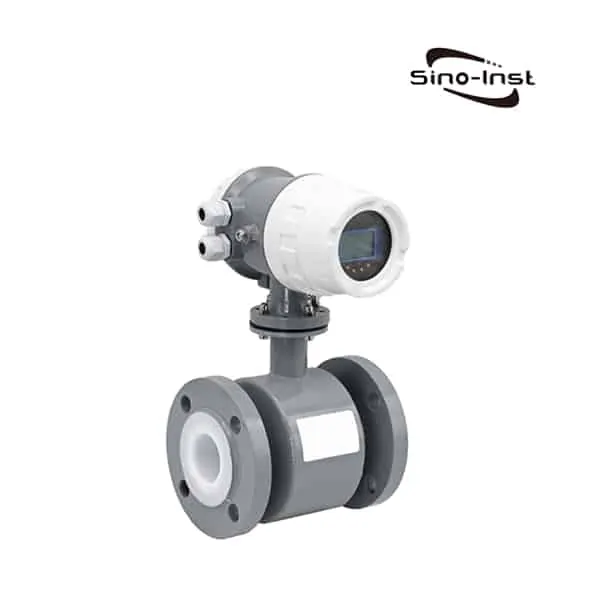
Magnetic Water Flow Meter
DN10–DN3000 | ±0.5% | 5D/3D straight run — the most installation-forgiving full-bore meter for water, wastewater, and conductive liquids.
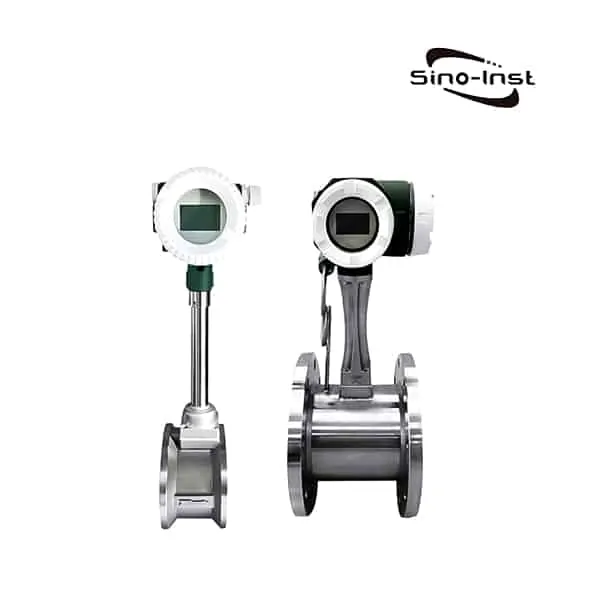
Vortex Flow Meter
DN15–DN300 | ±1% | Steam, gas, low-viscosity liquids. Reducer-vortex variant cuts upstream requirement to 10D.
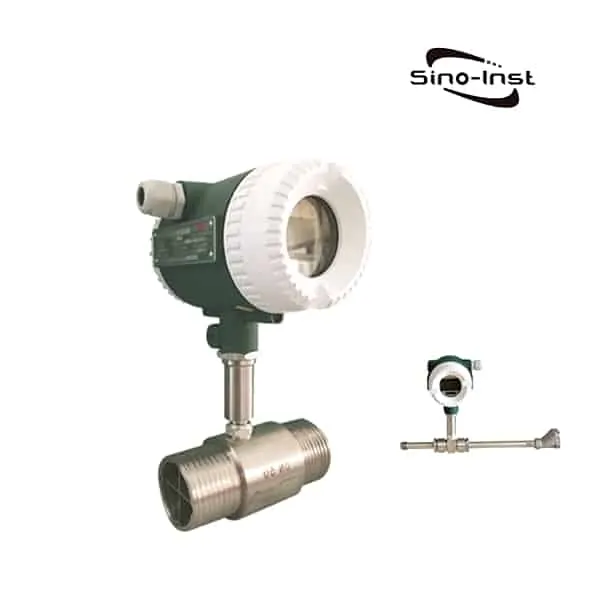
Turbine Pulse Flow Meter
DN4–DN200 | ±0.5% | 15–20D upstream + integral strainer skid. Standard for fuel oil and clean liquid custody metering.
Need Help Picking the Right Meter for Your Piping?
Send us your line ID, fluid, flow range, and a sketch of the surrounding piping. Our process instrumentation engineers will recommend the meter technology that fits the straight pipe you actually have — and quote a complete skid if you need a conditioner.
Related: vertical pipe installation guidance.
Request a Quote

Wu Peng, born in 1980, is a highly respected and accomplished male engineer with extensive experience in the field of automation. With over 20 years of industry experience, Wu has made significant contributions to both academia and engineering projects.
Throughout his career, Wu Peng has participated in numerous national and international engineering projects. Some of his most notable projects include the development of an intelligent control system for oil refineries, the design of a cutting-edge distributed control system for petrochemical plants, and the optimization of control algorithms for natural gas pipelines.