

Updated Apr 25, 2026 — Reviewed by Sino-Inst Engineering Team
A BTU meter for chilled water quantifies cooling energy by combining a flow meter with a matched pair of RTDs on the supply and return. On a typical HVAC loop at 44°F supply / 54°F return (10°F ΔT), the temperature signal — not the flow signal — drives almost all of the billing-grade uncertainty. This guide covers ultrasonic vs electromagnetic selection, why ±0.1°F matched PT1000 pairs are non-negotiable, straight-pipe rules, and BACnet / Modbus integration. For the primer, see What Is a BTU Meter.
Contents
- How a BTU Meter Works for Chilled Water
- Ultrasonic vs Electromagnetic BTU Meters for Chilled Water
- RTD Matched Pairs and Why ΔT Accuracy Matters
- How to Select a BTU Meter for Chilled Water
- Installation Requirements for Chilled Water BTU Meters
- HVAC Integration: BACnet, Modbus, and Certifications
- Applications
- Featured Chilled-Water BTU & Flow Meters
- Frequently Asked Questions
How a BTU Meter Works for Chilled Water
A BTU meter integrates three signals into one energy totalizer: volumetric flow (ṃ), fluid specific heat (cp), and the return-minus-supply temperature difference (ΔT). The governing equation is:
The flow input is volumetric — converted from LPM, m³/h, or GPM into the totalizer’s internal unit. If a spec is in litres per minute but the BMS expects gallons per minute, our LPM to GPM conversion reference gives the exact factor and the US/UK gallon caveats.
Qenergy = ṃ × cp × ΔT
For a chiller plant delivering 500 GPM at 10°F ΔT, that is roughly 2.5 million BTU/hr (about 208 tons). For pulse-output flow meters, the integrator also stores the K-factor (see our flow meter K-factor chart for typical values). The integrator samples flow and both RTDs once per second and totalizes energy in BTU, kWh, MJ, or ton-hours.
The error budget is dominated by ΔT, not flow. At a 10°F design ΔT, a 0.2°F combined RTD error is a 2% energy error. At part-load — where chilled-water plants spend most run hours — ΔT collapses to 5–6°F and the same RTD error costs 3–4%. A ±0.5% flow meter cannot rescue a sloppy RTD pair, regardless of the underlying flow-rate vs pressure relationship in the loop.
Ultrasonic vs Electromagnetic BTU Meters for Chilled Water
Two technologies dominate chilled-water BTU metering. Transit-time Ultrasonic Water Flow Meters measure the time difference of acoustic pulses travelling with and against flow — no wetted parts, no pressure drop, clamp-on variants install without shutdown. Electromagnetic meters apply Faraday’s law and need fluid conductivity above 5 µS/cm, which treated chilled water satisfies.
| Criterion | Ultrasonic (transit-time) | Electromagnetic |
|---|---|---|
| Accuracy (inline) | ±1.0% of reading | ±0.2–0.5% of reading |
| Accuracy (clamp-on) | ±1.5–2% of reading | Not applicable |
| Minimum flow velocity | 0.1 m/s (0.33 ft/s) | 0.3 m/s (1.0 ft/s) |
| Turndown | 250:1 | 100:1 |
| Straight pipe | 10D upstream / 5D downstream | 5D upstream / 3D downstream |
| Pipe size sweet spot | DN50–DN300 | DN300 and above |
| Retrofit (no shutdown) | Yes (clamp-on) | No (flanged/wafer) |
| Pressure drop | Zero | Zero |
| AHRI 600 certifiable | Yes | Yes |
For a typical DN100–DN200 chiller riser with variable primary flow, ultrasonic wins: higher turndown handles the 10–100% load swing, lower minimum velocity keeps measurement alive below 20% load, and clamp-on retrofits skip the shutdown permit. Electromagnetic is the better pick when pipe exceeds DN300, when ±0.5% billing accuracy is required for district cooling, or when full-pipe verification is mandated by the AHJ.
RTD Matched Pairs and Why ΔT Accuracy Matters
EN 1434 and AHRI 600 both require a matched pair of RTDs — the pair is tested together across the operating temperature range and shipped with a calibration certificate tying their offsets to within ±0.1°F (0.05°C) of each other. Absolute accuracy of each sensor matters less than their agreement, because the energy calculation depends on ΔT, not on the two temperatures individually.
Do the arithmetic on a part-load riser at 44°F supply and 50°F return (6°F ΔT). Pair A matched to ±0.1°F — worst-case 0.2°F error on 6°F, or 3.3%. Pair B of unmatched Class A PT100 elements at ±0.25°F each — 0.5°F error on 6°F, or 8.3%. At 3°F ΔT the unmatched pair hits 17% — more than the plant’s annual efficiency budget. This is the 20%-error-at-low-ΔT story every district-cooling billing dispute traces back to.
PT1000 is preferred over PT100 because the higher base resistance (1000 Ω vs 100 Ω at 0°C) makes lead-resistance error roughly 10× smaller for the same cable run. Use 4-wire connections over 10 m and twisted-shielded-pair cable routed away from VFDs. See how to calibrate a flow meter for calibration practice.
How to Select a BTU Meter for Chilled Water
Work through the four questions below in order — each one eliminates options and sharpens the shortlist.
- Pipe size. DN50–DN300 → transit-time ultrasonic (inline or clamp-on). Above DN300 → electromagnetic becomes cost-competitive. See Flow Meter Straight Length Requirements for the straight-run table.
- Design ΔT and turndown. If the plant is low-ΔT (6–10°F) with variable primary pumping, demand a meter with 100:1 turndown and certified minimum flow below 0.3 m/s. If ΔT is a stable 12–14°F, turndown is less critical and electromagnetic’s accuracy edge matters more.
- Retrofit vs new construction. Retrofit into an occupied building with no planned shutdown → clamp-on ultrasonic is the only option that doesn’t trigger a drain-down. New construction or planned tie-in → inline electromagnetic or inline ultrasonic with full pipe-condition verification.
- BMS protocol and billing class. Tenant sub-billing requires MID Module B+D or AHRI 600 certification. BACnet MS/TP, BACnet/IP, Modbus RTU, and M-Bus are the four protocols you will actually encounter; confirm the exact points list and register map before purchase.
For a deeper dive on flow technology for HVAC chilled water, see our Chilled Water Flow Meter Selection Guide.
Installation Requirements for Chilled Water BTU Meters
Straight pipe. 10D upstream / 5D downstream for transit-time ultrasonic, 5D / 3D for electromagnetic. A single 90° elbow one diameter upstream can skew a clamp-on reading by 4–6%. Where mechanical-room congestion forces a compromise, use a flow conditioner or accept the AHRI 600 penalty — the upstream/downstream straight pipe rules give exact elbow-and-valve multipliers.
Sensor location. Install the flow sensor on the return line per EN 1434 §6 — return is closer to ambient, which reduces heat exchange at the sensor. The supply-side RTD thermowell goes within 300 mm of the branch takeoff so the measured temperature reflects what the tenant receives.
Insulation. Chilled water runs below dew point. Insulate the flow sensor body, both thermowells, and the first 150 mm of RTD cable with closed-cell foam plus vapor-barrier tape — otherwise condensation wicks into the junction box and the RTD reads ambient within a season. Thermowell tips should reach past pipe centerline.
Electrical. Electromagnetic meters need a solid pipe ground (earth) on both sides of the meter; grounding rings or reference electrodes on non-conductive pipe. Keep both flow and RTD cables in a separate conduit from VFD and chiller-motor cables — 300 mm minimum spacing or crossed at 90°.
HVAC Integration: BACnet, Modbus, and Certifications
Modern BTU meters expose four output options. BACnet MS/TP at 76.8 kbps over RS-485 is the North American commercial-HVAC default; the meter appears as a BACnet device with analog-input objects for power, flow, supply / return temperatures, plus an accumulator for totalized energy. BACnet/IP is preferred on converged-network campuses. Modbus RTU at 9600 baud covers Asian / European plants and older BMS head-ends. M-Bus (EN 13757) dominates European tenant-billing — two-wire, bus-powered, natively understood by billing gateways.
Three certifications carry real weight. AHRI 600 certifies BTU meter accuracy to ±1.5% of reading across a defined flow and ΔT range — the certificate cited in billing disputes. MID Module B+D (Directive 2014/32/EU) is the EU equivalent and is legally required for any meter invoiced against. UL 916 covers integrator electrical safety and is usually demanded by the AHJ for BMS panels. Ask for paper certificates; do not rely on “compliant with” language on a datasheet.
Applications
- Chiller plant efficiency (kW/ton). BTU meter on the plant header plus chiller power meter gives real-time kW/ton — the single best operator KPI.
- District cooling billing. Meter at every building entry; MID or AHRI 600 certified; ±0.05°C matched RTDs; M-Bus or BACnet/IP to the central billing engine.
- Tenant sub-billing in commercial real estate. One BTU meter per tenant riser or air-handling unit; pulse output or BACnet MS/TP into the property-management system.
- Data-center CRAH/CRAC loops. Low ΔT (8–12°F) and high turndown mandate matched RTDs and a 250:1 turndown meter. Energy data feeds PUE reporting.
- LEED / WELL compliance. Sub-metering credits require calibrated, certified, BMS-logged BTU data over 12+ months.
Featured Chilled-Water BTU & Flow Meters
Sino-Inst supplies the flow-meter component of chilled-water BTU systems — paired with matched PT1000 RTDs and an integrator, the three below cover the full DN15–DN3000 range.
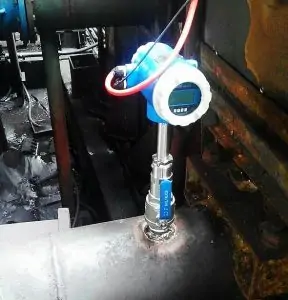
Chilled Water Flow Meter Selection Guide
Technology-by-technology selection walkthrough for chilled-water HVAC — ultrasonic, electromagnetic, turbine and vortex — with pipe-size, accuracy and BMS-protocol decision criteria.
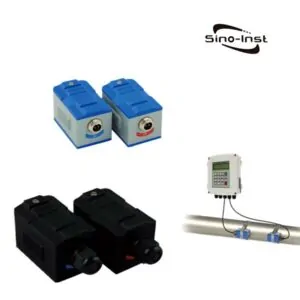
Clamp-On Ultrasonic Flow Meter
Transit-time clamp-on ultrasonic flow meter for DN15–DN6000 pipe — no shutdown, no cutting, ±1.5% accuracy. The default retrofit choice for occupied buildings and existing risers.
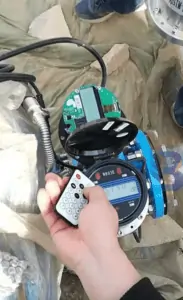
Industrial Magmeter Flow Meter
Electromagnetic flow meter DN3–DN3000 for conductive liquids — ±0.2% of reading, 100:1 turndown, AHRI 600 and MID variants available. The billing-grade choice for district cooling and large risers.
Frequently Asked Questions
Is an AHRI 600 certified BTU meter required for tenant billing?
In most US jurisdictions, AHRI 600 is the accepted standard for tenant sub-billing — it certifies ±1.5% of reading across the declared flow and ΔT envelope. Some states accept MID Module B+D as equivalent. For industrial sub-billing that is not tariff-regulated, a non-certified meter with documented factory calibration is often accepted contractually.
Which BTU meter is best for low-flow chilled water?
Transit-time ultrasonic with 250:1 turndown and certified minimum velocity of 0.1 m/s (0.33 ft/s). Electromagnetic meters typically lose accuracy below 0.3 m/s, which on most risers is 30–40% of design flow. Pair with ±0.1°F matched PT1000 RTDs — at low flow, ΔT also collapses and the RTD pair becomes the dominant error source.
Do chilled water BTU meters support BACnet output?
Yes. Current-generation BTU meters ship with BACnet MS/TP at 76.8 kbps on RS-485 as standard; BACnet/IP over Ethernet is available on higher-tier integrators. Expect 20–40 BACnet objects covering power, flow, supply and return temperatures, ΔT, totalized energy, and alarm status. Confirm the vendor’s BACnet PICS matches your BMS points list.
What is the minimum ΔT for reliable chilled-water BTU measurement?
3°C (5.4°F) is the practical floor, and that is already tight — a matched-pair ±0.1°F RTD set introduces 3.3% error at that ΔT. If you routinely see ΔT below 3°C, the problem is usually hydronic (three-way valve bypass, fouled coils, oversized primary pumps) and should be fixed before trusting the BTU data. Most integrators will flag a “low ΔT” alarm and optionally freeze the totalizer.
PT100 or PT1000 RTDs for a chilled-water BTU meter?
PT1000 is the current best practice for chilled water. The 10× higher base resistance means lead-resistance error drops by roughly 10× for the same cable run — important on building risers where RTD-to-integrator runs of 30–50 m are normal. Both PT100 and PT1000 can be matched pairs; the electrical advantage is what tips the decision.
Can a clamp-on ultrasonic BTU meter be installed without a shutdown?
Yes — that is the main reason it exists. Transducers strap to the pipe exterior with acoustic couplant; RTDs install via strap-on surface-mount pads or hot-tap thermowells. Strap-on RTDs lag real fluid temperature by 30–60 seconds — acceptable for trend monitoring, not for tenant billing.
How often should a chilled-water BTU meter be recalibrated?
EN 1434 requires recalibration every 5 years for billing-grade meters. Plant-efficiency meters can be verified annually against a portable reference and recalibrated only on drift. RTD pairs typically drift slower than the flow element — keep them in place unless the mismatch exceeds 0.1°F at steady state.
Do I need a separate BTU meter for heating and cooling on a changeover system?
No. Bidirectional BTU meters maintain separate heating and cooling energy registers and automatically assign each sample to the correct register based on the sign of ΔT. Common on four-pipe and seasonal changeover systems. Confirm the meter has two independent totalizers accessible over BACnet / Modbus — some budget meters expose only the net energy, which is useless for utility billing.
Related: use a dedicated condensate flow meter for the steam return.
Request a Quote

Wu Peng, born in 1980, is a highly respected and accomplished male engineer with extensive experience in the field of automation. With over 20 years of industry experience, Wu has made significant contributions to both academia and engineering projects.
Throughout his career, Wu Peng has participated in numerous national and international engineering projects. Some of his most notable projects include the development of an intelligent control system for oil refineries, the design of a cutting-edge distributed control system for petrochemical plants, and the optimization of control algorithms for natural gas pipelines.