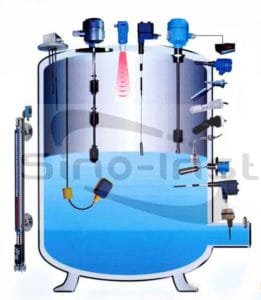
A cryogenic level sensor measures the liquid level of nitrogen, oxygen, argon, hydrogen, or LNG inside vacuum-jacketed (VJ) tanks at temperatures between −162 °C and −253 °C. Because every cryogen has its own dielectric constant, vapor pressure, and stratification behavior, the right sensor changes with the fluid — capacitive probes work for LN2 and LAr, hydrostatic DP transmitters dominate LOX and LNG bulk tanks, and only specialised resistive or superconducting probes survive LH2. This guide picks the technology by fluid, by tank type, and by safety class.
Contents
- Why Cryogenic Level Is Different From Ambient Service
- Five Cryogens, Five Sets of Sensor Constraints
- Capacitive Probe in Liquid Nitrogen and Argon Tanks
- Differential-Pressure Level on LOX, LIN, and LNG Bulk Tanks
- Magnetostrictive and Magnetic-Float Indicators for Dewars
- Superconducting and Resistive Probes for Liquid Hydrogen
- Installation, Boil-Off, and Stratification Rules
- Featured Cryogenic Level & Pressure Products
- FAQ
Why Cryogenic Level Is Different From Ambient Service
A cryogenic tank is never a closed pot of cold liquid. It is a thermodynamically active vessel where the gas head is constantly being generated by boil-off, the liquid is constantly stratified into a warmer top layer and a colder bulk, and the wetted parts of the level sensor see a 200 to 270 K temperature step. That single fact rules out most ambient-service level technologies.
Three failure modes matter most. Cold-shock crack on glass-filled probes during a fast fill, ice plug on any vent line that touches ambient humidity, and density error on hydrostatic measurement when the saturated boil-off layer sits between the head pressure tap and the liquid. A correctly specified cryogenic level sensor solves all three through material choice (austenitic 304/316L or 9% Ni for LNG), a vacuum-jacketed extension neck or stilling well, and a vapor-corrected level algorithm.
The legacy ASME B31.3 and CGA-341 rules for cryogenic piping carry over to level instrumentation: every wetted thermowell, flange, and probe needs a documented cryogenic temperature rating, and any gauge connected to a hydrogen service must additionally meet IEC 60079 IIC zone classification with an internal flame arrestor.
Five Cryogens, Five Sets of Sensor Constraints
The fluid drives the sensor. The table below summarises the four properties that decide which level technology survives: boiling point at 1 atm, liquid density, relative dielectric constant εr, and the highest safety risk class. Use it as the first sieve before discussing specific products.
| Cryogen | BP @ 1 atm | Liquid ρ (kg/m³) | εr (liquid) | Primary risk | Workable level tech |
|---|---|---|---|---|---|
| Liquid Nitrogen (LN2) | −195.8 °C | 808 | 1.43 | Asphyxiation, cold burn | Capacitive, DP, magnetostrictive |
| Liquid Oxygen (LOX) | −183.0 °C | 1141 | 1.49 | Oxidiser ignition | DP (LOX-cleaned), capacitive (Cu-free) |
| Liquid Argon (LAr) | −185.9 °C | 1394 | 1.50 | Asphyxiation | Capacitive, DP, magnetostrictive |
| Liquid Natural Gas (LNG) | −161.5 °C | 422 to 470 | 1.66 to 1.85 | Flammable IIA | DP, servo, GWR with PTFE seal |
| Liquid Hydrogen (LH2) | −252.9 °C | 71 | 1.23 | Flammable IIC, hot spot | Superconducting wire, resistive C-glass, DP |
Two numbers in the table do most of the work. A liquid density of 71 kg/m³ (LH2) means a 5 m tall tank generates only 3.5 kPa of hydrostatic head — close to the resolution floor of a 25 kPa DP cell, which is why pure DP rarely works on hydrogen. And an εr of 1.23 for LH2 versus 1.49 for LOX is the reason a capacitive probe calibrated for liquid oxygen will under-read LH2 by roughly 50% if the user does not retune.
Capacitive Probe in Liquid Nitrogen and Argon Tanks
The capacitive cryogenic level sensor is the workhorse for LN2, LAr, and most laboratory dewars. It is a coaxial probe — an inner stainless rod surrounded by an outer perforated tube — immersed vertically through the tank top flange. The capacitance between the two electrodes scales linearly with the immersed length because the dielectric constant of LN2 (1.43) is far below the gas-phase εr (1.0006).
A simple coaxial form gives C = 2πε₀εrL / ln(b/a), where a and b are the inner and outer radii and L is the wetted length. For a typical 6 mm inner / 12 mm outer probe immersed 1 m in LN2, the capacitance change between empty and full is around 75 pF — large enough that a 1 mm resolution is achievable with off-the-shelf 4–20 mA transmitters.
Two practical mistakes show up on commissioning. First, contractors run the probe cable through the same conduit as a ground-side heater wire, picking up 50/60 Hz noise that breaks the 1 mm resolution claim — the fix is a separate, shielded twisted pair grounded only at the transmitter end. Second, the probe is left dry-calibrated and then dropped into LN2; a 200 K cold-shock causes the PTFE bushing inside the probe head to contract more than the stainless rod, opening a leak path. Soak the probe in vapor for 60 seconds before full immersion to avoid this.
Differential-Pressure Level on LOX, LIN, and LNG Bulk Tanks
Differential-pressure level is the dominant technology on LOX, bulk LIN, and most onshore LNG storage above 50 m³. It uses two diaphragm-seal cells — one at the bottom of the tank reading liquid + gas pressure, one at the top reading gas pressure only — and the level is computed as L = (Pbottom − Ptop) / (ρ · g). The vapor-corrected output is automatic because both cells share the gas head.
Three details separate a working DP install from a drifting one. The capillary fill fluid must be silicone DC-704 for LN2 and LAr (good to −90 °C inside the capillary), but for LOX it must be LOX-cleaned Halocarbon 0.8 oil to avoid an oxygen-promoted ignition path. The bottom diaphragm has to sit on a vacuum-jacketed flange spool so the wetted face stays at tank temperature; otherwise vapor flashes inside the seal cavity and corrupts the head reading. And the top tap needs to draw from the gas dome at least 300 mm above the maximum operating level to avoid liquid pickup during a roll-over event.
For LNG, density correction matters more than for LIN. LNG density varies from 422 kg/m³ (warm boil-off-rich) to 470 kg/m³ (cold sub-cooled), which is an 11% spread. Modern smart DP transmitters take a temperature input from a tank RTD and apply a stored density curve so the level reading does not drift across that envelope.
Magnetostrictive and Magnetic-Float Indicators for Dewars
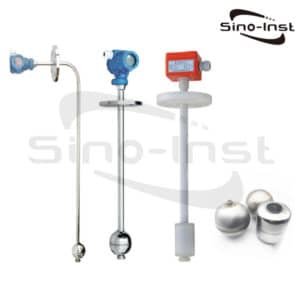
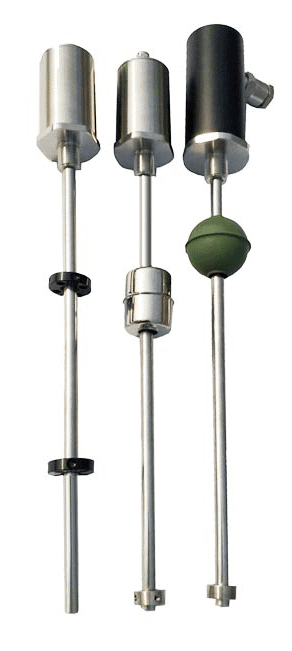
Magnetostrictive level transmitters work on small mobile dewars and on the side-mounted level-sight chambers of vertical LN2/LAr tanks where capacitive probes are not practical. The principle is unchanged from ambient service — a torsion pulse traveling along a nickel-iron wire is reflected by a magnetic float — but the float, the stem material, and the head seal must all be qualified at −196 °C. A standard ambient-service magnetostrictive will fail at the float magnet (room-temperature NdFeB loses 10% of its remanence at 77 K and develops cracks below 60 K) within 50 thermal cycles.
For dewar service, specify a SmCo (samarium-cobalt) float magnet, an Inconel 625 stem, and a vacuum-jacketed head extension. With those upgrades, the device delivers 1 mm resolution and survives 1000+ thermal cycles. Magnetic-flap visual indicators (no power, no electronics, just a chain of red/white flippers driven by the moving magnet) remain popular as a backup readout on safety-critical LN2 storage rooms because they keep working when the SCADA is offline.
Superconducting and Resistive Probes for Liquid Hydrogen
Liquid hydrogen needs a different physics altogether. The 71 kg/m³ density makes hydrostatic DP marginal, and the εr of 1.23 makes capacitance probes only twice as sensitive as gas-phase — not enough for production tanks. Two technologies dominate large-scale LH2 storage at NASA, ITER, and merchant H2 plants.
Superconducting wire probes use a multi-strand NbTi or Nb3Sn wire stretched vertically inside the tank. Above 9.2 K the wire is resistive (about 0.4 ohm/m); below it the wire is superconducting (zero ohm). Liquid hydrogen at 20.4 K cools the wetted segment below the superconducting transition while the gas-phase segment stays normal. The resistance ratio reads out level directly with sub-mm resolution. Because the wire dissipates only 50–200 mW, parasitic boil-off is negligible.
Resistive carbon-glass thermometer ladders are the simpler alternative. A vertical chain of 20 to 50 carbon-glass thermometers reads an order-of-magnitude resistance step on the wetted vs gas-phase elements. Resolution is set by sensor spacing (typically 50 mm) and the technology is fully compatible with IIC explosion-proofing, which is why most road-tanker LH2 trucks use it.
Installation, Boil-Off, and Stratification Rules
Three install rules apply across every cryogen and every technology. Each one corrects an error we routinely see on commissioning visits.
- Slow-fill the probe before service. Vent the tank to atmosphere, crack the fill valve, and let cold vapor flow past the probe for 60–120 seconds before liquid covers it. Direct liquid hit on a warm probe will fracture glass-fibre PCB substrates inside the head.
- Use a stilling well in agitated tanks. Pumping LN2 into a transport bullet creates surface waves of 50–150 mm. A perforated 100 mm stilling pipe surrounding the probe damps the waves below 10 mm and stops the level loop from running away.
- Compensate for stratification on bulk LNG. A 30 m LNG tank can have a 0.5 K stratification top-to-bottom, which becomes a 3% density error. Pair the level transmitter with two RTDs (top quarter, bottom quarter) and let the smart DP cell apply density correction in real time.
Boil-off itself is rarely a level-sensor problem on LIN or LAr (typical evaporation rate is 0.3 to 1% per day on a well-insulated VJ tank), but on LNG bulk storage, a 0.05 to 0.15% boil-off rate combined with the 11% density spread means the level loop must be filtered to a 30-second moving average to avoid actuator hunting. For LH2, boil-off climbs to 1 to 3% per day on smaller dewars, and the level reading is normally combined with a mass-flow boil-off integrator to compute usable inventory.
Featured Cryogenic Level & Pressure Products

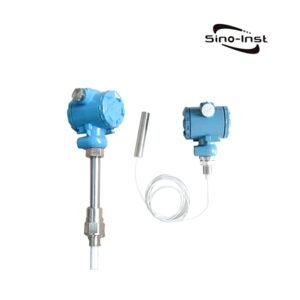
Capacitive Level Sensors
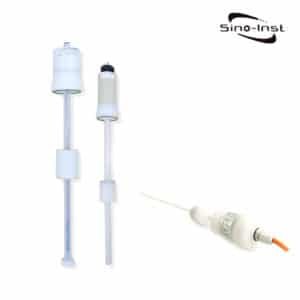
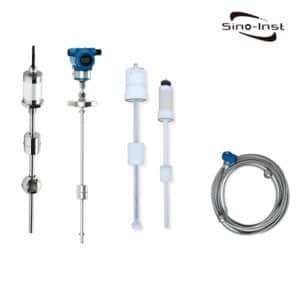
Coaxial RF capacitance probes for LN2 and LAr dewars. PTFE-isolated stainless rods, 304/316L wetted parts, 4–20 mA HART output. 1 mm resolution on 1 m immersion in nitrogen and argon.
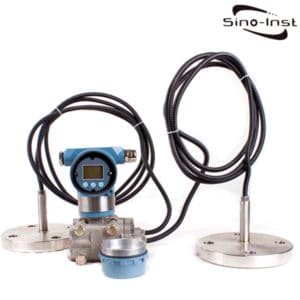
SMT3151LT DP Level Transmitter
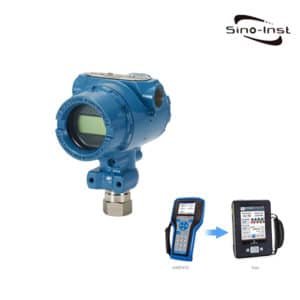
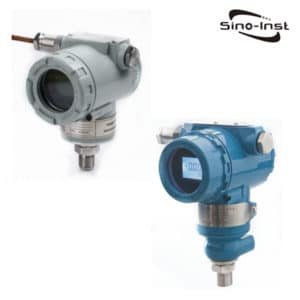
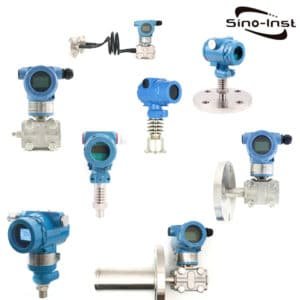
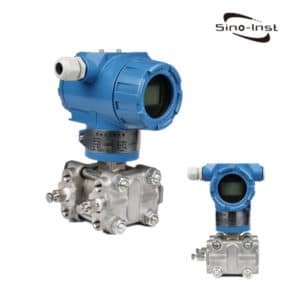
Smart DP cell for vapor-corrected level on LOX, LIN, and LNG bulk tanks. Halocarbon-fill capillary option for LOX service, ATEX/IECEx Ex d, density-compensation block built in.

Cryogenic Pressure Transducers
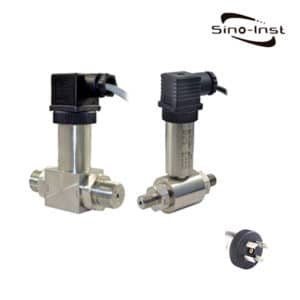
VJ-rated pressure transducers for hydrostatic level on LH2 and LHe service. −269 °C operating, IIC zone certification, mass-balance level computation when paired with a top-of-tank reference cell.
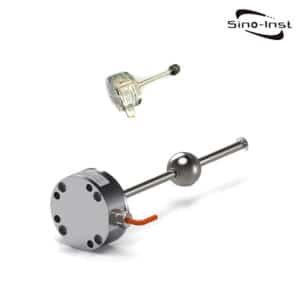
Need help matching one of these to your tank geometry, fluid, and area classification? Tell us the cryogen, the tank height, the operating pressure, and whether the service is bulk storage or a transport dewar — we will return a model-specific recommendation with capillary fill and material call-outs the same business day. For broader level technology context, see our overview of level measurement technologies and the DP level transmitter selection notes. Tank-form factors that affect probe placement are covered in our tank-bottom hydrostatic level guide, and our SI-100 magnetostrictive level transmitter page covers the SmCo float upgrade for dewar applications.
FAQ
What is the most accurate way to measure liquid nitrogen level in a dewar?
A coaxial capacitive probe with a SmCo-magnet stilling well delivers 1 mm resolution on a 1-metre LN2 immersion. Hydrostatic DP works but is limited by the LN2 density of 808 kg/m³ and is normally reserved for tanks above 5 m tall. For sub-millimetre laboratory work, a superconducting wire probe is the only option.
Can a standard 4–20 mA pressure transmitter work as an LN2 level sensor?
Only if it is qualified to −196 °C and the tank has a stable gas head. A non-VJ ambient pressure transmitter mounted on the bottom flange will read correctly until vapor flashes inside the impulse line and locks the reading. Use a vacuum-jacketed bottom-tap configuration or a dedicated cryogenic pressure transducer.
Why does my capacitive LN2 level sensor read 5% high after a fast fill?
Surface foam from a high fill rate creates a 50–150 mm wave layer with a higher effective εr than the bulk liquid. Slow the fill below 50 litres per minute or install a perforated stilling well around the probe; the reading will normalise within 60 seconds.
Are LOX level sensors interchangeable with LN2 level sensors?
Mechanically yes; chemically no. LOX-rated equipment must be cleaned to ASTM G93 Level C, which forbids hydrocarbon residues. A capacitive probe used in LN2 service that has not been LOX-cleaned creates a documented oxidiser-ignition hazard if transferred to LOX service.
How do I measure liquid hydrogen level in a small research dewar?
For dewars below 100 L, a carbon-glass thermometer ladder gives the best price-to-resolution ratio. The wetted carbon-glass elements show roughly a 5× resistance step at the LH2 surface and the technology is intrinsically IIC compatible. Above 100 L, a NbTi superconducting wire probe is preferred for the continuous-readout advantage.
What is the typical accuracy of a DP level transmitter on LNG bulk storage?
With a smart DP cell and density compensation from two RTDs, level accuracy is ±0.1% of span on a 30 m tank, equivalent to about 30 mm. Without density compensation, the same install drifts to ±1% across the warm-cold density envelope of LNG.
Request a Quote


Wu Peng, born in 1980, is a highly respected and accomplished male engineer with extensive experience in the field of automation. With over 20 years of industry experience, Wu has made significant contributions to both academia and engineering projects.
Throughout his career, Wu Peng has participated in numerous national and international engineering projects. Some of his most notable projects include the development of an intelligent control system for oil refineries, the design of a cutting-edge distributed control system for petrochemical plants, and the optimization of control algorithms for natural gas pipelines.