
A piston flow meter measures liquid by counting how many fixed-volume slugs pass through the meter body. Each rotation of the piston pushes one chamber of liquid past a sealed reference, and a magnet on the piston shaft drives a register or a pulse output. Because the volume per cycle is mechanical — set by the bore and stroke at the factory — a piston meter is one of the most accurate ways to measure low-flow viscous liquids without depending on electronics inside the wet path.
PD meters generate one pulse per displacement cycle — the pulse count per litre is the meter’s K-factor, and it is stamped on the calibration certificate.
Contents
- A Piston Flow Meter in One Sentence
- The Four Phases of One Piston Cycle
- Oscillating Piston vs. Reciprocating Piston
- Accuracy, Turndown, and Viscosity Window
- Piston vs. Other Positive-Displacement Meters
- Where the Piston Geometry Wins
- Installation Rules and Failure Modes
- Featured Positive-Displacement Flow Meters
- FAQ
A Piston Flow Meter in One Sentence
A piston flow meter is a positive-displacement (PD) flow meter in which a piston sweeps a fixed volume of liquid through a precision-bored cylinder once per cycle, and a magnet-coupled counter totalises cycles into volume. Because the volume per cycle is fixed by hardware, accuracy is independent of fluid viscosity, conductivity, or temperature within the meter’s operating window — a property no inferential meter (turbine, magnetic, ultrasonic) can match.
The same physics that makes piston meters accurate also makes them the best fit for very low flow (down to a few mL/min) and high-viscosity service (up to ~10,000 cP). Below we walk through the cycle, the two common geometries, and where the piston wins versus the gear, oval-gear, and nutating-disc PD meters.
The Four Phases of One Piston Cycle
One full piston cycle moves a known volume — the swept volume of the cylinder — from inlet to outlet. The cycle is mechanically forced by the inlet pressure; there is no motor and no electronic actuation in the wet path.
- Inlet fill. Inlet pressure forces liquid into chamber A on the inlet side of the piston. The piston is at one end of its stroke, and chamber B (on the outlet side) is full.
- Crossover. A slide valve or rotary valve, mechanically linked to the piston, switches the inlet port from chamber A to chamber B and the outlet port from chamber B to chamber A.
- Discharge / fill. Now chamber B fills while chamber A discharges through the outlet. The piston moves to the opposite end of the stroke.
- Pulse and reset. A magnet on the piston shaft passes a Hall sensor or reed switch, generating one pulse per cycle (or per half-cycle, depending on geometry). The valve crossover happens again, and the next cycle begins.
Volume per pulse is set by the cylinder bore and stroke: Vpulse = π × (D/2)² × L, factory-calibrated and stamped on the meter nameplate. Typical pulse volumes range from 0.5 mL/pulse on a micro-flow meter up to 1 L/pulse on a large oil meter.
Oscillating Piston vs. Reciprocating Piston
Two piston geometries share the “piston flow meter” label, and they have different performance envelopes.
- Reciprocating piston. The piston moves linearly in a cylinder. A crank or slide valve switches the ports at each end of the stroke. Used for very low flow and high precision (volumetric uncertainty <0.1% of reading achievable). The piston is single-acting (one chamber) or double-acting (two chambers, one cycle counts twice).
- Oscillating (rotary) piston. A hollow ring-shaped piston oscillates around a central partition inside a cylindrical chamber. There is no separate valve — the piston geometry itself ports the inlet and outlet flows. Each oscillation displaces a fixed annular volume. Cheaper to build, more tolerant of dirty fluids, slightly lower accuracy (typically ±0.5% of reading).
Reciprocating piston meters dominate laboratory and chemical-injection service where 0.1% accuracy is required. Oscillating piston meters dominate utility water sub-metering and small-batch chemical dosing where 0.5% is acceptable and the lower cost wins.
Accuracy, Turndown, and Viscosity Window
Three numbers define whether a piston meter fits an application: accuracy, turndown, and the viscosity window over which the accuracy holds.
| Spec | Reciprocating piston | Oscillating piston | Why it matters |
|---|---|---|---|
| Accuracy | ±0.05% to ±0.2% of reading | ±0.5% to ±1.0% of reading | Custody transfer needs ≤0.2% |
| Repeatability | ±0.02% | ±0.05% | Critical for dosing |
| Turndown | 50:1 typical, 100:1 in lab | 10:1 to 20:1 | Wide-range process flow |
| Min flow | 0.5 mL/min | 50 mL/min | Catalyst/additive injection |
| Max flow | 50 L/min | 500 L/min | Bulk fuel transfer |
| Viscosity | 0.5–10,000 cP (hot oil 50,000+ cP) | 0.5–500 cP | Heavy fuel, polymer, syrup |
| Pressure drop @ rated flow | 0.3–1 bar | 0.1–0.3 bar | Low-head systems |
The viscosity window is the most underappreciated spec. Inferential meters (turbine, magnetic, vortex) lose accuracy as viscosity rises because the velocity profile inside the meter changes. A piston meter does not — the swept volume is the swept volume regardless of how slowly the liquid moves through it. That is why piston (and other PD) meters are the default for fuel oil, asphalt, and polymer dosing.
Piston vs. Other Positive-Displacement Meters
Piston is one of four common PD geometries. The choice between them is rarely “which is most accurate” — they’re all accurate by design — but rather which geometry fits the fluid, the flow range, and the maintenance budget.
| PD geometry | Accuracy | Best fluid | Particle tolerance | Notes |
|---|---|---|---|---|
| Piston (reciprocating) | ±0.05–0.2% | Clean low-viscosity to thick polymer | Low (≤25 µm) | Highest accuracy of the PD family |
| Piston (oscillating) | ±0.5–1% | Water, fuel, oils | Medium (≤100 µm) | Cheaper, looser tolerance |
| Oval gear | ±0.2–0.5% | Viscous oils, diesel, lube | Low (≤50 µm) | Good for high-viscosity custody transfer |
| Helical gear | ±0.2–0.5% | High-viscosity, high-flow | Low (≤50 µm) | Lower pressure drop than oval at same flow |
| Nutating disc | ±1.0–1.5% | Cold water, building service | Medium | The “domestic water meter” geometry |
| Rotary lobe | ±0.3% | Food, dairy, viscous chemicals | Medium | Sanitary clamp body; CIP-cleanable |
The decision rule we use:
- Need ≤0.1% accuracy on a clean low-flow stream → reciprocating piston.
- Need 0.2–0.5% on viscous oil at moderate flow → oval gear or helical gear.
- Sub-metering water or simple fuel transfer with ±1% acceptable → oscillating piston or nutating disc, whichever is on the shelf.
- Sanitary food/dairy or polymer dosing in a CIP loop → rotary lobe.
For a side-by-side on the gear vs piston decision specifically, see our turbine vs gear flow meter comparison; both gear families share most of their decision logic with the piston meter.
Where the Piston Geometry Wins
Three application classes consistently push the spec line to a piston flow meter rather than another PD or an inferential meter.
- Chemical injection and additive dosing. Catalyst, biocide, scale inhibitor, dye into a process line at flows of 1–500 mL/min. The 50:1 turndown of a reciprocating piston covers the full operating envelope of one injection skid.
- Fuel and lubrication oil custody transfer at low flow. Burner pump skids, generator day-tank metering, lube-oil dispensing carts. Viscosities of 5–500 cP at moderate temperature; piston accuracy holds where a turbine would slow and slip.
- Laboratory and pilot-plant flow measurement. Reactor feed streams, micro-distillation, polymer process development. The volume-per-cycle calibration travels with the meter, no flow standard needed in the lab.
For high-viscosity oil service specifically, see our oval-gear high-viscosity flow meter notes — at viscosities above 1000 cP the gear geometry sometimes beats the piston on pressure drop.
Installation Rules and Failure Modes
Piston meters are mechanically simple but unforgiving on installation. Three install errors account for the bulk of warranty returns.
- Strainer upstream is mandatory. 25 µm cartridge for reciprocating, 100 µm Y-strainer for oscillating. A single grit particle in the cylinder gap scores the bore; once scored, the volumetric reference is gone and the meter is scrap. This is the single biggest reason piston meters fail in service.
- Vapor lock and entrained air. Any air in the inlet pulses the piston at the air’s effective volume — usually higher than the liquid — causing positive bias. Mount horizontally, with a vent or an upstream air separator if the line is gravity-fed or has a pump suction issue.
- Pressure surge on start-up. A check valve closing into a piston meter creates a hammer that can fracture the cylinder casting. Add a soft-start sequence on the upstream pump, or a dampener on the line.
Most reciprocating piston meters also need an annual recalibration check. The wear is at the piston-to-bore clearance — <25 µm new, sometimes 50 µm after a year of service — which slips a small but measurable percentage of liquid past the piston without counting it. Recalibrate against a master meter or a gravimetric stand and re-stamp the K-factor on the nameplate.
Featured Positive-Displacement Flow Meters
The three meters below cover the three roles a piston-class meter is typically asked to fill — pure mechanical pointer for non-electrical service, electronic helical-gear PD for high-viscosity custody transfer, and sanitary clamp-mount PD for food/dairy dosing.
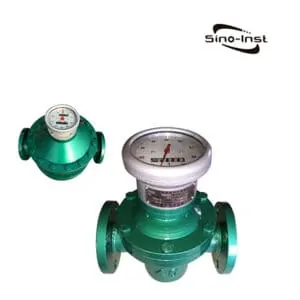
Pointer-Type Oval Gear Flow Meter
All-mechanical PD meter for non-electrical service: diesel transfer, hydraulic fluid, gear oil. Local pointer + 8-digit totalizer, no power needed. ±0.5% accuracy, viscosity 2–200 cP, DN15–DN100 sizes.
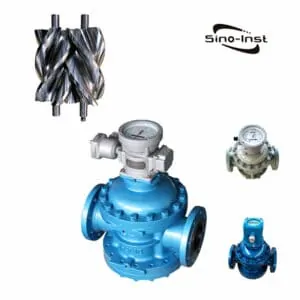
Helical Gear PD Flow Meter
Electronic PD meter for high-viscosity custody transfer: heavy fuel oil, lube oil, polymer melt to 10,000 cP. Pulse + 4–20 mA + Modbus output, ±0.2% accuracy. Lower pressure drop than oval-gear at the same flow.
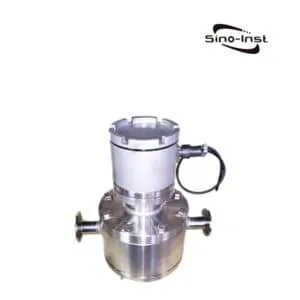
Sanitary Tri-Clamp PD Flow Meter
Sanitary clamp-mount PD meter for food, dairy, and personal-care dosing. 316L wetted parts, EPDM seals, CIP-compatible. ±0.5% accuracy on syrups, sauces, and cosmetic emulsions to 5,000 cP.
FAQ
How does a piston flow meter measure flow?
By counting fixed-volume cycles. Inlet pressure pushes liquid into one chamber, the piston shifts, and a slide valve crossports inlet and outlet so the next chamber fills. Each piston cycle moves a precisely-known volume from inlet to outlet. A magnet on the piston shaft generates a pulse per cycle, totalised by the register or downstream PLC.
Is a piston flow meter the same as a positive-displacement meter?
Piston is one geometry of positive-displacement meter; the others are oval gear, helical gear, nutating disc, and rotary lobe. All PD meters work by trapping known volumes between mechanical surfaces and counting them, but the surface geometry differs and the application fit differs with it.
What accuracy can I expect from a piston flow meter?
±0.05% to ±0.2% of reading for a reciprocating piston in clean service; ±0.5% to ±1.0% for an oscillating piston in utility-water or simple fuel-transfer service. Repeatability is typically a factor of 10 better than accuracy, so piston meters dose chemicals more precisely than they totalise volume on a single fill.
What viscosities can a piston flow meter handle?
Reciprocating piston meters handle 0.5–10,000 cP without recalibration, with hot-oil versions extending to 50,000 cP. Oscillating piston is limited to about 500 cP. Above 10,000 cP a helical-gear PD geometry usually wins on pressure drop.
Why does my piston flow meter need a strainer upstream?
The accuracy of a piston meter depends on a precision-bored cylinder with <25 µm clearance to the piston. A single hard particle in that gap scores the bore; once scored, liquid leaks past the piston without being counted, and the meter is no longer accurate. A 25 µm cartridge or 100 µm Y-strainer immediately upstream prevents this and is a non-negotiable install requirement.
How is a piston flow meter calibrated in the field?
By comparing meter output against a master meter or a gravimetric calibration stand at three flow points (low, mid, high). The K-factor (pulses per litre or per gallon) is adjusted in the totalizer or PLC and re-stamped on the nameplate. For custody transfer the calibration certificate is renewed every 12 months; for general process service every 24 months is typical.
When should I choose a different PD meter over a piston?
Choose oval gear or helical gear when the application is high-viscosity oil custody transfer at moderate flow (the gear geometry has lower pressure drop). Choose nutating disc for cold-water sub-metering where ±1% is fine. Choose rotary lobe for sanitary food/dairy/cosmetic dosing where the meter has to be CIP-cleanable. Stay with piston when accuracy must be ≤0.2% on low flow or the turndown must exceed 30:1.
If you’re sizing a meter for a chemical injection skid, a fuel custody transfer point, or a low-flow viscous service, send the fluid type, viscosity at operating temperature, flow range, and required accuracy — our team will reply with two or three meter options and the K-factor analysis within one business day.
Request a Quote

Wu Peng, born in 1980, is a highly respected and accomplished male engineer with extensive experience in the field of automation. With over 20 years of industry experience, Wu has made significant contributions to both academia and engineering projects.
Throughout his career, Wu Peng has participated in numerous national and international engineering projects. Some of his most notable projects include the development of an intelligent control system for oil refineries, the design of a cutting-edge distributed control system for petrochemical plants, and the optimization of control algorithms for natural gas pipelines.