
Choosing a radar antenna is choosing a beam. Beam angle, near-field length, focusing gain, build-up tolerance, and chemical compatibility all flow from the antenna geometry — not from the radar electronics. This guide compares the five antenna types used on industrial radar level meters (horn, planar/lens, parabolic, rod, and PTFE-clad), then maps each to the tank, dielectric, and process condition it actually fits. See blast furnace radar antenna selection for the lens-antenna + purge-air configuration used on 1200 °C ironworks service.
Contents
- The One-Sentence Antenna Decision
- Five Antenna Types: Beam, Gain, Cost — Side by Side
- Horn Antenna: the General-Purpose Default
- Planar / Lens Antenna for 80–120 GHz Narrow-Beam Tanks
- Parabolic Antenna for Long-Range Open-Air Service
- Rod Antenna for Small Vessels and Branch-Off Nozzles
- PTFE-Clad Antenna for Acid, Caustic, and Sticky Service
- Frequency × Antenna: Why 80 GHz Changed the Decision
- Featured Radar Level Meters by Antenna Type
- FAQ
The One-Sentence Antenna Decision
The antenna controls the beam angle, the beam angle controls how much of the tank wall you have to live with in the radar return, and the wall returns are the single biggest cause of false echoes — so the antenna decision boils down to: get the beam narrow enough that no internal obstruction sits inside the cone. Everything else (build-up tolerance, chemical resistance, cost) is a constraint that limits which narrow-beam option is available.
Once that one rule is in place, the rest of this guide is a lookup: given the tank diameter, the obstruction map, the medium, and the temperature/pressure envelope, which antenna keeps the beam clean.
Five Antenna Types: Beam, Gain, Cost — Side by Side
The matrix below is the field-engineer’s cheat sheet. Beam angle assumes the most common operating frequency for that antenna; the figures shift if you pair an antenna with a non-standard frequency.
| Antenna | Typical frequency | Beam angle (–3 dB) | Max range | Gain | Build-up tolerance | Process T / P | Best for |
|---|---|---|---|---|---|---|---|
| Horn (DN50–DN200) | 26 GHz | 8°–18° | 30 m | 20–28 dBi | Medium — flush bell collects light dust | 250 °C / 40 bar | Most liquids and slurries; default choice |
| Planar / lens | 80–120 GHz | 3°–4° | 30 m (liquid), 80 m (solid) | 27–36 dBi | High — flat smooth face | 150 °C / 16 bar | Narrow nozzles, internal obstructions, small tanks |
| Parabolic | 5.8 / 10 GHz | 4°–6° | 70 m | 30–35 dBi | Low — open dish collects build-up | 80 °C / atm | Open-air silos, water reservoirs, mining stockpiles |
| Rod (PTFE/PP) | 6 GHz | 30°–40° | 10 m | 10–12 dBi | High — non-stick rod | 120 °C / 6 bar | Small vessels, branch nozzles, acidic liquids |
| PTFE-clad horn | 26 GHz | 8°–14° | 20 m | 18–24 dBi | High — chemical-resistant lining | 200 °C / 25 bar | HCl, H₂SO₄, NaOH, latex, syrups |
Two numbers in the matrix carry most of the design weight: the beam angle and the build-up tolerance. The next five sections explain when each antenna deserves the spec line.
Horn Antenna: the General-Purpose Default
The horn antenna is the sensible default on a 26 GHz radar level meter. The conical bell focuses the beam to 8°–18°, and the steel construction handles process temperatures up to 250 °C and 40 bar without an exotic seal.
Geometry rules of thumb for a horn:
- Bell diameter sets the beam width. A DN50 horn at 26 GHz gives ≈18° half-power beam; DN100 gives ≈10°; DN200 gives ≈6°.
- Nozzle clearance. The nozzle bore must be at least the bell diameter, and the bell must extend 10 mm past the inside of the tank roof. A horn that sits inside the nozzle generates a doughnut of false echoes from the nozzle wall.
- Vertical alignment. Tilt of the horn axis must be <1° from vertical. A 5° tilt on a 25 m tank shifts the beam centroid by 2.2 m, which can drag the cone onto an agitator or ladder.
Horns lose to planar/lens antennas when the tank has crowded internals or the nozzle is undersized for an adequate bell — that’s where the next antenna type wins.
Planar / Lens Antenna for 80–120 GHz Narrow-Beam Tanks
An 80 GHz or 120 GHz planar/lens antenna delivers a 3°–4° beam from a face only 50–100 mm across. That combination — narrow beam, small footprint — solves three failure modes that defeat horn radars.
- Tanks under 1.5 m diameter. A horn’s 10° cone clips the wall in any vessel narrower than 1.5 m at 5 m measurement distance; the planar’s 3° cone clears that down to 0.4 m diameter.
- Tanks with internal obstructions. Agitator shafts, heating coils, anti-vortex baffles. A 4° beam threads through gaps that a 12° beam cannot.
- Build-up service. The flat lens surface stays cleaner than a horn bell; condensate runs off and dust does not collect in a bell-shaped pocket.
The trade-offs are temperature and pressure: PTFE/PEEK lens windows top out around 150 °C and 16 bar. Above that, you go back to a horn. For solids tanks and wide silos, a high-frequency lens has changed the economics — see our notes on silo radar level measurement.
Parabolic Antenna for Long-Range Open-Air Service
The parabolic dish is the long-range specialist. A 600 mm dish at 10 GHz produces a 4° beam with 35 dBi gain — enough echo budget to measure 70 m of stockpile at the edge of a quarry crusher.
Parabolic earns its spec line in three jobs:
- Open-air bulk solids. Cement, coal, aggregate stockpiles, fly ash. The high gain handles the diffuse return from a sloped solid surface.
- Water reservoirs and reservoirs. 20 m+ depth with no upper structure to anchor a horn.
- Mining bin level (top-of-pile). Where the dust load and the conical pile angle would defeat any other antenna.
The downside is the dish itself: it collects rain, dust, and bird debris, and it cannot survive a closed pressurized vessel. A parabolic outdoors needs a feed-horn weather cap and a quarterly visual inspection — not a fit-and-forget install.
Rod Antenna for Small Vessels and Branch-Off Nozzles
Rod antennas are the workhorse for the cheap end of the radar level meter market — small vessels, hot-water tanks, condensate receivers, branch-off nozzles where a 1.5 m horn cannot fit.
The geometry trade is clear: the radiating element is a rod of PTFE or PP, 100–250 mm long, that floods the nozzle with a 30°–40° wide beam. This makes rod antennas tolerant of a misaligned mount, but vulnerable to false echoes from anything inside the cone.
- Use a rod antenna when the vessel is <1 m diameter, the nozzle is DN25–DN50, and the medium is a low-corrosion liquid (water, oil, glycol).
- Avoid a rod antenna when the tank has internals, when measurement range exceeds 10 m, or when accuracy needs to beat ±10 mm — the wide beam smears the echo.
The rod’s PTFE construction also gives chemical resistance for free, which carries over to the next category.
PTFE-Clad Antenna for Acid, Caustic, and Sticky Service
PTFE-clad horns and rods are the answer when the medium attacks bare 316L. Hydrochloric acid, sulfuric acid, sodium hydroxide, ferric chloride, latex, syrups, polymer slurries — all eat 316 within months. PTFE shrugs them off.
Two configurations cover most acid/caustic tanks:
- PTFE-clad horn (extended antenna). The horn bell is overlaid with 2–4 mm of PTFE that extends past the flange face. Antenna gain drops by 2–4 dBi vs bare steel, but corrosion vanishes. Used on 26 GHz radars in chemical tanks up to 200 °C / 25 bar.
- PTFE rod (drip-tip). All-plastic radiating element with a teardrop shape that resists wetting. Self-cleaning under condensate and droplet flow. Used on storage tanks for HCl, NaOH, and corrosive condensate streams.
PTFE-clad antennas pair well with the chemical tank scenarios discussed in our sulfuric acid storage tank level radar guide, where the same antenna geometry argues against straight-stainless probes.
Frequency × Antenna: Why 80 GHz Changed the Decision
Antenna and frequency are coupled by the same physics — beam angle is roughly proportional to λ/D, where λ is the wavelength and D is the antenna aperture. Doubling the frequency halves the wavelength, so the same aperture gets you a beam half as wide. This is why 80 GHz radars rewrote the antenna selection table:
| Aperture | Beam at 6 GHz | Beam at 26 GHz | Beam at 80 GHz |
|---|---|---|---|
| 50 mm | ~70° | ~18° | ~6° |
| 100 mm | ~35° | ~10° | ~3° |
| 200 mm | ~18° | ~5° | ~1.5° |
The practical consequence: a 100 mm planar 80 GHz antenna delivers a tighter beam than a 200 mm 26 GHz horn — at a quarter of the nozzle footprint. That is why narrow-beam, small-footprint planar antennas have become the default for new tanks under 5 m diameter and for any retrofit where the existing nozzle is undersized.
For a deeper look at how operating frequency choices interact with antenna selection, see our radar level transmitter frequency range reference.
Featured Radar Level Meters by Antenna Type
One sample sensor for each of the three antennas that cover the most common application classes — horn (default liquids), parabolic (long-range solids), and planar 120 GHz (narrow-beam, small-footprint).
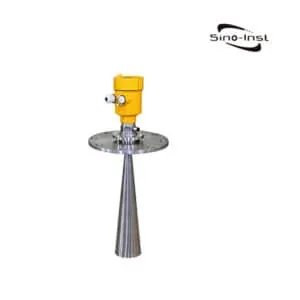
SIRD-905 Horn Antenna Radar
26 GHz horn antenna for sealed pressurized tanks. 8°–14° beam, 30 m range, 250 °C / 40 bar process. Default choice for chemical reactors, fuel tanks, and condensate receivers where a clean horn aperture survives the duty.
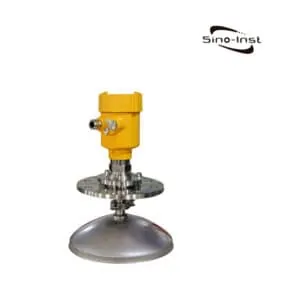
SIRD-904 Parabolic Antenna Radar
10 GHz parabolic dish for long-range open-air service. 4°–6° beam, 70 m range, 35 dBi gain. Used on coal stockpiles, cement silos, water reservoirs and any open-vessel application beyond 30 m.
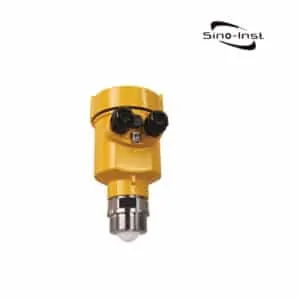
SI-FMF11 120 GHz FMCW Radar (Planar Lens)
120 GHz planar lens antenna with a 3° beam from a 50 mm aperture. 30 m liquid range, 80 m solids. Use on small vessels, congested-internals tanks, and DN50 nozzle retrofits where a horn cannot fit.
FAQ
What is the most common radar level meter antenna?
The 26 GHz horn antenna is still the installed-base default for liquid storage tanks, with beam angles from 8° to 18° depending on bell diameter. The 80–120 GHz planar/lens antenna is the fastest-growing category for new builds, especially small vessels and retrofits with undersized nozzles.
How do I choose between a horn and a planar antenna?
Pick a horn when the process is hot (above 150 °C) or pressurized (above 16 bar) and the nozzle is generous (≥DN80). Pick a planar/lens when the tank is small (<1.5 m diameter), the internals are crowded, the nozzle is undersized (≤DN50), or the medium tends to coat the antenna.
Why does a narrower beam matter?
Anything inside the beam cone returns a radar echo. A 12° beam at 10 m range covers a 2.1 m diameter footprint on the surface — easily wide enough to clip an agitator shaft or a heating coil. A 3° beam at the same range covers 0.5 m, which threads through most internals and removes the false-echo source at the geometry level.
Can a parabolic antenna be used in a closed tank?
No. Parabolic dishes are an open-air technology — they cannot be sealed inside a flange and they collect product on the dish surface in any closed vessel. For closed-tank long range, use an 80 GHz planar antenna with a high-gain lens, not a parabolic.
Does a PTFE-clad antenna lose accuracy?
The PTFE layer absorbs about 2–4 dB of antenna gain compared with bare steel, which costs 3–6 m of maximum range. Accuracy at typical operating distances (under 15 m) is unchanged. The chemical-resistance benefit easily outweighs the gain loss for any acid, caustic, or sticky-medium service.
What antenna should I use on a small condensate tank?
For a tank under 1 m diameter, use either a PTFE rod antenna at 6 GHz (cheap, condensate-tolerant, range under 10 m) or a planar 80 GHz with a 3° beam (more expensive but more accurate, immune to nozzle reflections). Avoid a horn: the bell will not clear the nozzle and false echoes will dominate.
If you have an existing radar-level installation that loses lock or shows a wandering reading, the antenna and the nozzle geometry are usually the first place to look — send the tank drawing and the radar model and our team will diagnose within one business day.
Request a Quote
Related: stilling well pipe sizing.

Wu Peng, born in 1980, is a highly respected and accomplished male engineer with extensive experience in the field of automation. With over 20 years of industry experience, Wu has made significant contributions to both academia and engineering projects.
Throughout his career, Wu Peng has participated in numerous national and international engineering projects. Some of his most notable projects include the development of an intelligent control system for oil refineries, the design of a cutting-edge distributed control system for petrochemical plants, and the optimization of control algorithms for natural gas pipelines.