
Updated 2026-06-01 by the Sino-Inst Engineering Team
Crude oil density looks simple until a custody-transfer reading disagrees with the lab by 0.3% and the money is real. The fix is almost always one of two things: a density quoted without its reference temperature, or an online meter mounted where gas or low flow corrupts the reading. This guide shows how to measure crude oil density properly — the API gravity conversion, the ASTM D1250 temperature correction, and where to put an online density meter so its number holds up at the transfer point.
Contents
- Why crude oil density always needs a reference temperature
- API gravity and density: the conversion
- How to measure it: lab vs online
- Temperature correction with ASTM D1250
- Online density meter placement for custody transfer
- What throws the reading off
- Choosing a method for your duty
- Related density products
- Frequently asked questions
Why Crude Oil Density Always Needs a Reference Temperature
A crude oil density figure is meaningless without the temperature it was measured at. Oil expands as it warms, so the same barrel reads lighter hot and denser cold. The industry settles this by quoting density at a standard reference temperature — 60 °F (15.56 °C), or 15 °C in metric practice. Every custody-transfer number is corrected back to that base so two parties compare like with like.
This is the root of most density disputes. One side reports a field reading at 32 °C, the other a lab value corrected to 15 °C, and the gap looks like an error when it is just physics. The discipline is simple: never state crude oil density without its reference temperature, and never compare an uncorrected field reading to a standardized one. Get that habit right and most “0.3% discrepancies” vanish before they reach the commercial team.
API Gravity and Density: The Conversion
API gravity is just a rescaled way of expressing density relative to water, defined at 60 °F. The two convert directly. To go from specific gravity to API gravity, use API = 141.5 / SG − 131.5. To go the other way, density in kg/m³ = 141,500 / (131.5 + °API), with the result at the 60 °F reference. Water sits at 10 °API; most crudes fall between roughly 10 and 45 °API, where higher API means lighter oil.
| Crude grade | API gravity | Density @ 60 °F (kg/m³) |
|---|---|---|
| Light | > 31.1 °API | < 870 |
| Medium | 22.3–31.1 °API | 870–920 |
| Heavy | 10–22.3 °API | 920–1000 |
The classification matters because it drives both pricing and the measurement method. A light 38 °API crude behaves very differently in a meter than a heavy 14 °API one near its wax point. If you are choosing instruments, our overview of density meters and their types sets out the options before you match one to a grade.
How to Measure Crude Oil Density: Lab vs Online
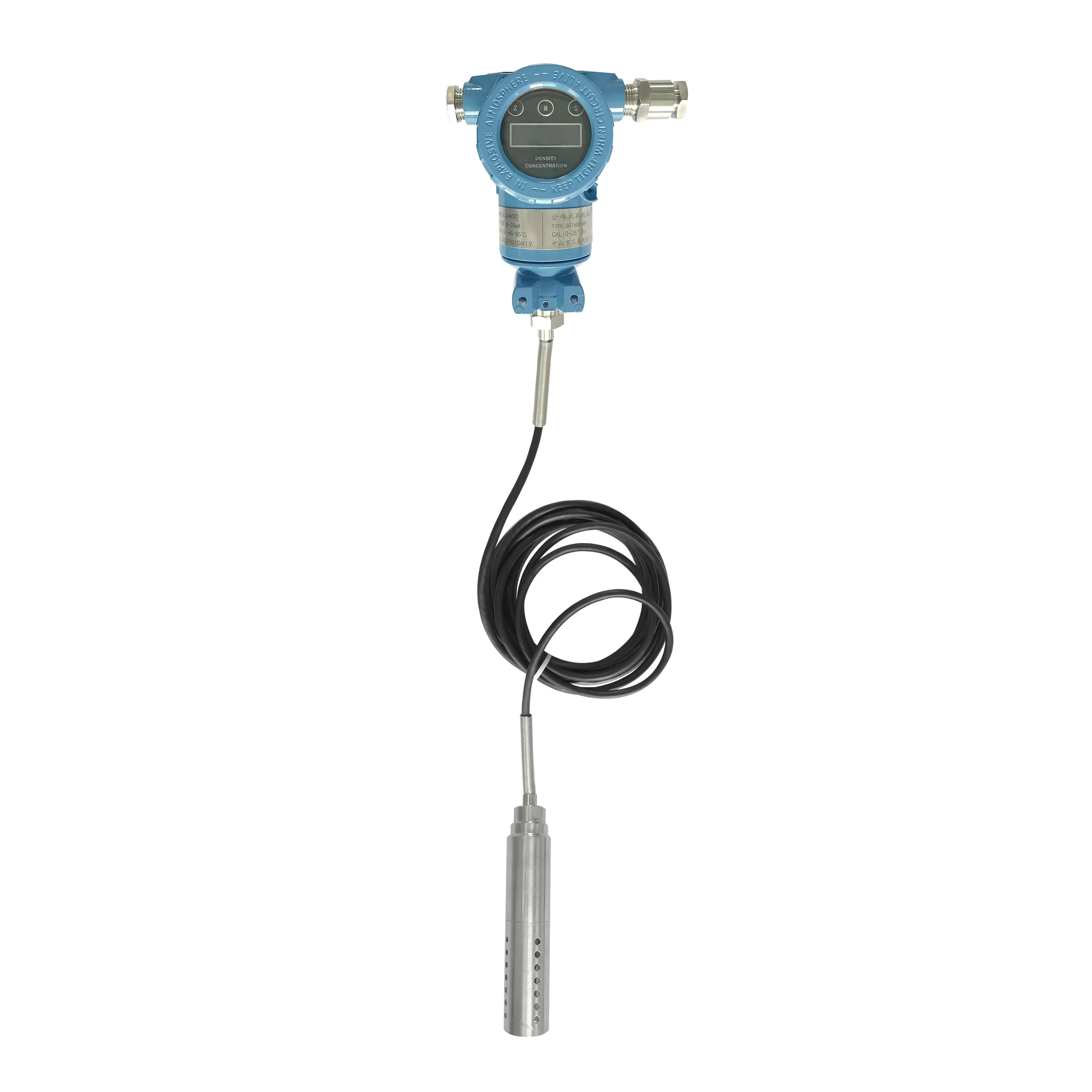
There are two routes, and they answer different needs. The laboratory route takes a spot sample and measures it under controlled conditions — the hydrometer method of ASTM D1298, or the oscillating U-tube digital density meter of ASTM D4052 (with ASTM D5002 specific to crude oils). It is the reference for dispute resolution and quality certificates. The online route puts a meter in the pipe — a Coriolis or tuning fork density meter — and reads density continuously for real-time custody and blending.
| Method | Standard | Use | Note |
|---|---|---|---|
| Hydrometer | ASTM D1298 | Field / lab spot check | Cheap; operator-dependent |
| Digital U-tube (lab) | ASTM D4052 / D5002 | Reference, certificates | High accuracy on a sample |
| Coriolis (inline) | — | Real-time custody / mass | Density + mass flow together |
| Tuning fork (inline) | — | Continuous process density | ±0.0005 g/cm³ achievable |
For custody transfer most operators run both: an online meter for the live, ticket-by-ticket value and periodic lab samples to verify it. The online meter keeps the transfer moving; the lab keeps everyone honest. A good online density meter reaches ±0.0005 g/cm³ — fine enough for transfer — provided it is installed where the fluid is representative, which is the part people get wrong.
Temperature Correction with ASTM D1250
Whatever instrument you use, the raw reading is at line temperature and must be corrected to 60 °F. ASTM D1250 — the same content as API MPMS Chapter 11.1 — provides the petroleum measurement tables that do this. The correction for temperature on the liquid (CTL, sometimes called the volume correction factor, VCF) scales the observed value to the standard base using the fluid’s thermal expansion behaviour.
The reason a generic correction will not do: thermal expansion varies with the oil. Lighter fractions expand more per degree than heavy ones, so D1250 keys the correction to the fluid’s density class rather than applying one slope to everything. In practice the meter’s flow computer applies the D1250 algorithm automatically from the live temperature and density. Your job is to confirm it is using the current standard tables and the right product group — not to interpolate paper tables by hand. Mismatched product groups are a quiet source of transfer error.
Online Density Meter Placement for Custody Transfer
Where you mount the meter decides whether its number survives an audit. The fluid at the sensor must be single-phase, representative, and stable. That means downstream of the pump where pressure is high enough to keep gas in solution, in a full, flooded line — never a section that can run partially empty — and away from low-flow dead legs where the sample stagnates. A vertical run with upward flow helps keep the line full and sweeps gas through rather than trapping it.
A case from our field files makes the point. An export station mounted a tuning fork density meter on a gas-entrained section upstream of the booster pump. Entrained bubbles dropped the indicated density about 0.4% — straight onto the wrong side of the transfer. Moving it to the stabilized, pressurized line after the pump and adding a small gas-eliminator brought it back within 0.1% of the lab. Nothing was wrong with the meter; the location was wrong. The same care applies to heavier duties such as slurry density measurement.
What Throws the Reading Off
- Entrained gas — bubbles lower indicated density; stabilize pressure and de-gas before the meter.
- Free water / emulsion — a separate water phase reads as a density anomaly; account for BS&W.
- Wax near the cloud point — light crudes near their wax point drift; keep the line warm and flowing.
- Missing temperature correction — an uncorrected field value compared to a 60 °F lab value looks like a fault.
- Wrong product group in D1250 — using the lubricant or refined-product table for crude skews the correction.
Choosing a Method for Your Duty
Match the method to the job. For a one-off check or a dispute, take a sample and run ASTM D1298 or a lab D4052/D5002 density. For continuous custody transfer or blending, install an inline Coriolis or tuning fork meter in a stabilized line and let the flow computer apply D1250. For mass-based accounting, a Coriolis meter gives density and mass flow in one device. Whatever you pick, store the reference temperature with every value and verify the online meter against the lab on a schedule. Our review of industrial density meter applications and the note on Coriolis density measurement go further on selection.
Related Density Products
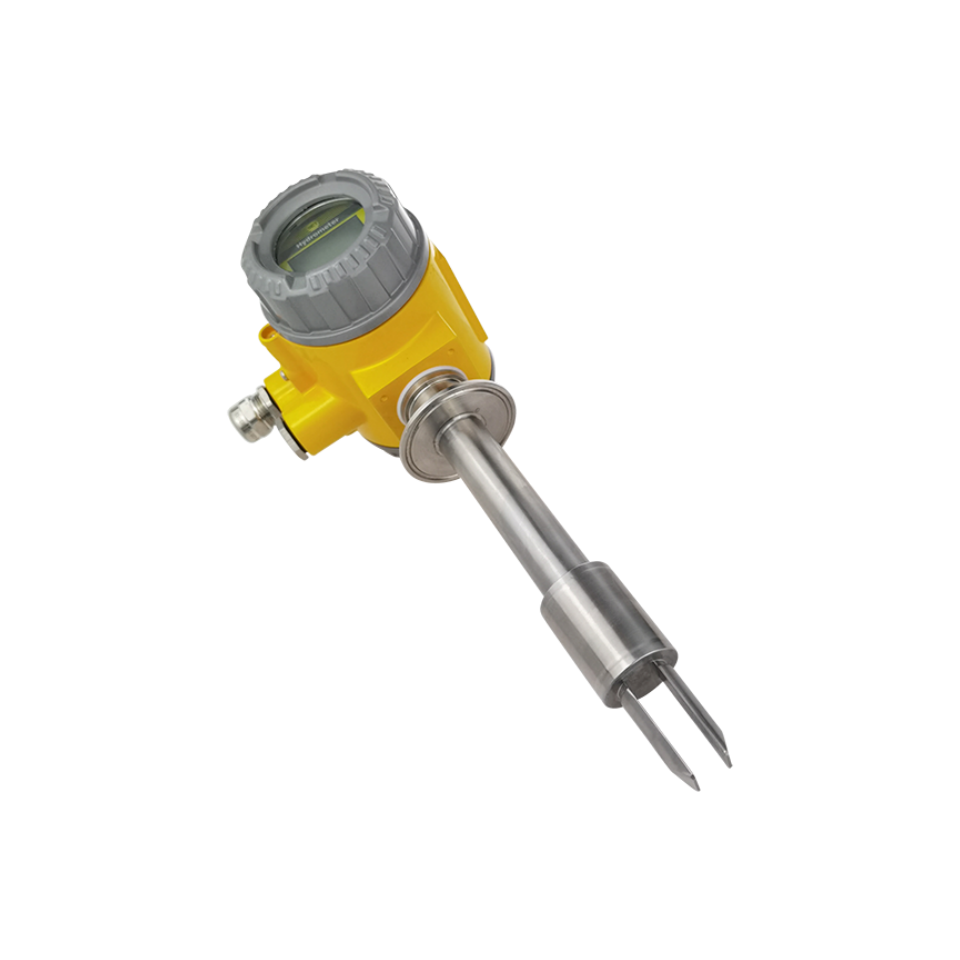
Tuning Fork Density Meter
Inline density meter for crude, fuels, and process liquids. Continuous density to ±0.0005 g/cm³ with temperature output for D1250 correction at the flow computer.
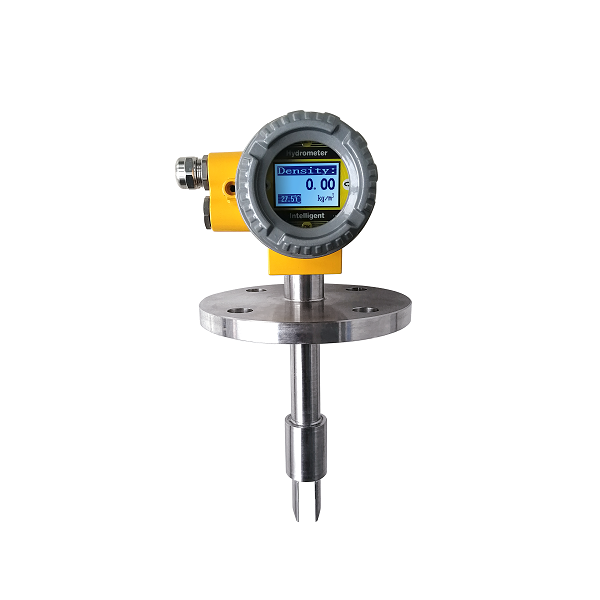
Online Density Meter
Flange-mounted meter for stabilized, flooded transfer lines. Real-time density and temperature for live custody tickets and blending control.
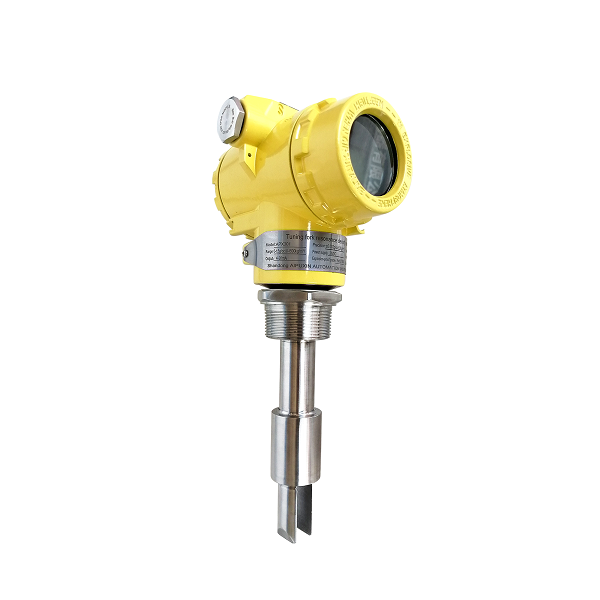
Threaded Inline Density Meter
Threaded process-connection version for small-bore sample and side-stream loops. Same fork sensing for spot custody verification next to the main line.
Frequently Asked Questions
How do you convert API gravity to density?
Use density in kg/m³ = 141,500 / (131.5 + °API), giving the value at the 60 °F reference temperature. To go the other way, API = 141.5 / SG − 131.5, where SG is specific gravity at 60 °F. Water is 10 °API; most crudes fall between 10 and 45 °API.
What standard is used to correct crude oil density for temperature?
ASTM D1250, identical in content to API MPMS Chapter 11.1, provides the petroleum measurement tables. The correction for temperature on the liquid (CTL or VCF) scales the observed density or volume to the 60 °F base using the fluid’s thermal expansion, keyed to its product group.
Should crude oil density be measured in a lab or online?
Both, for custody transfer. An online Coriolis or tuning fork meter gives the live, ticket-by-ticket density, while periodic lab samples by ASTM D1298 or D4052/D5002 verify it. The lab is the reference for disputes; the online meter keeps the transfer moving in real time.
Why does my online density meter read low?
The most common cause is entrained gas. Bubbles in the fluid lower indicated density, often by a few tenths of a percent. Mount the meter downstream of the pump in a stabilized, flooded line, add a gas eliminator if needed, and avoid low-flow dead legs. Free water and wax can also skew the reading.
What is the reference temperature for crude oil density?
60 °F (15.56 °C), or 15 °C in metric practice. Because oil expands with temperature, every density and API gravity figure is corrected back to this base so measurements compare on a common footing. Always record the reference temperature with the value.
About this article
Written and technically reviewed by the Sino-Inst engineering team — last reviewed 2026-06-01 (AI-assisted drafting). Based on ASTM D1250 / API MPMS 11.1, ASTM D1298, and D4052/D5002, plus field experience installing online density meters on crude custody-transfer lines. Questions? Reach our application engineers.
Request a Quote
Tell us your crude grade, line conditions, and whether you need custody-grade accuracy. A Sino-Inst engineer will recommend the right density meter and installation for a reading that holds up at the transfer point.
Request a Quote

Wu Peng, born in 1980, is a highly respected and accomplished male engineer with extensive experience in the field of automation. With over 20 years of industry experience, Wu has made significant contributions to both academia and engineering projects.
Throughout his career, Wu Peng has participated in numerous national and international engineering projects. Some of his most notable projects include the development of an intelligent control system for oil refineries, the design of a cutting-edge distributed control system for petrochemical plants, and the optimization of control algorithms for natural gas pipelines.