
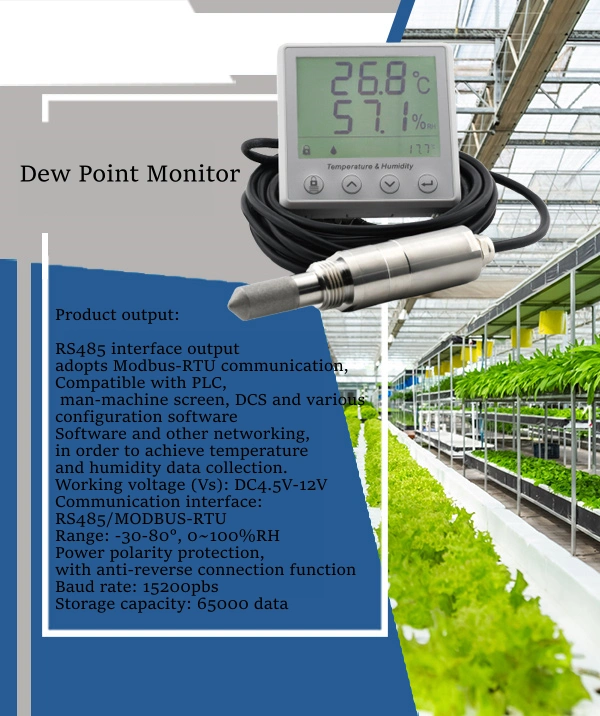
Condensation on cartons, a wet film on chilled apples, mould blooming in a corner of the room — these almost always trace back to one number most produce stores do not watch closely enough: the dew point of the air. This guide shows how to set dew point and humidity targets by commodity, where to put the sensor so the reading means something, and a simple control routine that keeps surfaces dry without drying out the produce.
Contents
- What is dew point, and why it matters more than humidity
- When does condensation actually form on produce?
- Dew point and humidity targets by commodity
- How to measure dew point in a cold room
- A practical routine to prevent condensation
- Common mistakes monitoring dew point in produce storage
- Featured dew point instruments
- Frequently asked questions
What is dew point, and why it matters more than humidity
Dew point is the temperature at which the air in your cold room becomes saturated and water vapour starts to condense. Relative humidity (RH) only tells you how close the air is to saturation at its current temperature; cool that same air and its RH climbs even though the actual moisture has not changed. Dew point is the absolute number — the temperature any surface has to stay above to remain dry. That is why two rooms at “90% RH” can behave completely differently, and why a dew point monitor tells you more than a hygrometer alone.
When does condensation actually form on produce?
Condensation forms the moment any surface — produce skin, carton, evaporator coil, wall, or a cold pallet just moved in — drops below the dew point of the surrounding air. Researchers studying cold-chain losses call this the dew point undershot. A worked example: room air at 4 °C and 90% RH has a dew point of about 2.5 °C, so a pallet brought in at 1 °C will sweat until its surface warms past 2.5 °C. The fix is not lower humidity for its own sake; it is keeping every cold surface a degree or two above the room’s dew point.
Dew point and humidity targets by commodity
Most fruits and vegetables want high humidity to limit weight loss, but the safe dew point depends on the storage temperature. Use these as starting points, then adjust to your coldest surface:
| Commodity | Storage temp | Target RH | Approx. air dew point |
|---|---|---|---|
| Leafy greens, lettuce | 0–1 °C | 95–98% | -0.5 to 0.5 °C |
| Apples, pears | 0–4 °C | 90–95% | -1 to 3 °C |
| Citrus | 5–8 °C | 85–90% | 3 to 6 °C |
| Potatoes, onions (cured) | 7–10 °C | 90–95% | 5.5 to 9 °C |
| Tomatoes, cucumber | 10–13 °C | 85–90% | 7.5 to 11 °C |
The pattern is the same everywhere: the higher the RH you run for freshness, the smaller the margin between dew point and your coil and product surfaces — which is exactly why the dew point has to be measured, not assumed.
How to measure dew point in a cold room
Two sensor technologies cover almost all produce storage. A capacitive polymer sensor measures RH and temperature and computes dew point; it is rugged, inexpensive, and good to about ±2 °C dew point — the right choice for room and duct monitoring with an online dew point meter. A chilled-mirror hygrometer measures dew point directly to about ±0.2 °C and is used as a reference or for tight controlled-atmosphere rooms. Whichever you use, mount it in the return-air stream away from doors and the coil, run one per temperature zone, and confirm placement with a portable dew point meter before fixing it in place.

A practical routine to prevent condensation
Keep the room’s dew point one to two degrees below the coldest surface in the space, and most condensation problems disappear. In practice that means:
- Stage warm incoming product so it is not parked directly under a cold coil discharge.
- Manage door infiltration — humid outside air is the fastest way to spike room dew point. Use strip curtains or air doors.
- Coordinate defrost timing so coil surfaces do not sit below dew point dripping onto product.
- Keep airflow even; dead spots run higher RH and dew point than the sensor in the main stream reports.
- Trend dew point over a full day, not a spot reading — door cycles and restocking move it more than the setpoint does.
Common mistakes monitoring dew point in produce storage
The recurring field mistakes are predictable. Operators watch RH alone and miss that a 2 °C temperature drop pushed the air to saturation. Sensors get mounted next to the evaporator, reading colder and wetter than the room. Nobody compensates for the dew point spike every time the dock door opens. And calibration is skipped for years, so a capacitive sensor that has drifted 5–8% RH is quietly trusted. Respiration heat from dense produce also raises local humidity above what a single sensor sees. If you also store in modified atmospheres, a zirconia oxygen analyzer alongside the dew point monitor keeps both moisture and gas in range.
Featured dew point instruments
Three Sino-Inst dew point instruments cover fixed room monitoring, in-line transmitting, and spot checks:
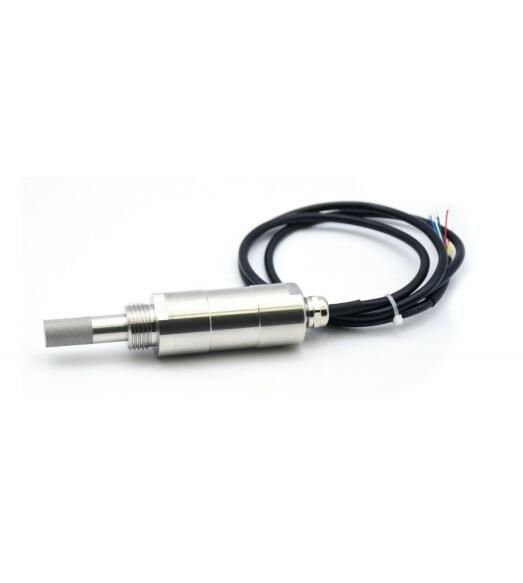
Dew Point Meter 602 Series
Wall- or panel-mount dew point meter for cold rooms and CA storage, with capacitive sensing and a clear local display for daily checks.

Dew Point Transmitter 608 Series
Loop-powered 4–20 mA dew point transmitter that feeds your refrigeration controller or PLC for automatic humidity management.
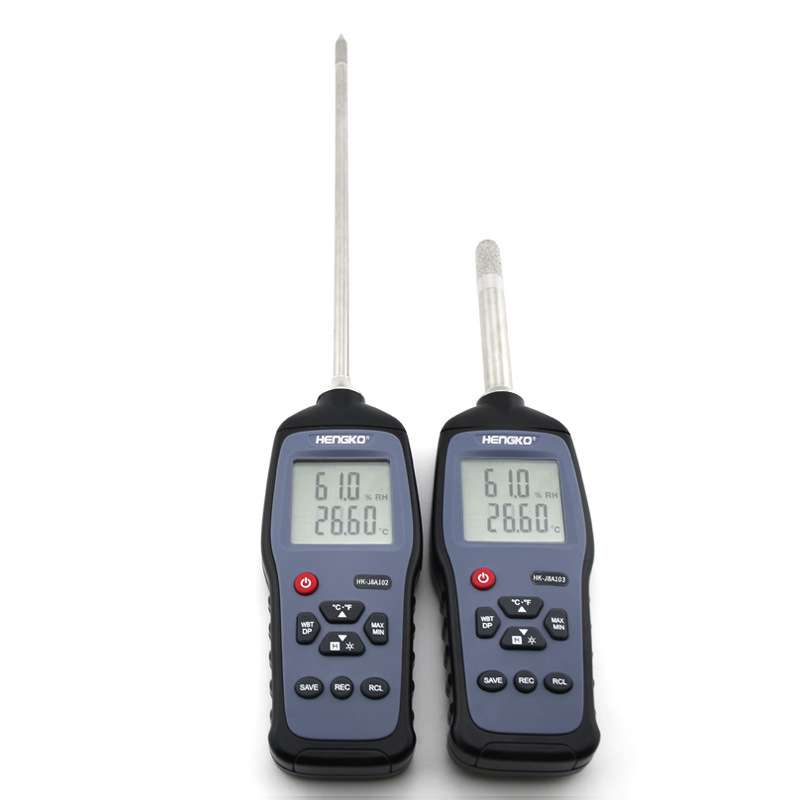
Portable Dew Point Meter
Handheld dew point meter for verifying sensor placement, surveying zones, and troubleshooting condensation complaints on the spot.
Frequently asked questions
What is a good dew point for fruit and vegetable cold storage?
Aim to keep the air dew point 1–2 °C below the coldest surface in the room. For most produce held at 0–5 °C and 90–95% RH that means an air dew point in the roughly -1 to 3 °C range; warmer commodities like tomatoes allow a higher dew point.
Is dew point or relative humidity more important in cold storage?
Dew point. RH changes with temperature, so the same moisture reads as different RH in different parts of the room. Dew point is the absolute temperature at which condensation starts, which is what actually causes sweating and mould.
How do I stop condensation on fruit in cold storage?
Keep every cold surface above the room’s dew point, stage warm product away from cold coils, control door infiltration, and time defrosts so coils are not dripping below dew point. Monitor dew point continuously rather than relying on RH.
How often should a dew point sensor be calibrated?
Capacitive room sensors should be verified every 6–12 months against a reference such as a chilled-mirror or a calibrated portable unit, because polymer sensors drift a few percent RH per year in dusty, humid environments.
Can one dew point monitor cover a whole warehouse?
No. Run at least one sensor per temperature zone and per air-handling circuit. Airflow dead spots, multiple coils, and door areas all create local dew point differences a single sensor will miss.
About this article
Written and technically reviewed by the Sino-Inst engineering team — last reviewed 2026-06-02 (AI-assisted drafting). Based on psychrometric dew-point relationships and field practice in refrigerated produce and controlled-atmosphere storage. Questions? reach our application engineers.
Request a Quote

Wu Peng, born in 1980, is a highly respected and accomplished male engineer with extensive experience in the field of automation. With over 20 years of industry experience, Wu has made significant contributions to both academia and engineering projects.
Throughout his career, Wu Peng has participated in numerous national and international engineering projects. Some of his most notable projects include the development of an intelligent control system for oil refineries, the design of a cutting-edge distributed control system for petrochemical plants, and the optimization of control algorithms for natural gas pipelines.