
Updated 2026-05-11 by the Sino-Inst engineering team.
A density meter measures the mass per unit volume of a liquid, slurry, or gas, usually in real time and at process pressure. The reading is what you bill on, what you blend by, and what tells custody-transfer custody that you handed over the product you said you would. The same number — “density” — can be measured six different ways, and the wrong technology for the wrong service makes a 0.1 % error look like 5 %.
This guide covers what a density meter does, the working principle behind each sensing technology, a side-by-side comparison of the six main types, how to pick by fluid, how to read a spec sheet, temperature and pressure compensation, calibration, and four install pitfalls that wreck field accuracy.
Contents
- Density Meter Definition and Industrial Role
- Working Principle of a Density Meter
- Six Density Meter Technologies, Side by Side
- Process-Specific Density Meter Selection by Fluid Type
- Density Meter Spec Sheet Decoded
- Temperature and Pressure Compensation for Field Accuracy
- Calibration Procedure and Drift Management
- Four Install Pitfalls That Ruin Field Accuracy
- Featured Density Meters
- FAQ
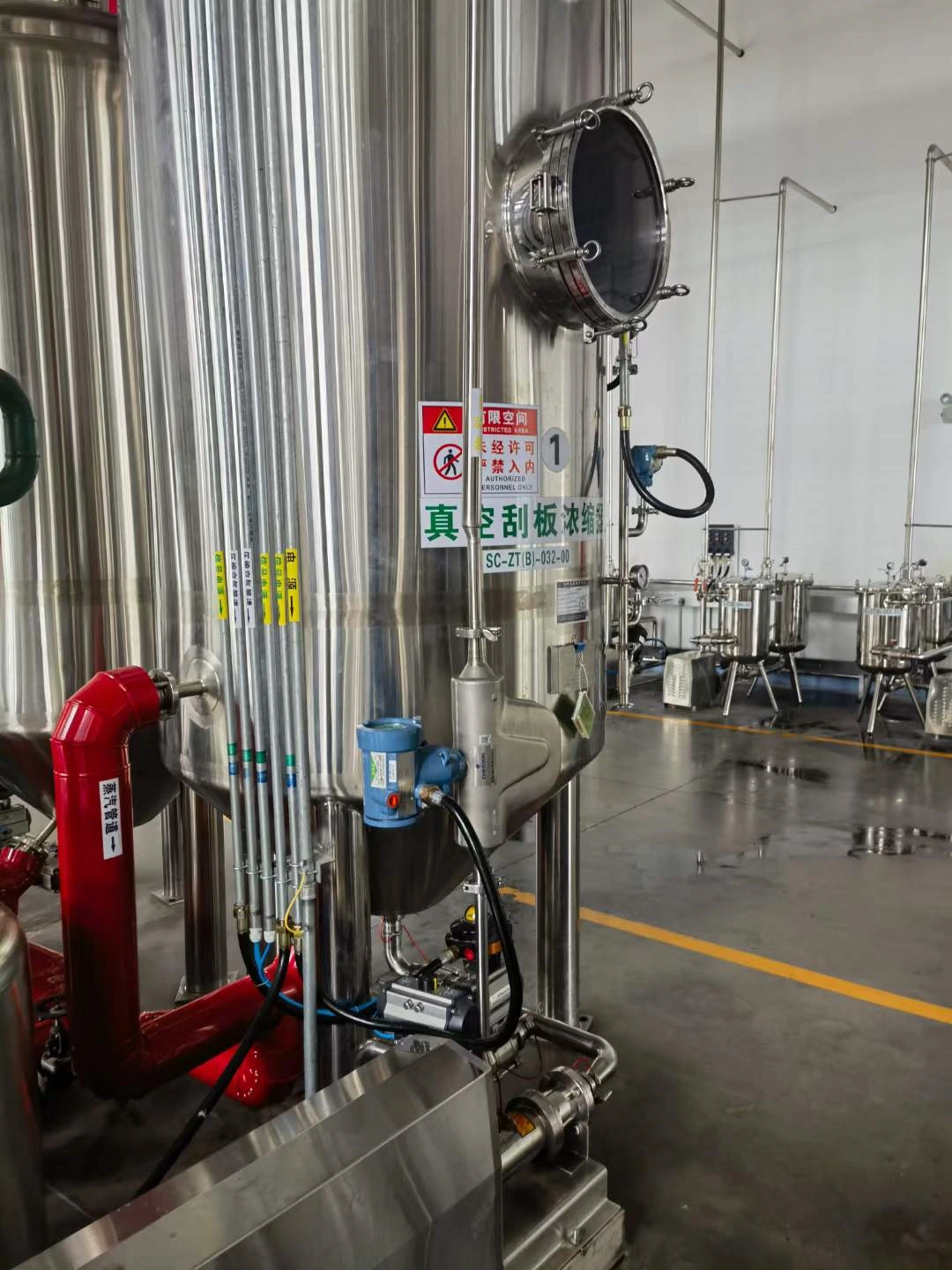
Density Meter Definition and Industrial Role
A density meter reports the density (ρ, in kg/m³ or g/cm³) of a fluid in real time. Density is mass divided by volume, but in process plants it doubles as a stand-in for concentration, dilution, fermentation progress, hydrocarbon API gravity, brine strength, or polymer solids content. A 0.5 % shift in density at the right point in a process tells the operator that a steam coil has stuck open, that a feed tank is being diluted by rinse water, or that a custody-transfer batch is off-spec — long before any other parameter catches it.
For background on the SI and field units density meters report — kg/m³, g/cm³, API gravity, °Brix, °Baumé — see our note on the unit of measurement for density.
Working Principle of a Density Meter
Every density meter exploits one of four physical effects: mechanical resonance shift, gravitational hydrostatic pressure, acoustic time-of-flight, or nuclear absorption. The choice of effect drives accuracy, fluid compatibility, and price.
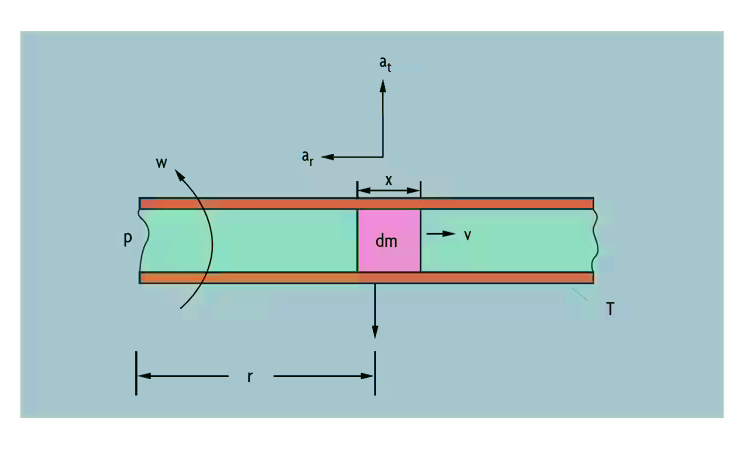
- Mechanical resonance. A tube or fork is vibrated at its natural frequency. As denser fluid loads the structure, the resonant frequency drops. Coriolis tubes, tuning forks, and Anton-Paar-style U-tubes all use this principle. Resolution is excellent (4-decimal density), but the cell sees the process directly and must tolerate it.
- Hydrostatic ΔP. Two pressure transmitters at known elevations in a tank read the column weight; density is ΔP / (g·h). Slow, cheap, and immune to fluid type, but tank-mounted only and accuracy is limited by the transmitters.
- Acoustic time-of-flight. A pulse is launched across the fluid; the speed of sound depends on density and bulk modulus. Non-intrusive (clamp-on), but fluid-of-known-composition only.
- Gamma absorption. A small radioactive source on one side of the pipe, a detector on the other. Beam attenuation tracks density. Works on slurries, opaque flows, and high-pressure service where nothing else survives, but needs a radiation safety case.
Six Density Meter Technologies, Side by Side
Six technologies dominate field and lab density measurement. They span 5 decades of accuracy and 3 decades of price.
| Technology | Accuracy (kg/m³) | Best for | Avoid for | Cost band |
|---|---|---|---|---|
| Coriolis mass flow + density | ±0.5 | Custody transfer, hydrocarbons, dosing | Slurries with gas voids, very low flow | $$$$ |
| Tuning fork (insertion or in-line) | ±1 | Tank-side concentration, refining, food | Fibrous solids that snag the fork | $$ |
| Oscillating U-tube (lab/portable) | ±0.01 | Lab reference, batch QC, °Brix labs | In-line service, opaque slurries | $$$ |
| Differential pressure (hydrostatic) | ±2-5 | Open tanks, settling slurries | Closed pressure vessels, fast process | $ |
| Ultrasonic time-of-flight | ±2 | Non-intrusive retrofits, clean fluids | Gassy or particulate-laden streams | $$ |
| Gamma (nuclear) densitometer | ±1-5 | Drilling muds, ore slurries, coke, opaque high-P | Anywhere licensing is a problem | $$$$ |
Coriolis is the de-facto custody-transfer instrument for hydrocarbons because it gives mass flow and density simultaneously at ±0.1 % MV — but it cannot tolerate the gas voids that drilling mud delivers daily. For that, gamma is the answer. Oscillating U-tube wins the lab and the portable spot-check role; it is the reference for °Brix, °Baumé, and API gravity. For a deeper look at how Coriolis derives density from its tube resonance, see our Coriolis density measurement guide.
Process-Specific Density Meter Selection by Fluid Type
The fluid dictates the technology more than the budget does. A picker by service:
- Crude oil and refined hydrocarbons: Coriolis for custody transfer, oscillating U-tube for assay lab. See our density of crude oil guide for API gravity and ASTM D1250 corrections.
- Sugar, °Brix, fermentation: Oscillating U-tube for lab, tuning fork in-line for blending tanks.
- Acid (H₂SO₄, HCl, HNO₃): Tuning fork in tantalum or PEEK wetted parts, or non-intrusive ultrasonic.
- Settling slurries and drilling muds: Gamma densitometer — survives abrasion that destroys vibrating cells. For more on slurry behaviour, see our industrial slurry density measurement note.
- Polymer melts and high-viscosity fluids: Coriolis or hydrostatic ΔP; avoid tuning fork (high damping kills resolution).
- Cryogenic LNG and LPG: Coriolis with cryogenic-rated tubes — also the standard custody-transfer choice on LNG terminals.
Density Meter Spec Sheet Decoded
A density meter spec sheet drowns the buyer in numbers. Five fields decide whether the instrument fits the loop:
- Reference temperature. Density is meaningless without it. ASTM uses 15 °C, API uses 60 °F, food uses 20 °C. A “1000 kg/m³ water” reading at 4 °C is not the same as at 20 °C — there is a 0.18 % swing in between.
- Accuracy band (specified vs typical). Anton-Paar publishes ±0.0001 g/cm³ for the lab U-tube but only at 20 °C and after a 30-minute warm-up. Process Coriolis is ±0.5 kg/m³ across the full operating envelope. Compare like-for-like.
- Span vs zero stability. Span drift moves the calibration slope; zero drift moves the intercept. A spec sheet that quotes only “accuracy” without splitting the two is hiding something.
- Process connection and wetted materials. 316L is default; tantalum, Hastelloy C276, and PTFE-lined are extra-cost. Get the material right and the meter lasts; get it wrong and you lose it to corrosion in months.
- Output and protocol. 4-20 mA + HART, Modbus RTU, Foundation Fieldbus, EtherNet/IP. Match the loop, not the brochure.
Temperature and Pressure Compensation for Field Accuracy
Fluid density changes about 0.1 % per °C and about 0.005 % per bar. Without compensation a Coriolis or tuning fork running at 60 °C and 20 bar will read 5-6 kg/m³ off its 20 °C / 1 bar factory calibration. Modern transmitters apply two corrections automatically:
- Temperature compensation. An RTD glued to the resonating element or the U-tube reads element temperature and applies the manufacturer’s temperature coefficient.
- Pressure compensation. A static-pressure input (4-20 mA from a separate transmitter, or HART-burst from the same loop) corrects the resonator stiffness shift with line pressure.
Two field traps: first, the temperature sensor reads the wall of the cell, not the fluid bulk — a fast process step (a steam injection, a cold-water rinse) gives a transient density error until the wall equilibrates. Second, the pressure correction needs the actual line pressure, not the design pressure; a stuck pressure transmitter feeding a constant 16 bar will drift the density reading whenever the line moves up to 25 bar.
Calibration Procedure and Drift Management
Density meter calibration is a two-fluid procedure, regardless of technology:
- Air (or N₂) zero. Drain and dry the cell, take a reading at atmospheric pressure and known temperature. Compare to tabulated air/N₂ density at that T,P.
- Reference fluid span. Fill the cell with degassed deionised water (or another traceable reference). Read at known T,P, compare to tabulated value (999.0 kg/m³ at 15 °C, 998.2 at 20 °C).
- Adjust offset and slope. Most transmitters expose a two-point cal interface; enter the air and water readings, the firmware computes the new offset and slope.
- Verify with a third fluid. Run a second reference (denser organic solvent like trichloroethylene at 1462 kg/m³, or a sodium-chloride brine) and check the meter is within ±0.5 kg/m³ of the tabulated value.
Field intervals: lab U-tubes monthly, Coriolis and tuning fork annually, gamma every two years (with a source-decay correction built into the firmware). Drift rates: 1-2 kg/m³ per year for Coriolis and tuning fork on clean fluids, faster on abrasives. If the meter swings more than 0.5 % between cal cycles, look at coating, erosion, or mounting strain before declaring the sensor faulty.
Four Install Pitfalls That Ruin Field Accuracy
- Strain from pipe expansion. A Coriolis or tuning fork bolted between rigid supports picks up axial stress as the line heats up; the resonator stiffens and the density reading drifts low by 5-10 kg/m³. Use a flexible mount or a thermal-expansion loop upstream.
- Gas entrainment. A single 1 mm bubble at 10 barg can pull a Coriolis reading 20 kg/m³ low for several seconds. Mount horizontally with the tubes upwards, or install a gas eliminator if the line is suspect.
- Wrong orientation for tank settling. Tuning fork insertion probes mounted at the bottom of a tank read the heavy phase, not the bulk. Mount at the mid-tank or in the recirculation loop.
- Vibration coupling from pumps. A positive-displacement pump 2 m upstream of a Coriolis at 10-15 Hz couples into the resonator and adds 1-2 kg/m³ noise. Decouple with a flexible connector or move the meter further away. For more on equivalent piping discipline, see our industrial applications of density meters note.
Featured Density Meters
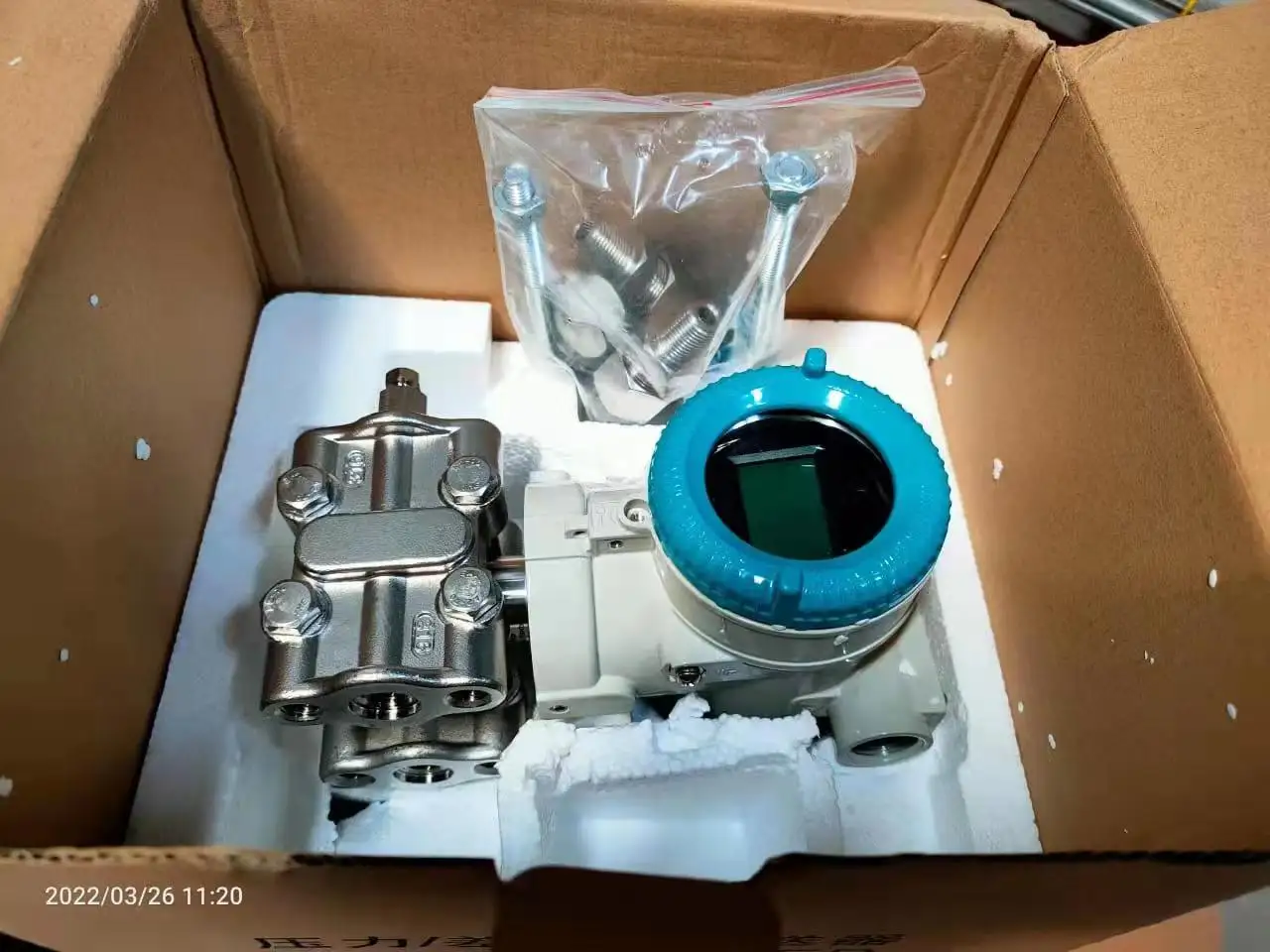
Online Density Meters by Differential Pressure
Tank-mount ΔP density, 0-3000 kg/m³, 4-20 mA + HART, ±2 kg/m³ accuracy.
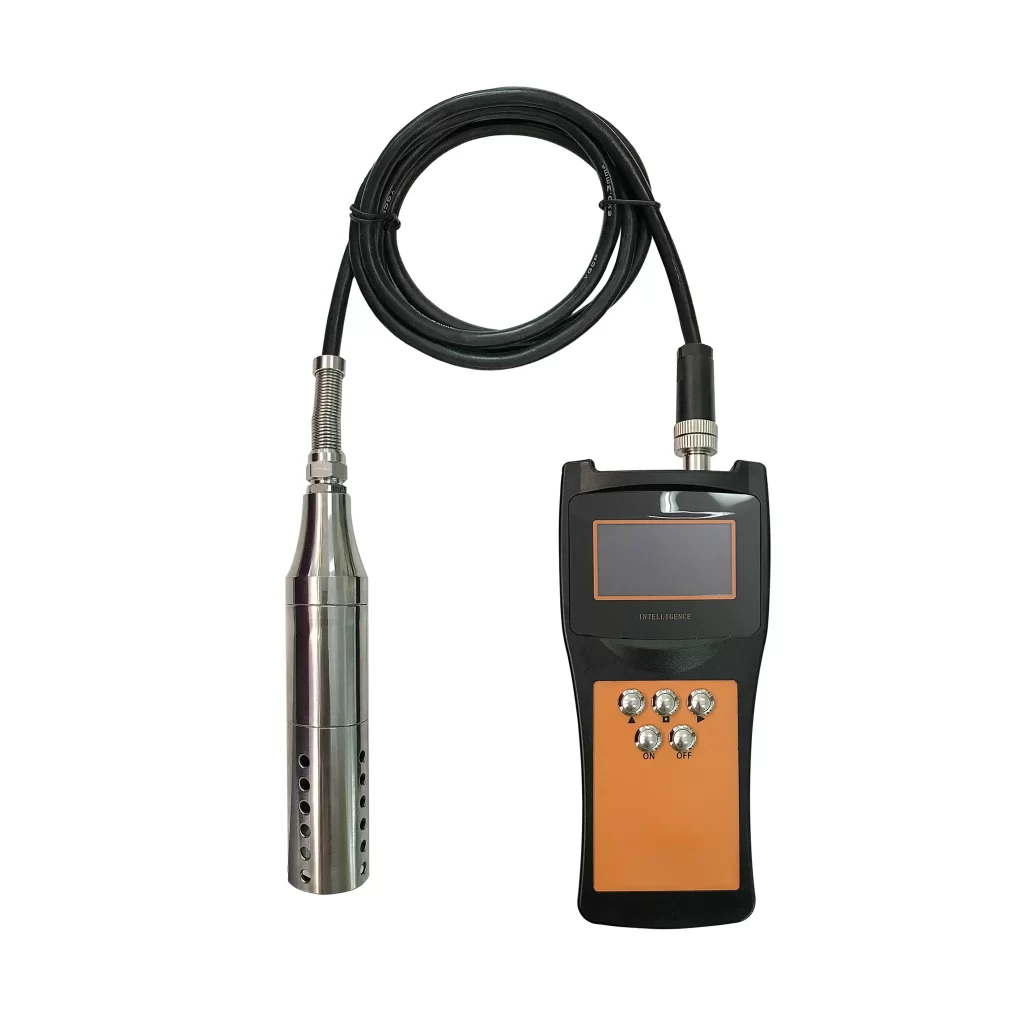
Portable Density Meter (Tuning Fork)
Hand-held tuning fork, 0-3000 kg/m³, °Brix / °API conversion, data-log.
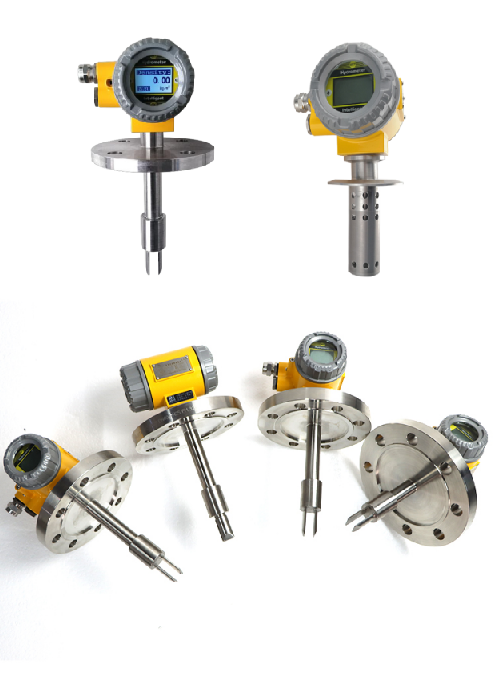
In-line Tuning Fork Density Meter
In-line insertion fork, 0-2000 kg/m³, 4-20 mA + Modbus, ±1 kg/m³ accuracy.
FAQ
What is a density meter?
An instrument that measures the mass per unit volume (density) of a fluid at process conditions. Real-time units are typically kg/m³ or g/cm³; derived units include °Brix, °Baumé, and API gravity.
How does a density meter work?
The four working principles in use are mechanical resonance shift (Coriolis, tuning fork, U-tube), hydrostatic ΔP, acoustic time-of-flight, and nuclear absorption. Each maps a physical effect that depends on density into an electrical signal.
What does SG 20/20 mean?
Specific gravity 20/20 means the density of the sample at 20 °C divided by the density of pure water at 20 °C. It is dimensionless and slightly different from SG 60/60 (the API petroleum convention at 60 °F).
Can density be measured in g/m³?
Technically yes, but no one does for liquids — values would run into millions. Liquids use kg/m³ or g/cm³; only very low-density gases (atmospheric particulate, trace contaminants) are reported in g/m³.
How do you read a density meter?
Read the primary display (kg/m³ or g/cm³), then check the reference temperature it is corrected to. If the reading is at process temperature uncorrected, apply the manufacturer’s T-coefficient to get the value at 15 °C or 20 °C reference.
How often should a density meter be calibrated?
Lab oscillating U-tubes monthly. Process Coriolis and tuning fork annually. Gamma densitometers every two years with source-decay correction. Verify after any major piping work that could induce strain.
Which density meter is best for slurries?
Gamma densitometer for abrasive or opaque slurries (drilling muds, ore concentrates). For lighter slurries with gas tolerance, a properly-mounted Coriolis can work. Avoid tuning fork in fibrous slurries.
Need help picking a density meter for your fluid, accuracy band, and budget? Our engineers can quote and ship within 24 hours — message us with the service, line pressure, fluid composition, and target accuracy.
Request a Quote
Request a Quote

Wu Peng, born in 1980, is a highly respected and accomplished male engineer with extensive experience in the field of automation. With over 20 years of industry experience, Wu has made significant contributions to both academia and engineering projects.
Throughout his career, Wu Peng has participated in numerous national and international engineering projects. Some of his most notable projects include the development of an intelligent control system for oil refineries, the design of a cutting-edge distributed control system for petrochemical plants, and the optimization of control algorithms for natural gas pipelines.