
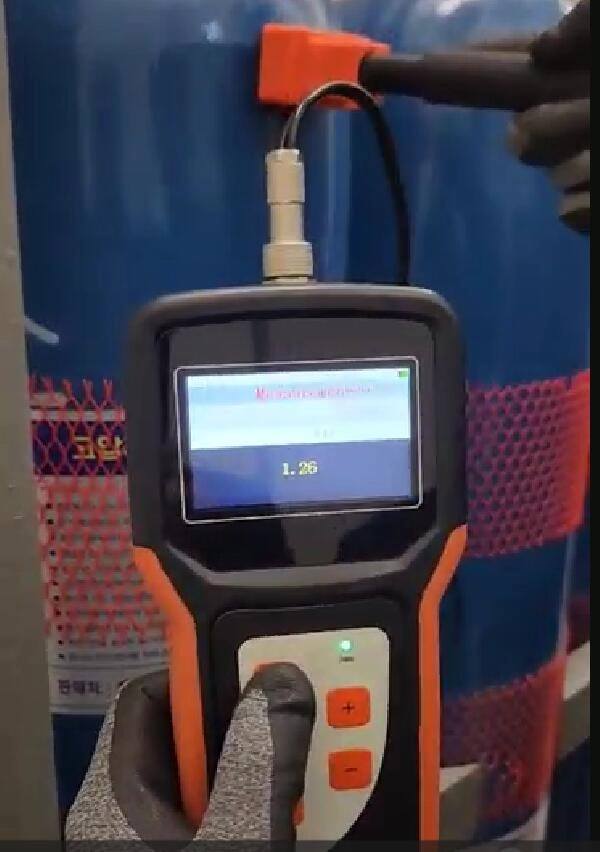
An ultrasonic CO2 level indicator is a portable handheld tool that confirms how full a CO2 cylinder is without removing it from service. A technician presses the probe against the outside of the cylinder, runs it up and down, and reads the liquid line off the indicator. No weighing scale, no shutdown, no off-loading the cylinder. This guide explains how the device works, lists specifications and cylinder compatibility, and walks through the field procedure for fire-suppression and beverage CO2 cylinders alike.
Contents
- What an Ultrasonic CO2 Level Indicator Is and Where It Fits
- How an Ultrasonic CO2 Liquid Level Indicator Works
- Cylinder Sizes and Coupling Compatibility
- Specifications: Range, Accuracy, Battery, Probe
- NFPA 12 Inspection Schedule for CO2 Suppression Systems
- Ultrasonic vs Weighing vs Pressure: Comparison Table
- Field Procedure: Measuring a CO2 Cylinder in 90 Seconds
- Common Errors and How to Avoid Them
- Related Cylinder and Tank Level Tools
- FAQ
What an Ultrasonic CO2 Level Indicator Is and Where It Fits
CO2 stored under pressure inside a cylinder is a saturated mixture: liquid at the bottom, vapour above. The boundary moves down as gas is drawn off, and on a fire-suppression cylinder there is no sight glass to watch it. An ultrasonic indicator finds that liquid-to-vapour interface from the outside by listening to the echo signature change at the line.
It is the field-portable cousin of the fixed ultrasonic level measurement instruments installed on bulk tanks. The physics is the same — a piezo transducer pulses, the echo bounces back from material density boundaries, and timing gives position. The package is what differs: a battery-powered probe and a small audio or LED display, designed to be carried up and down a fire-suppression bottle rack.
Typical end users are fire-suppression service contractors, beverage and brewery technicians, marine engineers maintaining CO2 hold-flooding systems, and industrial gas plant operators checking ASUs and bulk receivers, often paired with the DP transmitter installation protecting the line side.
How an Ultrasonic CO2 Liquid Level Indicator Works
The probe contains a single piezoelectric transducer that does both transmit and receive. Acoustic gel between the probe face and the cylinder wall couples the pulse into the steel. When the pulse meets liquid CO2 on the inside of the cylinder wall, most of the energy carries forward; when the pulse meets vapour, almost all of it reflects back. That reflection difference is what the device hears.
Sliding the probe from bottom to top of the cylinder, the user crosses the liquid-vapour interface. Below the line: low echo (signal is absorbed and carried into the liquid). Above the line: high echo (signal bounces off the gas pocket). The unit indicates this with one of three feedback methods, depending on the model:
- Audio tone — tone changes pitch when the probe crosses the liquid line
- Bar graph LED — bars fill below the line, empty above
- Digital LCD — shows numeric height and percent fill
The same piezo principle underpins the broader piezo sensing family used in pressure, knock, and flow instruments — only here the geometry favours interface detection over absolute distance.
Cylinder Sizes and Coupling Compatibility
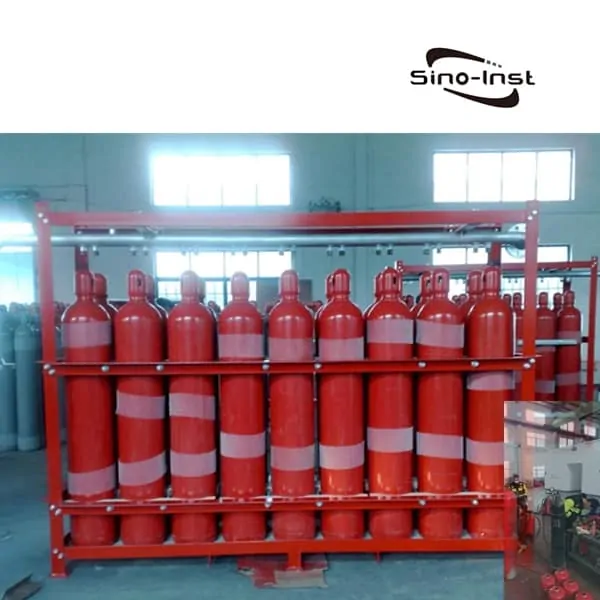
The indicator works through any steel or aluminium cylinder wall in the 3 mm to 30 mm range. Practical cylinder coverage:
| Cylinder / Vessel | Wall Type | Use Case |
|---|---|---|
| Fire-suppression CO2 cylinders 5–100 kg | Seamless steel, 6–12 mm | NFPA 12 inspection |
| Beverage and brewery CO2 cylinders 6.8–22.7 kg (15-50 lb) | Aluminium or steel | Replace-when-empty signal |
| Marine CO2 hold-flooding cylinders | Steel, 8–15 mm | SOLAS / Lloyd’s annual check |
| Bulk CO2 receivers up to 1000 kg | Steel, 10–25 mm | Spot check during normal operation |
| Halon / FM-200 / Novec 1230 cylinders | Steel, 8–15 mm | Same physics applies to other liquefied agents |
The same instrument that measures a CO2 cylinder also reads liquid Halon, FM-200, Novec 1230, and propane — wherever there is a liquid-vapour interface inside a metal pressure vessel.
Specifications: Range, Accuracy, Battery, Probe
| Liquid-line accuracy | ±2 mm typical at 20 °C |
| Cylinder wall range | 3 mm to 30 mm steel / aluminium |
| Operating temperature | −10 °C to +50 °C ambient |
| Cylinder content temperature | −20 °C to +60 °C |
| Indication mode | Audio + LED bar + numeric (model-dependent) |
| Battery | 9 V or rechargeable Li-ion, 8–20 h continuous |
| Coupling | Standard ultrasonic gel — no permanent fitting |
| Probe diameter | 15–25 mm |
| Weight | 0.5–1.0 kg complete |
| Enclosure | IP54 / IP65 hand-held |
NFPA 12 Inspection Schedule for CO2 Suppression Systems
NFPA 12 (Standard on Carbon Dioxide Extinguishing Systems) sets the inspection cadence for fire-suppression CO2 cylinders in the United States. The relevant clauses on cylinder content verification are simple:
- Semi-annually — check cylinder weight or liquid level. A loss greater than 10% requires recharging or replacement.
- Annually — full system inspection including discharge nozzles, manifold, valves, and pilot devices.
- Five-yearly — internal cylinder inspection per DOT requalification.
An ultrasonic indicator satisfies the semi-annual content-verification requirement without taking the cylinder offline. A fire-suppression rack with 30 cylinders becomes a 45-minute inspection instead of a half-day weighing job. The same DP and ultrasonic principles also drive industrial pressure verification on the lines that feed those cylinders — see the related pressure transmitter working principle notes.
Ultrasonic vs Weighing vs Pressure: Comparison Table
| Method | Ultrasonic Indicator | Weighing Scale | Pressure Gauge |
|---|---|---|---|
| What it measures | Liquid line position | Total mass | Saturation pressure (not content) |
| Cylinder offline? | No | Yes — must remove | No |
| Accuracy | ±2 mm (≈ ±2% mass) | ±0.1 kg | Useless for content — pressure stays constant until ~95% empty |
| Time per cylinder | 60–90 s | 5–10 min | 5 s |
| Capital cost | $400–$1,500 | $200–$2,000 | Already on cylinder |
| Skill required | 15-minute training | None | None — and gives wrong answer |
| NFPA 12 acceptance | Yes (content verification) | Yes | No — does not show liquid mass |
Pressure gauges fail as content indicators because CO2 saturation pressure at 20 °C is around 57 bar whether the cylinder is 90% full or 10% full. The pressure only drops once the last of the liquid evaporates. Weighing scales are accurate but require removing the cylinder from service and bringing a scale rated for the cylinder mass. Ultrasonic indicators are the fastest in-service method.
Field Procedure: Measuring a CO2 Cylinder in 90 Seconds
- Confirm cylinder temperature is stable. A cylinder that has just discharged is cold — wait 15 minutes for the wall to equalise.
- Apply a 5 mm bead of ultrasonic gel to the probe face.
- Press the probe firmly against the cylinder at the bottom. The display should indicate “in liquid” (audio low tone or full bar).
- Slide the probe slowly upward at about 30 mm per second, maintaining contact.
- Mark where the signal changes — this is the liquid line. A piece of chalk or a marker is enough.
- Measure from the cylinder base to the line. Convert to fill percent using the manufacturer’s chart for that cylinder model — the K-factor conversion principle is the same idea applied to flow.
- Record the percentage and date. Anything below 90% on an in-service CO2 suppression cylinder (the same threshold used in underground tank level monitoring) requires a follow-up per NFPA 12.
Common Errors and How to Avoid Them
- Reading on a freshly discharged cylinder. The wall is colder than ambient and the liquid column hasn’t settled. Wait 15 minutes.
- Insufficient gel. The number-one false reading. Air gaps reflect almost as well as vapour does. Use enough gel that you see a clean bead at the probe edge.
- Reading through paint. Heavy or peeling paint scatters ultrasound. Sand a 25 × 100 mm patch to bare metal for repeatable readings.
- Reading through a dent or weld bead. Reflections fragment. Move 50 mm away from any dent, label, or weld and re-measure.
- Wrong cylinder height chart. A 45 kg DOT cylinder and a 45 kg ISO cylinder are different heights for the same mass. Match the chart to the cylinder.
For more demanding service such as bulk CO2 storage and cryogenic tanks the fixed continuous-measurement family applies — see installation requirements for the supply lines feeding those vessels.
Related Cylinder and Tank Level Tools
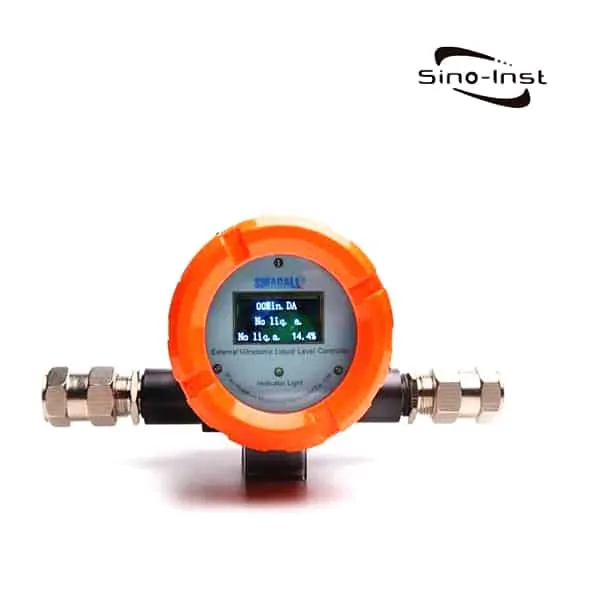
HS-ULC External Ultrasonic Level Switch
Fixed external mount | High/Low level alarm | No tank penetration — for permanent CO2 storage monitoring.
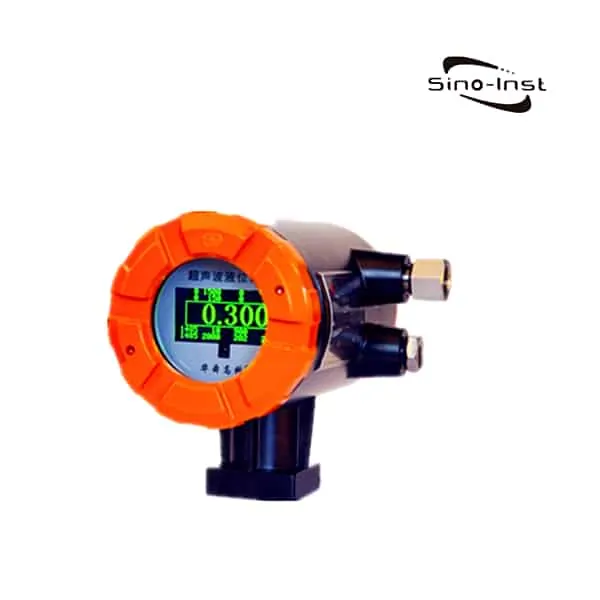
HS-2000 Tank Level Sensor
Continuous external-mounted | 4-20 mA output | Bulk CO2 receivers and bulk liquid agent tanks.
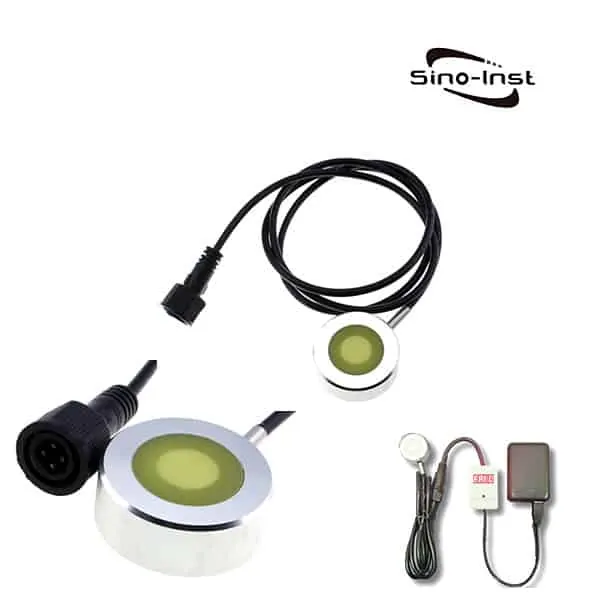
Ultrasonic Oil & Fluid Level Sensor
External paste-on sensor | Fuel, hydraulic, water | Same physics, different geometry — fleet and remote tank monitoring.
FAQ
How accurate is an ultrasonic CO2 level indicator?
±2 mm on the liquid line at 20 °C is typical, which translates to roughly ±2% on cylinder mass for a standard 45 kg fire-suppression bottle. Accuracy degrades on cylinders below −10 °C or above +60 °C, on heavily painted cylinders, and when the operator does not use enough gel.
Does it work on Halon, FM-200, or Novec 1230 cylinders?
Yes. The instrument detects the liquid-vapour interface inside any pressurised steel or aluminium cylinder. Halon 1301, FM-200 (HFC-227ea), Novec 1230, and propane all have a clear interface that the ultrasonic probe can find. Calibration values may differ slightly between agents, so use the cylinder-specific chart.
Can I use it on a cylinder I cannot move?
Yes — that is the entire point of the tool. The probe applies from the outside while the cylinder remains pressurised and connected. NFPA 12 semi-annual content checks were historically done by weighing each cylinder. An ultrasonic indicator replaces that with an in-place reading.
Will it work through cylinder labels or paint?
Through thin, well-bonded paint — yes. Through thick, peeling, or layered paint — readings become unstable. Sand a 25 × 100 mm vertical strip to bare metal on each cylinder you intend to monitor regularly. Mark it for repeat use.
Send us your cylinder dimensions and service type (fire suppression, beverage, marine, or industrial gas) and our engineers will spec a model, probe geometry, and battery configuration sized for your fleet within 24 hours.
Request a Quote

Wu Peng, born in 1980, is a highly respected and accomplished male engineer with extensive experience in the field of automation. With over 20 years of industry experience, Wu has made significant contributions to both academia and engineering projects.
Throughout his career, Wu Peng has participated in numerous national and international engineering projects. Some of his most notable projects include the development of an intelligent control system for oil refineries, the design of a cutting-edge distributed control system for petrochemical plants, and the optimization of control algorithms for natural gas pipelines.