
Updated April 2026 — By Sino-Inst Engineering Team
Flow rate and pressure are the two most measured variables in any piping system. They are connected, but not in a simple linear way. Pressure difference drives flow. No pressure difference, no flow — even if the pipe is full and pressurized.
Contents
- How Flow Rate and Pressure Are Related
- Key Formulas
- How to Calculate Flow Rate from Pressure
- Pressure Drop in Piping Systems
- Quick Reference: Flow-Pressure Formulas
- Featured DP Flow Meters from Sino-Inst
- Frequently Asked Questions
- Request a Quote
This article covers the actual physics behind the relationship, gives you the working formulas, and shows how to calculate one from the other in real piping systems.
How Flow Rate and Pressure Are Related
A common misconception: high pressure means high flow. Not true. A pipe can sit at 150 psi with zero flow if both ends are at equal pressure. Flow happens only when there is a pressure difference (ΔP) between two points.
Once a piping system is fixed (pipe diameter, length, roughness, fittings), flow rate is proportional to the square root of the pressure difference:
Q ∝ √ΔP
Double the pressure difference and flow increases by about 41%, not 100%. This square-root relationship appears everywhere — in Venturi tubes, orifice plates, and control valve sizing equations.
Key Formulas
Bernoulli’s Equation
For an ideal (inviscid, incompressible) fluid flowing along a streamline:
P₁ + ½ρv₁² + ρgh₁ = P₂ + ½ρv₂² + ρgh₂
Where P is static pressure (Pa), ρ is fluid density (kg/m³), v is velocity (m/s), g is gravity (9.81 m/s²), and h is elevation (m). This equation tells you: when velocity goes up, pressure goes down. That is the principle behind every differential pressure flow meter.
Bernoulli applies to clean, low-viscosity fluids at moderate speeds. For real-world pipe systems, you need to account for friction losses.
Darcy-Weisbach Equation (Pressure Drop in Pipes)
The standard formula for friction-based pressure drop in a straight pipe:
ΔP = f × (L/D) × (ρv²/2)
Where f is the Darcy friction factor (dimensionless), L is pipe length (m), D is internal diameter (m), ρ is density (kg/m³), and v is flow velocity (m/s). The friction factor depends on Reynolds number and pipe roughness — use a Moody chart or the Colebrook equation to find it.
Poiseuille’s Law (Laminar Flow Only)
For laminar flow (Re < 2100) in a circular pipe:
Q = π × d⁴ × ΔP / (128 × μ × L)
Where Q is volumetric flow rate (m³/s), d is pipe diameter (m), ΔP is pressure drop (Pa), μ is dynamic viscosity (Pa·s), and L is pipe length (m). This equation works for heavy oils, glycol, and other viscous fluids moving at low velocity.
DP Flow Meter Formula
For an orifice plate, Venturi, or flow nozzle:
Q = C × ε × A₂ × √(2ΔP / (ρ(1 − β⁴)))
Where C is the discharge coefficient, ε is the expansion factor (for gases), A₂ is the bore area, β is the diameter ratio (bore/pipe), and ΔP is measured differential pressure. This is how every DP flow meter converts a pressure reading into a flow rate.
How to Calculate Flow Rate from Pressure
You cannot calculate flow from a single pressure reading. You need pressure difference between two points, plus information about the system. Here is the practical approach:
- Measure ΔP — Install pressure taps at two points along the pipe. The difference is your driving force.
- Know your pipe — Internal diameter, length between taps, material (roughness), and any fittings or valves.
- Know your fluid — Density and viscosity at operating temperature.
- Estimate Reynolds number — Start with an assumed velocity, calculate Re = ρvD/μ. This determines if the flow is laminar or turbulent.
- Apply the right formula — Laminar: use Poiseuille. Turbulent: use Darcy-Weisbach with the Moody friction factor. Iterate if needed — start with an estimated f, solve for v, recalculate Re, update f, repeat until values converge.
In practice, most engineers skip the manual calculation. Install a differential pressure flow meter and let the transmitter do the math internally. Modern DP transmitters compute flow rate in real-time from the measured ΔP, programmed pipe data, and fluid properties.
Pressure Drop in Piping Systems
Every pipe, valve, elbow, and fitting consumes energy. That energy loss shows up as pressure drop. Two categories:
Friction loss (major loss) — Caused by fluid viscosity against the pipe wall. Proportional to pipe length and the square of velocity. Longer pipes and faster flow mean more pressure drop.
Minor losses — From elbows, tees, valves, reducers, and flow meters. Each component has a loss coefficient (K-factor). In short runs with many fittings, minor losses can exceed friction losses.
Total pressure drop: ΔP_total = ΔP_friction + Σ(K × ρv²/2)
When selecting a flow meter, check its permanent pressure loss specification. An orifice plate typically causes 40-70% permanent loss of the measured ΔP. A Venturi tube recovers most of the pressure — only 5-20% permanent loss. For applications where pumping energy matters, the Venturi tube or V-Cone meter is a better choice.
Quick Reference: Flow-Pressure Formulas
| Formula | Use Case | Key Variables |
|---|---|---|
| Q ∝ √ΔP | General pipe systems | ΔP = pressure difference |
| Bernoulli (P + ½ρv² + ρgh = const) | Ideal flow, DP meters | P, v, ρ, h |
| Darcy-Weisbach (ΔP = f·L/D·ρv²/2) | Turbulent pipe friction | f, L, D, ρ, v |
| Poiseuille (Q = πd⁴ΔP/128μL) | Laminar flow (Re < 2100) | d, ΔP, μ, L |
| DP meter (Q = CεA√(2ΔP/ρ(1−β⁴))) | Orifice, Venturi, nozzle | C, ε, A, ΔP, β, ρ |
Featured DP Flow Meters from Sino-Inst

Orifice Plate Flow Meter
Accuracy: ±1% | DN15–DN1200
4-20mA/HART | Steam, gas, liquid

Venturi Tube Flow Meter
Low pressure loss: 5-20% | DN50–DN2000
High accuracy for large pipes
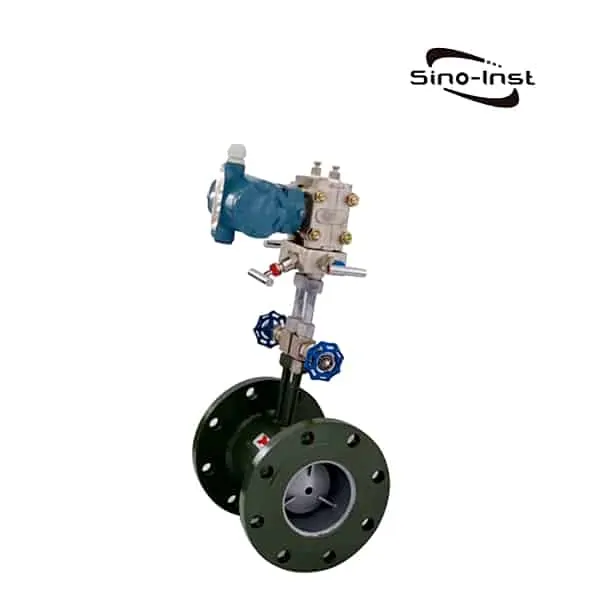
Integral DP Flow Meter
Built-in ΔP transmitter | Compact
4-20mA/HART | Easy install
Browse all flow meters | Use our flow & pressure calculators
Frequently Asked Questions
Does higher pressure always mean higher flow rate?
No. Flow depends on pressure difference, not absolute pressure. A pipe at 200 bar with equal pressure at both ends has zero flow. Increase the pressure at one end while keeping the other constant, and flow begins.
Why is the flow-pressure relationship a square root, not linear?
Friction losses in turbulent flow are proportional to velocity squared (Darcy-Weisbach equation). Since pressure drop goes as v², flow rate (which is proportional to v) goes as the square root of ΔP. Double the flow requires four times the pressure difference.
How do I measure flow rate using pressure?
Use a differential pressure flow meter — an orifice plate, Venturi tube, or flow nozzle installed in the pipe. A DP transmitter measures the pressure drop across the restriction and calculates flow using the square-root relationship. This is the most widely used industrial flow measurement method per ISO 5167.
What is the difference between pressure drop and pressure loss?
They mean the same thing in practice. Pressure drop is the reduction in pressure as fluid moves through a pipe or component. Some engineers reserve “pressure loss” for permanent, non-recoverable losses (friction, turbulence) and “pressure drop” for the total change including recoverable portions (like in a Venturi).
Can I calculate flow rate from a single pressure gauge reading?
Not directly. You need two pressure readings (upstream and downstream) to get a ΔP, or you need a known flow restriction with calibrated characteristics. A single gauge reading tells you the static pressure at one point — it says nothing about velocity or flow rate.
Which flow meter has the lowest pressure drop?
Among DP meters, the Venturi tube has the lowest permanent pressure loss (5-20% of ΔP). Magnetic flow meters and ultrasonic flow meters cause almost no pressure drop because they have no flow obstruction. Orifice plates have the highest pressure loss (40-70% of ΔP).
Request a Quote
Tell us your application — pipe size, fluid, temperature, pressure, required accuracy. Our engineers will recommend the right flow meter and provide a quote within 24 hours.
Request a Quote
About the Author
Sino-Inst Engineering Team — With over 20 years of experience in industrial process instrumentation, our team specializes in flow, level, pressure, and temperature measurement solutions. We have completed 10,000+ installations across oil & gas, water treatment, chemical, and power generation industries worldwide. Our engineers hold certifications in ISA, IEC, and ISO standards. For technical questions, contact us at rfq@sino-inst.com or call +86-180 4861 3163.

Wu Peng, born in 1980, is a highly respected and accomplished male engineer with extensive experience in the field of automation. With over 20 years of industry experience, Wu has made significant contributions to both academia and engineering projects.
Throughout his career, Wu Peng has participated in numerous national and international engineering projects. Some of his most notable projects include the development of an intelligent control system for oil refineries, the design of a cutting-edge distributed control system for petrochemical plants, and the optimization of control algorithms for natural gas pipelines.