
Updated April 2026 — By Sino-Inst Engineering Team
Wiring a pressure transducer correctly is the difference between a clean 4–20 mA signal and hours of troubleshooting. The three wiring configurations — 2-wire, 3-wire, and 4-wire — each have different power supply requirements, signal routing, and use cases.
This guide provides wiring diagrams for all three types, explains the electrical differences, and covers the most common wiring mistakes.
Contents
- 2-Wire vs 3-Wire vs 4-Wire: Quick Comparison
- 2-Wire Pressure Transducer Wiring Diagram
- 3-Wire Pressure Transducer Wiring Diagram
- 4-Wire Pressure Transducer Wiring Diagram
- Common Wiring Mistakes
- Featured Pressure Transmitters
- FAQ
- Request a Quote
2-Wire vs 3-Wire vs 4-Wire: Quick Comparison
| Feature | 2-Wire | 3-Wire | 4-Wire |
|---|---|---|---|
| Cables required | 2 | 3 | 4 |
| Power & signal | Share same 2 wires | Shared ground, separate signal | Fully separate |
| Common output | 4–20 mA | 0–10 V or 4–20 mA | 4–20 mA, 0–10 V, 0–5 V |
| Power supply | 12–36 VDC (loop) | 12–36 VDC | 12–36 VDC or 220 VAC |
| Max cable length | 1–2 km | 500 m | 500 m (voltage) / 1–2 km (current) |
| Cost | Lowest | Medium | Highest |
| Best for | Process control, long runs | Test/lab, moderate distance | High-accuracy, multi-function |
2-Wire Pressure Transducer Wiring Diagram
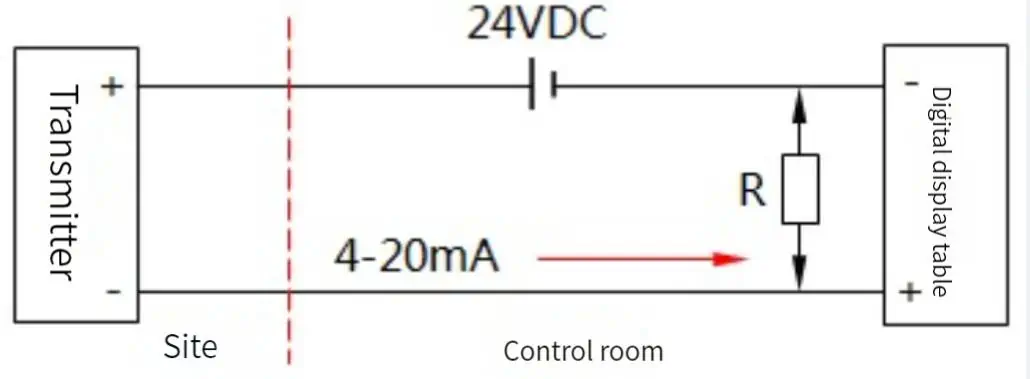
A 2-wire transmitter is loop-powered. The power supply and the 4–20 mA signal share the same two wires. At zero pressure, the transmitter draws 4 mA. At full scale, it draws 20 mA. The PLC analog input reads this current to determine the pressure.
Wiring steps:
- Connect the positive (+) terminal of the 24 VDC power supply to the positive (+) terminal of the transmitter.
- Connect the negative (−) terminal of the transmitter to the positive (+) input of the PLC analog module (or across a 250 Ω resistor for voltage conversion).
- Connect the negative (−) terminal of the PLC analog module back to the negative (−) terminal of the 24 VDC power supply.
The 2-wire configuration is the industry standard for process control. It uses less cable, is immune to lead resistance errors (current signals are not affected by wire length), and supports HART communication on the same two wires. Over 80% of industrial pressure transmitters use 2-wire 4–20 mA connections.
3-Wire Pressure Transducer Wiring Diagram
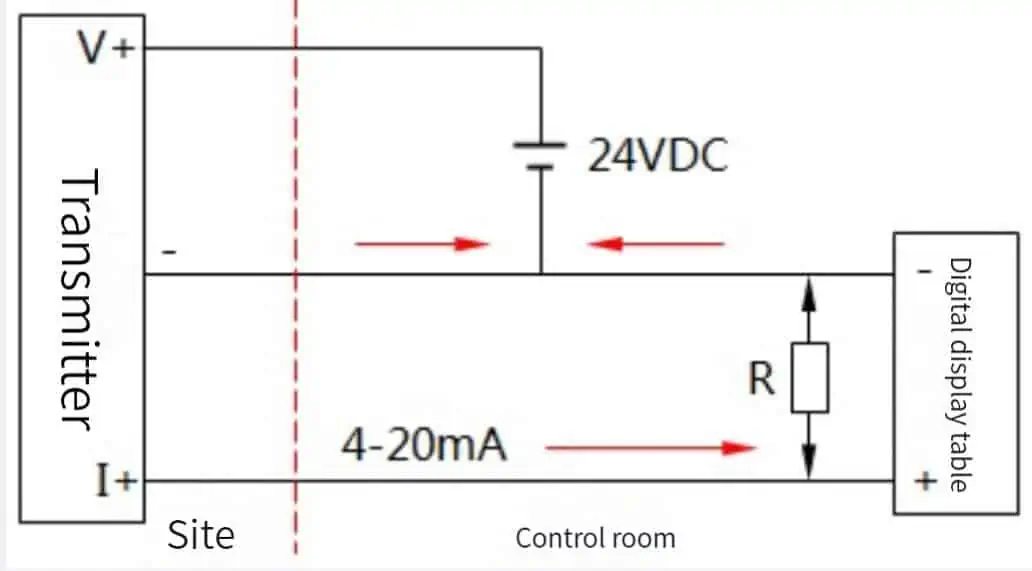
A 3-wire transmitter has a dedicated power positive wire, a signal output wire, and a shared ground (common) wire. The power supply and signal output share the negative/ground connection.
Wiring steps:
- Connect V+ (power positive) to the positive terminal of the 24 VDC power supply.
- Connect Signal Out to the positive input of your PLC analog module or display instrument.
- Connect GND (common) to both the negative terminal of the power supply and the negative terminal of the PLC input.
The 3-wire configuration is common in voltage-output transmitters (0–5 V, 0–10 V). The separate signal wire avoids the voltage drop issue that affects 2-wire voltage transmitters over long cable runs. However, for distances over 500 m, a 4–20 mA current output is still preferred.
4-Wire Pressure Transducer Wiring Diagram
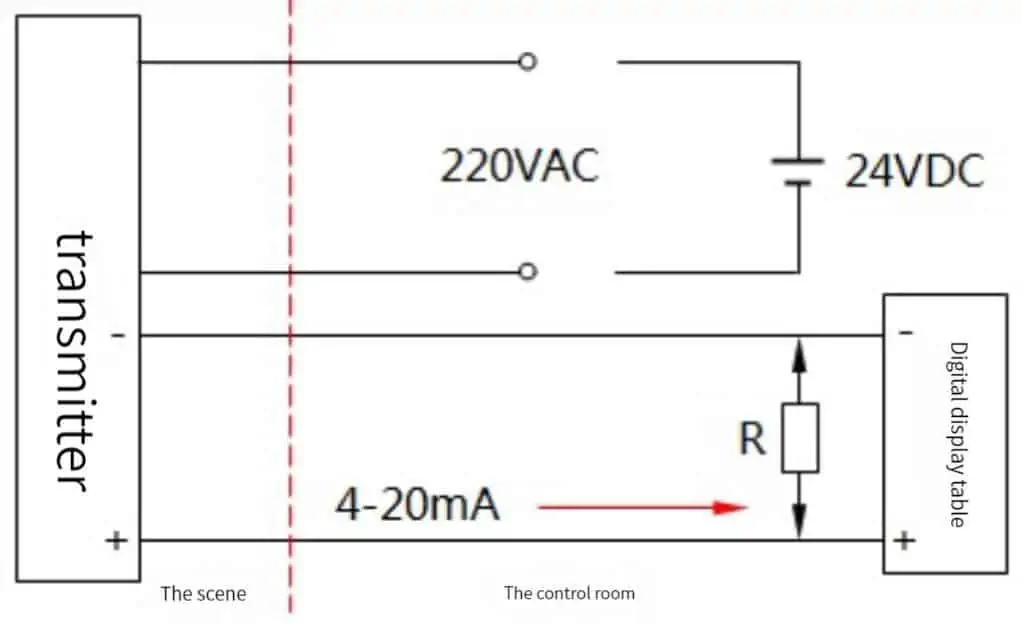
A 4-wire transmitter has completely separate power and signal circuits — two wires for power, two wires for signal. This isolation between power and measurement eliminates ground loops and allows both current and voltage output options.
Wiring steps:
- Connect Power + to the positive terminal of the power supply (24 VDC or 220 VAC depending on model).
- Connect Power − to the negative terminal of the power supply.
- Connect Signal + (current or voltage output) to the positive input of the PLC analog module.
- Connect Signal − to the negative input of the PLC analog module.
The 4-wire configuration is used in high-performance transmitters that need more power than a 2-wire loop can provide (the 4 mA minimum in a 2-wire system limits the available power to roughly 36 mW at 24 V). Transmitters with LCD displays, HART modems, or multiple outputs often require 4-wire power. Some 4-wire models accept 220 VAC directly.
Common Wiring Mistakes
Reversed polarity. Connecting + and − backwards. Most modern transmitters have reverse polarity protection, but some older models can be damaged. Always check terminal markings before applying power.
Wrong supply voltage. Applying 220 VAC to a 24 VDC transmitter destroys it instantly. Confirm the rated voltage on the nameplate.
Load resistance too high. A 2-wire 4–20 mA transmitter needs enough voltage to drive the current through the total loop resistance. If your PLC input impedance plus cable resistance exceeds the transmitter’s maximum load, the signal clips at the top end. Check the specification: most 24 VDC transmitters support up to 500–750 Ω total loop resistance.
Ground loops. Connecting the signal ground to the power ground at multiple points creates a ground loop. This adds 50/60 Hz noise to the signal. Use a single grounding point, or use a 2-wire 4–20 mA transmitter (current loops are inherently immune to ground loops).
Mixing up TEST and OUT terminals. Some transmitters have both OUT (operating output) and TEST (factory calibration) terminals. Only connect to the OUT terminals for normal operation.
Featured Pressure Transmitters from Sino-Inst
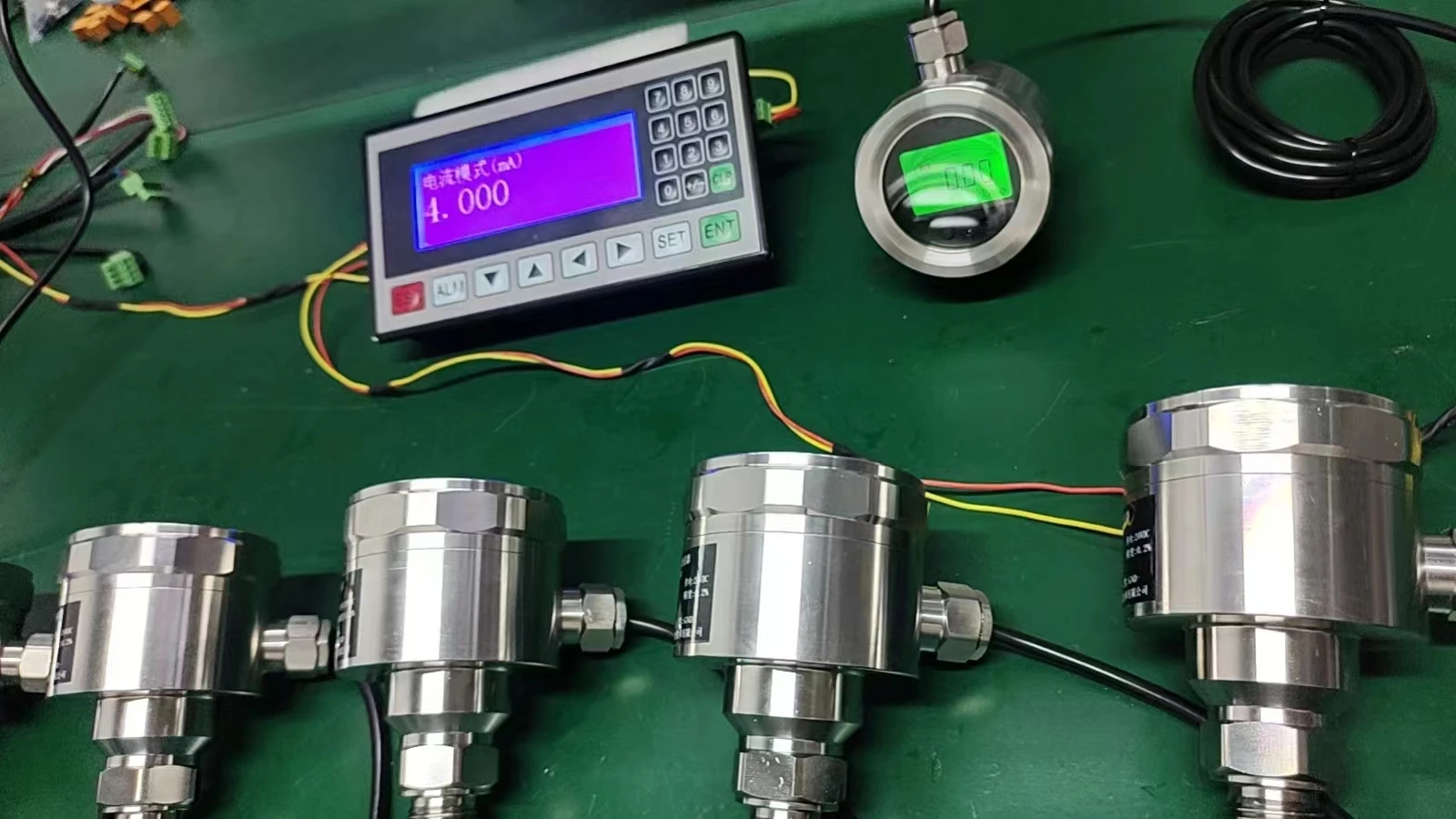
2-Wire 4–20 mA Transmitter
Loop-powered | ±0.25% FS
24 VDC | SS316L | HART option
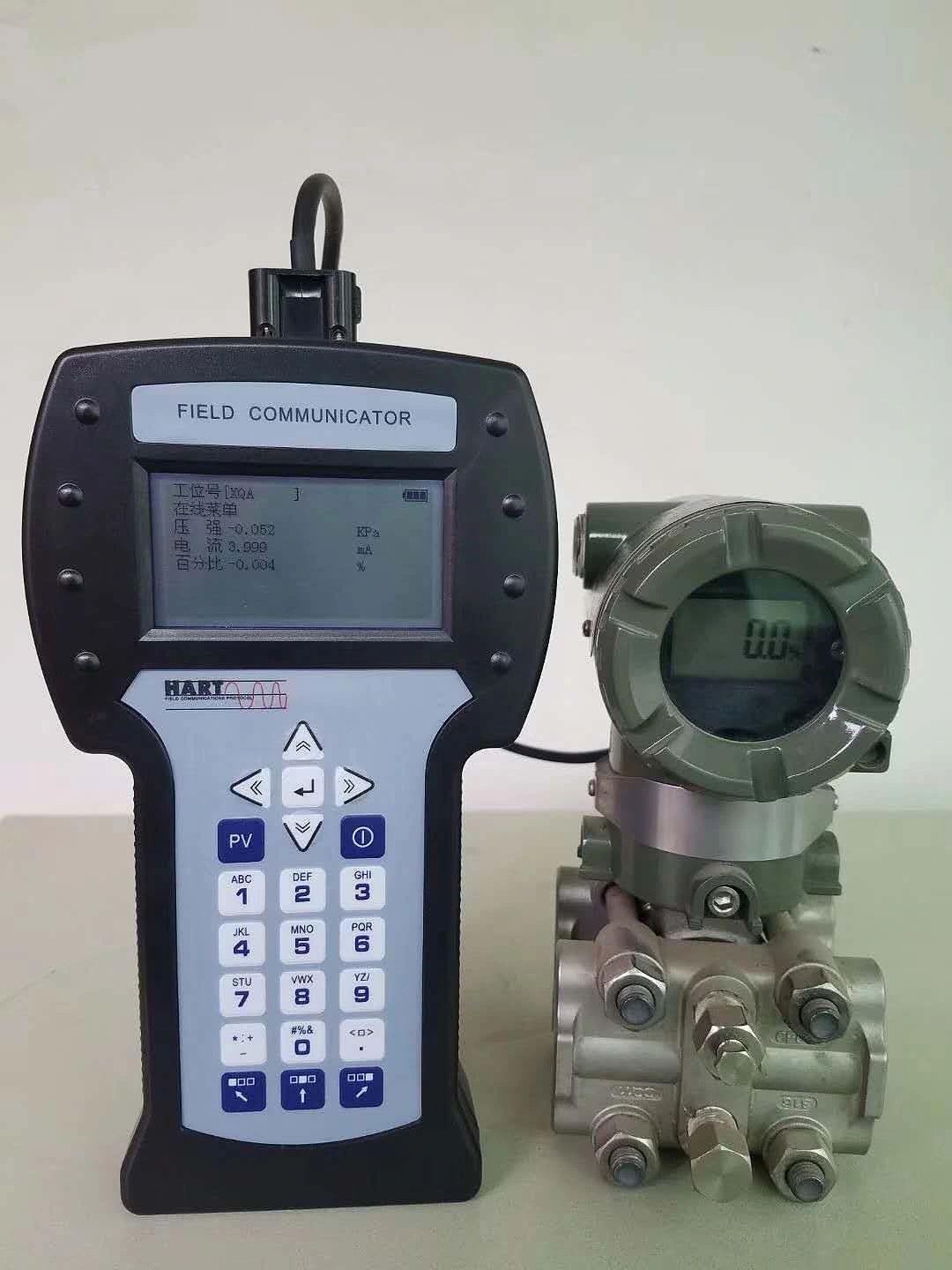
4-Wire DP Transmitter
Separate power/signal | ±0.075% FS
HART/Modbus | LCD display
Explosion-Proof Transmitter
ATEX/IECEx | Intrinsically safe
2-wire or 4-wire | IP67
Browse all pressure transmitters | How pressure transmitters work | Calibration guide
Pressure Transducer Wiring FAQ
What happens if I wire a 2-wire transmitter with wrong polarity?
Reverse polarity on a 2-wire transmitter blocks current flow completely. The loop reads 0 mA, and the PLC/DCS shows an under-range fault. Most modern transmitters have built-in reverse-polarity protection — the device won’t be damaged, but it won’t output a signal until you swap the wires. Always check with a multimeter before powering on.
Can I use a 4-wire transmitter in a 2-wire loop?
No. A 4-wire transmitter needs a separate power supply and has dedicated signal output terminals. You cannot wire it into a standard 2-wire 4–20 mA loop. If your system only supports 2-wire loops, you need a 2-wire transmitter or a signal isolator to convert the 4-wire output.
How long can I run 4–20 mA signal cable?
With standard 18 AWG twisted-pair cable, a 4–20 mA loop typically runs up to 1,500 meters (about 5,000 feet). The limiting factor is total loop resistance — keep it under what the transmitter can drive. For a 24 VDC supply with a 250 Ω sense resistor, a typical transmitter handles around 600 Ω total loop resistance. Longer runs need thicker cable or a higher supply voltage.
Why does my pressure reading drift after wiring?
Common causes: loose terminal connections causing intermittent contact, incorrect grounding creating ground loops, or EMI pickup from running signal wires alongside power cables. Check all connections are tight, verify single-point grounding, and use shielded cable with the shield grounded at one end only.
Do I need shielded cable for pressure transducer wiring?
For 4–20 mA loops in industrial environments — yes. Shielded twisted-pair cable reduces electromagnetic interference from VFDs, motors, and switchgear. Ground the shield at the control room end only. For short runs in electrically quiet environments, unshielded cable works, but shielded is always the safer choice.
What is the minimum supply voltage for a 2-wire transmitter?
Most 2-wire transmitters need 12–36 VDC, but check the specific model’s datasheet. The actual minimum depends on total loop resistance. A rough formula: V_min = 12V + (0.02A × R_loop). With a 250 Ω load resistor and 50 Ω cable resistance, you need at least 18 VDC. A 24 VDC supply handles most installations.
Written by the Sino-Inst Engineering Team — with over 20 years of experience in industrial pressure measurement, installation, and commissioning across oil & gas, water treatment, HVAC, and chemical processing plants worldwide.
Request a Quote or Technical Support
Need help selecting the right pressure transducer for your wiring configuration? Our engineers can recommend the best signal output type — 2-wire, 3-wire, or 4-wire — based on your system requirements.
Request a Quote

Wu Peng, born in 1980, is a highly respected and accomplished male engineer with extensive experience in the field of automation. With over 20 years of industry experience, Wu has made significant contributions to both academia and engineering projects.
Throughout his career, Wu Peng has participated in numerous national and international engineering projects. Some of his most notable projects include the development of an intelligent control system for oil refineries, the design of a cutting-edge distributed control system for petrochemical plants, and the optimization of control algorithms for natural gas pipelines.