
Updated: April 15, 2026
A metal tube flow meter is a variable-area (VA) rotameter built with a stainless steel measuring tube instead of glass. A float inside the tube rises to a height proportional to the flow rate, and a magnetic coupling transfers that position to an external scale or a 4–20 mA transmitter. It’s the standard choice for high-pressure, high-temperature, or opaque fluids where a glass rotameter won’t survive.
This guide covers the working principle, when to pick metal tube over glass or digital flow meters, accuracy and pressure limits, and what to specify when ordering one. If you already know you need a rotameter and just want the specs, jump to the comparison table and product cards below.
Contents
- What Is a Metal Tube Flow Meter?
- How Does a Metal Tube Rotameter Work?
- Metal Tube vs Glass Tube vs Digital Rotameter
- What Pressure, Temperature and Accuracy Can It Handle?
- Where Are Metal Tube Flow Meters Used?
- How to Specify a Metal Tube Flow Meter
- Featured Metal Tube Rotameters
- FAQ
What Is a Metal Tube Flow Meter?
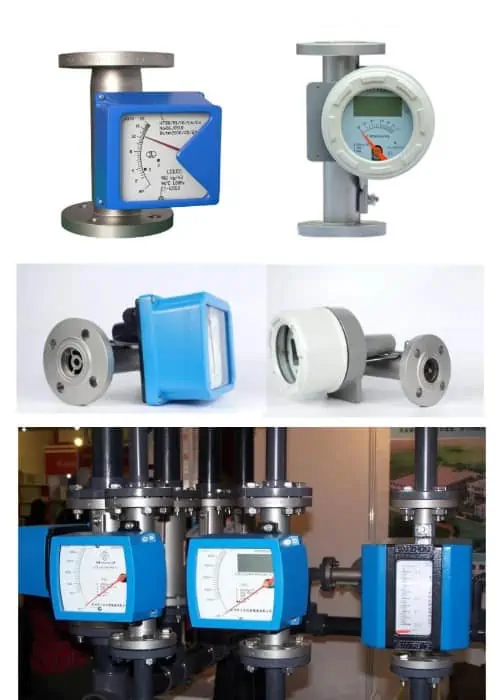
A metal tube flow meter — also called a metal tube rotameter or LZ-series variable area flow meter — measures liquid or gas flow using a float suspended in a vertical metal tube. “Metal tube” distinguishes it from the glass-tube rotameters used for low-pressure water and air service.
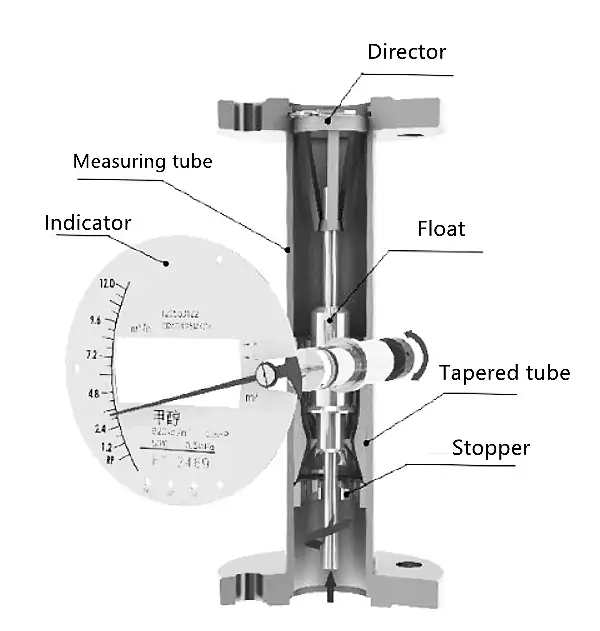
Typical construction: 304 or 316L stainless tube, a stainless or Hastelloy float, and an external magnetic indicator with pointer or LCD display. Wetted parts can be PTFE-lined for acid and chlorine service. Connection is flanged or threaded, sizes DN15–DN200.
How Does a Metal Tube Rotameter Work?
Fluid enters the bottom, flows upward, and lifts a float until the upward drag force balances gravity. Higher flow pushes the float higher. A permanent magnet inside the float couples through the stainless wall to an external indicator or transmitter — no mechanical feedthrough, no seals to leak.
The governing equation is a balance between float weight and the dynamic pressure of flow through the annular gap:
Q = Cd × A × √(2 × g × Vf × (ρf − ρ) / (Af × ρ))
Where Q is volumetric flow, A is the annular flow area, Vf and Af are the float volume and cross-section, ρf and ρ are float and fluid density. What this tells you in practice: a float calibrated for water will read wrong on heavier oils or gases — always calibrate for the specific fluid.
For a deeper comparison of variable-area flow measurement vs other technologies, see our rotameter vs flow meter comparison.
Metal Tube vs Glass Tube vs Digital Rotameter
Metal tube is the right answer when pressure, temperature, or opacity rules out glass. Digital VA meters add outputs but cost more.
| Parameter | Glass Tube | Metal Tube | Digital VA |
|---|---|---|---|
| Max Pressure | 1 MPa (145 psi) | 25 MPa (3,600 psi) | 25 MPa |
| Max Temperature | 120 °C | 300 °C | 300 °C |
| Accuracy | ±2% – ±5% FS | ±1.5% – ±2.5% FS | ±1% FS |
| Turndown | 10:1 | 10:1 | 20:1 |
| Output | Visual only | Visual + 4–20 mA / HART / alarm | 4–20 mA / HART / Modbus |
| Opaque / colored fluid | Unreadable | OK (magnetic coupling) | OK |
| Relative cost | 1× | 3–4× | 5–7× |
Pick metal tube when you’re above 10 bar, above 120 °C, or measuring oil, slurry, or steam condensate. Stick with glass for clean low-pressure water and air. Pay for digital VA only if you need remote output on fluids where a magnetic flow meter or vortex flow meter won’t work.
What Pressure, Temperature and Accuracy Can It Handle?
Typical metal tube rotameter specs for standard LZ-series:
- Size range: DN15 to DN200 (½” to 8″)
- Flow range: 2.5 L/h to 100 m³/h for water; 0.1 to 1,000 Nm³/h for air
- Pressure: PN16 to PN64 standard; PN250 on request
- Temperature: −40 °C to +300 °C; higher with remote indicator
- Accuracy: ±1.5% of full scale (±1% for calibrated premium units)
- Repeatability: ±0.5%
- Turndown ratio: 10:1
- Outputs: local pointer, LCD, 4–20 mA, HART, alarm contact, pulse
Where Are Metal Tube Flow Meters Used?
Metal tube rotameters dominate three duty areas where digital flow meters either cost too much or can’t cope with the fluid.
- Chemical injection and dosing. Low flow, aggressive fluids, and the need for a local visual indicator make rotameters the default on batch reactors and wastewater treatment skids.
- Utility gas and steam condensate. Where upstream straight run is short and accuracy requirements are moderate, a metal tube VA is simpler than Coriolis or thermal mass.
- Oil and lubricant supply lines. Dark fluids make glass rotameters unreadable. Magnetic coupling solves this without electronics.
- High-pressure gas cylinders and analyzers. PN64+ rating handles industrial gas distribution without bulky electronics.
How to Specify a Metal Tube Flow Meter
Get these six items right on the RFQ and you’ll receive a workable quote without back-and-forth.
- Fluid. Name and density/viscosity. “Water” isn’t enough — brine, DI water, and boiler feed all calibrate differently.
- Flow range. Minimum and maximum normal flow. Size for the meter’s mid-range, not the max.
- Operating pressure and temperature. Nominal and maximum. Adds 20% margin as a default.
- Connection type. Flanged (ANSI B16.5 or EN 1092-1) vs threaded; pipe size and rating.
- Output and display. Local pointer only, LCD+4–20 mA, HART, alarm switches — each adds cost.
- Orientation and mounting. Vertical is standard. Horizontal or top-mount needs a specific float design — call it out.
Common mistake on RFQs: asking for a single meter to cover 0–100 m³/h on the same spec sheet. Turndown is 10:1, so that unit will not read below 10 m³/h reliably. Either split into two meters or switch to a vortex or electromagnetic meter with 100:1 turndown.
Featured Metal Tube Rotameters
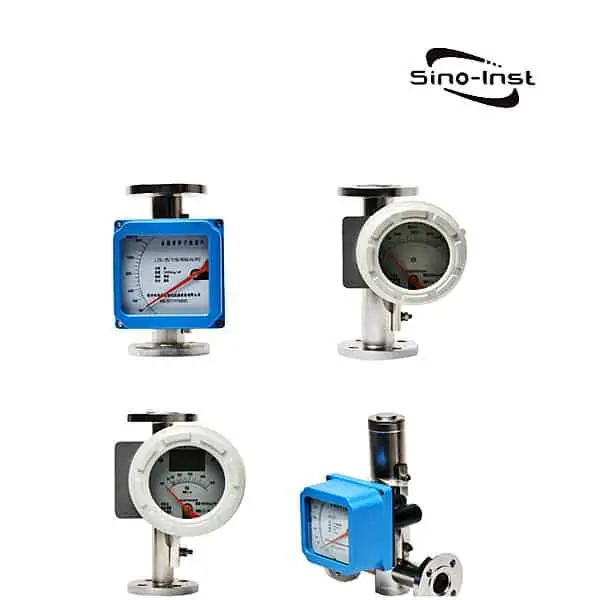
LZ Metal Tube Rotameter
Variable-area metal-tube rotameter for liquid, gas and steam in low-flow lines. Local dial plus optional remote 4-20mA transmitter — built for small-flow chemical dosing and utility service.
High-Temp Metal Rotameter
Metal-tube rotameter rated to 25 MPa for high-pressure liquid and gas service. Local dial plus optional 4-20mA output — built for hydraulic, LNG and chemical-injection skids.
PTFE-Lined Metal Rotameter
Variable-area metal-tube rotameter for liquid, gas and steam in low-flow lines. Local dial plus optional remote 4-20mA transmitter — built for small-flow chemical dosing and utility service.
FAQ
What does LZ mean on a metal tube rotameter?
LZ is the Chinese industry naming code for metal tube variable-area flow meters. LZD is a version with damping, LZB has been superseded by LZ for glass-tube designs. Spec sheets from Chinese manufacturers will use LZ-, LZB-, LZD- prefixes interchangeably.
Does a metal tube rotameter need straight pipe upstream?
Yes — 5 pipe diameters upstream and 250 mm downstream is the standard recommendation. Turbulence pushes the float off centre and skews the reading. See the full flow meter straight length requirements.
Can a metal tube rotameter measure gas and liquid with the same unit?
No. The float is sized for the fluid’s density. A float calibrated for air won’t measure water correctly. Order separate units or ask for a dual-calibration chart if flow alternates between two known fluids.
How often does a metal tube rotameter need recalibration?
Every 2–3 years for process use. Check the float visually after any line flush — debris wedged in the annular gap causes readings to stick at specific values. Our flow meter calibration guide covers the full procedure.
What’s the minimum viscosity a metal tube rotameter can handle?
Viscosity immunity varies by float type. Standard ball floats work up to ~30 cP. For heavier lubricants and syrups, specify a viscosity-immune float (V-shape or dual-ring) which extends the range to ~300 cP.
Are metal tube rotameters ATEX certified?
Yes — most manufacturers offer ATEX Ex ia or Ex d versions for hazardous area installation. Specify the zone and gas group on the order. Standard mechanical pointer units without electronics are inherently suitable for most hazardous areas.
Ready to spec a metal tube rotameter? Send us fluid, flow range, pressure, temperature, and connection size. Our engineers reply within 24 hours with a sized unit and a price — no account needed.
Related: high-temperature steam condensate metering.
Request a Quote

Wu Peng, born in 1980, is a highly respected and accomplished male engineer with extensive experience in the field of automation. With over 20 years of industry experience, Wu has made significant contributions to both academia and engineering projects.
Throughout his career, Wu Peng has participated in numerous national and international engineering projects. Some of his most notable projects include the development of an intelligent control system for oil refineries, the design of a cutting-edge distributed control system for petrochemical plants, and the optimization of control algorithms for natural gas pipelines.