Updated May 27, 2026 | Sino-Inst Engineering Team
A tank level monitoring system is not a single sensor — it is three layers: the level sensor, the 4–20 mA or HART signal, and the recorder or SCADA that turns the signal into a usable display, alarm, and inventory log. Most failed installations get layer 1 right (pick the sensor) and skip layers 2 and 3 — then wonder why nobody trusts the readings. This guide walks the full stack: sensor technology selection, signal-path wiring, recorder integration, and three real installation cases.
Contents
- The three layers of a tank level monitoring system
- Five questions to ask before picking a sensor technology
- Sensor technology comparison table (7 technologies)
- How the signal reaches the control room
- Recorder, SCADA, and overfill alarm wiring
- Three installation case studies
- Tank level monitoring products
- FAQ

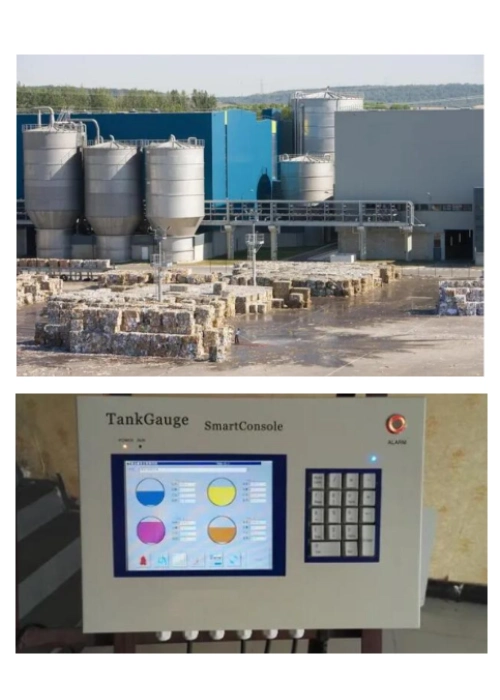
The three layers of a tank level monitoring system
A working tank-level loop needs all three of these components, wired and configured to work together:
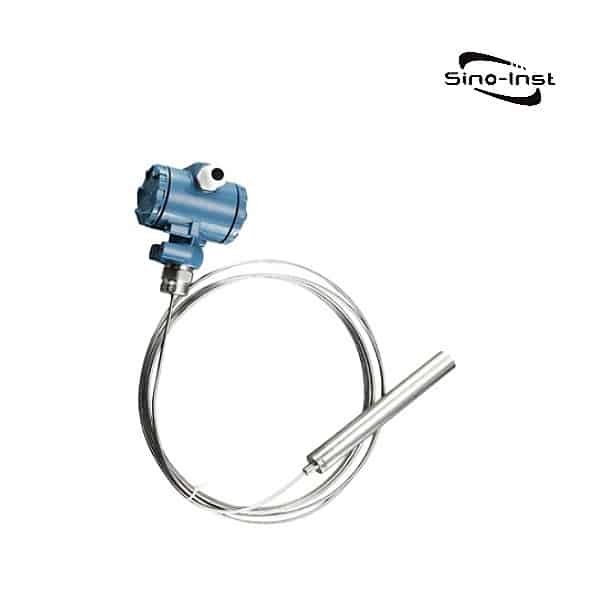
- Sensor — the device that converts liquid level to an electrical signal. Radar, ultrasonic, hydrostatic pressure, guided-wave radar, capacitance, magnetostrictive, or float-based.
- Signal transmission — the way that signal moves from the tank to the control room. Usually 4–20 mA analog, sometimes HART for diagnostics, Modbus RTU over RS-485 for multi-tank serial bus, or wireless (LoRa, WirelessHART) for remote sites.
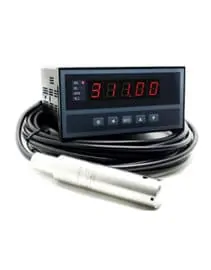
- Recorder / SCADA — the display, log, alarm, and integration into plant systems. Can be a standalone digital tank recorder, a PLC analog input card feeding a SCADA tag, or a cloud-connected gateway for inventory monitoring.
The most common installation failure is treating layer 3 as an afterthought. A radar sensor with no overfill alarm wiring is just a number on a display; it does not stop a spill. The recorder layer is where automation, logging, and safety interlocks actually live. For background on the signal layer, see our pressure transmitter working principle page — the same 4–20 mA loop math applies whether the sensor is a pressure transducer or a radar.
Five questions to ask before picking a sensor technology
Before any RFQ, walk these five. Wrong answer to any one rules out three or four of the seven common technologies.
- Tank geometry — vertical cylinder, horizontal cylinder, sphere, irregular underground? Tall narrow tanks (>5:1 H:D) suit guided-wave radar; flat-bottom storage tanks suit free-space radar; spherical tanks need radar or hydrostatic.
- Media type — clean water, viscous oil, slurry, foam, condensing vapor, hazardous chemical? Foam blocks ultrasonic; low-dielectric liquids (LPG, fuel) need guided-wave radar; corrosive media drives wetted-material selection per our wetted materials reference.
- Process conditions — temperature, pressure, vapor blanket, agitation? Above 200 °C rules out standard ultrasonic; sealed pressurized tanks need DP or radar; agitated tanks need anti-turbulence damping.
- Hazardous area classification — Class I Div 1, Div 2, Zone 0/1/2, IECEx, ATEX? Explosion-proof or intrinsically-safe certification narrows the supplier list and adds 30–50% to sensor cost.
- Required accuracy — ±2% is fine for surge tanks, ±0.5% is needed for inventory, ±0.05% is required for custody transfer. Custody-grade tanks justify magnetostrictive or servo gauges.
The biggest mismatch we see in field tickets is ultrasonic on foamy or condensing media. The sonic pulse scatters in foam and reads false-low; in tall narrow tanks the beam reflects off the wall instead of the surface. Both failure modes get blamed on the sensor when the root cause is wrong-technology-for-the-tank. For a sensor-by-sensor master reference, see our 7 types of tank level sensors guide.
Sensor technology comparison table (7 technologies)
| Technology | Best fit | Avoid when | Typical accuracy | Relative cost |
|---|---|---|---|---|
| Free-space radar (FMCW, 80/120 GHz) | Storage tanks, flat-top sealed pressurized, hazardous area | Heavy condensate on antenna, dust above DT3 | ±2 mm | 4× |
| Guided-wave radar (GWR) | Tall narrow tanks, foam, low-dielectric (LPG, fuel) | Heavy build-up on probe, mechanical agitation | ±3 mm | 3× |
| Ultrasonic (non-contact) | Open water, wastewater, simple geometry | Foam, condensate, vacuum, sealed tanks, >200 °C | ±0.5% FS | 1× |
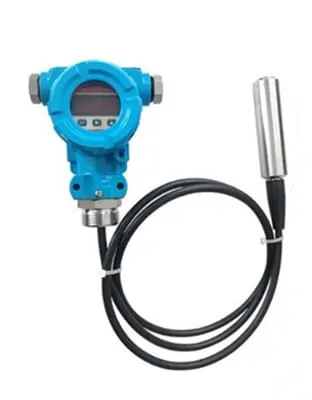
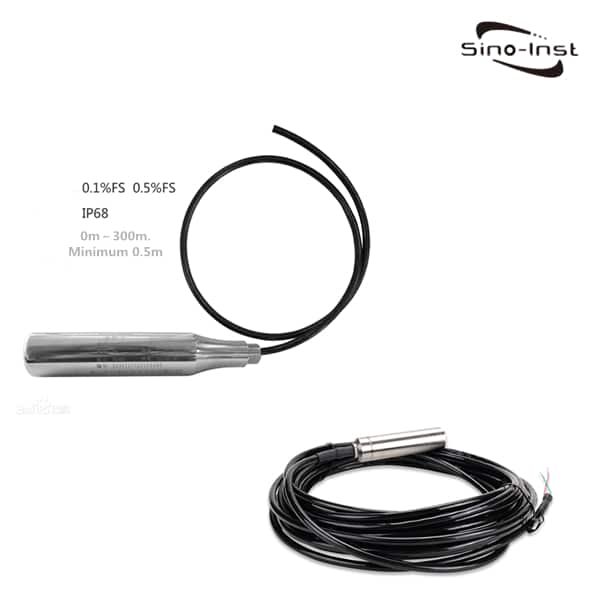
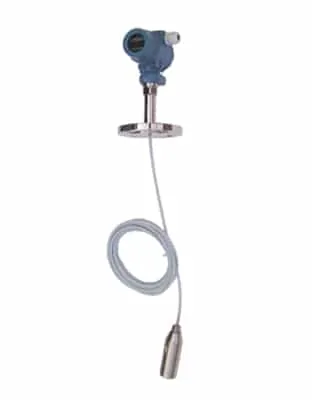
| Hydrostatic (submersible / bottom-port) | Open vented tanks, wells, sumps | Sealed pressurized tanks without DP version | ±0.1% FS | 1× |
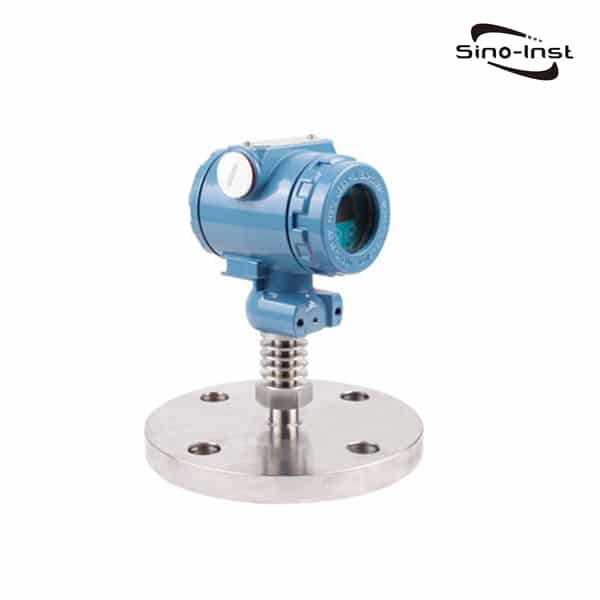
| Differential pressure (DP) | Sealed pressurized tanks, boiler drums, reactors | Need impulse-line maintenance, freezing risk | ±0.075% FS | 2× |
| Magnetostrictive | Custody transfer, fuel terminals, magnetic-friendly media | Highly conductive slurries, magnetic media | ±0.05% FS | 5× |
| Capacitive | Small tanks, sumps, conductive or non-conductive liquids | Coating build-up, dielectric drift over time | ±1% FS | 1.5× |
Cost ratios are normalized against a basic ultrasonic transmitter as 1×. Custody-transfer applications (gasoline terminals, LPG depots, refining) routinely justify 4–5× cost premium for the accuracy. For sulfuric acid and other aggressive chemistries see our sulfuric acid tank level radar guide — non-contact radar wins because nothing touches the media.
How the signal reaches the control room
Once the sensor produces a level reading, it has to travel to the control room. Five common signal options:
- 4–20 mA analog — the industrial default. Two-wire loop, 0% = 4 mA, 100% = 20 mA. Robust over 1 km cable runs, accepted by every DCS and PLC analog card. For the math on minimum supply voltage and burden resistor see our 4-20 mA conversion guide.
- 4–20 mA + HART — same two wires, but a small digital signal overlays the analog. Lets you read diagnostics, change span, and pull secondary variables without disconnecting.
- Modbus RTU over RS-485 — serial bus, up to 32 devices on one pair. Used for multi-tank installations where running individual 4–20 mA pairs is uneconomical.
- WirelessHART / LoRa — battery-powered transmitter, no field cable. Used for remote pump stations, lift stations, and brownfield retrofits where conduit runs would cost more than the sensor.
- Ethernet (Modbus TCP, EtherNet/IP) — for sensors with built-in network stacks. Emerging for new installations but still rare on legacy plants.
Default to 4–20 mA + HART unless cost forces a downgrade. The HART overlay costs nothing extra at the sensor (most modern transmitters include it), and the diagnostics save service calls. For wiring layout and shield-ground best practice see our transmitter installation guide — the rules are identical for level transmitters.
Recorder, SCADA, and overfill alarm wiring
The recorder is the layer that turns a 4–20 mA signal into a useful tank monitoring system. Three architectures cover ~90% of installations:
- Standalone digital tank recorder — paperless recorder mounted at the tank farm or control room, with 4–20 mA / 0–10 V / RS-485 inputs and a touchscreen. Logs to internal memory or USB. Best for single-tank or small-farm installations. Our recorder line accepts 0–5 V, 0–10 V, 4–20 mA, 0–20 mA, and millivolt inputs simultaneously.
- PLC + SCADA — sensor 4–20 mA wired to a PLC analog input card; PLC publishes to SCADA over Modbus TCP or OPC UA. Best for multi-tank, multi-process plants where level is one variable among many. Alarm logic and trending live in the SCADA.
- Cloud gateway — sensor wired to an edge gateway that pushes data to a cloud dashboard over cellular or wired internet. Best for inventory monitoring across geographically distributed tanks (fuel terminals, water utilities).
For any tank holding hazardous or environmentally regulated media, the overfill alarm has to be wired separately — a second sensor (typically a vibrating fork or magnetic float switch), independent power, and independent shutoff valve. The primary level transmitter is for monitoring and trending, not for safety interlock. This is API 2350 standard practice for storage terminals and required by most environmental regulators. For SIL 2 or SIL 3 service per IEC 61511 / IEC 61508, the overfill sensor, logic solver, and final element must each be certified to the target SIL — a vendor’s SIL certificate covers only that one box, not the full loop.
Three installation case studies
Underground septic tank — 80 GHz radar
Customer needed level monitoring on a buried septic tank with irregular dome geometry. Hydrostatic was ruled out — the tank vent allowed evaporative cooling that altered head. We installed an 80 GHz FMCW radar through the existing manway lid. Beam angle 3° handled the dome curvature without false echoes. Output 4–20 mA to a standalone tank recorder. Background on similar underground installations is in our underground tank level guide. If the tank had been agitated or had heavy turbulence, we would have added a stilling well — see our stilling well sizing & install guide for the sizing rules.
Horizontal LPG tank — external ultrasonic
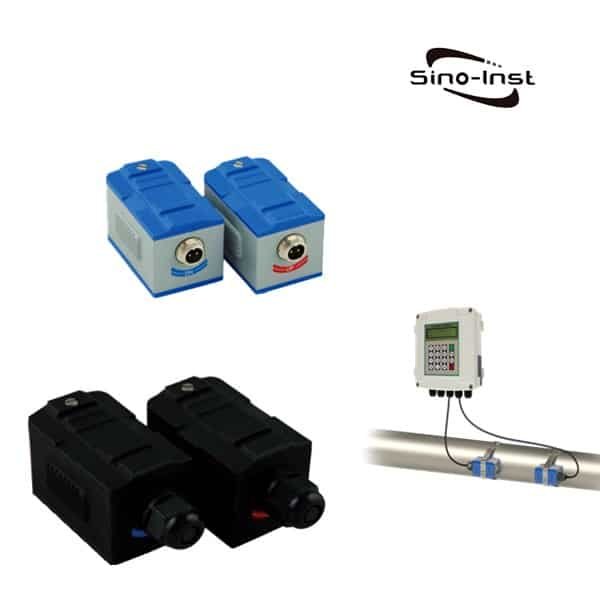
Customer wanted level monitoring on a 5-tonne horizontal LPG tank without drilling new ports. We installed an externally mounted ultrasonic level meter that reads through the tank wall using a high-frequency transducer. No process penetration, no hot work permit, no shutdown required. Accuracy ±2% FS — acceptable for inventory but not custody transfer. The horizontal cylindrical profile required a depth-to-volume lookup table in the recorder.
Diesel storage in hazardous area — explosion-proof ultrasonic
Customer needed level monitoring on diesel storage in an ATEX Zone 1 area (vapor recovery on-site). Standard ultrasonic was disqualified by certification. We installed an explosion-proof ultrasonic level transmitter (ATEX Ex d IIB T6) with intrinsically-safe 4–20 mA output to a barrier in the safe area, then to a tank recorder. Recorder logs daily inventory and pushes a SCADA alarm at 90% high level.
Tank level monitoring products


Non-Contact Radar Level Transmitter
80–120 GHz FMCW radar, narrow 3° beam, range 30 m. Non-contact, no maintenance, immune to dust, vapor, and foam. Suits storage tanks, hazardous-area and pressurized service.
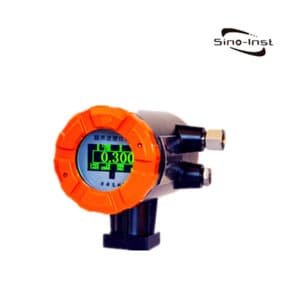
Ultrasonic Level Sensor
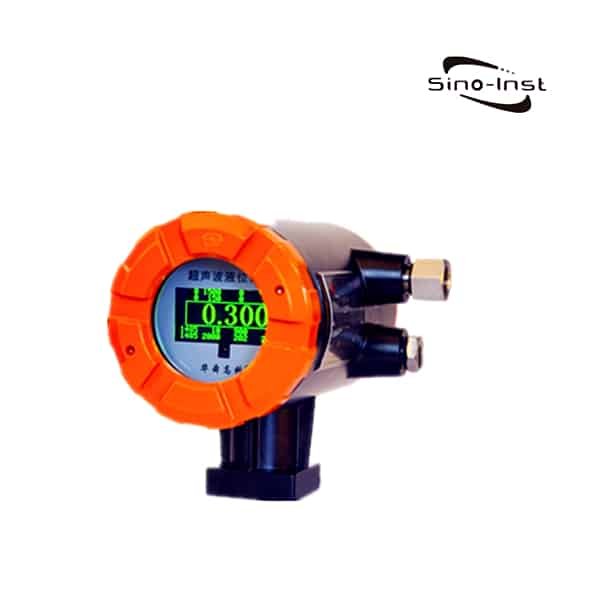
External-mount or top-down ultrasonic for water, wastewater, and benign liquids. No tank penetration, ±0.5% accuracy, range to 15 m. Lowest-cost continuous level option for open vented tanks.
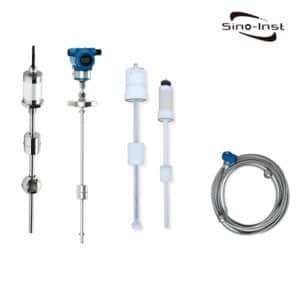
Magnetostrictive Level Transmitter
±0.05% custody-grade accuracy for fuel terminals and inventory tanks. Floating magnet on stainless probe, no moving electrical parts, decades of service life. 4–20 mA, HART, and Modbus output.
FAQ
What is a tank level monitoring system?
A tank level monitoring system is the full stack that turns liquid level into a usable plant signal — sensor, transmitter output, and recorder or SCADA. The sensor measures level using radar, ultrasonic, hydrostatic, or magnetostrictive technology. The transmitter converts that measurement to 4–20 mA or digital. The recorder logs, displays, and triggers alarms. All three layers have to work together for the system to be useful.
How do you choose a tank level sensor?
Walk five questions: tank geometry, media type, process conditions (temperature, pressure, agitation), hazardous-area classification, and required accuracy. Radar fits most flat-bottom storage tanks; guided-wave radar suits tall narrow tanks and low-dielectric media; hydrostatic suits open vented tanks; magnetostrictive is for custody-grade inventory.
Can one monitoring system handle multiple tanks?
Yes. Two common architectures: a PLC with multiple analog input channels feeding one SCADA, or a Modbus RTU RS-485 bus with up to 32 transmitters wired in series. A single tank recorder unit can typically handle 4 to 8 inputs; for more, a PLC is more economical and gives you alarm logic and trending out of the box.
Do I need a separate overfill alarm sensor?
For tanks holding hazardous or environmentally regulated media, yes. The primary level transmitter is for monitoring and trending; the overfill alarm has to be a separate sensor (vibrating fork, magnetic float switch, or capacitance switch) on independent power and an independent shutoff valve. This is API 2350 standard practice and required by most regulators.
What is the typical accuracy of a tank level monitoring system?
It depends on sensor choice. Ultrasonic ±0.5% FS, hydrostatic ±0.1% FS, free-space radar ±2 mm absolute, magnetostrictive ±0.05% FS. The recorder and SCADA layers add minimal error (typically < 0.1% if 16-bit analog inputs are used). For custody transfer, magnetostrictive or servo gauges are required.
Designing a new tank level monitoring system or replacing legacy gear? Send tank dimensions, media, process conditions, and hazardous-area classification — we will recommend a sensor, signal path, and recorder. For specific submersible applications see our submersible pressure transducer guide.
Request a Quote


Wu Peng, born in 1980, is a highly respected and accomplished male engineer with extensive experience in the field of automation. With over 20 years of industry experience, Wu has made significant contributions to both academia and engineering projects.
Throughout his career, Wu Peng has participated in numerous national and international engineering projects. Some of his most notable projects include the development of an intelligent control system for oil refineries, the design of a cutting-edge distributed control system for petrochemical plants, and the optimization of control algorithms for natural gas pipelines.