
Updated: April 11, 2026
A BTU meter measures the thermal energy transferred in a heating or cooling system. It combines a flow sensor with a pair of temperature sensors and a calculator to determine how many BTUs (British Thermal Units) pass through a piping loop over time. HVAC engineers use BTU meters to bill tenants for actual energy consumption, verify chiller performance, and identify inefficiencies in district cooling or heating networks. For meter-type selection by pipe size, accuracy, and glycol-corrected reading, see our chilled water flow meter decision matrix.
Contents
- What Is a BTU?
- What Is a BTU Meter?
- BTU Meter Working Principle
- BTU Meter Calculation Example
- BTU Meter Types
- BTU Meter for Chilled Water Systems
- Installation Guidelines
- BTU Meter vs Flow Meter
- BTU Meters from Sino-Inst
- FAQ
What Is a BTU?
A BTU (British Thermal Unit) is the amount of heat needed to raise the temperature of one pound of water by one degree Fahrenheit. In metric terms, 1 BTU equals approximately 1,055 joules or 0.293 watt-hours.
BTU is the standard unit for rating heating and cooling equipment capacity in North America. A residential air conditioner might be rated at 24,000 BTU/h (2 tons of cooling), while a large commercial chiller can deliver millions of BTU/h. Knowing the actual BTU consumption—not just the rated capacity—is what makes a BTU meter valuable.
What Is a BTU Meter?
A BTU meter (also called an energy meter or heat meter) is an instrument that calculates thermal energy transfer by measuring two things simultaneously: the flow rate of the heat-transfer fluid and the temperature difference between the supply and return lines.

Every BTU meter system has three core components:
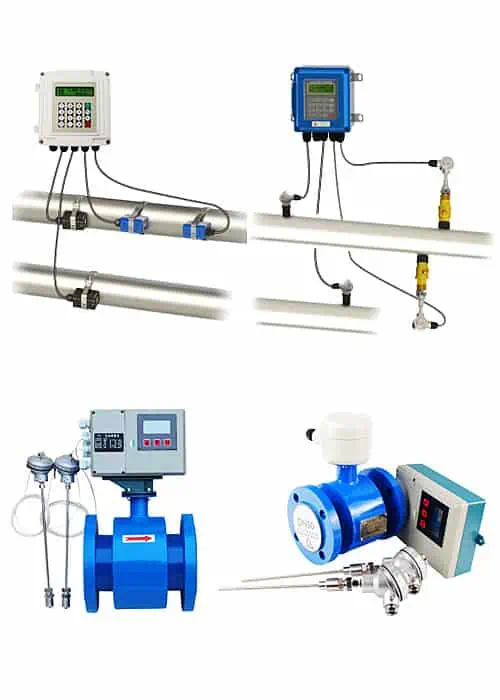
- Flow sensor — measures the volume of water passing through the pipe (electromagnetic, ultrasonic, or mechanical)
- Temperature sensor pair — typically matched PT1000 RTDs installed on the supply and return lines
- Calculator (integrator) — processes flow and temperature data to compute cumulative energy in BTU, kWh, MJ, or GJ
The calculator multiplies flow volume by the temperature difference (delta-T) and the specific heat of the fluid to produce the energy reading. This is the fundamental measurement behind every chilled water BTU metering application.
BTU Meter Working Principle
The BTU meter calculates thermal energy using this formula:
Q = V × ρ × Cp × ΔT
Where Q is heat energy (BTU), V is water volume (gallons), ρ is water density, Cp is specific heat capacity (1 BTU/lb·°F for water), and ΔT is the temperature difference between supply and return lines (°F).

In practice, the flow sensor sends a pulse or analog signal proportional to the flow rate. The two PT1000 sensors measure supply and return water temperatures simultaneously. The calculator samples these inputs every few seconds, computes the instantaneous thermal power (BTU/h), and integrates it over time to give the cumulative energy total.
Accuracy of the BTU reading depends on all three components. The flow sensor is typically the largest source of error. Electromagnetic and ultrasonic flow sensors achieve ±0.5–1% accuracy, while mechanical types are closer to ±2–3%. The matched PT1000 pair should have a combined error of less than ±0.1°C to keep the temperature measurement contribution small.
BTU Meter Calculation Example
Here is a practical calculation for a chilled water system:
Given: Flow rate = 500 GPM, supply temperature = 42°F, return temperature = 56°F.
Step 1: ΔT = 56°F − 42°F = 14°F
Step 2: Convert GPM to lb/min: 500 GPM × 8.34 lb/gal = 4,170 lb/min
Step 3: BTU/min = 4,170 × 14 × 1.0 = 58,380 BTU/min
Step 4: BTU/h = 58,380 × 60 = 3,502,800 BTU/h (about 292 tons of cooling)
This calculation is what the BTU meter’s integrator performs continuously. The meter accumulates these readings over hours, days, and months to show total energy consumption for billing or performance analysis.
BTU Meter Types
BTU meters are classified by the flow measurement technology used in the base meter.
Ultrasonic BTU Meters
Ultrasonic BTU meters use transit-time or Doppler techniques to measure flow velocity without any moving parts. Clamp-on versions mount externally on the pipe, making them ideal for retrofit installations. Inline versions offer higher accuracy (±0.5–1%). Ultrasonic meters work well with clean water and glycol mixtures. They have the longest service life—typically 10+ years without maintenance—because nothing contacts the flow stream in clamp-on designs.
Electromagnetic BTU Meters
Electromagnetic (mag) BTU meters apply Faraday’s law: a conductive fluid moving through a magnetic field generates a voltage proportional to its velocity. They offer excellent accuracy (±0.5%) and handle dirty or particle-laden water without performance degradation. Mag meters require a minimum fluid conductivity of about 5 μS/cm, which all water-based systems exceed. They are the preferred choice for chilled water and hot water loops in commercial HVAC. For more on how electromagnetic flow measurement works, see our GPM flow meter guide.
Mechanical BTU Meters
Mechanical meters use turbine wheels or impellers driven by the fluid. They are the lowest-cost option but have moving parts that wear over time. Typical accuracy is ±2–3%. Suitable for residential or small commercial systems where cost matters more than long-term precision. Expect to replace the flow cartridge every 5–6 years.
| Feature | Ultrasonic | Electromagnetic | Mechanical |
|---|---|---|---|
| Accuracy | ±0.5–1% | ±0.5% | ±2–3% |
| Moving parts | None | None | Yes (impeller) |
| Maintenance | Very low | Low | Periodic replacement |
| Pipe size range | DN15–DN6000 | DN10–DN2000 | DN15–DN150 |
| Dirty water tolerance | Low (transit-time) | High | Low |
| Cost | Medium–High | Medium | Low |
| Typical lifespan | 10+ years | 10+ years | 5–6 years |
BTU Meter for Chilled Water Systems
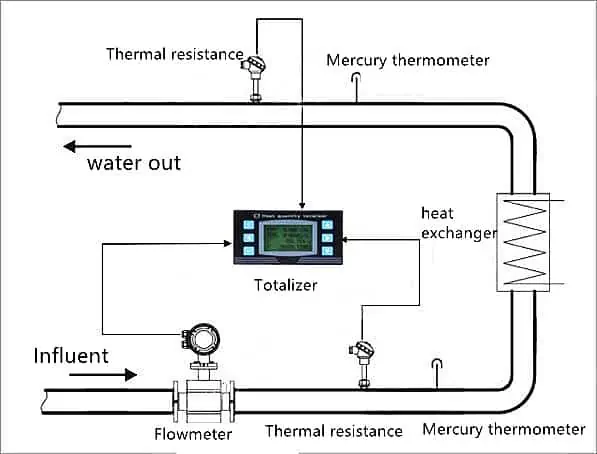
Chilled water systems are the most common application for BTU meters. In a typical district cooling setup, a central chiller plant produces chilled water at 40–45°F and distributes it to multiple buildings. Each building has a BTU meter on its chilled water loop to measure actual cooling energy consumed.
The flow sensor is installed on the return line (where flow is more stable). One PT1000 sensor goes on the supply line, the other on the return line. The delta-T in a well-operating chilled water system is typically 10–16°F. If the delta-T drops below 8°F, it usually signals a control valve problem or coil fouling—the BTU meter data helps diagnose this.
For sub-metering in multi-tenant buildings, the BTU meter enables fair cost allocation. Each tenant pays for their actual cooling consumption rather than a proportional share based on floor area. This alone can reduce energy waste by 15–25% because tenants have an incentive to control their usage. For a dedicated guide, see our page on BTU meters for chilled water.
Installation Guidelines
Proper installation is the single biggest factor affecting BTU meter accuracy. Here are the key points:
Flow sensor placement: Install on the return line in a straight pipe section. Maintain the manufacturer’s required upstream/downstream straight lengths (typically 10D/5D for mag meters, 15D/10D for ultrasonic). Avoid installing immediately after pumps, elbows, or partially closed valves.
Temperature sensors: Use matched PT1000 pairs from the same manufacturer. Install them in thermowells that are fully immersed in the flow. The supply sensor goes on the supply pipe, the return sensor on the return pipe—sounds obvious, but swapped sensors produce negative energy readings.
Wiring: Use shielded cable for temperature sensors to prevent electrical noise from affecting the small resistance signals. Keep sensor cables away from power cables and VFD outputs. A common field error is running PT1000 wires in the same conduit as 480V power—this introduces enough noise to cause 1–2°F measurement error.
Commissioning: After installation, verify that the flow direction arrow on the sensor matches the actual flow direction. Check that both temperature sensors read within 0.1°F of each other when the system is off (no flow, water at the same temperature). If the sensors disagree by more than 0.3°F, the BTU accuracy will suffer at low delta-T conditions.
BTU Meter vs Flow Meter
A flow meter measures volume or mass flow rate—gallons per minute, cubic meters per hour. A BTU meter uses a flow meter as one of its components but adds temperature measurement and energy calculation to produce a thermal energy reading.
| Parameter | BTU Meter | Flow Meter |
|---|---|---|
| What it measures | Thermal energy (BTU, kWh, MJ) | Flow rate (GPM, m³/h) or total volume |
| Components | Flow sensor + 2 temp sensors + calculator | Flow sensor only |
| Output | Energy consumption over time | Instantaneous flow rate and totalized volume |
| Typical application | HVAC energy billing, chiller monitoring | Water distribution, process control |
| Cost | Higher (more components) | Lower (single device) |
If you only need to know how much water is flowing, a flow meter or flow totalizer is sufficient. If you need to know how much heating or cooling energy that water is carrying, you need a BTU meter.
BTU Meters from Sino-Inst
Sino-Inst supplies complete BTU metering systems for HVAC, district energy, and industrial heating/cooling applications. Each system includes a calibrated flow sensor, matched PT1000 temperature sensor pair, and an energy calculator with RS485/Modbus output.
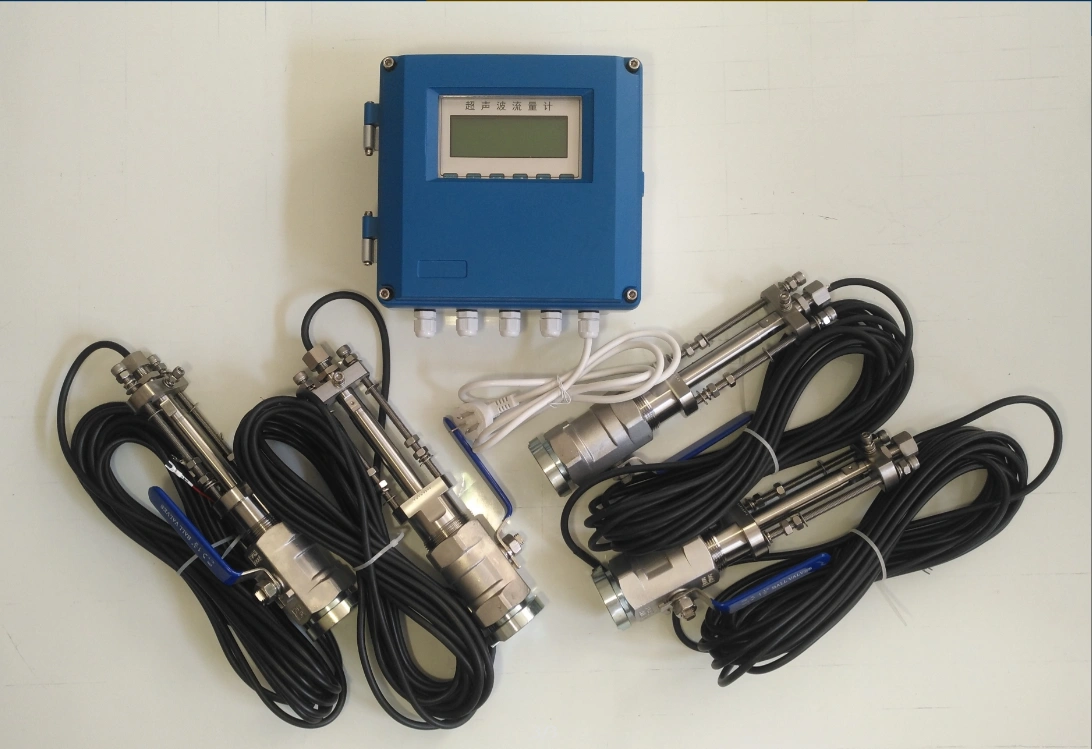
Ultrasonic BTU Meter
Transit-time and Doppler ultrasonic flow meters for clean liquids and dirty slurries. Clamp-on, insertion and in-line versions — pick by fluid type, pipe size and accuracy target.
Electromagnetic BTU Meter
Industrial electronic flow meters for digital fluid flow measurement. Compare electromagnetic, ultrasonic, vortex and turbine types to pick the right one for your pipe, fluid and accuracy budget.
BTU Measurement System
Transit-time and Doppler ultrasonic flow meters for clean liquids and dirty slurries. Clamp-on, insertion and in-line versions — pick by fluid type, pipe size and accuracy target.
FAQ
What is the difference between a BTU meter and an energy meter?
They are the same thing. “BTU meter” is the common term in North America where energy is measured in BTU. “Energy meter” or “heat meter” is more common internationally where energy is measured in kWh, MJ, or GJ. The device and working principle are identical—only the display unit differs.
Why use PT1000 instead of PT100 for BTU meters?
PT1000 has a base resistance of 1,000 ohms at 0°C compared to 100 ohms for PT100. The higher resistance means the sensor signal is less affected by lead wire resistance, which allows two-wire connections without significant error. For BTU metering, where the delta-T might be only 10–15°F, even small measurement errors are significant. PT1000 gives better accuracy with simpler wiring.
Can I use a BTU meter for steam systems?
Standard BTU meters are designed for closed-loop water systems where the same water flows through supply and return lines. Steam systems involve phase change (water to steam and back), which changes the calculation significantly. For steam energy metering, you need a differential pressure flow meter (vortex or orifice) with temperature/pressure compensation and a steam-specific energy calculator.
How often should a BTU meter be calibrated?
Most standards and building codes require recalibration every 3–5 years. Electromagnetic and ultrasonic flow sensors hold their calibration well because they have no moving parts. The temperature sensor pair should be checked annually by comparing both sensors at the same temperature. If the pair drifts more than 0.2°F apart, replace them.
What accuracy class should I specify for tenant billing?
For commercial tenant billing, specify a BTU meter that meets EN 1434 Class 2 or better (overall system accuracy of ±2% at the design flow rate). Most electromagnetic and ultrasonic meters exceed this easily. Mechanical meters may only meet Class 3, which is acceptable for monitoring but marginal for billing purposes.
What is the minimum delta-T for accurate BTU measurement?
Most BTU meter calculators need a minimum delta-T of 3°F (1.5°C) to produce a reliable reading. Below this threshold, the temperature measurement error becomes a large percentage of the actual difference, and the energy calculation becomes unreliable. In chilled water systems, design delta-T is typically 10–16°F, so this is rarely an issue during normal operation.
Need help selecting the right BTU metering system for your HVAC project? Our engineering team can help you choose the correct flow meter technology, pipe size, and sensor configuration. We provide complete systems with flow sensor, matched PT1000 pair, and energy calculator—ready to install. Contact us for a technical consultation or quotation.
Request a Quote

Wu Peng, born in 1980, is a highly respected and accomplished male engineer with extensive experience in the field of automation. With over 20 years of industry experience, Wu has made significant contributions to both academia and engineering projects.
Throughout his career, Wu Peng has participated in numerous national and international engineering projects. Some of his most notable projects include the development of an intelligent control system for oil refineries, the design of a cutting-edge distributed control system for petrochemical plants, and the optimization of control algorithms for natural gas pipelines.