What Is a Metal Tube Flow Meter? Rotameter Specs & Selection Guide

Updated: April 15, 2026

A metal tube flow meter is a variable-area (VA) rotameter built with a stainless steel measuring tube instead of glass. A float inside the tube rises to a height proportional to the flow rate, and a magnetic coupling transfers that position to an external scale or a 4–20 mA transmitter. It’s the standard choice for high-pressure, high-temperature, or opaque fluids where a glass rotameter won’t survive.

This guide covers the working principle, when to pick metal tube over glass or digital flow meters, accuracy and pressure limits, and what to specify when ordering one. If you already know you need a rotameter and just want the specs, jump to the comparison table and product cards below.

Contents

What Is a Metal Tube Flow Meter?

A metal tube flow meter — also called a metal tube rotameter or LZ-series variable area flow meter — measures liquid or gas flow using a float suspended in a vertical metal tube. “Metal tube” distinguishes it from the glass-tube rotameters used for low-pressure water and air service.

Typical construction: 304 or 316L stainless tube, a stainless or Hastelloy float, and an external magnetic indicator with pointer or LCD display. Wetted parts can be PTFE-lined for acid and chlorine service. Connection is flanged or threaded, sizes DN15–DN200.

How Does a Metal Tube Rotameter Work?

Fluid enters the bottom, flows upward, and lifts a float until the upward drag force balances gravity. Higher flow pushes the float higher. A permanent magnet inside the float couples through the stainless wall to an external indicator or transmitter — no mechanical feedthrough, no seals to leak.

The governing equation is a balance between float weight and the dynamic pressure of flow through the annular gap:

Q = Cd × A × √(2 × g × Vf × (ρf − ρ) / (Af × ρ))

Where Q is volumetric flow, A is the annular flow area, Vf and Af are the float volume and cross-section, ρf and ρ are float and fluid density. What this tells you in practice: a float calibrated for water will read wrong on heavier oils or gases — always calibrate for the specific fluid.

For a deeper comparison of variable-area flow measurement vs other technologies, see our rotameter vs flow meter comparison.

Metal Tube vs Glass Tube vs Digital Rotameter

Metal tube is the right answer when pressure, temperature, or opacity rules out glass. Digital VA meters add outputs but cost more.

ParameterGlass TubeMetal TubeDigital VA
Max Pressure1 MPa (145 psi)25 MPa (3,600 psi)25 MPa
Max Temperature120 °C300 °C300 °C
Accuracy±2% – ±5% FS±1.5% – ±2.5% FS±1% FS
Turndown10:110:120:1
OutputVisual onlyVisual + 4–20 mA / HART / alarm4–20 mA / HART / Modbus
Opaque / colored fluidUnreadableOK (magnetic coupling)OK
Relative cost3–4×5–7×

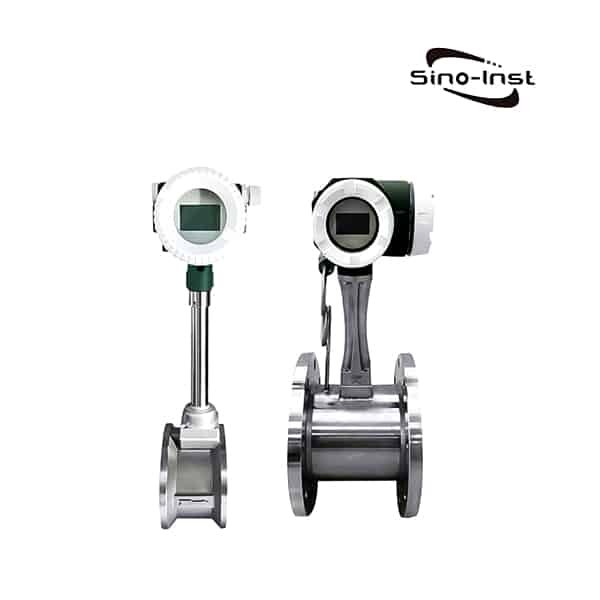
Pick metal tube when you’re above 10 bar, above 120 °C, or measuring oil, slurry, or steam condensate. Stick with glass for clean low-pressure water and air. Pay for digital VA only if you need remote output on fluids where a magnetic flow meter or vortex flow meter won’t work.

What Pressure, Temperature and Accuracy Can It Handle?

Typical metal tube rotameter specs for standard LZ-series:

  • Size range: DN15 to DN200 (½” to 8″)
  • Flow range: 2.5 L/h to 100 m³/h for water; 0.1 to 1,000 Nm³/h for air
  • Pressure: PN16 to PN64 standard; PN250 on request
  • Temperature: −40 °C to +300 °C; higher with remote indicator
  • Accuracy: ±1.5% of full scale (±1% for calibrated premium units)
  • Repeatability: ±0.5%
  • Turndown ratio: 10:1
  • Outputs: local pointer, LCD, 4–20 mA, HART, alarm contact, pulse

Where Are Metal Tube Flow Meters Used?

Metal tube rotameters dominate three duty areas where digital flow meters either cost too much or can’t cope with the fluid.

  • Chemical injection and dosing. Low flow, aggressive fluids, and the need for a local visual indicator make rotameters the default on batch reactors and wastewater treatment skids.
  • Utility gas and steam condensate. Where upstream straight run is short and accuracy requirements are moderate, a metal tube VA is simpler than Coriolis or thermal mass.
  • Oil and lubricant supply lines. Dark fluids make glass rotameters unreadable. Magnetic coupling solves this without electronics.
  • High-pressure gas cylinders and analyzers. PN64+ rating handles industrial gas distribution without bulky electronics.

How to Specify a Metal Tube Flow Meter

Get these six items right on the RFQ and you’ll receive a workable quote without back-and-forth.

  1. Fluid. Name and density/viscosity. “Water” isn’t enough — brine, DI water, and boiler feed all calibrate differently.
  2. Flow range. Minimum and maximum normal flow. Size for the meter’s mid-range, not the max.
  3. Operating pressure and temperature. Nominal and maximum. Adds 20% margin as a default.
  4. Connection type. Flanged (ANSI B16.5 or EN 1092-1) vs threaded; pipe size and rating.
  5. Output and display. Local pointer only, LCD+4–20 mA, HART, alarm switches — each adds cost.
  6. Orientation and mounting. Vertical is standard. Horizontal or top-mount needs a specific float design — call it out.

Common mistake on RFQs: asking for a single meter to cover 0–100 m³/h on the same spec sheet. Turndown is 10:1, so that unit will not read below 10 m³/h reliably. Either split into two meters or switch to a vortex or electromagnetic meter with 100:1 turndown.

Featured Metal Tube Rotameters

LZ Metal Tube Rotameter

LZ Metal Tube Rotameter

Variable-area metal-tube rotameter for liquid, gas and steam in low-flow lines. Local dial plus optional remote 4-20mA transmitter — built for small-flow chemical dosing and utility service.

High-Temp Metal Rotameter

Metal-tube rotameter rated to 25 MPa for high-pressure liquid and gas service. Local dial plus optional 4-20mA output — built for hydraulic, LNG and chemical-injection skids.

PTFE-Lined Metal Rotameter

Variable-area metal-tube rotameter for liquid, gas and steam in low-flow lines. Local dial plus optional remote 4-20mA transmitter — built for small-flow chemical dosing and utility service.

FAQ

What does LZ mean on a metal tube rotameter?

LZ is the Chinese industry naming code for metal tube variable-area flow meters. LZD is a version with damping, LZB has been superseded by LZ for glass-tube designs. Spec sheets from Chinese manufacturers will use LZ-, LZB-, LZD- prefixes interchangeably.

Does a metal tube rotameter need straight pipe upstream?

Yes — 5 pipe diameters upstream and 250 mm downstream is the standard recommendation. Turbulence pushes the float off centre and skews the reading. See the full flow meter straight length requirements.

Can a metal tube rotameter measure gas and liquid with the same unit?

No. The float is sized for the fluid’s density. A float calibrated for air won’t measure water correctly. Order separate units or ask for a dual-calibration chart if flow alternates between two known fluids.

How often does a metal tube rotameter need recalibration?

Every 2–3 years for process use. Check the float visually after any line flush — debris wedged in the annular gap causes readings to stick at specific values. Our flow meter calibration guide covers the full procedure.

What’s the minimum viscosity a metal tube rotameter can handle?

Viscosity immunity varies by float type. Standard ball floats work up to ~30 cP. For heavier lubricants and syrups, specify a viscosity-immune float (V-shape or dual-ring) which extends the range to ~300 cP.

Are metal tube rotameters ATEX certified?

Yes — most manufacturers offer ATEX Ex ia or Ex d versions for hazardous area installation. Specify the zone and gas group on the order. Standard mechanical pointer units without electronics are inherently suitable for most hazardous areas.

Ready to spec a metal tube rotameter? Send us fluid, flow range, pressure, temperature, and connection size. Our engineers reply within 24 hours with a sized unit and a price — no account needed.
Request a Quote

Please enable JavaScript in your browser to submit the form

Tank Level Sensors: How to Choose by Tank Content (Decision Matrix)

Updated: April 16, 2026 | By Sino-Inst Engineering Team

Most tank level sensor guides start with the sensor — radar, ultrasonic, hydrostatic, capacitance — and tell you what each one does. That is the wrong way around. The fluid you are measuring eliminates more than half the sensor types before you even think about budget. This guide flips the lookup: pick your tank content first, and the right sensor narrows to one or two choices. Use it for new specifications or to second-guess an existing installation that keeps failing.

Contents

Quick decision matrix: tank content to sensor

Tank contentFirst-choice sensorBackup choiceAvoid
Clean water (tower, cistern, well)Submersible hydrostaticRadar (80 GHz)Capacitance
Diesel / fuel oilMagnetostrictiveServo gaugeUltrasonic (vapor)
Strong acids / causticsGuided wave radar (PFA-coated)Bubbler / DPHydrostatic submersible
Slurry, sludge, mud80 GHz radar (non-contact)DP transmitter with diaphragm sealsFloat, capacitance
Foamy or stratified liquidsGuided wave radarMagnetic level gaugeUltrasonic, free-space radar
Hot oil / asphalt (>200°C)Guided wave radar (HT probe)Servo gaugeSubmersible, capacitance
Food, beverage, pharmaSanitary radar (3A / EHEDG)Sanitary capacitanceBubbler, contact float
LNG, LN2, cryogenicMagnetostrictive (cryo seal)Servo with floatCapacitance, hydrostatic
Solid powders / pellets80 GHz radar with dust shieldGuided wave radarUltrasonic, hydrostatic
Overflow / dry-run point onlyVibrating fork (tuning fork)RF admittance, float switchContinuous transmitter

Step 1: Define what’s in the tank

“Liquid” is not a content category. Conductive vs non-conductive matters for capacitance probes. Dielectric constant matters for radar. Foam matters for ultrasonic. Vapor pressure matters for any non-contact tech. Before specifying anything, write down these six properties of your fluid:

  • Density (kg/m³ at operating temperature)
  • Dielectric constant εr (water = 80, hydrocarbons = 2-4, plastics = 1.5-3)
  • Conductivity (water with salts = high, distilled water = low, oils = none)
  • Viscosity at operating temperature
  • Foam tendency (yes / no / sometimes)
  • Vapor or condensate above the surface (steam, solvent vapor, etc.)

If you cannot get this from the SDS, ask the process engineer who designed the tank. Specifying a level sensor without these numbers is what produces the field calls we get six months later.

Step 2: Continuous reading or point switch?

Continuous transmitters give you a 4-20 mA reading anywhere in the tank’s range. Point switches just close a contact at one fixed level. They cost different orders of magnitude and they fail differently.

NeedUse continuousUse point switch
Inventory trackingYesNo
PID loop / blending controlYesNo
Pump start / stop onlyOptionalYes (cheaper)
Overflow safety / dry-run cutoutNo (use both)Yes (SIL-rated)
Custody transferYes (servo or magnetostrictive)No
Budget under $200Rare (hydrostatic + display)Yes (float, fork)

For pump control, a continuous transmitter feeding the PLC plus an independent float switch as backup is a far more reliable arrangement than two transmitters in voting. The float switch covers the failure mode where the transmitter fails high or stuck. For pump-only switching, see our float switch wiring guide.

Clean water and potable storage

Submersible hydrostatic transmitters are the default. The probe sits at the tank bottom, measures the pressure of the water column above it, and outputs 4-20 mA proportional to depth. Accuracy is ±0.1% FS for quality units, the cable doubles as a vent (atmospheric reference), and there are no moving parts to wear out.

For potable water, choose a NSF/ANSI 61 certified probe. For elevated towers (over 15 m head), check the cable’s vent tube doesn’t sag and form condensate traps — a saturated vent tube reads erratically. The non-contact alternative is 80 GHz radar mounted on the top, which avoids any in-tank hardware but costs roughly 3x.

Fuel, diesel and lubricating oil

Magnetostrictive transmitters dominate this category because hydrocarbons have stable density, low foam, and the float-on-stem principle gives the ±1 mm accuracy that fuel inventory needs. The same probe can carry up to 8 RTDs for ATG (automatic tank gauging) compliance. For an underground or buried tank with restricted top access, the flexible-cable version of the same technology installs through a 2″ riser.

Avoid ultrasonic on diesel — vapor density above the liquid changes the speed of sound, which throws the level reading off by 1-3% as temperature swings. Use it only on water; on fuel it always disappoints in field service.

Acids, caustics and corrosive chemicals

Guided wave radar with a PFA or PTFE-coated probe is the safe specification for sulfuric acid, sodium hydroxide, hydrogen peroxide, and other aggressive chemicals. The radar pulse travels along the probe regardless of dielectric constant, vapor density, or foam. The PFA coating isolates everything but the probe end from the medium.

For storage tanks where in-tank hardware is forbidden by safety policy, fall back to a bubbler system (DP transmitter with a purge gas line). Bubblers are old technology but they are bulletproof on the most aggressive chemicals — nothing wetted is in contact with the tank except the dip tube.

Slurry, sludge and abrasive media

Anything in contact with mining slurry, raw sewage, paper pulp, or cement gets coated, eroded, or both. The default specification is non-contact 80 GHz radar mounted above the tank with a 6° narrow beam and a self-cleaning antenna. Build-up on the antenna is what kills slurry radars; the 80 GHz devices have small antenna footprints and air-purge ports for periodic cleaning.

If radar isn’t an option (sealed tank with no top opening), DP transmitters with remote diaphragm seals on the tank’s high and low pressure taps work — but every cleaning cycle becomes a maintenance event. Avoid floats and capacitance in slurry; both will be disabled within a month.

Food, beverage and pharmaceutical

3A and EHEDG certifications are non-negotiable. Sanitary radar is the dominant choice — flush-mount on a tri-clamp connection, no crevices for product to harbor in, full CIP/SIP cleanability. For low-cost agitated tanks, sanitary capacitance probes work for water-based products but struggle when fat content varies (changing dielectric).

Avoid bubblers (purge gas in product is unacceptable) and avoid contact floats (cleaning impossible).

Cryogenic and extreme temperature

Below -40°C and above 200°C is where most general-purpose level sensors quietly drift out of spec. Magnetostrictive transmitters with cryogenic seal extensions work down to liquid nitrogen temperatures. For LNG bullets, a servo gauge with a stainless float is the API standard.

For molten sulfur, asphalt, and hot oil up to 400°C, guided wave radar with a high-temperature antenna assembly is the only practical continuous solution. Hydrostatic submersibles are not rated; capacitance probes drift severely with temperature. For more on hot-tank installation specifics, see our high-temperature radar level guide.

The common mistake: defaulting to ultrasonic

Ultrasonic level transmitters are cheap, non-contact, and look like a universal solution. They are not. Ultrasonics measure the time-of-flight of a sound pulse to the liquid surface and back. Anything that disrupts the air column between the sensor and the surface throws the reading off.

  • Vapor: any solvent vapor, condensing steam, or even rapid temperature gradients change the speed of sound by several percent.
  • Foam: the pulse reflects off foam, not the actual liquid surface.
  • Dust or fog: attenuates the signal until it reads “lost echo.”
  • Stratified temperature: outdoor tanks in summer have a cool layer near the liquid and hot air at the top — a refraction lens that bends the pulse.

Ultrasonics are appropriate for clean water in open atmospheric tanks at stable temperatures. That is a small slice of real applications. When in doubt, switch to 80 GHz radar — same non-contact installation, immune to all the conditions above, costs about 1.5x.

Featured tank level sensors

Submersible Hydrostatic (Water)

SMT3151TR submersible hydrostatic level transmitter with 316L stainless probe. Drops straight into wells, reservoirs and storage tanks — 4-20mA output for continuous level monitoring.

Magnetostrictive (Fuel)

Magnetostrictive level transmitter with ±1 mm resolution for high-accuracy tank gauging. Preferred choice on fuel depots, API terminals and chemical inventory measurement.

DP Transmitter (Chemical)

DP transmitters measure pressure difference across gas, liquid or steam. 4-20mA / 0-5V output drives liquid level, density and flow loops across process plants.

FAQ

What is the most accurate tank level sensor?

Magnetostrictive transmitters reach ±0.1 mm in custody-transfer configurations, the highest of any commercial tank level technology. Servo gauges (Honeywell Enraf, Endress+Hauser Proservo) match this for tall storage tanks. Hydrostatic and radar are typically ±2-5 mm at best.

What is the cheapest reliable tank level sensor?

For continuous reading on water, a basic submersible hydrostatic transmitter runs $150-300 and works for 5+ years with no maintenance. For point-only level switching, a cable-tilt float switch is under $40. Don’t pay more for fancier tech if your application doesn’t need it.

Can one sensor replace multiple float switches?

Yes. A continuous transmitter feeding a PLC can derive any number of virtual setpoints in software — high-high alarm, high pump-stop, low pump-start, low-low cutoff — from one 4-20 mA reading. The trade-off is single point of failure; most safety systems still keep one independent float switch as a backup.

Do I need radar or ultrasonic for an outdoor tank?

Radar. Ultrasonic readings drift in summer when the air column above the liquid stratifies into hot upper / cool lower zones, and they fail outright in heavy rain or fog. 80 GHz radar is unaffected by atmospheric conditions.

How do I measure level in a tank with foam on top?

Guided wave radar — the radar pulse travels along a probe into the foam and reflects off the actual liquid surface below it. Free-space radar and ultrasonic both reflect off the foam itself and read incorrectly. The other option is a magnetic level gauge with an external chamber: foam stays in the main tank, the chamber sees clean liquid.

What sensor works for solid material in tanks (powders, pellets)?

80 GHz radar with a dust-shielded antenna is the modern default. Guided wave radar with a single rope probe works for tanks under 30 m where the rope can swing freely. Avoid ultrasonic — solids have an irregular angle of repose that scatters the pulse.

How often should tank level sensors be calibrated?

Hydrostatic and DP transmitters drift slowly and benefit from annual zero/span verification. Magnetostrictive and servo gauges measure time-of-flight and don’t drift mechanically — every 2-3 years is usually enough. Radar gauges have no moving parts and need calibration only when something physically changes inside the tank (new internals, repositioned nozzle).

Need help specifying for your tank?

Send tank dimensions, fluid SDS, operating temperature/pressure, and any agitation or foam characteristics. We’ll spec a primary and a backup option, with an honest reason if the lowest-cost answer is the right one.

Request a Quote

Please enable JavaScript in your browser to submit the form

Inline Water Flow Meters: Types, Sizing & Buying Guide (2026)

Updated: April 15, 2026

An inline water flow meter measures water flow while installed directly in the pipeline — no bypass, no strap-on sensors. Three technologies dominate this space: mechanical (turbine), electromagnetic, and ultrasonic. The right choice depends on pipe size, water quality, required accuracy, and whether you need digital output for building automation or SCADA.

This guide compares the three technologies with real specs and prices, walks through sizing and installation, and gives a straight answer to the question most buyers ask first: which type do I actually need?

Contents

What Is an Inline Water Flow Meter?

An inline water flow meter is a flow-measuring device cut directly into the pipe so all water passes through the sensing element. This differs from clamp-on (strap-on) meters, which sit outside the pipe, and from insertion meters, which measure a small cross-section through a tap.

Inline designs give the highest accuracy — typically ±0.5% to ±2% of reading — because every drop of water touches the sensor. The trade-off is pressure drop and the need to shut down the line for installation.

You’ll find inline meters in residential sub-metering, HVAC chilled water loops, irrigation systems, cooling towers, and light industrial water treatment. For a deeper look at hot water metering specifically, see our hot water flow meters guide.

What Are the 3 Main Types of Inline Water Flow Meters?

Mechanical, electromagnetic, and ultrasonic — these three cover more than 90% of installed inline water meters worldwide.

Mechanical (Turbine and Multi-Jet)

A mechanical meter uses a rotor or impeller that spins as water flows past. Rotations are converted to volume through a register or pulse output. Multi-jet meters dominate residential service (¾” and 1″), while turbine meters cover industrial sizes up to 12″.

Accuracy is typically ±1.5% to ±2%. They work on clean water only — sand, scale, and fibers wear the bearings. Expected service life is 10–15 years for residential units and shorter under heavy industrial use.

Electromagnetic (Magmeter)

A magmeter generates a magnetic field across the pipe. Conductive water moving through the field induces a voltage proportional to flow velocity (Faraday’s law). No moving parts, no pressure drop, and accuracy of ±0.2% to ±0.5%.

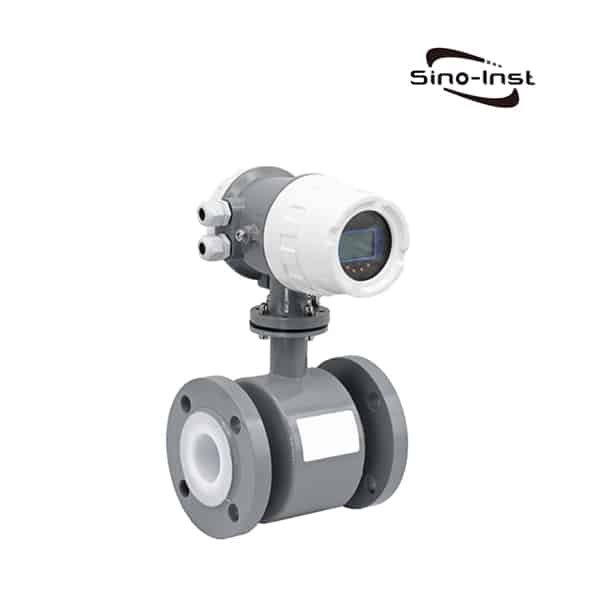
Magmeters need water with conductivity above 5 µS/cm — fine for tap water, process water, and wastewater; not suitable for deionized water. For full specs and models, see our magnetic flow meter guide.

Inline Ultrasonic (Transit-Time)

Inline ultrasonic meters fire sound pulses upstream and downstream between two transducers. The time difference is proportional to flow velocity. No moving parts, no pressure drop, accuracy ±1% to ±2%.

They handle clean water and most process water, but air bubbles and heavy solids degrade signal. Increasingly popular for residential district metering because they have no mechanical wear and run on a battery for 10+ years.

Mechanical vs Electromagnetic vs Ultrasonic: Which Is Best?

There’s no single winner. Match the technology to the water and the job.

ParameterMechanicalElectromagneticUltrasonic
Accuracy±1.5% – ±2%±0.2% – ±0.5%±1% – ±2%
Pressure DropMedium–HighNoneNone
Moving PartsYesNoNo
Water QualityClean onlyAny conductiveClean, low bubbles
Pipe Size Range½” – 12″½” – 120″½” – 48″
Turndown10:1 – 50:1100:1 – 1000:1100:1
PowerNone (register) or 9VAC or 24VDCBattery 10+ yrs or DC
Typical Price (DN50)$150 – $400$600 – $1,500$500 – $1,200
Service Life10–15 years20+ years15+ years

Pick mechanical for residential billing and low-cost sub-metering. Pick electromagnetic when you need high accuracy, wide turndown, or zero pressure drop on cooling loops and process water. Pick ultrasonic for battery-powered district metering and retrofits where you can’t run power.

How Do You Size an Inline Water Flow Meter?

Size the meter to the flow rate, not to the pipe. The common mistake is to match meter size to pipe diameter — this oversizes the meter and kills accuracy at normal flow.

Aim for flow velocity between 0.5 and 3 m/s (1.6–10 ft/s) through the meter. Outside this window, mechanical meters lose accuracy at the low end, and all types see excessive wear or cavitation at the high end.

  1. Find your normal operating flow rate (not peak).
  2. Compute required pipe area: A = Q / v, using v = 2 m/s as target.
  3. Pick the meter size whose nominal rating covers your normal flow in the middle of its range.
  4. If your pipe is larger than the meter, use eccentric reducers and the upstream and downstream straight pipe rule (10D upstream, 5D downstream).

How Do You Install an Inline Water Flow Meter?

Proper installation is the difference between ±0.5% and ±5% accuracy. Four rules cover 95% of field installations:

  • Straight pipe runs. Provide 10× diameter upstream and 5× diameter downstream, free of elbows, valves, and reducers.
  • Full pipe. Electromagnetic and ultrasonic meters need 100% liquid. Install on a vertical rising section or a well-flooded horizontal section.
  • Flow direction. Match the arrow on the meter body to flow direction. Reverse installation voids warranty on most mechanical meters.
  • Isolation. Put shutoff valves on both sides and a strainer (20–40 mesh) upstream of mechanical and small ultrasonic meters.

A common field error is installing the meter right after a pump or control valve. Turbulence from these devices skews the flow profile for 20+ pipe diameters downstream and produces readings that can be off by 5–10%.

How Much Does an Inline Water Flow Meter Cost?

Prices scale with pipe size, technology, and output. For a DN50 (2″) water line, expect these ranges from a direct manufacturer:

  • Mechanical multi-jet with pulse output: $150–$400
  • Inline ultrasonic, battery-powered: $500–$1,200
  • Electromagnetic with 4–20 mA + Modbus: $600–$1,500
  • Sanitary tri-clamp electromagnetic: $900–$2,000

Jumping to DN100 (4″) roughly doubles these. DN200+ pricing varies heavily by lining and electrode material — contact our engineers for a quote on anything above DN150.

Featured Inline Water Flow Meters

Inline Ultrasonic Water Flow Meter

In-line transit-time ultrasonic flow meter with pre-calibrated pipe spool. Wetted-transducer design delivers higher accuracy than clamp-on whenever a line shutdown is acceptable.

Residential Ultrasonic Water Meter

Insertion ultrasonic water flow meter for DN100-DN3000 mains. Hot-tap installation means no pipe cutting and no shutdown — ideal for water utilities, irrigation and cooling loops.

Electromagnetic Water Flow Meter

Electromagnetic water flow meter for drinking water, sewage, seawater and cement slurry. IP68 sensor for buried mains, optional MID / OIML R49 compliance for custody transfer billing.

FAQ

What does “inline” mean on a flow meter?

Inline means the meter is installed directly in the pipeline — water flows through the sensor body. Clamp-on and insertion meters are the two non-inline alternatives.

Can I install an inline water flow meter in any orientation?

Horizontal is preferred for most types. Vertical rising flow is also acceptable and helps keep the meter full. Avoid horizontal-downward orientations, which trap air at the sensor.

What’s the most accurate inline water flow meter?

Electromagnetic meters, at ±0.2% to ±0.5% of reading, are the most accurate for any conductive water. Coriolis meters are more accurate still but cost 3–5× more and are overkill for water service.

Do inline water flow meters need straight pipe?

Yes. All three types require at least 10 pipe diameters upstream and 5 downstream, free of fittings. Some electromagnetic models tolerate 5D/3D, but you pay a small accuracy penalty.

How often does an inline water meter need calibration?

For custody-transfer use, calibrate annually. For process monitoring, every 3–5 years is typical. See our flow meter calibration guide for procedures.

Can an inline water flow meter work on hot water?

Yes. Electromagnetic meters handle up to 180°C with proper lining (PFA or PTFE). Ultrasonic models go to 150°C. Mechanical multi-jets are usually rated 30–90°C — always check the data sheet.

Still unsure which inline water flow meter fits your line? Send us your pipe size, flow range, water type, and required output — our engineers will reply within 24 hours with a specific recommendation and a quote.

Request a Quote

Please enable JavaScript in your browser to submit the form

How Does a Capacitive Liquid Level Sensor Work? (Engineer’s Guide 2026)

Updated: April 15, 2026

A capacitive liquid level sensor detects level by measuring the capacitance change between a probe and the tank wall (or a second probe) as the liquid rises or falls. The liquid acts as the dielectric — its dielectric constant determines how much capacitance changes per centimeter of level. That’s the whole working principle in one sentence.

What matters in the field is knowing when this technology works well (oils, water, most chemicals, slurries) and when it doesn’t (varying dielectric, heavy coating, high-purity water). This guide walks through the physics, sensor types, calibration, and the dielectric-constant numbers you actually need to size a probe.

Contents

How Does a Capacitive Liquid Level Sensor Work?

The sensor acts as one plate of a capacitor; the tank wall or a second rod acts as the other plate. Liquid between them is the dielectric material. When level rises, more of the probe is submerged, dielectric material replaces air (εr of water is 80 vs air’s 1), and capacitance jumps.

The transmitter converts that capacitance change into a 4–20 mA or digital signal proportional to level. The equation:

C = (ε0 × εr × A) / d

Where ε0 is the vacuum permittivity, εr is the relative dielectric constant of the liquid, A is the submerged electrode area, and d is the gap. Because εr is the only variable that depends on the medium, the sensor must be calibrated to the specific liquid.

What Are the Main Types of Capacitive Level Sensors?

Four probe configurations cover almost every tank scenario.

  • Bare rod (single probe, metal tank). The rod and the conductive tank form the capacitor. Simplest and cheapest. For conductive liquids like water, the rod must be insulated.
  • Insulated rod. PTFE or PFA jacket prevents shorting in conductive media. Standard for water, acids, and alkalis.
  • Dual-rod (coaxial). A second rod replaces the tank wall — used in plastic or fiberglass tanks where there’s no grounded reference.
  • RF admittance. Adds a driven guard to cancel out coating effects on the probe. Used on sticky liquids like slurries, glue, and chocolate. See our RF admittance level sensor guide.

What Dielectric Constants Work with Capacitive Sensing?

Capacitive sensors work reliably when the liquid’s dielectric constant is ≥1.8 and stable. Below that, capacitance change per cm is too small to measure reliably. If εr varies with temperature or composition, calibration drifts.

Liquidεr (approx.)Capacitive sensing
Air / vapor1.0Reference
Gasoline, kerosene2.0Marginal — needs sensitive electronics
Diesel, fuel oil2.1–2.3Good
Lubricating oil2.2–2.8Good
Vegetable oil3.0Good
Alcohols (ethanol)24Excellent
Water (tap)80Excellent — requires insulated probe
Aqueous acids/bases40–80Excellent — requires insulated probe

Do not use capacitive sensing on liquids with unpredictable εr — examples include variable oil–water emulsions and slurries of changing solids content. Use guided wave radar or float-based measurement instead.

What Are the Advantages and Disadvantages?

Short answer: capacitive is a low-cost, rugged workhorse, but it’s sensitive to medium properties and probe coating.

AdvantagesDisadvantages
No moving parts — long service lifeNeeds stable dielectric constant
Works in pressurized and high-temp tanks (to 200 °C, 40 bar)Coating on probe shifts calibration
Compact — fits small tanks where radar doesn’tMetal tank required for single-rod types
Low cost: $150–$600 per sensorMust be recalibrated if liquid changes
Accuracy ±1% of full scaleFoam and vapor can affect top of range

How Do You Calibrate a Capacitive Liquid Level Sensor?

Two-point calibration handles most capacitive sensors. Do it with the actual process liquid, not water. For general calibration procedures across flow and level instruments, see our calibration procedures guide.

  1. Empty the tank. Set the low (4 mA / 0%) point. This captures probe-to-tank baseline capacitance.
  2. Fill to 100% of measuring range. Set the high (20 mA / 100%) point.
  3. Verify at midpoint. Fill to 50% and check reading is 12 mA ±1%. If off, check for probe coating or partial air gap.
  4. Log ambient temperature. εr of many oils changes 0.1% per °C. For wide temperature swings, use a transmitter with temperature compensation.

A common field mistake is to calibrate with water when the tank will hold oil. The dielectric constants differ by a factor of 30, and the sensor reads nonsense until you recalibrate.

Capacitive vs Float vs Ultrasonic: Which to Pick?

Capacitive wins on cost and durability in small-to-medium tanks with stable liquids. Float meters win where power or electronics aren’t available. Ultrasonic wins on non-contact measurement in open tanks.

CriterionCapacitiveFloatUltrasonic
Contact with liquidYesYesNo
Moving partsNoYesNo
Handles foam / vaporFairFairPoor
Handles sticky / coating liquidsPoor (RF admittance: Good)PoorGood
Accuracy±1% FS±3–5% FS±0.5% FS
Typical cost (1 m range)$150–$600$50–$300$300–$800

Featured Capacitive Level Sensors

Capacitance Level Transmitter

SI700 RF capacitance level transmitter for continuous and point level detection in liquids and solids. Resists coating, condensation and vapour layers — reliable where radar struggles.

Capacitive Water Level Sensor

Contact and non-contact capacitive water level sensor for storage tanks, wells and corrosive liquids. Resists temperature, humidity and conductivity drift for reliable readings where floats fail.

Capacitive Level Switch

Capacitive (RF) level sensor for liquid, solid and interface measurement. Handles high-temp, corrosive and easy-to-crystallise media with anti-clogging probes and 4-20mA output.

FAQ

Can a capacitive level sensor measure both liquids and solids?

Yes, for solids with dielectric constant ≥1.8 — grain, plastic pellets, cement powder all work. The accuracy is lower (±3%) because dielectric varies with bulk density.

Does probe length affect accuracy?

Longer probes give higher capacitance change per unit level, which improves resolution. Up to a point — probes over 4 m may need a high-sensitivity transmitter. Never cut a factory probe in the field; it changes the calibration curve.

What makes RF admittance different from standard capacitive?

RF admittance uses a driven guard electrode that cancels out capacitance caused by coating on the probe. Standard capacitive sensors drift when a residue builds up; RF admittance ignores it. Use RF admittance on sticky liquids and heated oils.

Does a capacitive sensor work with pure deionized water?

Yes, but with reduced accuracy. DI water’s dielectric constant is the same (80), but its low conductivity causes response instability. For ultra-pure water service, conductivity-based or ultrasonic water level sensors are more reliable.

Is capacitive level sensing safe for hazardous areas?

Yes. Intrinsically safe and explosion-proof versions are available with ATEX and IECEx certifications. Specify Ex ia for flammable liquid tanks and Ex d for vapor spaces.

How long does a capacitive level sensor last?

With no moving parts, expected life is 10–15 years in normal service. PTFE-jacketed probes in aggressive chemicals last 5–10 years before coating degradation forces replacement.

Need to confirm whether capacitive is the right fit for your tank? Send us the liquid, probe length, and tank material. Our engineers will recommend the right probe type and output, plus a quote — usually within 24 hours.

Request a Quote

Please enable JavaScript in your browser to submit the form

The Secret of Ultrasonic Level Measurement

Updated: April 13, 2026

An ultrasonic level sensor measures liquid or solid levels by sending a sound pulse and timing the echo. No contact with the media. No moving parts. That makes it one of the most reliable options for corrosive, hot, or dirty liquids where other sensors fail fast.

This guide covers how ultrasonic level sensors work, what types are available, where they perform best, and how to avoid the most common sizing and installation mistakes.

Contents

How Does an Ultrasonic Level Sensor Work?

An ultrasonic level sensor emits a short burst of high-frequency sound (typically 20–200 kHz) from a piezoelectric transducer mounted at the top of a tank. The sound pulse travels through air, hits the liquid surface, and bounces back. The sensor measures the round-trip time and calculates distance using a simple formula:

Distance = (Speed of Sound × Time) ÷ 2

The speed of sound in air is roughly 343 m/s at 20°C. Since this speed changes with temperature—about 0.17% per °C—every practical ultrasonic sensor includes a built-in temperature compensation circuit. Without it, a 30°C temperature swing can introduce 1.5% measurement error.

Ultrasonic level sensor measurement diagram: the sensor calculates level from the echo transit time.

The sensor’s microprocessor filters out false echoes from tank internals—pipe fittings, agitator blades, weld seams—using echo suppression algorithms. This is called “false echo mapping” and is configured during commissioning.

What Are the Types of Ultrasonic Level Sensors?

Ultrasonic level sensors fall into two main categories based on output type and measurement method.

By output:

  • Continuous level transmitters — Output a 4–20 mA or digital signal proportional to the level. Used for process monitoring and control.
  • Point level switches — Trigger an alarm or relay at a preset level. Used for overfill protection or low-level alarms.

By mounting:

  • Top-mount (non-contact) — Sensor sits above the liquid. Most common type. Measures through air gap.
  • External clamp-on — Mounts on the outside of the tank wall. Sound travels through the tank material. No process penetration needed. Works on metal and plastic tanks up to 30 mm wall thickness.
TypeRangeAccuracyBest For
Compact transmitter (2-wire)0.3–8 m±3 mmSmall tanks, water treatment
Standard transmitter (4-wire)0.5–15 m±3 mmChemical tanks, open channels
Long-range transmitter1–30 m±5 mmLarge storage tanks, silos
Clamp-on (external)0.1–5 m±5 mmSealed tanks, hazardous media

Ultrasonic vs Radar Level Sensor: Which One Should You Use?

Ultrasonic sensors use sound waves. Radar sensors use electromagnetic waves. That single difference drives all the practical trade-offs.

FactorUltrasonicRadar (non-contact)
Affected by temperatureYes — needs compensationNo
Affected by vapor/foamYes — can lose echoMinimal
Works in vacuumNo — needs air to propagateYes
Max range~30 m~70 m
CostLower ($200–$800)Higher ($500–$3000)
Best applicationWater, wastewater, chemicalsHigh-temp, high-pressure, volatile

Use ultrasonic when the application is straightforward: open tanks, water and wastewater, non-foaming chemicals, and ambient conditions below 80°C. Switch to radar level sensors when you have heavy foam, vapor blankets, high temperature, vacuum, or tanks deeper than 20 m.

What Applications Are Ultrasonic Level Sensors Best For?

Ultrasonic level sensors handle most ambient-condition liquid applications well. Here are the areas where they are the default choice in the field.

Water and Wastewater Treatment

Wastewater plants use ultrasonic sensors in equalization tanks, wet wells, clarifiers, and sludge holding tanks. The non-contact design means no fouling from grease, sludge, or chemical dosing agents. Most municipal plants standardize on ultrasonic for open-top tanks. For more on water tank level sensors, see our selection guide.

Chemical Storage Tanks

Acids, caustic solutions, and solvents corrode contact-type sensors within months. An ultrasonic sensor mounted above the liquid avoids all media contact. Common media include sulfuric acid, sodium hydroxide, hydrochloric acid, and various organic solvents.

Open Channel Flow

Paired with a Parshall flume or V-notch weir, an ultrasonic sensor measures the head (water height) to calculate flow rate. This is a standard setup in irrigation canals, stormwater outfalls, and treatment plant influent channels.

Bulk Solids and Powder

Grain bins, cement silos, and aggregate hoppers use ultrasonic sensors for inventory management. The key: use a sensor rated for twice the actual distance. Dust and irregular surfaces weaken the echo, so the extra power margin ensures a clean return signal. Mount the sensor perpendicular to the material’s angle of repose.

How to Install an Ultrasonic Level Sensor Correctly

Installation errors cause more ultrasonic sensor failures than product defects. Follow these five rules.

  1. Respect the dead zone (blocking distance). Every sensor has a minimum distance (typically 15–50 cm) below the transducer face where it cannot measure. Make sure the maximum liquid level never enters this dead zone.
  2. Mount perpendicular to the liquid surface. Even a 3° tilt sends the echo away from the sensor. Use a level to verify the mounting angle.
  3. Keep away from fill streams. Mount the sensor at least 30 cm from the inlet pipe. Turbulence, splashing, and foam near the fill point cause false echoes.
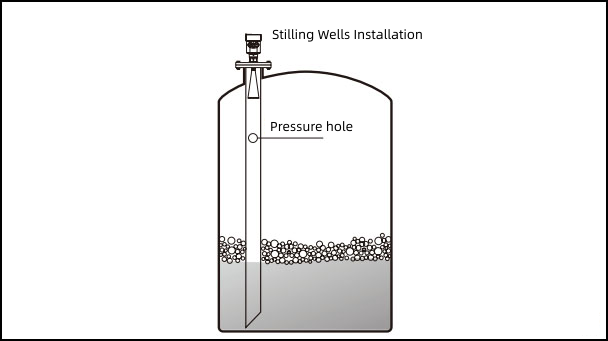
  4. Avoid obstructions in the beam path. The ultrasonic beam spreads at roughly 5–12° depending on frequency. Ladders, baffles, and heating coils within the beam cone will generate interference. For guidance on stilling well installations, refer to our design guide.
  5. Use a sun shade outdoors. Direct sunlight heats the transducer housing and creates a temperature gradient between the sensor and the air path. This introduces measurement drift. A simple sun shade solves the problem.

How to Select the Right Ultrasonic Level Sensor

Choosing the right ultrasonic level sensor comes down to four parameters.

ParameterWhat to CheckTypical Range
Measurement rangeTank height from sensor to lowest level0.3–30 m
Process temperatureAir temperature at sensor face, not media temp-40 to +80°C
Process connectionThread type and size matching your tank nozzleG1½”, G2″, 2″ NPT, DN50 flange
Output signalMatch your PLC/DCS input card4–20 mA, HART, RS485 Modbus

Also check: Is there heavy foam? (Consider guided wave radar instead.) Is the tank under pressure or vacuum? (Ultrasonic will not work — the sound pulse cannot propagate.) Is the atmosphere dusty or full of vapor? (Select a higher-power sensor or switch technology.)

For explosion-hazard areas, specify an ATEX/IECEx certified ultrasonic sensor. Sino-Inst offers Ex d (flameproof) and Ex ia (intrinsically safe) versions. See our Class 1 Div 1 vs Div 2 guide for zone classification details.

Featured Ultrasonic Level Sensors

ULT-100A Level Transducer

TKWL-1600 ultrasonic level transducer for tanks, sumps and open channels. Non-contact, low-maintenance, 4-20mA output — installs in minutes without draining the process.

ULT-200 Level Detector

Portable ultrasonic CO2 bottle / cylinder level indicator. Detects the liquid / gas interface through metal, glass and plastic walls — no opening or weighing needed.

HS-2000 Clamp-On Sensor

Clamp-on ultrasonic flow meter — no pipe cutting, no shutdown, no wetted parts. Standard and high-temperature transducers cover pipes from DN15 up to DN6000.

FAQ

Can an ultrasonic sensor measure level through a closed tank?

A standard top-mount ultrasonic sensor works fine in sealed tanks as long as the tank is not pressurized or under vacuum. For sealed tanks where you cannot install a nozzle, use a clamp-on (external mount) ultrasonic sensor that transmits sound through the tank wall.

What is the maximum temperature for an ultrasonic level sensor?

Most standard ultrasonic sensors operate up to 80°C process temperature. The limiting factor is the air temperature at the transducer face, not the liquid temperature at the bottom of the tank. For higher temperatures, consider a radar level sensor.

Does foam affect ultrasonic level measurement?

Yes. Dense foam absorbs the sound pulse and prevents a clean echo return. Light surface foam (less than 5 cm thick) usually does not cause issues. Heavy or thick foam requires switching to a guided wave radar or contact-type sensor.

How accurate is an ultrasonic level sensor?

Typical accuracy is ±3 mm for ranges up to 10 m. Longer-range models (15–30 m) usually spec ±5 mm. These figures apply under stable conditions. Turbulence, temperature gradients, and vapor can degrade accuracy to ±0.5% of range in worst cases.

Can ultrasonic sensors measure solid levels in silos?

Yes. Ultrasonic sensors measure grain, cement, powder, and aggregate levels. The key is to select a sensor with twice the actual required range. The uneven surface of bulk solids scatters the echo, so the extra power compensates for signal loss. Mount the sensor perpendicular to the material’s angle of repose for best results.

What is the difference between an ultrasonic level sensor and an ultrasonic level transmitter?

Functionally, they are the same device. “Sensor” often refers to the transducer element alone. “Transmitter” refers to the complete instrument with signal processing, display, and a calibrated output (4–20 mA or digital). In practice, most people use both terms interchangeably.

Need help selecting an ultrasonic level sensor for your application? Our instrumentation engineers can review your tank specs and recommend the right model. Contact us for a free consultation and quote.

Request a Quote

Please enable JavaScript in your browser to submit the form

Ultrasonic Water Level Sensors: Types, Applications & Buying Guide

Updated: April 14, 2026

An ultrasonic water level sensor measures water level in tanks, rivers, reservoirs, and wells without touching the water. It’s the go-to choice for clean-water monitoring where a non-contact sensor is required. But it has a blind spot: foamy, turbulent, or steamy water surfaces. This guide covers when to choose ultrasonic over radar or submersible sensors, and how to install it correctly.

Contents

What Is an Ultrasonic Water Level Sensor?

An ultrasonic water level sensor is a non-contact level transmitter that uses high-frequency sound pulses to measure the distance from the sensor face to the water surface. It then subtracts that distance from the tank or channel height to report water level, volume, or flow.

The sensor sits above the water, usually on a bracket or flange. It never contacts the water, which makes it well-suited for drinking water, treated effluent, cooling water, and open-channel flow where fouling or corrosion would damage a contact sensor. Typical ranges run from 0.3 m (short-range, for small tanks) up to 15 m (long-range, for reservoirs and open channels).

How Does an Ultrasonic Water Level Sensor Work?

The sensor transmits a sound pulse, typically at 30–70 kHz, toward the water surface. The pulse reflects off the water and returns to the sensor. The time between transmission and reception, combined with the speed of sound in air, gives the distance:

Distance = (speed of sound × time) ÷ 2

Speed of sound in air varies with temperature (roughly 331 m/s at 0°C and 343 m/s at 20°C). Good ultrasonic sensors include a built-in temperature sensor to correct for this automatically. Without temperature compensation, a 20°C swing introduces about 3.5% error.

The measured distance is then subtracted from the total tank height to give the water level. Most sensors output 4–20 mA (proportional to level, volume, or flow), with optional RS-485 Modbus or HART for digital integration.

Where Are Ultrasonic Water Level Sensors Used?

Five applications where ultrasonic is almost always the right choice.

  • Elevated water storage tanks. Municipal water towers, industrial process tanks, fire-suppression reservoirs. Calm surface, clean air, clear signal.
  • Wastewater sumps and lift stations. Provided the sensor is rated IP68 and uses a corrosion-resistant face (PVDF or Teflon). Non-contact is a big advantage over floats that foul.
  • Open-channel flow measurement. Paired with a Parshall flume or weir, an ultrasonic sensor gives real-time flow readings for stormwater, wastewater influent, or irrigation channels.
  • River and reservoir level monitoring. Mounted on a bridge or gantry, long-range sensors (up to 15 m) deliver continuous level data for flood warning and water-resource management.
  • Well water level. Where the well diameter is at least 200 mm and the air column is free of obstructions, ultrasonic works well. Narrower wells favor submersible pressure sensors.

For broader non-water applications and general working principles, see our ultrasonic level sensors for liquid measurement guide.

Ultrasonic vs Radar vs Submersible: Which Is Best for Water?

For water level specifically, three technologies compete. Here’s when each one wins.

FactorUltrasonicRadar (80 GHz)Submersible
Measurement principleSound pulseMicrowave pulseHydrostatic pressure
Contact with waterNoNoYes
Max range15 m80 mUp to 200 m depth
Accuracy±0.25%±2 mm±0.1–0.5%
Foam tolerancePoorGoodExcellent
Steam/vapor tolerancePoorGoodExcellent
Turbulence toleranceModerateGoodExcellent
Typical cost$200–$1500$1200–$4000$300–$1500
Best forClean, calm water in open airChallenging conditionsDeep wells, raw sewage

Quick rule of thumb: if the water surface is clean, calm, and the air above it is free of steam, ultrasonic is the best value. If there’s foam, heavy steam, or strong turbulence, go radar. If you need to put a sensor in a deep narrow well or directly into raw sewage, go submersible. For treated water in towers, storage tanks, and open channels, ultrasonic is almost always the right call.

How Accurate Is an Ultrasonic Water Level Sensor?

Good ultrasonic sensors achieve ±0.25% of range under ideal conditions. For a 10-meter sensor, that’s ±25 mm. Real-world accuracy drops to ±0.5–1% when you factor in temperature gradients, wind, and mounting imperfections.

Four factors that degrade accuracy:

  • Temperature stratification. A hot sensor above a cool water column creates a sound-speed gradient the sensor can’t fully compensate for. Use a shaded mount in direct sun.
  • Wind. Strong wind deflects sound pulses. For outdoor installations, use a stilling tube or baffle.
  • Foam or floating debris. Absorbs the ultrasonic signal and can cause loss of echo. If foam is frequent, switch to radar.
  • Condensation on sensor face. Common in humid or steamy tanks. Self-cleaning transducers (with a heater element) solve this.

Installation Tips for Water Applications

  1. Mount perpendicular to the water surface. Even a 5° tilt can cause the echo to miss the transducer, especially at long range.
  2. Respect the blanking distance. Every ultrasonic sensor has a “dead zone” close to its face (typically 0.25–0.5 m) where it cannot measure. Don’t mount it so close to the maximum water level that the level enters the blanking zone.
  3. Keep the beam path clear. Pipes, ladders, agitators, and inlet streams inside the beam cone cause false echoes. Aim for a clear vertical path to the water surface.
  4. Use a stilling well in turbulent tanks. A 150 mm diameter PVC pipe suspended from the sensor down to 0.5 m above the expected minimum level calms surface motion and protects from inlet splash.
  5. Ground and shield cables properly. Ultrasonic signals are low amplitude and susceptible to electrical noise from nearby VFDs, pumps, and radio transmitters.

For a full installation walkthrough for stilling wells and mounting brackets, see our stilling well installation guide. For submersible alternatives in wells and deep sumps, our water tank level sensor overview compares sensor options.

Ultrasonic Water Level Sensors for Sale

Three models cover most water-level applications from small tanks to long-range reservoir monitoring.

Compact 5m Water Level Sensor

Contact and non-contact capacitive water level sensor for storage tanks, wells and corrosive liquids. Resists temperature, humidity and conductivity drift for reliable readings where floats fail.

Integrated 10m Water Level Sensor

Radar water level sensor covering 0.05 m to 120 m range for reservoirs, rivers and floodgates. Non-contact technology unaffected by wind, foam, fog or temperature swings.

Split-Type 15m River Level Sensor

SIRD-801 radar level sensor for slightly corrosive liquids, sewage and acid/alkali sumps. PTFE antenna and non-contact design deliver years of maintenance-free service.

FAQ

Can an ultrasonic sensor detect water level?

Yes. Ultrasonic sensors are one of the most common non-contact technologies for water level measurement. They work well on clean water surfaces in tanks, reservoirs, and open channels. Accuracy is typically ±0.25% of range, with measurement distances from 0.3 m up to 15 m depending on the model.

Which sensor is best for a water level indicator?

For clean water in open tanks or channels, ultrasonic is the best value. For water with heavy foam, steam, or strong turbulence, radar (80 GHz) performs better. For deep wells or raw sewage where fouling is severe, submersible hydrostatic sensors are most reliable.

Do ultrasonic water level sensors work outdoors?

Yes, with proper specification. Outdoor sensors should be IP68-rated, temperature-compensated, and ideally mounted with a sun shield to prevent the sensor housing from overheating. Strong wind and heavy rain can cause temporary signal loss, but modern sensors handle this with signal averaging.

What’s the difference between an ultrasonic water level sensor and a radar sensor?

Ultrasonic uses sound waves; radar uses microwaves. Ultrasonic is cheaper and accurate on clean, calm water. Radar is not affected by foam, steam, pressure, or temperature changes in the air column, making it the better choice for challenging surfaces. Radar costs 2–3 times more than ultrasonic at similar ranges.

How far can an ultrasonic water level sensor measure?

Common ranges are 5 m, 10 m, and 15 m. Some specialized long-range models reach 20–30 m but with reduced accuracy. The practical upper limit is around 15 m for reliable industrial use. Beyond that, radar becomes the better choice.

How much does an ultrasonic water level sensor cost?

A compact 5 m ultrasonic water level sensor with 4-20 mA output typically costs $200–$500. A 10 m integrated sensor with RS-485 Modbus runs $600–$1200. Long-range 15 m split-type sensors with external displays cost $1000–$1500. Contact us for volume pricing and custom range models.

Need a sensor for a specific tank, channel, or river application? Share the range, ambient conditions, and output requirements with our engineering team and we’ll match you with the right model and pricing within one business day.

Request a Quote

Please enable JavaScript in your browser to submit the form

Diesel fuel tank level gauges & Indicators

Updated: April 13, 2026

A diesel fuel tank level gauge measures the amount of fuel remaining in a storage tank or vehicle fuel tank. The right gauge prevents run-dry shutdowns, catches fuel theft early, and keeps inventory records accurate. Choosing the wrong type leads to drift, fouling, or false alarms — all common problems in fuel storage.

This guide covers the five main types of diesel tank level gauges, where each one works best, and how to set up a monitoring system for industrial tanks and vehicle fleets.

Contents

What Are the Types of Diesel Fuel Tank Level Gauges?

Five sensor technologies cover the majority of diesel fuel level applications. Each has trade-offs in accuracy, cost, and installation complexity.

Magnetostrictive Level Transmitter

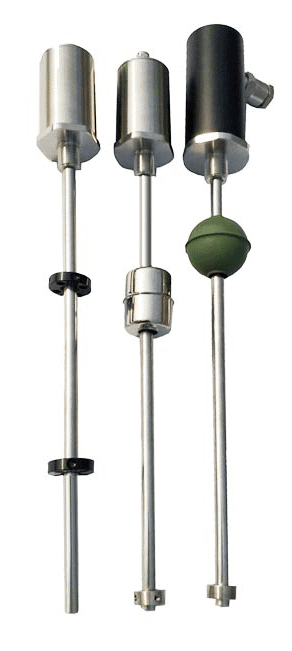
A magnetostrictive probe sits vertically inside the tank. A float carrying a magnet rides the probe as the fuel level changes. The electronics measure the float’s position by timing a current pulse along a waveguide wire. Accuracy reaches ±1 mm over ranges up to 6 m. This is the default choice for aboveground diesel storage tanks in refineries, fuel depots, and power plants where high accuracy matters for custody transfer and inventory accounting.

Float Level Gauge (Mechanical)

A float connects to a dial indicator via a cable and pulley. As diesel level rises or falls, the float moves and the dial reads out directly. No power required. Accuracy is ±5–10 mm. Simple, cheap, and reliable for small tanks (under 3 m) where a visual reading is enough. Common on generator day tanks and small bulk storage. For more on float sensors, see our water tank level sensor guide.

Ultrasonic Level Sensor

Mounted on top of the tank, an ultrasonic sensor sends a sound pulse and times the echo. No contact with the diesel. Accuracy is ±3–5 mm for ranges up to 10 m. Works well on open-top or vented tanks. Not suitable for pressurized tanks or tanks with heavy vapor above the fuel surface. For technical details, see our ultrasonic level sensor guide.

Radar Level Sensor

Radar uses electromagnetic waves instead of sound. Unaffected by temperature, vapor, or pressure changes. Accuracy is ±1–3 mm. The best option for large diesel storage tanks (10–30 m), pressurized tanks, and tanks with heavy condensation or diesel vapor. Higher cost than ultrasonic, but more reliable in harsh conditions. See our stilling well design guide for radar installation best practices.

Hydrostatic Pressure Transmitter

A pressure sensor at the bottom of the tank measures the hydrostatic head. Level = Pressure / (Density × Gravity). Accuracy depends on knowing the diesel density accurately — typically ±5–10 mm after density compensation. Good for underground tanks where top-mount access is limited. Submersible versions are rated IP68 and handle buried fuel tanks well.

How Do They Compare? Selection Table

TypeAccuracyRangePowerCostBest For
Magnetostrictive±1 mm0.1–6 m24 VDC$$$Bulk storage, custody transfer
Float (mechanical)±5–10 mm0.3–3 mNone$Small tanks, generator day tanks
Ultrasonic±3–5 mm0.3–10 m24 VDC$$Vented storage tanks, water treatment
Radar±1–3 mm0.5–30 m24 VDC$$$$Large tanks, pressurized, harsh vapor
Hydrostatic±5–10 mm0.5–100 m24 VDC$$Underground tanks, deep wells
Diesel fuel tank level gauge comparison by accuracy, range, and application.

Mechanical vs Electronic: Which Is Better for Diesel Tanks?

Mechanical gauges (float + dial) require no power, no wiring, and no calibration. They work for decades with minimal maintenance. The trade-off: no remote reading, no alarm output, and no data logging. If you only need a local visual check on a small day tank, mechanical is hard to beat.

Electronic gauges (magnetostrictive, ultrasonic, radar, hydrostatic) provide a 4–20 mA or RS485 output that connects to a PLC, SCADA system, or cloud-based monitoring platform. They support high/low alarms, trend logging, and remote access. For any tank where fuel management, theft detection, or regulatory reporting is required, electronic is the only practical option.

Most industrial diesel installations use electronic gauges on the main storage tanks and mechanical gauges on small auxiliary tanks (generator sets, pump skids) where remote monitoring isn’t justified.

How to Set Up a Diesel Tank Level Monitoring System

A complete monitoring system has three layers: sensor, data acquisition, and display/alarm.

  1. Sensor layer. Install a level transmitter on each tank. Magnetostrictive for high-accuracy inventory. Ultrasonic or hydrostatic for general monitoring. Output: 4–20 mA or RS485 Modbus RTU.
  2. Data acquisition layer. A PLC, RTU, or IoT gateway collects signals from all sensors. For remote sites (fuel depots, cell towers, pipeline pump stations), a 4G/LTE cellular gateway transmits data to a cloud server. For on-site systems, wire the 4–20 mA signals directly to the plant DCS or SCADA.
  3. Display and alarm layer. The SCADA or cloud dashboard shows real-time levels, consumption trends, and fill history. Configure high-level alarms (overfill protection), low-level alarms (run-dry prevention), and abnormal consumption alerts (theft detection). Most systems log data at 1–5 minute intervals.

For tank farms with 5+ tanks, add a temperature transmitter to each tank. Diesel volume changes ~0.08% per °C. Without temperature compensation, a 30°C seasonal swing introduces ~2.4% volume error — significant for custody transfer and tax reporting.

How Do You Monitor Fuel Level in a Vehicle Fleet?

Fleet fuel monitoring uses a different approach. Vehicle tanks are small (100–500 L), move constantly, and have no fixed wiring.

The standard solution is an external clamp-on ultrasonic sensor mounted under the fuel tank. It transmits sound through the tank bottom and measures the diesel level without any drilling or tank modification. The sensor connects to a GPS tracker that reports level data via cellular network to a fleet management platform.

This setup detects fuel theft (sudden level drops), unauthorized refueling, and abnormal consumption patterns. Typical accuracy is ±5 mm, which translates to ±2–5 L depending on tank geometry. The sensor draws under 100 mA and runs off the vehicle’s 12/24 V power.

What Are Common Installation Mistakes?

Four mistakes account for most diesel tank gauge failures in the field.

  1. Wrong probe length. Magnetostrictive probes must be cut to match the tank depth. Too short and you miss the bottom 10–20 cm of fuel. Too long and the float bottoms out before the tank is empty. Measure the actual tank depth from the nozzle flange to the tank floor.
  2. Ignoring diesel density variation. Hydrostatic gauges calculate level from pressure. If the density setting is wrong (for example, using water density instead of diesel at 0.84 kg/L), the level reading will be off by 16%. Always set the density parameter to match your actual diesel grade.
  3. Mounting ultrasonic sensors on pressurized tanks. Sound waves need air to propagate. A nitrogen-blanketed or pressure-rated diesel tank will give no echo return with an ultrasonic sensor. Use radar or magnetostrictive instead. For more on pressure transmitter selection, see our technical guide.
  4. No lightning protection on outdoor tanks. Electronic level transmitters on outdoor diesel tanks are exposed to lightning. Install surge protectors on all signal cables. A single lightning event can destroy every transmitter on a tank farm.

Featured Diesel Tank Level Gauges

LD Magnetostrictive Transmitter

Magnetostrictive level transmitter with ±1 mm resolution for high-accuracy tank gauging. Preferred choice on fuel depots, API terminals and chemical inventory measurement.

LR Flange-Mount Level Sensor

Magnetostrictive level transmitter with ±1 mm resolution for high-accuracy tank gauging. Preferred choice on fuel depots, API terminals and chemical inventory measurement.

LT Digital Display Level Sensor

Magnetostrictive level transmitter with ±1 mm resolution for high-accuracy tank gauging. Preferred choice on fuel depots, API terminals and chemical inventory measurement.

FAQ

How do you measure diesel fuel level in an underground tank?

Submersible hydrostatic pressure transmitters are the standard for underground diesel tanks. The sensor is lowered to the tank bottom and measures the hydrostatic pressure of the diesel column above it. Set the density parameter to 0.82–0.86 kg/L depending on your diesel grade. Magnetostrictive probes also work if you have top access through a fill riser.

What accuracy do I need for diesel fuel inventory?

For custody transfer and tax reporting, you need ±1 mm accuracy — magnetostrictive or radar. For operational monitoring (refill scheduling, low-level alarms), ±5 mm is sufficient — ultrasonic or hydrostatic. For vehicle fleet fuel theft detection, ±5 mm (external ultrasonic) is practical and cost-effective.

Can I use a float gauge on a diesel storage tank?

Yes, for tanks under 3 m depth where you only need a local visual reading. Float gauges are reliable for generator day tanks (500–5000 L). For anything requiring remote monitoring, alarms, or data logging, switch to an electronic gauge with a 4–20 mA or digital output.

Do diesel tank level gauges need explosion-proof certification?

Yes, if the tank is in a classified hazardous area. Diesel vapor forms an explosive atmosphere above the liquid surface. Most diesel storage areas are classified as Class I, Division 1 or 2 (NEC) or Zone 1/Zone 2 (IECEx). The level gauge must carry the appropriate Ex rating. Sino-Inst offers ATEX and IECEx certified models. See our Class 1 Division 1 vs Division 2 guide for details.

How do you detect fuel theft from a diesel tank?

Set up a monitoring system that logs level at 1-minute intervals. Configure an alarm for any level drop exceeding a threshold (for example, 5 L in 10 minutes) when no scheduled dispensing is active. A sudden drop outside of normal consumption or refueling patterns triggers an alert. Combine with GPS data for vehicle fleets to correlate location with fuel events.

What is the typical lifespan of a diesel tank level gauge?

Magnetostrictive and ultrasonic gauges typically last 10–15 years with minimal maintenance. Float gauges can last 20+ years since they have no electronics. Hydrostatic sensors may need membrane replacement every 5–8 years depending on diesel quality and water contamination levels.

Need help selecting the right level gauge for your diesel tank? Our engineers specialize in fuel storage measurement. Contact us with your tank dimensions, diesel type, and monitoring requirements for a free recommendation.

Request a Quote

Please enable JavaScript in your browser to submit the form

Rotameter vs Flow Meter: Comparison, When to Use, and Alternatives

Updated: April 14, 2026

A rotameter is a flow meter, not a separate instrument. It’s one specific type called a variable area flow meter. The real question most engineers ask is: how does a rotameter compare to other flow meter types like magnetic, turbine, or ultrasonic meters, and when should you choose one over the others? This guide answers exactly that.

Contents

Is a Rotameter a Flow Meter?

Yes. A rotameter is a type of flow meter, specifically categorized as a variable area (VA) flow meter. “Flow meter” is the broad category and “rotameter” is one of about a dozen technologies inside that category.

The confusion happens because “rotameter” is a trademark-turned-generic term (originally from the Rota company, now Yokogawa Rota). People use it interchangeably with “variable area flow meter,” “float flow meter,” or just “visual flow indicator.” All four terms describe the same basic device: a vertical tapered tube with a float that rises higher as flow increases.

Where rotameters differ from most modern flow meters is that they are mechanical, direct-reading, and typically have no electrical output. You read the scale by eye. Everything else, including magnetic, ultrasonic, Coriolis, and turbine meters, produces an electronic signal (4–20 mA, pulse, HART, or digital).

How Does a Rotameter Work?

A rotameter balances two forces on a float: gravity pulling it down, and drag from the fluid flow pushing it up. The tube is tapered, wider at the top than the bottom. As flow increases, the annular area around the float grows until drag equals gravity, and the float reaches equilibrium at a specific height.

The scale is calibrated so the float’s height directly corresponds to a flow rate. Different fluids require different floats and scales because density and viscosity change the force balance. A rotameter calibrated for water will read incorrectly if you put oil through it.

Rotameters must be installed vertically with flow going up. Horizontal or inverted mounting breaks the physics. A few specialized designs (spring-loaded variants) work in any orientation, but they are not true rotameters in the classic sense.

How Does a Rotameter Compare to Other Flow Meter Types?

Here’s how a standard rotameter stacks up against the five most common alternatives for small-to-medium flow applications.

FeatureRotameter (VA)MagneticTurbineUltrasonicCoriolis
PrincipleFloat displacementFaraday inductionRotating bladeSound transit timeTube oscillation
Accuracy±2–5%±0.5%±0.5%±1%±0.1%
Electrical outputOptionalStandardStandardStandardStandard
Power neededNoneRequiredOptionalRequiredRequired
Moving partsYes (float)NoneYes (rotor)NoneVibrating tubes
InstallationVertical onlyAnyHorizontal preferredAnyAny
Typical cost$50–$500$500–$3000$300–$2000$1500–$8000$3000–$15000
Best forLocal indicationConductive liquidsClean low-viscosityNon-invasiveMass + density

The rotameter’s advantages are simplicity, low cost, and no power requirement. Its disadvantages are limited accuracy, vertical installation requirement, and (in the standard version) no way to feed readings into a control system.

When Should You Use a Rotameter Instead of an Electronic Flow Meter?

A rotameter is the right choice in five specific scenarios.

  • Local visual indication only. Operator walks by the line once per shift and checks a flow. No PLC integration needed.
  • Purge and cooling water lines. Low-flow utility lines where ±5% accuracy is fine and the main requirement is confirming flow exists.
  • Small gas flows. Nitrogen blanketing, instrument air sampling, purge gas lines — rotameters handle these cleanly.
  • Chemical feed systems. Adding a fixed small flow of reagent where you adjust a needle valve by watching the float.
  • No-power environments. Field locations without 24 VDC, Ex-rated areas where avoiding electronics simplifies approval.

Rotameters are not the right choice for custody transfer, batch control, bidirectional flow, pulsating flow, or any application requiring better than ±2% accuracy. For those, use an electromagnetic, Coriolis, or turbine meter. See our guide on flow meter K-factor calibration for high-accuracy turbine meter setup.

What Are the Limitations of a Rotameter?

Four hard limitations to know before specifying one.

  • Fluid-specific calibration. Change the fluid and the scale is wrong. Water and oil rotameters are not interchangeable without a correction factor.
  • Limited turndown. Typical 10:1 ratio between max and min readable flow. Below 10% of full scale the float behavior gets erratic.
  • Pressure drop. A rotameter imposes a permanent pressure drop (usually 0.1–0.5 bar). In low-head systems this is a problem.
  • Glass tube fragility. Glass rotameters can shatter on thermal shock or water hammer. Metal-tube (armored) versions solve this but cost more and require a magnetic indicator to read externally.

How Accurate Is a Rotameter?

Standard glass-tube rotameters achieve ±2–3% of full scale under good conditions. Metal-tube versions with calibrated floats reach ±1–2%. Industrial precision models with temperature-compensated floats can hit ±0.5%, but at that level you are paying nearly as much as an electromagnetic meter with better overall performance.

Note that accuracy is usually stated as percent of full scale, not percent of reading. At 50% flow, a ±2% FS rotameter could be off by 4% of actual reading. At 10% flow, the same meter could be off by 20%. This is why turndown matters so much.

Recommended Rotameters and Alternatives

Metal Tube Rotameter

Variable-area metal-tube rotameter for liquid, gas and steam in low-flow lines. Local dial plus optional remote 4-20mA transmitter — built for small-flow chemical dosing and utility service.

Glass Tube Rotameter

Variable-area metal-tube rotameter for liquid, gas and steam in low-flow lines. Local dial plus optional remote 4-20mA transmitter — built for small-flow chemical dosing and utility service.

Electromagnetic Flow Meter

Electromagnetic (EMF) flow meter for conductive liquids — water, slurry, chemicals, effluent. No moving parts, zero pressure drop, DN3-DN3000 range; the gold standard for wastewater.

FAQ

Is a rotameter the same as a flow meter?

A rotameter is a flow meter. Specifically, it is a variable area flow meter, one of roughly a dozen flow meter technologies. The word “rotameter” is often used loosely to mean any simple, visual flow meter with a float in a tapered tube.

Which is better: rotameter or magnetic flow meter?

It depends on the application. For local visual indication with no power, the rotameter wins on cost and simplicity. For accurate measurement, PLC integration, or any conductive liquid at larger line sizes, the magnetic flow meter is better. Rotameters max out around DN100 while mags scale to DN3000.

Can a rotameter measure gas flow?

Yes. Gas-calibrated rotameters are common in nitrogen blanketing, air purge, and instrument gas lines. The float and scale are designed for a specific gas at a specific pressure and temperature. Changing any of those requires a correction calculation or re-calibration.

Why does a rotameter have to be installed vertically?

Because its operation relies on gravity balancing the drag force on the float. In a horizontal or angled installation, gravity no longer pulls the float back toward zero flow, and the measurement breaks. Only specialized spring-loaded variants work in any orientation, and they are not considered classic rotameters.

What is the minimum flow a rotameter can measure?

Typical rotameters have a 10:1 turndown. If the full scale is 100 L/min, the minimum readable flow is around 10 L/min. Below that the float position becomes unstable and the reading unreliable.

Can a rotameter provide 4-20 mA output?

Some metal-tube rotameters offer magnetic-coupled transmitters that convert float position into a 4-20 mA signal. This adds about 30–50 percent to the meter cost. For most remote-output applications, an electromagnetic or turbine meter is a better value than adding a transmitter to a rotameter.

Need help choosing between a rotameter and an electronic flow meter for your line? Share the fluid, flow range, pipe size, and accuracy target with our engineering team and we’ll recommend the right option within one business day.

Request a Quote

Please enable JavaScript in your browser to submit the form

Flow Meter Straight Length Requirements by Type: Complete Guide

Updated: April 14, 2026

Flow meter straight length requirements tell you how much undisturbed pipe you need upstream and downstream of the meter. Get this wrong and accuracy drops by 2–5×, regardless of how precise the meter itself is. This guide covers the specific requirements by meter type, how upstream fittings change them, and what to do when piping is tight.

Contents

What Are Flow Meter Straight Length Requirements?

Straight length requirements specify the minimum length of straight, unobstructed pipe you must install before and after a flow meter. They are expressed as multiples of the pipe’s inner diameter (D), typically as “10D upstream, 5D downstream.”

For a 4-inch (100 mm) pipe, a 10D upstream requirement means 1000 mm (about 40 inches) of straight pipe ahead of the meter. These lengths are not optional suggestions. They are the conditions under which manufacturers and calibration labs verified the meter’s accuracy spec. Ignore them and the ±0.5% number on the datasheet becomes meaningless.

ISO 5167 (for orifice plates and nozzles) and manufacturer datasheets are the two authoritative sources. For most industrial meters, follow the stricter of the two.

Why Do Flow Meters Need Straight Pipe Runs?

Flow meters assume a fully developed, symmetrical velocity profile. Any elbow, valve, pump, or pipe reducer disturbs that profile and introduces swirl, asymmetry, or turbulence. Different meter technologies respond differently to each type of disturbance.

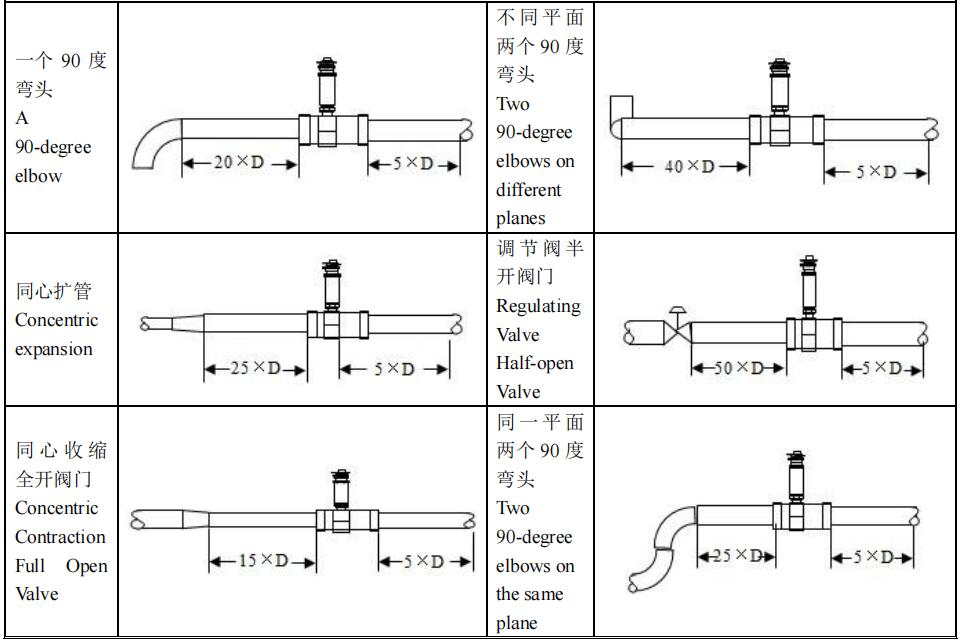
A single 90° elbow creates asymmetric flow that can persist 20–30 diameters downstream. Two elbows in different planes generate rotational swirl that takes even longer to decay. Partially closed valves create jet effects that can bias readings by 5–15%.

The straight pipe gives this disturbed flow room to re-develop before it reaches the sensing element. For a detailed breakdown of how upstream and downstream distances are calculated, see our upstream and downstream straight pipe guide.

How Much Straight Pipe Does Each Flow Meter Type Need?

Requirements vary widely by technology. Differential pressure meters (orifice, venturi) are the most sensitive. Coriolis meters are the least sensitive. The table below gives typical minimums for a single 90° elbow upstream.

Meter TypeUpstream (min)Downstream (min)Sensitivity
Orifice plate10–44D4–7DVery high
Venturi tube3–16D2–4DModerate
Nozzle6–36D4–6DHigh
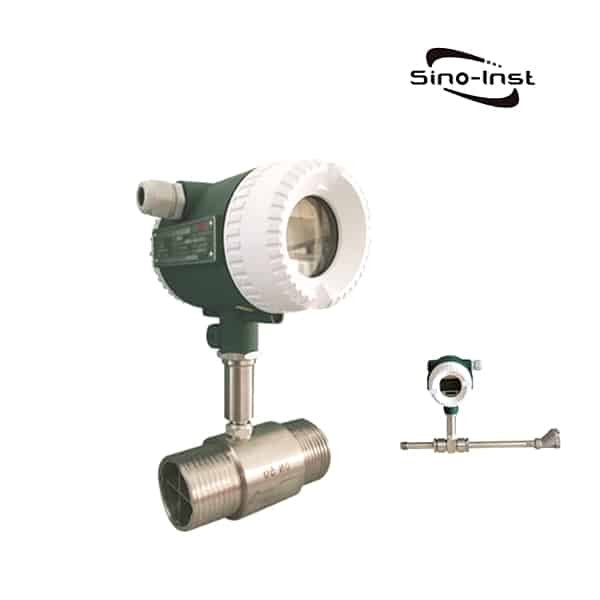
Turbine10–20D5DHigh
Vortex15–40D5DHigh
Electromagnetic5D3DLow
Ultrasonic (transit time)10–20D5DModerate
Ultrasonic (clamp-on)10–30D5DModerate–High
Coriolis0–5D0–2DVery low
Thermal mass10–15D5DModerate
Positive displacement0D0DNone
Typical straight length requirements after a single 90° elbow. Always verify with the specific meter datasheet.

Two practical observations. First, electromagnetic and Coriolis meters are often chosen specifically because they tolerate short installations in cramped skids. Second, orifice plates look cheap on paper but the piping cost to give them 20–40D of straight run often erases that advantage in real projects.

How Do Upstream Disturbances Change the Requirement?

The required straight length depends on what disturbance sits upstream of the meter. The worse the disturbance, the more pipe you need. Below are typical multipliers for a turbine or vortex meter (β ≈ 0.7 for DP meters follows similar patterns per ISO 5167).

Upstream DisturbanceTurbine / Vortex (D)Orifice β=0.7 (D)
Single 90° elbow10–2028
Two 90° elbows, same plane2036
Two 90° elbows, different planes25–4062
Reducer (gradual)1014
Expander (gradual)1528
Fully open gate valve1018
Partially closed valve50+60+
Pump discharge30+50+

The worst case is a partially closed control valve directly upstream of the meter. Never do this. Always place control valves downstream of the flow meter. If a valve must sit upstream, use a gate or ball valve in the fully open position and add flow conditioning.

What If You Don’t Have Enough Straight Pipe?

Three practical options exist when piping is tight.

  1. Install a flow conditioner. Devices like the Zanker plate, tube bundle, or Vortab eliminate swirl and accelerate profile re-development. A good conditioner reduces the required upstream length to 3–10D depending on the meter type.
  2. Switch to a less sensitive meter technology. If the process permits, electromagnetic, Coriolis, or thermal mass meters work in much shorter runs. The upfront cost is higher but installation cost drops.
  3. Run an in-situ calibration. Install the meter as-is, then calibrate it against a reference meter in a spool that is run in series. This is common in critical skid applications where physical space cannot be expanded.

What doesn’t work: assuming “it’s probably fine” and skipping the calculation. We’ve seen 8% errors in custody transfer skids that were traced back to a 2D shortfall after an elbow. Do the math before the piping is welded.

How Do You Measure Straight Length Correctly?

Measure from the downstream edge of the last fitting to the centerline of the flow meter’s sensing element. For upstream, this is the inlet flange of an orifice plate, the leading edge of a turbine rotor, or the shedder bar of a vortex meter. For downstream, measure from the sensing element to the next fitting.

Three common mistakes to avoid:

  • Measuring from the flange of the upstream fitting rather than its internal disturbance point.
  • Forgetting that a tee used as an elbow is more disruptive than a proper long-radius elbow.
  • Using pipe OD instead of ID. “10D” means 10 inner diameters, which for Schedule 40 steel pipe is noticeably smaller than OD.

For DP meters, reference ISO 5167-2 for the formal rule set. For turbine, vortex, and ultrasonic meters, follow the manufacturer’s datasheet, which is usually stricter than ISO norms. For a deeper dive into K-factor calibration adjustments that can partially compensate for imperfect piping, see our dedicated guide.

Recommended Flow Meters for Short-Run Installations

If piping space is constrained, these three meter types work well with reduced straight runs.

Electromagnetic Flow Meter

Electromagnetic (EMF) flow meter for conductive liquids — water, slurry, chemicals, effluent. No moving parts, zero pressure drop, DN3-DN3000 range; the gold standard for wastewater.

Coriolis Mass Flow Meter

Triangle-tube Coriolis mass flow meter for small-flow, high-viscosity and non-Newtonian fluids. Direct mass, density and temperature output — no density-based correction needed.

Ultrasonic Flow Meter

Transit-time and Doppler ultrasonic flow meters for clean liquids and dirty slurries. Clamp-on, insertion and in-line versions — pick by fluid type, pipe size and accuracy target.

FAQ

What is the 10D/5D rule for flow meters?

The 10D/5D rule means 10 pipe diameters of straight pipe upstream and 5 downstream. It is a rough baseline for turbine, vortex, and magnetic meters after a single 90° elbow. Always verify against the meter’s datasheet, as DP meters and orifice plates often require much longer runs (up to 44D).

Do electromagnetic flow meters need straight pipe?

Yes, but much less than other meter types. Most manufacturers specify 5D upstream and 3D downstream. Some modern electromagnetic meters with full-bore design and advanced signal processing require as little as 3D upstream. Check the datasheet for the specific model.

Can a flow conditioner replace straight pipe?

A flow conditioner can reduce the required upstream length by 50–80% for most meter types. Common designs include Zanker plates, tube bundles, and Vortab conditioners. They do not eliminate the requirement entirely. You still need a few diameters of straight pipe between the conditioner and the meter.

What happens if there is not enough straight pipe?

Accuracy degrades. The actual error depends on the disturbance type and shortfall magnitude. Typical field errors range from 2% to 15% when straight runs are 30–50% short of the requirement. In custody transfer or batch applications, this is financially material.

Does a Coriolis meter really need no straight pipe?

Coriolis meters are nearly immune to velocity profile distortion because they measure mass flow via tube oscillation, not velocity. Most manufacturers still recommend 0–5D of straight pipe upstream to prevent pressure pulsation and gas entrainment issues, but the sensitivity to elbows and valves is minimal.

Should valves be installed upstream or downstream of the flow meter?

Always downstream. A partially closed control valve upstream creates a jet effect that can skew readings by more than 15% even with 50D of straight pipe. If a valve must go upstream, use an on/off type (gate or ball valve) and keep it fully open during operation.

Need help selecting a meter for a short-run installation or calculating straight pipe for an existing line? Our engineers can review your P&ID and recommend the right technology. Share your application details below and we’ll respond within one business day.

Request a Quote

Please enable JavaScript in your browser to submit the form

Venturi Tube: Working Principle, Design & Flow Measurement Guide

Updated: April 11, 2026

A venturi tube is a differential pressure device used to measure the flow rate of fluids in a pipe. It works on a simple principle: force fluid through a constriction, measure the pressure drop, and calculate the flow rate from that drop. The design has no moving parts, which means it lasts for decades with almost zero maintenance. Engineers have been using venturi tubes in water systems, steam lines, and gas pipelines since the late 1800s.

Contents

What Is a Venturi Tube?

A venturi tube is a shaped pipe section with three main parts: a converging cone at the inlet, a narrow throat in the middle, and a diverging cone (diffuser) at the outlet. When fluid enters the converging section, it speeds up. At the throat, the velocity reaches its maximum and the pressure drops to its lowest point. The diffuser then gradually slows the fluid back down, recovering most of the pressure.

Two pressure taps—one at the upstream inlet and one at the throat—connect to a differential pressure transmitter. The pressure difference between these two points is directly related to the flow rate. A higher flow produces a larger pressure drop across the throat.

Compared to other differential pressure flow elements, the venturi tube has the lowest permanent pressure loss—typically only 10–15% of the measured differential pressure. That makes it the preferred choice when pumping costs matter or when you need to minimize energy loss in a pipeline.

The Venturi Effect and Bernoulli’s Equation

The venturi effect is the drop in fluid pressure that occurs when a fluid flows through a constricted section of pipe. Italian physicist Giovanni Battista Venturi first described this phenomenon in 1797. The underlying physics comes from Bernoulli’s principle: in a steady, incompressible flow with negligible friction, the total energy along a streamline stays constant.

Bernoulli’s equation states:

P + ½ρv² + ρgh = constant

Where P is static pressure, ρ is fluid density, v is velocity, g is gravitational acceleration, and h is elevation. For a horizontal pipe (h₁ = h₂), the equation simplifies: when velocity increases at the throat, pressure must decrease. This pressure drop is what we measure.

The venturi effect is not limited to pipe flow measurement. It appears in aircraft wing design (lift generation), carburetor fuel mixing, medical aspirators, and building ventilation systems. But in industrial process instrumentation, it is primarily used to determine flow rates in closed conduits.

Venturi Tube Working Principle

The measurement relies on two equations working together: the continuity equation and Bernoulli’s equation.

The continuity equation for incompressible flow says:

A₁ × v₁ = A₂ × v₂

Where A₁ and v₁ are the cross-sectional area and velocity at the inlet, and A₂ and v₂ are at the throat. Since A₂ is smaller than A₁, v₂ must be larger than v₁.

Combining both equations gives the volumetric flow rate formula:

Q = C × A₂ × √(2ΔP / (ρ × (1 − β⁴)))

Where C is the discharge coefficient (typically 0.95–0.99 for a properly manufactured venturi), ΔP is the measured differential pressure, ρ is fluid density, and β is the diameter ratio (d/D, throat diameter divided by pipe diameter). Understanding the relationship between flow rate and pressure is fundamental to applying this formula correctly.

A practical note: the discharge coefficient for a standard venturi tube per ISO 5167 is well-characterized and stable. That stability is why venturi tubes can achieve ±0.5% measurement accuracy when manufactured to standard dimensions.

Venturi Tube Design Types

ISO 5167-4 defines three main venturi tube construction types, each suited to different applications and pipe sizes.

Classic (Machined) Venturi

The classic venturi has a 21°±1° converging cone, a cylindrical throat with length equal to its diameter, and a diverging cone with a 7°–15° angle. The inlet cylinder length equals the pipe diameter D. This is the most accurate type, with a well-documented discharge coefficient. Suitable for pipe sizes DN 50 to DN 1200.

Welded (Fabricated) Venturi

Made from rolled sheet metal and welded together, the fabricated venturi is used for large-diameter pipes (DN 200 to DN 3000 and above). The convergent angle can vary from 10.5°±0.5° to 21°±1°. Manufacturing cost is lower than the machined type, making it practical for large water mains and industrial gas ducts.

Venturi Nozzle (ISA 1932 Nozzle + Diffuser)

A venturi nozzle combines an ISA 1932 nozzle entrance with a diverging diffuser section. It offers a shorter overall length than the classic venturi while maintaining low pressure loss. Pipe sizes range from DN 50 to DN 500. Often chosen where installation space is limited but you still need the pressure recovery benefit.

FeatureClassic VenturiWelded VenturiVenturi Nozzle
Converging angle21°±1°10.5°–21°ISA 1932 profile
Pipe size rangeDN 50–1200DN 200–3000+DN 50–500
Permanent pressure loss10–15%10–15%5–20%
Accuracy (per ISO 5167)±1%±1.5%±1.2%
Best forStandard industrialLarge pipes, water mainsSpace-constrained installs

How to Measure Flow with a Venturi Tube

Setting up a venturi tube for flow measurement involves these steps:

1. Install the venturi tube. Mount it inline with the correct upstream and downstream straight pipe lengths. A typical requirement is 5D–10D upstream and 4D downstream, though the venturi is more forgiving than an orifice plate.

2. Connect the differential pressure transmitter. Run impulse tubing from the upstream pressure tap and the throat pressure tap to a DP transmitter. Slope the tubing properly to avoid air pockets (for liquid service) or condensate traps (for gas/steam). For more on how DP transmitters work, see our guide on pressure transmitter working principles.

3. Configure the transmitter. Enter the pipe diameter, throat diameter, fluid density (or configure temperature/pressure compensation for gas), and the transmitter will calculate the flow rate using the square-root relationship between ΔP and flow.

4. Verify with a reference. After installation, compare readings against a known flow rate if possible. The K-factor method can help verify accuracy during commissioning.

A common field mistake: installing the venturi tube backwards. The converging section must face the flow direction. If installed in reverse, the pressure recovery won’t work and the measurement will be unreliable. Always check the flow arrow marked on the body.

Venturi Tube vs Orifice Plate vs Flow Nozzle

All three are differential pressure flow elements defined in ISO 5167. Each has trade-offs.

ParameterVenturi TubeOrifice PlateFlow Nozzle
Permanent pressure loss10–15% of ΔP40–80% of ΔP30–50% of ΔP
Accuracy±0.5–1%±0.5–2%±1–1.5%
Straight pipe requirement5–10D upstream10–40D upstream10–30D upstream
Dirty fluid toleranceGood (smooth profile)Poor (edge buildup)Moderate
CostHighLowMedium
MaintenanceVery lowPeriodic plate inspectionLow
Installation lengthLongShort (flange-mounted)Medium

Choose a venturi tube when permanent pressure loss must be minimized—for instance, in gravity-fed water systems or high-volume gas pipelines where compressor costs are significant. Choose an orifice plate when budget is tight and you can accept the energy penalty. A flow nozzle sits between the two in both cost and performance.

Venturi Flow Meters from Sino-Inst

Sino-Inst manufactures venturi tubes and complete venturi flow meter assemblies (venturi + DP transmitter + valve manifold) for water, steam, gas, and chemical applications. All units are manufactured per ISO 5167-4 and supplied with calibration certificates.

Standard Venturi Tube

Classical venturi flow meter with low permanent pressure loss and high repeatability. Long service life on dirty liquids, gas and steam where orifice plates wear out fast.

Orifice Plate Flow Meter

SI-LG orifice plate flow meter — the standard DP primary element for steam, gas and clean liquids. Supports concentric, segmental and eccentric plates, pairs with any smart DP transmitter.

Flow Nozzle

ISA1932 / long-radius flow nozzle for high-temperature, high-pressure steam and gas. Lower permanent pressure loss than orifice plates makes it the default DP element for utility headers.

FAQ

What is the typical accuracy of a venturi tube?

A standard venturi tube manufactured per ISO 5167-4 achieves ±1% accuracy on the discharge coefficient. With a properly calibrated DP transmitter, overall system accuracy of ±0.5–1.5% of actual flow is achievable. Accuracy depends on the beta ratio, Reynolds number, and manufacturing tolerances.

What is the difference between a venturi tube and a venturi meter?

A venturi tube is just the physical pipe element with its converging-throat-diverging geometry. A venturi meter (or venturi flow meter) is the complete measurement system: venturi tube + differential pressure transmitter + connecting impulse tubing + signal processing. The tube creates the pressure drop; the meter gives you the flow reading.

Can a venturi tube measure gas flow?

Yes. Venturi tubes measure gas, liquid, and steam. For gas applications, you need temperature and pressure compensation because gas density changes with operating conditions. The DP transmitter or flow computer applies the gas expansion factor defined in ISO 5167 to correct the reading.

Why does a venturi tube have lower pressure loss than an orifice plate?

The diverging diffuser section gradually decelerates the fluid after the throat, converting kinetic energy back into pressure. An orifice plate has no diffuser—the fluid exits the orifice into a sudden expansion, which creates turbulence and wastes energy. The venturi tube typically recovers 85–90% of the differential pressure, while an orifice plate recovers only 20–60%.

What beta ratio should I use for a venturi tube?

The beta ratio (d/D) for standard venturi tubes per ISO 5167 ranges from 0.3 to 0.75. A beta of 0.4–0.6 is most common. Lower beta means higher differential pressure and better signal-to-noise ratio but also higher permanent pressure loss. Higher beta means lower differential pressure and less energy loss but requires a more sensitive DP transmitter.

How long does a venturi tube last?

With no moving parts and a smooth internal profile, a venturi tube in clean service can last 20–30 years or more without recalibration. In corrosive or abrasive service, material selection (316SS, Hastelloy, ceramic-lined) determines lifespan. Periodic throat diameter measurement confirms that erosion has not shifted the calibration.

Need help selecting the right venturi tube or DP flow meter for your application? Our engineering team can review your process data—pipe size, fluid type, flow range, pressure, and temperature—and recommend the optimal solution. Contact us for a technical consultation or quotation.

Request a Quote

Please enable JavaScript in your browser to submit the form