
Updated: April 23, 2026
Every differential pressure flow meter — orifice plate, venturi, flow nozzle, V-cone, averaging pitot — runs the same equation. Bernoulli says the velocity through a restriction goes as the square root of the pressure drop. Multiply by the area and the discharge coefficient, and you have flow. This page covers the formulas in the form you will use them, three worked examples that mirror real plant calculations, and the common errors that turn a 0.5% accuracy meter into a 5% one.
Contents
- The DP Flow Calculation Formula
- What Each Variable Means
- Worked Example 1: Orifice Plate on Water
- Worked Example 2: Mass Flow on Saturated Steam
- Worked Example 3: 4-20 mA Output to Flow Rate
- DP Sizing Rules of Thumb
- Common Calculation Errors
- DP Transmitters for Flow Measurement
- FAQ
The DP Flow Calculation Formula
The volumetric flow through any DP element is given by:
The result Q here is in m³/s; for a transmitter display you almost always convert to GPM or LPM depending on the region the meter ships to.
Q = Cd · A2 · √(2 · ΔP / [ρ · (1 − β4)])
For mass flow, multiply by density:
W = Cd · A2 · √(2 · ΔP · ρ / (1 − β4))
Both forms come straight from Bernoulli’s equation. The (1 − β4) term is the velocity-of-approach correction. ISO 5167 — the international standard for orifice, nozzle, and venturi metering — wraps everything except ΔP into a flow coefficient K so the working form becomes:
Q = K · √(ΔP / ρ) (volumetric)
W = K · √(ΔP · ρ) (mass)
For compressible fluids, an expansion factor ε (less than 1.0) is added to account for gas expansion through the restriction:
W = K · ε · √(ΔP · ρ1)
where ρ1 is the density at upstream conditions.
What Each Variable Means
| Symbol | Quantity | SI Unit | Notes |
|---|---|---|---|
| Q | Volumetric flow | m³/s | Multiply by 3600 for m³/h |
| W | Mass flow | kg/s | Multiply by 3600 for kg/h |
| Cd | Discharge coefficient | — | 0.60 for sharp orifice, 0.98 for venturi |
| A2 | Throat (bore) area | m² | π·d²/4 where d is bore diameter |
| ΔP | Differential flow rate and pressure relationship | Pa | 1 kPa = 1000 Pa, 1 bar = 100,000 Pa |
| ρ | Fluid density | kg/m³ | At flowing conditions, not standard |
| β | Diameter ratio d/D | — | Bore divided by pipe ID |
| ε | Expansion factor | — | Gas only; 1.0 for liquids |
| K | Flow coefficient | — | Combines Cd, A2, β, units |
The discharge coefficient is the part most people get wrong. It is not 0.6 for everything. ISO 5167 publishes the Reader-Harris/Gallagher equation for sharp-edged orifice Cd, which depends on β, Reynolds number, and tap configuration. For first-pass sizing, use 0.60 for orifice, 0.98 for classical venturi, 0.99 for a long-radius nozzle. Final sizing should always come from a sizing tool that solves the iterative equation.
Worked Example 1: Orifice Plate on Water
A 6-inch (DN150) line carries water at 25 °C. An orifice plate with bore diameter d = 90 mm is installed in the line (pipe ID D = 154 mm). The DP transmitter reads ΔP = 25 kPa. Find the volumetric flow.
- β = d/D = 90/154 = 0.584
- 1 − β4 = 1 − 0.5844 = 1 − 0.1163 = 0.8837
- A2 = π · (0.090)² / 4 = 6.362 × 10⁻³ m²
- ρ = 997 kg/m³ (water at 25 °C)
- ΔP = 25,000 Pa
- Cd = 0.605 (sharp-edged orifice, β = 0.584, high Re)
Plug into the volumetric equation:
Q = 0.605 · 6.362 × 10−3 · √(2 · 25,000 / [997 · 0.8837])
Q = 0.00385 · √(56.76) = 0.00385 · 7.534 = 0.0290 m³/s = 104.4 m³/h
That is the answer for water. Notice the square-root behavior: doubling ΔP from 25 to 50 kPa would only raise flow from 104 to 148 m³/h — a 41% increase, not 100%. That non-linearity is the largest weakness of DP flow.
Worked Example 2: Mass Flow on Saturated Steam
A 4-inch (DN100) line carries saturated steam at 10 bar gauge. Pipe ID D = 102 mm. An orifice with d = 60 mm gives β = 0.588. The DP transmitter reads ΔP = 12 kPa. Find the steam mass flow in kg/h.
- Saturated steam at 10 bar(g) ≈ 11 bar(a), saturation temperature 184 °C
- Steam density ρ = 5.64 kg/m³ (from steam tables)
- 1 − β4 = 1 − 0.5884 = 0.8804
- A2 = π · (0.060)² / 4 = 2.827 × 10⁻³ m²
- Cd = 0.605
- Expansion factor ε ≈ 0.985 (small ΔP / P ratio)
Mass flow:
W = 0.605 · 2.827 × 10−3 · 0.985 · √(2 · 12,000 · 5.64 / 0.8804)
W = 1.683 × 10⁻³ · √(153,775) = 1.683 × 10−3 · 392.2 = 0.660 kg/s = 2376 kg/h
Steam flow calculations are sensitive to density. A 10 °C error in steam temperature shifts density by roughly 2%, which shifts mass flow by 1%. Always pick density from current operating pressure and temperature, not the design point.
Worked Example 3: 4-20 mA Output to Flow Rate
A DP transmitter is ranged 0-50 kPa with 4-20 mA output. The corresponding calibrated flow range is 0-200 m³/h on a clean orifice. The transmitter is currently outputting 12 mA. What is the flow?
The relationship between current output and DP is linear:
ΔP = (I − 4) / 16 · 50 kPa = (12 − 4) / 16 · 50 = 25 kPa (50% of span)
But flow is square-root of DP, so 50% DP is not 50% flow:
Q = 200 · √(25/50) = 200 · √0.5 = 200 · 0.7071 = 141.4 m³/h (70.7% of full flow)
This square-root extraction is why DP transmitters today usually have an internal √ function or are paired with a flow computer. The output can be set to either linear-with-DP or linear-with-flow. If the DCS does the extraction, the transmitter sends linear DP. If the transmitter does it, the DCS sees linear flow but loses some resolution at low flow rates. For background on what the milliamp output means, see our 4-20 mA signal conversion guide.
DP Sizing Rules of Thumb
Size the DP element so the full-scale ΔP falls into a sensible band. Too low and signal noise dominates; too high and permanent pressure loss kills pump capacity.
| Element | Typical β | Full-scale ΔP | Permanent Pressure Loss |
|---|---|---|---|
| Sharp-edged orifice | 0.4 – 0.7 | 10 – 50 kPa | 40 – 80% of ΔP |
| Classical venturi | 0.4 – 0.75 | 10 – 50 kPa | 5 – 20% of ΔP |
| Long-radius nozzle | 0.4 – 0.8 | 10 – 50 kPa | 30 – 50% of ΔP |
| V-cone | 0.45 – 0.85 | 5 – 25 kPa | 10 – 30% of ΔP |
| Averaging pitot | — | 2 – 10 kPa | < 5% of ΔP |
Three sizing rules carry most installations through:
- Pick ΔP at full flow first. Aim for 25 kPa as a starting target. Below 5 kPa, transmitter zero drift becomes a problem. Above 100 kPa, the permanent pressure loss starts to matter.
- Then solve for β. Use the volumetric equation with Cd = 0.605 and your design flow to find A2, then β = d/D.
- Check β bounds. Stay between 0.20 and 0.75 for orifice. Outside that range, the Cd uncertainty grows and the standard ISO 5167 formulas no longer apply.
For straight-pipe upstream and downstream requirements once the element is picked, see our upstream and downstream straight pipe guide.
Common Calculation Errors
- Standard density vs flowing density. Gas calculations done with standard density (15 °C, 1 atm) instead of the actual line condition can be off by 5-15×. Always use ρ at the upstream pressure and temperature.
- Forgetting (1 − β4). For β below 0.3, the velocity-of-approach factor is close to 1 and can be skipped, but for β = 0.7 it is 0.76 and ignoring it gives a 14% high reading.
- Wrong unit for ΔP. Mixing kPa, mbar, mmH₂O, and inches of water column accounts for half of all calculation mistakes. Convert everything to Pa before plugging in.
- Square-root output already extracted. Calculating Q = K · √ΔP when the transmitter has already done the extraction gives Q ∝ ΔP instead of Q ∝ √ΔP — wrong by a factor of √ over the range.
- Discharge coefficient assumed constant. Cd drifts with Reynolds number below Re = 10⁴. Cold viscous fluids in small pipes hit this region in low flow. Use the Reader-Harris/Gallagher equation, not a fixed 0.6.
DP Transmitters for Flow Measurement
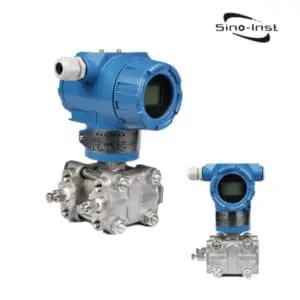
SMT3151DP Smart DP Transmitter
±0.075% accuracy, ranges 0.1 to 25,000 kPa, square-root extraction onboard. Standard for orifice, venturi, and nozzle metering loops.
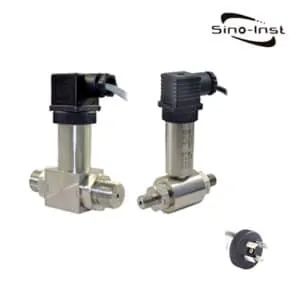
SI-801 Piezoresistive DP Transmitter
Compact piezoresistive DP cell for filter ΔP, blower discharge, and small DP flow loops. Lower cost where ±0.5% is acceptable.
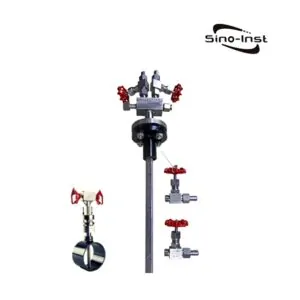
Verabar Averaging Pitot Flow Meter
Insertion DP element with very low permanent pressure loss. Use on large pipes where orifice retrofit is not practical.
FAQ
What is the formula for differential pressure flow measurement?
The working form is Q = K · √(ΔP / ρ) for volumetric flow and W = K · √(ΔP · ρ) for mass flow. K bundles the discharge coefficient, throat area, β-correction, and unit conversions. The relationship is square-root, so flow doubles when ΔP quadruples.
Why is DP flow proportional to the square root of pressure?
Bernoulli’s equation says ΔP = ½ρv², so velocity v = √(2ΔP/ρ). Volumetric flow is Q = A·v, which gives the square-root relationship. Kinetic energy scales with v², so a fixed pressure drop fixes velocity, not flow magnitude directly.
How do I calculate flow from a 4-20 mA DP transmitter?
Convert mA to ΔP linearly: ΔP = (I − 4)/16 · range. Then take the square root and scale to flow: Q = Qmax · √(ΔP / ΔPmax). At 12 mA (50% of span) the flow is 70.7% of maximum, not 50%.
What is the discharge coefficient for an orifice plate?
Around 0.60-0.61 for a sharp-edged orifice with β between 0.4 and 0.7 at high Reynolds numbers. ISO 5167-2 publishes the Reader-Harris/Gallagher equation that gives Cd as a function of β, Re, and tap configuration. Long-radius nozzles run 0.99, and classical venturis 0.98.
How do I size an orifice plate for a given flow?
Pick a target full-scale ΔP (typically 25 kPa). Solve the volumetric equation for A2 with Cd = 0.605 and your design flow. Take β = d/D and check it falls between 0.20 and 0.75. Iterate once with the corrected Cd from the standards.
What is the difference between mass flow and volumetric flow?
Volumetric flow Q (m³/h) is volume per time. Mass flow W (kg/h) is mass per time. They are linked by density: W = Q · ρ. Custody transfer and steam balances use mass flow because density changes with temperature and pressure; volumetric does not stay conserved across heat exchangers or expansion valves.
Get a DP Flow Measurement System Quote
Send us your fluid, design flow, line size, operating pressure, and temperature. We’ll size the DP element, pick the transmitter range, and send back a calculation sheet plus drawing — usually within one business day.
Request a Quote

Wu Peng, born in 1980, is a highly respected and accomplished male engineer with extensive experience in the field of automation. With over 20 years of industry experience, Wu has made significant contributions to both academia and engineering projects.
Throughout his career, Wu Peng has participated in numerous national and international engineering projects. Some of his most notable projects include the development of an intelligent control system for oil refineries, the design of a cutting-edge distributed control system for petrochemical plants, and the optimization of control algorithms for natural gas pipelines.