
Choosing an ultrasonic level sensor for diesel tanks is a tank-geometry problem before it is a sensor-spec problem. The same 4–20 mA transmitter that reads cleanly on a 3 m vertical cylindrical AST can drift, foam-out, or echo the wrong wall on a 30 m³ horizontal underground tank — and a clamp-on through-wall device that suits a steel road tanker will fail on a polyethylene farm tank. This guide walks the four diesel-tank geometries our field team meets most often, names the four failure modes that show up in service, and matches frequency, beam angle, and hazardous-area rating to each.
Contents
- Diesel Tank Geometry Drives the Sensor Choice
- Four Field Failures of Ultrasonic in Diesel Service
- Frequency and Beam Angle by Tank Type
- Hazardous-Area Certification: ATEX, IECEx, Class I Div 2
- Externally-Mounted Sensors: When and Why
- Diesel Inventory Telemetry: 4–20 mA, RS-485, LoRaWAN
- Featured Ultrasonic Level Sensors for Diesel Tanks
- FAQ
Diesel Tank Geometry Drives the Sensor Choice
The single biggest predictor of a clean ultrasonic measurement on a diesel tank is the tank shape, not the sensor brand. Vertical cylindrical above-ground tanks (AST) give a flat liquid surface and a clean acoustic path; horizontal cylindrical AST and underground tanks (UST) introduce a curved surface and side-wall echoes; mobile or skid-mounted day tanks add slosh, vibration, and short-range dead zones. We size the sensor and choose mounting geometry against each of these four shapes.
| Tank type | Typical depth | Acoustic challenge | Recommended sensor |
|---|---|---|---|
| Vertical cylindrical AST (1–10 m) | 1–10 m | Vapor cone above warm fuel | 40 kHz top-mount, 5° beam |
| Horizontal cylindrical AST (5–50 m³) | 1.5–2.5 m liquid depth | Curved surface, echo from far wall | 40–50 kHz, narrow 3–5° beam, manhole-port mount |
| Underground tank (UST, 5–30 m³) | 1.5–2.5 m | No top access; condensation in fill pipe | External clamp-on or fill-pipe insert; 40 kHz |
| Mobile / skid day tank (200–2000 L) | 0.3–1.2 m | Short-range dead zone; vibration | 200 kHz short-range probe, 5–150 cm range |
| Plastic farm tank (HDPE, 1–10 m³) | 1.0–2.5 m | Wall transmits acoustic energy poorly | External-paste sensor — verify wall thickness ≤ 25 mm |
For above-ground vertical tanks the standard answer is a top-mount 40 kHz transmitter with a 5° beam — narrow enough to clear the manhole nozzle, wide enough to absorb mild surface ripple. The horizontal AST is the trickiest case: the curved upper surface defines a small “good zone” directly under the highest point of the tank, and the sensor must mount at the apex through a manhole port. Underground tanks usually demand external-mount or fill-pipe-insert configurations because there is no top access. Mobile day tanks need a short-range, high-frequency probe that can resolve the bottom 5–150 cm without slosh artifacts.
Four Field Failures of Ultrasonic in Diesel Service
Diesel itself is acoustically friendly — speed of sound around 1325 m/s at 20 °C, low foaming tendency, no aggressive vapors at ambient. But four failure modes still account for most warranty calls on diesel-tank ultrasonic installs. Recognising them in commissioning saves a return trip.
- Vapor cone over warm fuel. Diesel returning from injectors at 60–80 °C creates a temperature gradient above the surface that bends the ultrasonic beam. Symptom: reading drifts low when the tank is hot, settles overnight. Fix: use a stilling well or a sensor with on-board temperature compensation; mount the sensor away from the return-line splash zone.
- Foam from rapid filling. Foam absorbs ultrasonic energy and produces an echo from the foam top, not the liquid surface. Symptom: high reading immediately after fill, slow decay. Fix: throttle the fill rate (≤ 2 m/s into the tank), use a stilling well, or switch to an external clamp-on sensor that ignores the foam layer entirely.
- Condensation on the transducer face. Underground tanks vent humid air; the transducer face dews up overnight and attenuates the outgoing pulse. Symptom: lost echo until afternoon sun warms the head. Fix: add a small heat-traced shield, or mount the sensor inside a fill-pipe stilling tube where condensation drains away.
- Sediment shelf at tank bottom. Long-stored diesel forms an asphaltene/water layer at the bottom that gives an early echo. Symptom: tank “won’t read empty” — flat-lines at 50–100 mm above true zero. Fix: schedule annual tank cleaning; in the meantime, calibrate “empty” against the dipstick reading rather than the geometric bottom.
Frequency and Beam Angle by Tank Type
The frequency–beam-angle trade-off decides whether the sensor sees the diesel surface or the side wall. Lower frequencies (40–50 kHz) carry energy further with less attenuation and tolerate a dirty transducer face; higher frequencies (80–200 kHz) give a narrower beam and resolve the bottom 5–150 cm of a small tank. Our default for diesel ASTs is 40 kHz with a 5° half-angle beam.
| Frequency | Range | Beam half-angle | Best for | Watch out |
|---|---|---|---|---|
| 30–40 kHz | 0.3–15 m | 5–7° | Vertical AST, deep tanks | Wide beam — keep ≥ 300 mm from tank wall |
| 50 kHz | 0.3–10 m | 4–5° | Horizontal AST through manhole | Mount at apex, not over baffles |
| 80 kHz | 0.15–8 m | 3–4° | Tall narrow ASTs (silo-form) | Sensitive to dust on transducer |
| 120–200 kHz | 0.05–2 m | 2–3° | Mobile day tanks; small farm tanks | Short range; high attenuation in vapor |
For installation rules of thumb on dead zone, clearance from agitators, and stilling-well sizing, the engineering basics covered in our ultrasonic level transmitter installation guide apply equally to diesel service.
Hazardous-Area Certification: ATEX, IECEx, Class I Div 2
Diesel is a Class IIIB combustible liquid (flash point above 60 °C / 141 °F under most fuel-quality standards), so a closed bulk-storage tank is normally classified Class I Division 2 in NEC terminology, or Zone 2 under IEC 60079. Trucks, refueling skids, and any installation handling biodiesel blends or kerosene mixes can rise to Class I Division 1 / Zone 1.
- Class I Div 2 / Zone 2: non-incendive (NI) or intrinsically safe (IS) ultrasonic transmitter is acceptable; ATEX category 3G or IECEx Ex ec / Ex ic markings.
- Class I Div 1 / Zone 1: intrinsically safe (Ex ia) with certified barrier, or explosion-proof (Ex d) flameproof housing with sealed cable gland.
- Mobile / road tanker ADR/DOT service: ATEX Zone 1 + vibration-rated mounting; check EN 16323 for fuel-tanker-specific guidance.
Always pair the field transmitter with a Zener barrier or galvanic isolator at the safe-side panel; the barrier datasheet must show capacitance and inductance limits below the transmitter’s Ci/Li values, otherwise the IS loop is not certifiable. For a fuller treatment of intrinsic safety in fuel applications, see the truck fuel-tank ultrasonic sensor page.
Externally-Mounted Sensors: When and Why
External (clamp-on or paste-on) ultrasonic sensors fire through the tank wall and read the liquid level without any process penetration. They solve four real problems on diesel tanks: no tank entry on USTs, no permit-to-work for hot work on existing ASTs, no compatibility issue with anti-static linings, and no down-time during retrofit.
The trade-off is wall thickness and material. Carbon-steel tank walls up to 25 mm are workable; HDPE polyethylene walls work well at 8–15 mm; thicker walls or laminated/composite tanks scatter the pulse and lose accuracy. Plan for ±5 mm accuracy with external-mount, vs ±2 mm typical for top-mount through-air. Acoustic couplant grease must be reapplied every 2–3 years in outdoor service. For underground tanks where no top entry exists, an external clamp-on sensor on the fill pipe or the tank shell (where exposed in the dispenser pit) is often the only viable retrofit option — see our notes on how to check level in underground tanks for the five available methods compared.
Diesel Inventory Telemetry: 4–20 mA, RS-485, LoRaWAN
The output protocol decides who gets the level reading and how often. Loop-powered 4–20 mA suits a single tank wired to a local PLC or annunciator panel; RS-485 Modbus RTU multi-drops up to 32 sensors on a 1.2 km bus to a fleet SCADA; LoRaWAN and 4G NB-IoT transmit a daily reading from remote farm tanks or unmanned generator skids without trenching cable.
| Output | Power | Distance | Best for | Caveat |
|---|---|---|---|---|
| 4–20 mA HART | Loop, 24 VDC | ≤ 1 km | Single tank → PLC / DCS | One tank per loop unless multidrop HART |
| RS-485 Modbus RTU | External 24 VDC | ≤ 1.2 km | Fleet of tanks → SCADA | Termination resistor + shielded cable |
| LoRaWAN | Battery 5–10 yr | 5–15 km LOS | Remote farm / generator tanks | One reading per 6–24 h, not real-time |
| 4G NB-IoT | Battery 3–5 yr | Cellular coverage | Unmanned dispenser sites | SIM data plan; signal in metal pit may need external antenna |
For unattended truck depots and rural genset sites, the inventory telemetry is more important than the sensor itself — knowing the tank is at 12% before the driver arrives saves the trip. Fleet operators commonly pair an external ultrasonic with a LoRaWAN gateway and read each tank into the maintenance dashboard once an hour.
Featured Ultrasonic Level Sensors for Diesel Tanks
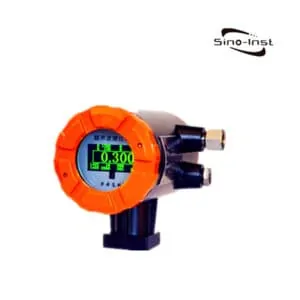
HS-2000 Ultrasonic Tank Level Sensor
External-mount through-wall design for steel and HDPE diesel tanks 0.3–10 m deep. No tank penetration, no hot work permit, ±5 mm typical accuracy.
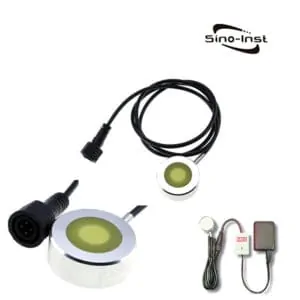
Truck Fuel Tank Ultrasonic Oil Level Sensor
External-paste sensor for ADR/DOT road tankers and mobile diesel skids. Vibration-rated, ATEX Zone 1, RS-485 Modbus output for fleet telematics.
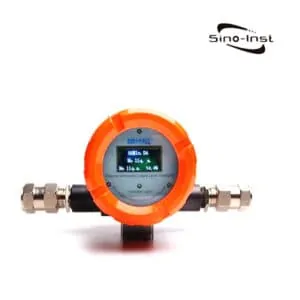
HS-ULC External-Mount Ultrasonic Level Switch
Point-level switch for low-low pump-trip and overflow protection on diesel ASTs. Single discrete output, no calibration, ATEX/IECEx certified.
FAQ
How accurate is an ultrasonic level sensor on a diesel tank?
A top-mount through-air ultrasonic transmitter delivers ±2 mm or 0.1% of range, whichever is greater, on a clean diesel surface. External clamp-on sensors are typically ±5 mm because the wall-coupling layer adds path uncertainty. Both figures degrade if vapor cone, foam, or condensation is present (see field-failures section).
Can ultrasonic measure diesel level through a plastic tank wall?
Yes, on HDPE and PE-100 walls up to about 15 mm thick. PVC and laminated composite tanks scatter the pulse and are not reliable. Always run a 60-second commissioning test on the actual tank — manufacturer wall-thickness charts are conservative.
Why does my ultrasonic sensor lose signal on cold mornings?
Condensation on the transducer face is the most common cause. Vented underground tanks pull humid air during the night, dew forms on the sensor head, and the outgoing pulse is attenuated. Add a small radiative cover or heat-trace ribbon, or relocate the sensor inside a fill-pipe stilling tube where condensation drains downward.
Is ultrasonic better than a float for a diesel day tank?
For continuous reading and remote telemetry, yes. Floats are excellent point-level switches but mechanical wear and sediment fouling shorten life on diesel-day tanks that cycle daily. A short-range 200 kHz ultrasonic gives a continuous level signal with no moving parts. Combine the two: ultrasonic for inventory, float switch for low-low pump trip.
What hazardous-area certification do I need for a diesel storage tank?
For most fixed bulk-storage tanks, Class I Division 2 (NEC) or Zone 2 (IEC 60079) is sufficient — diesel’s flash point exceeds the lower flammable limit at ambient. Mobile tankers, biodiesel blend service, and tanks within 1.5 m of a dispenser pump rise to Class I Division 1 / Zone 1 and require Ex ia intrinsically safe or Ex d flameproof construction. Always confirm the area classification with the site’s hazardous-area drawing before specifying.
Can I read a sediment-fouled tank empty with ultrasonic?
Not reliably. Asphaltene/water sludge at the bottom forms an acoustic shelf 50–100 mm above the geometric tank floor; the transmitter reads to that shelf, not to true zero. Calibrate “empty” against a manual dipstick after annual tank cleaning, and document the offset. Below 100 mm, switch to a low-low float or capacitive switch as a redundant trip.
Need help choosing the right ultrasonic level sensor for your diesel tank fleet? Our application engineers will review your tank dimensions, hazardous-area classification, and telemetry requirements and quote a fit-for-purpose configuration within one working day.
Request a Quote
Related: stilling well for ultrasonic level meters.

Wu Peng, born in 1980, is a highly respected and accomplished male engineer with extensive experience in the field of automation. With over 20 years of industry experience, Wu has made significant contributions to both academia and engineering projects.
Throughout his career, Wu Peng has participated in numerous national and international engineering projects. Some of his most notable projects include the development of an intelligent control system for oil refineries, the design of a cutting-edge distributed control system for petrochemical plants, and the optimization of control algorithms for natural gas pipelines.