
Updated: April 22, 2026
A 6-inch (DN150) flow meter sits in a specific sweet spot — large enough to handle plant-scale cooling water, wastewater, and district heating loops, but small enough that you still have five mainstream technologies to choose from. The decision is rarely about pipe size. It’s about fluid type, required accuracy, and how much straight pipe you actually have. This guide gives you the flow ranges, a side-by-side type comparison, and a decision path you can follow in under five minutes.
Contents
- What Is a 6-Inch (DN150) Flow Meter?
- What Flow Rate Can a 6″ Flow Meter Measure?
- 6-Inch Flow Meter Types Compared
- How Do You Select a 6″ Flow Meter by Fluid?
- Inline vs Insertion — Which Is Right at 6″?
- DN150 Installation: Straight Pipe & Mounting
- Featured 6″ Flow Meters
- FAQ
What Is a 6-Inch (DN150) Flow Meter?
A 6-inch flow meter is a flow measurement device with a 150 mm nominal bore (DN150, 6″ NPS). It measures volumetric or mass flow of liquids, gases, or steam in pipes with an inside diameter of roughly 146-160 mm depending on schedule. At this size, most plants use flanged ANSI 150#, PN16, or PN40 connections.
DN150 is a very common process size. You find it on boiler feedwater lines, cooling tower returns, district heating mains, pulp stock lines, and secondary wastewater discharge. Because the bore is large enough for full-bore inline meters but small enough to still be affordable, all major technology types are available — electromagnetic, turbine, vortex, ultrasonic, Coriolis, and thermal mass.
What Flow Rate Can a 6″ Flow Meter Measure?
A 6-inch flow meter typically handles 25-600 m³/h for liquids and 50-5,000 Nm³/h for gases, depending on the technology. The usable range depends on pipe velocity, not just bore size — most meters need the fluid velocity to stay between 0.5 and 10 m/s.
Use this as a quick sanity check before sizing. If your expected flow drops below the lower limit for weeks at a time, a smaller meter plus a reducer pair is usually more accurate than an oversized DN150.
| Fluid / Service | Typical Velocity | DN150 Flow Range |
|---|---|---|
| Clean water (cooling / domestic) | 1-3 m/s | 65-190 m³/h |
| Raw / wastewater | 0.5-2 m/s | 30-130 m³/h |
| Slurry (conductive) | 1-3 m/s | 65-190 m³/h |
| Hydrocarbon liquid | 1-4 m/s | 65-250 m³/h |
| Saturated steam (10 bar) | 20-40 m/s | 1,300-2,500 kg/h |
| Air / compressed gas | 10-30 m/s | 650-2,000 Nm³/h |
A good rule of thumb: if your normal flow sits near the middle of the velocity band and the peak does not exceed 6 m/s, DN150 is the right size. Push velocity past 6 m/s and you accelerate wear on turbines and create noise on vortex meters.
6-Inch Flow Meter Types Compared
Six technologies dominate the DN150 market. Each has strengths tied to fluid type and pressure drop. Use the table below as a first-pass filter, then read the notes that follow for the technology you’re drawn to.
| Type | Best For | Accuracy | Pressure Drop | Straight Pipe | Relative Cost |
|---|---|---|---|---|---|
| Electromagnetic | Conductive liquids, slurry, wastewater | ±0.5% | None | 5D / 3D | $$ |
| Turbine | Clean, low-viscosity liquids | ±0.5% | Low-medium | 10D / 5D | $$ |
| Vortex | Steam, clean gas, low-viscosity liquid | ±1% | Medium | 15D / 5D | $$ |
| Ultrasonic (transit-time) | Clean liquid, energy loops | ±1-2% | None (clamp-on) | 10D / 5D | $-$$ |
| Coriolis | Mass flow, custody transfer | ±0.1% | High | None | $$$$ |
| Thermal mass | Gas at low pressure | ±1-2% | Low | 10D / 5D | $$ |
6″ Electromagnetic (Magmeter) — the default for conductive liquids
For water, wastewater, acid, caustic, and most slurries, the magmeter is the first choice at DN150. No moving parts, no pressure drop, handles dirty fluid. The fluid just needs conductivity > 5 µS/cm. Modern 4-20 mA / HART / Modbus outputs are standard, and the flanged body survives decades on cooling loops.
6″ Turbine — for clean, well-filtered liquid
Turbines give excellent repeatability on clean low-viscosity fluids like diesel, jet fuel, or demineralized water. The main caveat is mechanical wear. Particles larger than 100 µm will shorten bearing life on a 6″ turbine. For a pipeline that occasionally passes construction debris, skip it.
6″ Vortex — the steam workhorse
Vortex is the go-to for saturated or superheated steam at DN150. It handles process temperatures up to 400 °C, reads mass flow when paired with integrated pressure/temperature, and has no moving parts. Its weakness is low-flow cutoff — below ~20% of the upper range, the von Kármán vortices become unstable and the reading drops to zero.
6″ Ultrasonic — inline or clamp-on
Transit-time ultrasonic is a strong option for clean liquids where you do not want pressure drop. Clamp-on versions are popular for retrofit on district heating or municipal water where you can’t cut the pipe. At DN150 the ultrasonic signal path is still strong enough that one pair of transducers in V-mode reaches ±1% accuracy after a field calibration. See the upstream and downstream straight pipe guide before you commit to a location.
6″ Coriolis — only when mass accuracy matters
At DN150, Coriolis meters become expensive and physically large. But if you need direct mass flow, density, and ±0.1% accuracy — for custody transfer of crude oil, chemical batching, or any two-phase dosing — nothing else comes close. Budget for a pressure drop of 0.3-1 bar at rated flow.
6″ Thermal mass — for low-pressure gas
Thermal mass meters measure gas mass flow directly without needing pressure or temperature compensation. They work well for compressed air, natural gas, biogas, or flue gas at DN150 sizes. Avoid them in wet gas or if the gas composition varies widely — both cases shift the heat-transfer coefficient and drive readings off.
How Do You Select a 6″ Flow Meter by Fluid?
Start with the fluid, not the budget. Once the fluid rules out half the technologies, the cost argument sorts itself out. Use this matrix:
| Fluid | First Choice | Runner-Up | Avoid |
|---|---|---|---|
| Clean water / cooling loop | Electromagnetic | Ultrasonic | Turbine if debris present |
| Wastewater / sludge | Electromagnetic | — | Turbine, vortex |
| Demineralized (DI) water | Ultrasonic | Turbine | Electromagnetic (<5 µS/cm) |
| Hydrocarbon liquid | Turbine | Coriolis | Electromagnetic (non-conductive) |
| Saturated / superheated steam | Vortex | — | Turbine, magmeter |
| Compressed air / natural gas | Thermal mass | Vortex | Electromagnetic |
| Slurry (mineral, pulp) | Electromagnetic | — | Turbine, vortex |
| Chemical batching, custody | Coriolis | — | Ultrasonic if entrained gas |
Two practical notes. First, electromagnetic is specified far more often than needed for clean water — ultrasonic clamp-on is frequently good enough and avoids cutting the pipe. Second, Coriolis at 6″ is rarely worth it if ±1% volumetric accuracy meets your specification.
Inline vs Insertion — Which Is Right at 6″?
Inline is almost always preferred at DN150 because the cost gap with insertion probes narrows at this size. But insertion still wins in three cases.
- Hot-tap retrofit — when shutting down to cut the line is not possible. Insertion probes install through a 2″ valve.
- Very large flow range — if you also run the same line at DN200 or DN250, one insertion probe can serve several sizes.
- Low-accuracy totalizing — where ±3% is acceptable (e.g., seasonal irrigation totalizing).
For continuous process measurement with ±1% or better accuracy, choose inline. An inline DN150 electromagnetic at DN150 costs less than most people expect, and you save the insertion-probe field-calibration steps. See our inline water flow meter guide for specific model comparisons.
DN150 Installation: Straight Pipe & Mounting
DN150 is large enough that poor installation costs real accuracy points. The mistake we see most often is mounting the meter right after an elbow. A 1% accuracy meter becomes a 3-5% reading if the flow profile is still swirling.
- Install the meter in a full-pipe section. For horizontal lines, mount in a raised loop or vertical-up leg to prevent air pockets.
- Respect the straight-pipe rule: 5D upstream and 3D downstream for magmeters; 10D/5D for turbines and ultrasonic; 15D/5D after two elbows on vortex.
- Avoid mounting downstream of control valves. Valve-induced turbulence survives 20D or more. Move the meter upstream.
- Match flange bolt torque to the gasket spec, and always use the earth rings on electromagnetic meters — the signal floats otherwise.
- Leave space for cable conduit access. The junction box on a 6″ magmeter typically needs 300 mm clearance on the side.
If your layout can’t meet the straight-pipe rule, a flow conditioner cuts the upstream requirement roughly in half. For details on pipe configuration effects, read the flow meter straight-length requirements guide.
Featured 6″ Flow Meters
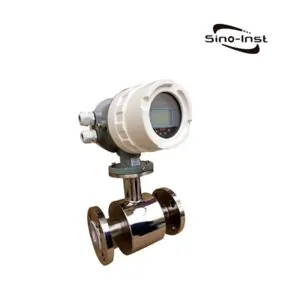
Stainless Steel Magnetic Flow Meter
DN150, PN16 flanged, ±0.5% accuracy. Conductive liquids, wastewater, clean & raw water.
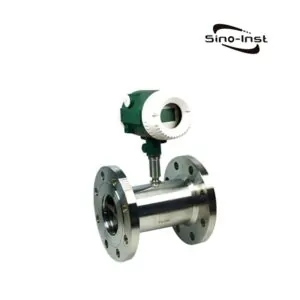
Liquid Turbine Flow Meter
DN150 clean liquid duty, ±0.5%, pulse & 4-20 mA. Diesel, jet fuel, DI water.
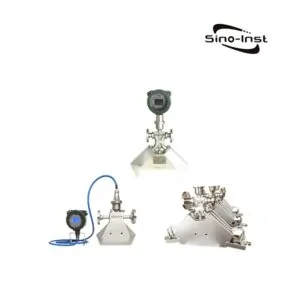
T-Series Coriolis Mass Flow Meter
±0.1% mass flow + density, DN150 variants. Custody transfer, chemical batching.
FAQ
What is the maximum flow rate of a 6-inch flow meter?
For liquids, a 6-inch (DN150) flow meter handles up to ~600 m³/h at a 10 m/s velocity cap. For steam at 10 bar, the upper range is around 2,500 kg/h. The practical limit is usually imposed by pressure drop or meter wear rather than the sensor itself.
How much does a 6″ flow meter cost?
Entry-level DN150 electromagnetic and vortex meters start in the low thousands USD. Coriolis jumps to five figures at this size because of the tube geometry and mass. Price swings with wetted material (316L vs Hastelloy vs PTFE lining) as much as with the technology itself.
Can I use an ultrasonic clamp-on on a 6″ pipe?
Yes. At DN150 a single-path V-mode ultrasonic clamp-on reads ±1-2% on clean liquid. For higher accuracy or on thick-walled steel pipes, specify a dual-path Z-mode transducer pair and calibrate against a portable reference meter after installation.
Is a 6-inch flow meter the same as DN150?
Yes, for most flow-meter specifications 6″ NPS and DN150 are interchangeable. The flange dimensions differ slightly between ANSI B16.5 (6″ class 150) and EN 1092 (DN150 PN16), so confirm the flange standard your piping uses before ordering.
Do I need straight pipe before a 6″ flow meter?
Yes. Most DN150 meters require 5-15 pipe diameters (5D-15D = 0.75-2.25 m) of straight pipe upstream and 3-5D downstream. Electromagnetic is the most tolerant (5D/3D); vortex after two elbows is the most demanding (15D/5D). A flow conditioner halves these requirements where space is tight.
Can a 6″ flow meter measure bidirectional flow?
Electromagnetic, Coriolis, and transit-time ultrasonic support bidirectional reading out of the box. Turbine and vortex are unidirectional at DN150 — reverse flow either gives zero or damages the sensor. Confirm bidirectional capability in the datasheet before specifying.
Request a DN150 Quote
Need help matching a 6-inch flow meter to your fluid, velocity, and accuracy target? Send the line size, fluid, nominal/peak flow, and ambient/process temperature. Our engineers will reply within one business day with a shortlist and indicative pricing.
Request a Quote

Wu Peng, born in 1980, is a highly respected and accomplished male engineer with extensive experience in the field of automation. With over 20 years of industry experience, Wu has made significant contributions to both academia and engineering projects.
Throughout his career, Wu Peng has participated in numerous national and international engineering projects. Some of his most notable projects include the development of an intelligent control system for oil refineries, the design of a cutting-edge distributed control system for petrochemical plants, and the optimization of control algorithms for natural gas pipelines.