
Updated May 30, 2026
A furnace thermocouple problem is almost always one of three things: the sensor itself, the compensating cable or its polarity, or the cold junction. You can pin down which one in under 20 minutes with a multimeter — before you ever decide whether to replace the element or change the grade. This guide gives you the field triage first, then the selection logic for picking the right thermocouple type for your furnace atmosphere and temperature. It is written for industrial process, heat-treatment, and kiln furnaces; if you are chasing a dead pilot light on a residential gas furnace, that part is a single-purpose flame-sensing thermocouple and the fix is normally a like-for-like replacement, not a grade decision.
Contents
- How do you know if a furnace thermocouple is bad?
- Type K vs N vs S vs B: which thermocouple for which furnace?
- Why is my furnace thermocouple reading low?
- How to test a furnace thermocouple with a multimeter
- Compensating cable and the reversed-polarity trap
- Protection sheath and placement inside the furnace
- Related thermocouple products
- Frequently asked questions
How do you know if a furnace thermocouple is bad?
Run a three-symptom triage before you condemn the sensor. A genuinely failed thermocouple shows one of three signatures: a reading pinned at full-scale or wildly erratic (open circuit), a reading stuck near ambient or close to zero millivolts (short circuit), or a stable but wrong reading that drifts slowly over weeks (sensor aging, contamination, or a cold-junction problem). The first two are sensor or wiring faults you can confirm in minutes. The third is the one that fools people, because the instrument still “works” — it just lies.
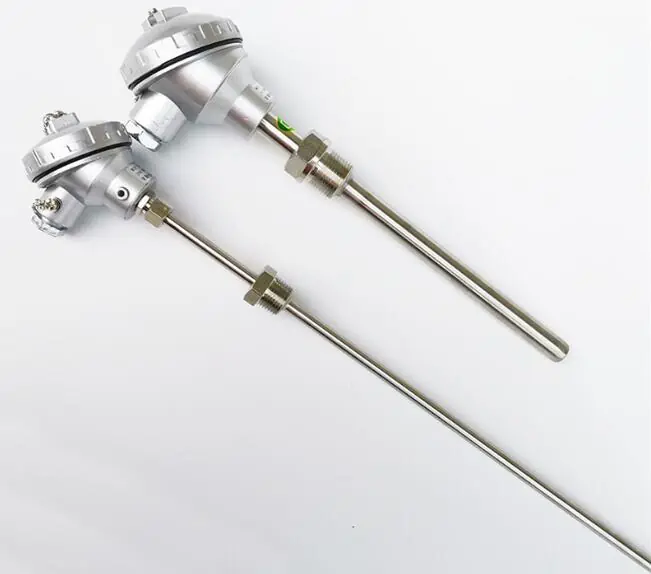
Start at the head, not the controller. Disconnect the extension wire at the thermocouple terminal and measure the millivolt output directly across the element with a multimeter on its DC mV range. Compare that reading against the reference table for the grade you have (a Type K thermocouple chart gives you the mV-to-temperature values). If the head reads correctly but the control room reads low, the fault is downstream — in the cable, the cold junction, or the transmitter — not in the thermocouple.
Type K vs N vs S vs B: which thermocouple for which furnace?
Pick the grade by furnace atmosphere and upper temperature, not by what is cheapest on the shelf. Base-metal types (K, N) cover most furnaces below 1260°C; noble-metal types (S, R, B) are for high-temperature and oxidizing duty above that. The trap is atmosphere: a Type K that is perfect in clean air drifts badly in reducing, sulfurous, or alternating atmospheres — the failure mode known as “K-state” short-range ordering.
| Type | Upper limit (continuous) | Best atmosphere | Watch out for |
|---|---|---|---|
| K (NiCr-NiAl) | ~1260°C | Oxidizing, inert | Reducing/sulfur drift; K-state ordering |
| N (Nicrosil-Nisil) | ~1260°C | Oxidizing, cycling | More stable than K; better for thermal cycling |
| S / R (Pt-Rh) | ~1480°C | Oxidizing, inert | Metal-vapor contamination; needs clean ceramic sheath |
| B (Pt-30Rh / Pt-6Rh) | ~1700°C | Oxidizing | Unreliable below ~50°C; not for low temps |
Tolerances follow IEC 60584-1, where Class 1 is tighter than Class 2 — specify the class your process actually needs rather than defaulting. If your furnace cycles hard, Type N resists drift better than K. For sustained high-temperature work, step up to the noble-metal grades; our guide to the standard platinum-rhodium thermocouple covers the S, R, and B distinctions, and for the extreme end there is the tungsten-rhenium thermocouple for vacuum and inert furnaces past 2000°C.
Why is my furnace thermocouple reading low?
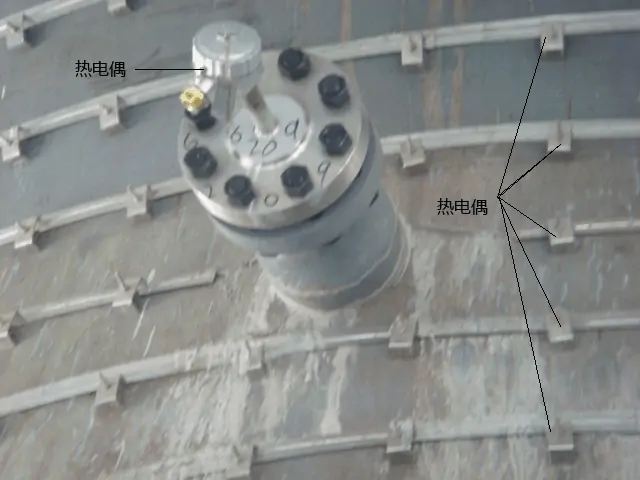
A reading that is low but stable is usually the wiring or the cold junction, not the element. The single most common cause we see in the field is the wrong extension wire: someone replaced a run of compensating cable with ordinary copper wire. Copper does not reproduce the thermocouple’s voltage-temperature curve, so a new thermal junction forms at the splice and the controller reads tens of degrees low. On one annealing furnace, a reading 30 to 50°C below true was traced to exactly this — plain copper instead of Type K compensating cable. Swapping in the correct compensating cable brought it back to zero error.
Work through the low-reading causes in order: extension cable type and polarity first, then cold-junction (reference) compensation in the transmitter or controller, then sheath degradation, and only last the element itself. This order matters because the cable and cold junction are the cheapest to fix and the most likely to be wrong after a maintenance change.
How to test a furnace thermocouple with a multimeter
Yes, a multimeter is enough to confirm an open or short circuit and to sanity-check the output. Set the meter to DC millivolts and measure across the two thermocouple legs at the head with the furnace hot. Three outcomes tell the story:
- Over-range or jumping millivolts — open circuit. The element or a connection has broken.
- Near zero millivolts with a hot furnace — short circuit, often a sheath-to-element short or a pinched cable.
- A sensible millivolt value — convert it with the reference table for your grade and compare to the controller. A gap points downstream to the cold junction or transmitter, which you can cross-check with our temperature converter and 4-20mA output calculator.
A resistance check on a cold element can hint at continuity, but it will not validate calibration — millivolt-against-reference is the meaningful test. If you are weighing the sensor against a resistance device (an RTD) for a rebuild, our RTD vs thermocouple comparison covers where each wins on temperature range and accuracy, and you can browse grades on our thermocouple temperature sensors page.
Compensating cable and the reversed-polarity trap
Reversed polarity is the error that produces a reading that moves the wrong way or sits oddly low, and it is easy to make because thermocouple wire colors vary by standard. A fast field check on Type K: the negative leg (NiAl) is magnetic and the positive leg (NiCr) is only weakly magnetic — a small magnet identifies the legs when the color code is ambiguous. Always carry the polarity through every junction; a single reversed splice in a long compensating run flips the sign of that segment’s contribution.
Use compensating or extension cable that matches the thermocouple grade, keep it away from power cabling to avoid induced noise, and confirm the terminal block and any connectors are the matching alloy. For the K-type details and color codes, see our K-type temperature sensor reference.
Protection sheath and placement inside the furnace
The sheath decides how long the element survives and how fast it responds. Metal sheaths (Inconel, stainless) suit base-metal types in most furnaces; noble-metal elements need a clean ceramic protection tube to keep metal vapors off the platinum, which otherwise contaminates and drifts the junction. Place the tip in the working zone the temperature actually controls — not in a stagnant corner or hard against the wall, where it reads radiant wall temperature instead of process temperature. Insert far enough that conduction down the sheath does not cool the junction. When a noble-metal reading drifts despite a good cable and cold junction, suspect sheath degradation or vapor contamination before the element.
Related thermocouple products

Thermocouple Temperature Sensors
K, N, S, R, B grades with metal or ceramic sheaths for furnace, kiln, and process duty. IEC 60584 Class 1 or 2 tolerance, head or transmitter output.
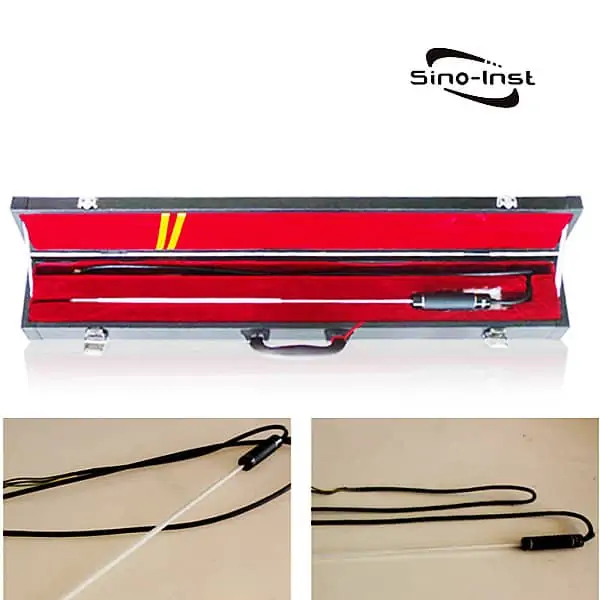
Platinum-Rhodium Thermocouple
Type S, R, and B noble-metal elements for oxidizing furnaces to 1700°C. Ceramic protection tube to resist metal-vapor contamination and drift.
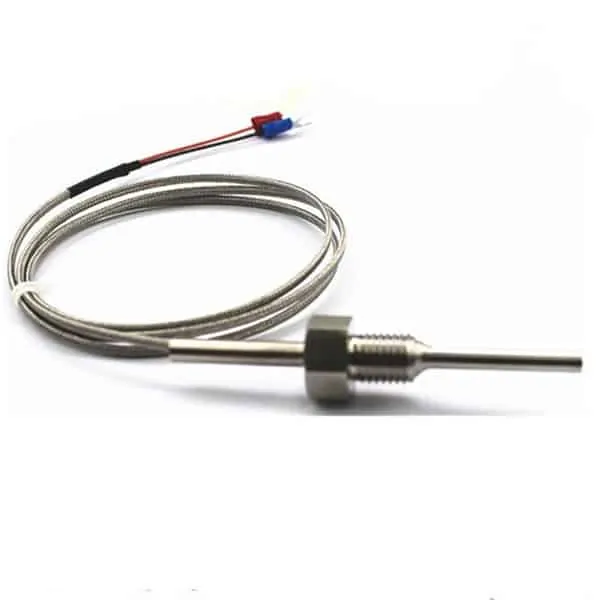
K-Type Armored Thermocouple
Flexible mineral-insulated K-type to 1260°C for furnaces that cycle. Fast response, bendable sheath, matching compensating cable available.
Frequently asked questions
How do I know if my furnace thermocouple is bad?
Measure the millivolt output at the head with a multimeter. An over-range or jumping value is an open circuit; a near-zero value with a hot furnace is a short; a stable but wrong value points to the cable, cold junction, or sheath rather than the element.
What is the difference between a K and N type thermocouple?
Both reach about 1260°C, but Type N (Nicrosil-Nisil) resists oxidation and thermal-cycling drift better than Type K, making it the more stable choice for furnaces that cycle frequently.
Why is my furnace thermocouple reading low?
The usual cause is the wrong extension wire — ordinary copper instead of matching compensating cable — or a cold-junction compensation error. Check cable type and polarity first, then the transmitter, before suspecting the element.
Can you test a thermocouple with a multimeter?
Yes. Use the DC millivolt range across the two legs and compare the value to the reference table for your grade. The multimeter confirms open and short circuits and lets you sanity-check the reading against the controller.
How do I check thermocouple polarity?
On Type K, the negative (NiAl) leg is magnetic and the positive (NiCr) leg is only weakly magnetic, so a small magnet identifies the legs when colors are unclear. Carry the correct polarity through every junction in the run.
Which thermocouple is best above 1500°C?
Use a Type B platinum-rhodium element (to about 1700°C) in oxidizing furnaces, or a tungsten-rhenium element for vacuum and inert atmospheres past 2000°C. Both need the right protection tube to avoid contamination.
Is an industrial furnace thermocouple the same as a residential gas furnace thermocouple?
No. A residential gas furnace uses a single fixed flame-sensing thermocouple as a safety device, replaced like-for-like. An industrial process or heat-treatment furnace measures temperature for control, so you choose the grade (K, N, S, R, B), sheath, and compensating cable to match the atmosphere and upper temperature — that selection is what this guide covers.
About this article
Written and technically reviewed by the Sino-Inst engineering team — last reviewed 2026-05-30 (AI-assisted drafting). Based on IEC 60584-1 thermocouple tolerance classes and field experience with industrial furnace temperature loops. Questions? reach our application engineers.
Get help selecting a furnace thermocouple
Tell us your furnace temperature, atmosphere, and mounting, and our engineers will recommend the grade, sheath, and cable. Request a quote below.
Request a Quote

Wu Peng, born in 1980, is a highly respected and accomplished male engineer with extensive experience in the field of automation. With over 20 years of industry experience, Wu has made significant contributions to both academia and engineering projects.
Throughout his career, Wu Peng has participated in numerous national and international engineering projects. Some of his most notable projects include the development of an intelligent control system for oil refineries, the design of a cutting-edge distributed control system for petrochemical plants, and the optimization of control algorithms for natural gas pipelines.