
Updated: April 15, 2026
An inline water flow meter measures water flow while installed directly in the pipeline — no bypass, no strap-on sensors. Three technologies dominate this space: mechanical (turbine), electromagnetic, and ultrasonic. The right choice depends on pipe size, water quality, required accuracy, and whether you need digital output for building automation or SCADA.
This guide compares the three technologies with real specs and prices, walks through sizing and installation, and gives a straight answer to the question most buyers ask first: which type do I actually need?
Contents
- What Is an Inline Water Flow Meter?
- What Are the 3 Main Types of Inline Water Flow Meters?
- Mechanical vs Electromagnetic vs Ultrasonic: Which Is Best?
- How Do You Size an Inline Water Flow Meter?
- How Do You Install an Inline Water Flow Meter?
- How Much Does an Inline Water Flow Meter Cost?
- Featured Inline Water Flow Meters
- FAQ
What Is an Inline Water Flow Meter?
An inline water flow meter is a flow-measuring device cut directly into the pipe so all water passes through the sensing element. This differs from clamp-on (strap-on) meters, which sit outside the pipe, and from insertion meters, which measure a small cross-section through a tap.
Inline designs give the highest accuracy — typically ±0.5% to ±2% of reading — because every drop of water touches the sensor. The trade-off is pressure drop and the need to shut down the line for installation.
You’ll find inline meters in residential sub-metering, HVAC chilled water loops, irrigation systems, cooling towers, and light industrial water treatment. For a deeper look at hot water metering specifically, see our hot water flow meters guide.
What Are the 3 Main Types of Inline Water Flow Meters?
Mechanical, electromagnetic, and ultrasonic — these three cover more than 90% of installed inline water meters worldwide.
Mechanical (Turbine and Multi-Jet)
A mechanical meter uses a rotor or impeller that spins as water flows past. Rotations are converted to volume through a register or pulse output. Multi-jet meters dominate residential service (¾” and 1″), while turbine meters cover industrial sizes up to 12″.
Accuracy is typically ±1.5% to ±2%. They work on clean water only — sand, scale, and fibers wear the bearings. Expected service life is 10–15 years for residential units and shorter under heavy industrial use.
Electromagnetic (Magmeter)
A magmeter generates a magnetic field across the pipe. Conductive water moving through the field induces a voltage proportional to flow velocity (Faraday’s law). No moving parts, no pressure drop, and accuracy of ±0.2% to ±0.5%.
Magmeters need water with conductivity above 5 µS/cm — fine for tap water, process water, and wastewater; not suitable for deionized water. For full specs and models, see our magnetic flow meter guide.
Inline Ultrasonic (Transit-Time)
Inline ultrasonic meters fire sound pulses upstream and downstream between two transducers. The time difference is proportional to flow velocity. No moving parts, no pressure drop, accuracy ±1% to ±2%.
They handle clean water and most process water, but air bubbles and heavy solids degrade signal. Increasingly popular for residential district metering because they have no mechanical wear and run on a battery for 10+ years.
Mechanical vs Electromagnetic vs Ultrasonic: Which Is Best?
There’s no single winner. Match the technology to the water and the job.
| Parameter | Mechanical | Electromagnetic | Ultrasonic |
|---|---|---|---|
| Accuracy | ±1.5% – ±2% | ±0.2% – ±0.5% | ±1% – ±2% |
| Pressure Drop | Medium–High | None | None |
| Moving Parts | Yes | No | No |
| Water Quality | Clean only | Any conductive | Clean, low bubbles |
| Pipe Size Range | ½” – 12″ | ½” – 120″ | ½” – 48″ |
| Turndown | 10:1 – 50:1 | 100:1 – 1000:1 | 100:1 |
| Power | None (register) or 9V | AC or 24VDC | Battery 10+ yrs or DC |
| Typical Price (DN50) | $150 – $400 | $600 – $1,500 | $500 – $1,200 |
| Service Life | 10–15 years | 20+ years | 15+ years |
Pick mechanical for residential billing and low-cost sub-metering. Pick electromagnetic when you need high accuracy, wide turndown, or zero pressure drop on cooling loops and process water. Pick ultrasonic for battery-powered district metering and retrofits where you can’t run power.
How Do You Size an Inline Water Flow Meter?
Size the meter to the flow rate, not to the pipe. The common mistake is to match meter size to pipe diameter — this oversizes the meter and kills accuracy at normal flow.
Aim for flow velocity between 0.5 and 3 m/s (1.6–10 ft/s) through the meter. Outside this window, mechanical meters lose accuracy at the low end, and all types see excessive wear or cavitation at the high end.
- Find your normal operating flow rate (not peak).
- Compute required pipe area: A = Q / v, using v = 2 m/s as target.
- Pick the meter size whose nominal rating covers your normal flow in the middle of its range.
- If your pipe is larger than the meter, use eccentric reducers and the upstream and downstream straight pipe rule (10D upstream, 5D downstream).
How Do You Install an Inline Water Flow Meter?
Proper installation is the difference between ±0.5% and ±5% accuracy. Four rules cover 95% of field installations:
- Straight pipe runs. Provide 10× diameter upstream and 5× diameter downstream, free of elbows, valves, and reducers.
- Full pipe. Electromagnetic and ultrasonic meters need 100% liquid. Install on a vertical rising section or a well-flooded horizontal section.
- Flow direction. Match the arrow on the meter body to flow direction. Reverse installation voids warranty on most mechanical meters.
- Isolation. Put shutoff valves on both sides and a strainer (20–40 mesh) upstream of mechanical and small ultrasonic meters.
A common field error is installing the meter right after a pump or control valve. Turbulence from these devices skews the flow profile for 20+ pipe diameters downstream and produces readings that can be off by 5–10%.
How Much Does an Inline Water Flow Meter Cost?
Prices scale with pipe size, technology, and output. For a DN50 (2″) water line, expect these ranges from a direct manufacturer:
- Mechanical multi-jet with pulse output: $150–$400
- Inline ultrasonic, battery-powered: $500–$1,200
- Electromagnetic with 4–20 mA + Modbus: $600–$1,500
- Sanitary tri-clamp electromagnetic: $900–$2,000
Jumping to DN100 (4″) roughly doubles these. DN200+ pricing varies heavily by lining and electrode material — contact our engineers for a quote on anything above DN150.
Featured Inline Water Flow Meters
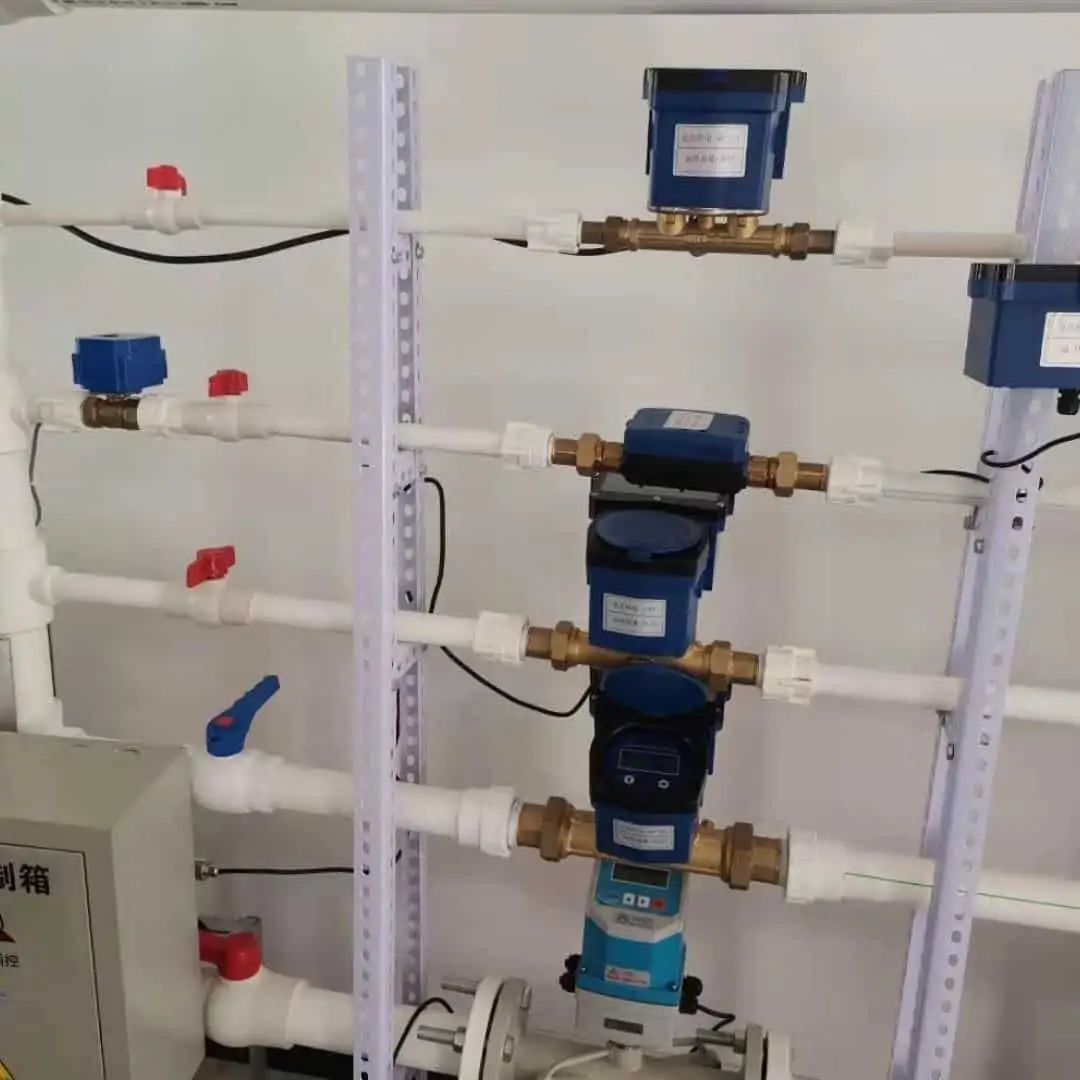
Inline Ultrasonic Water Flow Meter
In-line transit-time ultrasonic flow meter with pre-calibrated pipe spool. Wetted-transducer design delivers higher accuracy than clamp-on whenever a line shutdown is acceptable.
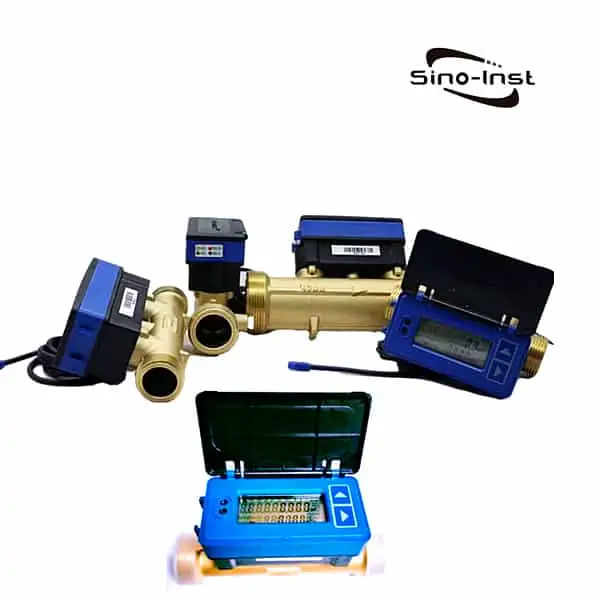
Residential Ultrasonic Water Meter
Insertion ultrasonic water flow meter for DN100-DN3000 mains. Hot-tap installation means no pipe cutting and no shutdown — ideal for water utilities, irrigation and cooling loops.
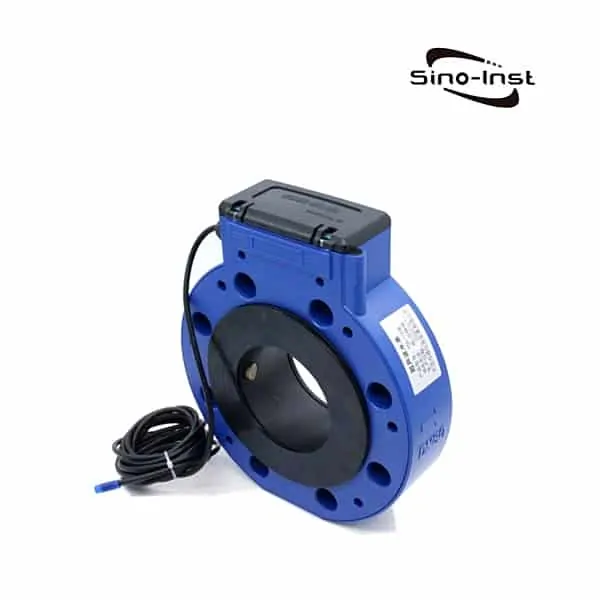
Electromagnetic Water Flow Meter
Electromagnetic water flow meter for drinking water, sewage, seawater and cement slurry. IP68 sensor for buried mains, optional MID / OIML R49 compliance for custody transfer billing.
FAQ
What does “inline” mean on a flow meter?
Inline means the meter is installed directly in the pipeline — water flows through the sensor body. Clamp-on and insertion meters are the two non-inline alternatives.
Can I install an inline water flow meter in any orientation?
Horizontal is preferred for most types. Vertical rising flow is also acceptable and helps keep the meter full. Avoid horizontal-downward orientations, which trap air at the sensor.
What’s the most accurate inline water flow meter?
Electromagnetic meters, at ±0.2% to ±0.5% of reading, are the most accurate for any conductive water. Coriolis meters are more accurate still but cost 3–5× more and are overkill for water service.
Do inline water flow meters need straight pipe?
Yes. All three types require at least 10 pipe diameters upstream and 5 downstream, free of fittings. Some electromagnetic models tolerate 5D/3D, but you pay a small accuracy penalty.
How often does an inline water meter need calibration?
For custody-transfer use, calibrate annually. For process monitoring, every 3–5 years is typical. See our flow meter calibration guide for procedures.
Can an inline water flow meter work on hot water?
Yes. Electromagnetic meters handle up to 180°C with proper lining (PFA or PTFE). Ultrasonic models go to 150°C. Mechanical multi-jets are usually rated 30–90°C — always check the data sheet.
Still unsure which inline water flow meter fits your line? Send us your pipe size, flow range, water type, and required output — our engineers will reply within 24 hours with a specific recommendation and a quote.
Request a Quote

Wu Peng, born in 1980, is a highly respected and accomplished male engineer with extensive experience in the field of automation. With over 20 years of industry experience, Wu has made significant contributions to both academia and engineering projects.
Throughout his career, Wu Peng has participated in numerous national and international engineering projects. Some of his most notable projects include the development of an intelligent control system for oil refineries, the design of a cutting-edge distributed control system for petrochemical plants, and the optimization of control algorithms for natural gas pipelines.