
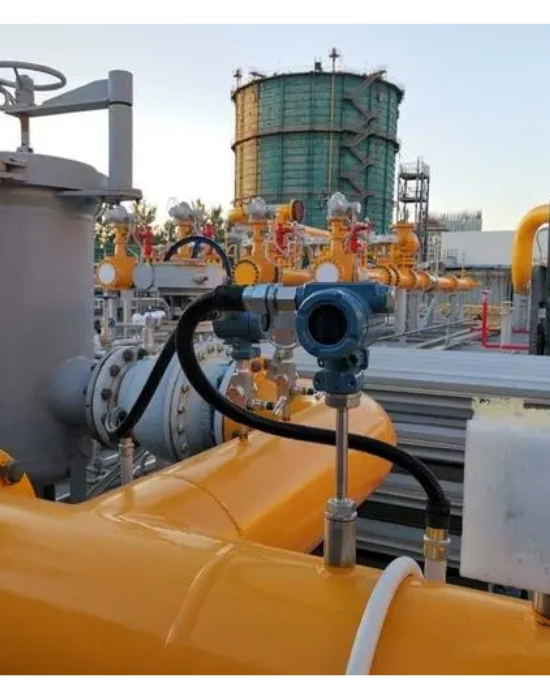
Updated May 21, 2026 — A pressure transmitter is only as accurate as its installation. Mount it on the wrong elevation, route impulse tubing without a proper slope, or skip the root valve and you will chase phantom readings for the life of the loop. This guide walks through tap location, mechanical mounting, impulse lines, manifold hookup, 4-20 mA wiring, and final loop checkout — with the numbers and IEC 62828-2 references field crews actually need.
The transmitter port reads static pressure; if your application also needs dynamic head from a Pitot or DP element, the relationship and Bernoulli formula are covered in our static vs dynamic pressure note.
Contents
- Site Survey: Tap Location and Mounting Position
- Mechanical Mounting: Bracket, U-Bolt, and Direct-Mount
- Impulse Tubing Routing: Slope, Pots, and Bends
- Manifold Selection: 3-Valve vs 5-Valve Hookup Drawings
- Wiring a 4-20 mA Loop: 2-Wire, 4-Wire, and Shielding
- Tap Orientation by Service: Liquid, Gas, and Steam
- Commissioning and Loop Checkout
- Six Common Installation Mistakes
- Frequently Asked Questions
Site Survey: Tap Location and Mounting Position
Pick the tap before you pick the bracket. The tap point determines whether the transmitter sees a clean process signal or noise from cavitation, two-phase flow, or pulsation. Follow three rules during the walk-down:
- Keep the tap on a straight run. Stay at least 5 pipe diameters downstream of an elbow, valve, or reducer and 2 diameters upstream of the next disturbance. The same 10D upstream / 5D downstream rule applies to most inline instruments.
- Stay away from heat and vibration sources. Hot spots above 85 °C ambient drift the electronics; pump skids and reciprocating compressors crack diaphragms.
- Allow elevation difference for static head correction. If the transmitter sits below the tap on a liquid service, expect a static offset equal to ρgh. Calibrate the zero after installation, not before.
Mount the housing where a technician can read the local display from eye level without climbing. The default mounting height is 1.3 to 1.5 m above grade or a permanent platform. Leave 200 mm of clearance behind the terminal cover so the conduit can be opened without rotating the body.
Mechanical Mounting: Bracket, U-Bolt, and Direct-Mount
Three mounting styles cover almost every plant installation. Pick by support availability and pipe size.
| Mount style | Best for | Pipe size | Watch-outs |
|---|---|---|---|
| 2-inch pipe stand bracket (U-bolt) | General-purpose remote mount | DN50 vertical pipe | Use SS304 bracket on outdoor or marine sites |
| Panel/wall bracket | Indoor instrument rack | n/a | Vibration isolation pads if rack is on a skid |
| Direct (close-coupled) mount | Clean liquids, short process lines | Process taps with 1/2 NPT or G1/2 | Avoid on hot or vibrating lines |
Use stainless or galvanized hardware on outdoor installations. Carbon-steel U-bolts rust in six months on a coastal site and torque-loose under thermal cycling. Torque the process flange bolts in a star pattern to the value printed on the transmitter nameplate — most 1/2 NPT process connections target 40 to 60 N·m.
Impulse Tubing Routing: Slope, Pots, and Bends
The impulse line carries process pressure from the tap to the transmitter. Bad routing introduces lag, plugging, and frozen lines. Stick to the slope rule and condensate-pot sizing below.
- Slope at least 1:10 (about 100 mm per meter) along the entire run. Slope down toward the transmitter for liquid; slope up toward the transmitter for gas.
- Keep the line as short as practical. Lines longer than 15 m add measurable response lag — about 0.5 s per 10 m on a 1/2 inch tube with water service.
- Use a single material. 316L stainless tubing is standard for general process; PTFE-lined or Monel handles chlorides and acids.
- Install a condensate pot on steam. Size the pot to hold at least 100 mL of condensate at working pressure. Fill the pots and isolate before commissioning.

Always include a root valve at the tap. A failed transmitter you can isolate; a failed transmitter on a live tap means a unit shutdown. The root valve must match the line rating — Class 300 process gets Class 300 root, not Class 150.
Manifold Selection: 3-Valve vs 5-Valve Hookup Drawings
A manifold lets the technician zero, vent, and isolate the transmitter without disturbing the process. Two configurations cover almost every job.
- 3-valve manifold — two block valves plus one equalizing valve. Standard for differential pressure on clean liquid or steam where venting through the equalizer to atmosphere is acceptable.
- 5-valve manifold — adds two vent valves at each block. Use when the process is toxic, when the transmitter handles a calibration in place, or when the customer spec calls for ANSI/ISA-77.40 compliant hookup.
The zero procedure is the same: close both blocks, open the equalizer, vent through the drain plug, then zero the transmitter. Open the high-side block first when bringing the loop back online so the diaphragm sees positive pressure first. If you need a printable hookup drawing, see our DP transmitter hookup drawings page.
Wiring a 4-20 mA Loop: 2-Wire, 4-Wire, and Shielding
Most industrial transmitters are 2-wire, loop-powered. The same pair of conductors carries 24 V DC supply and the 4-20 mA signal. Three rules keep the loop clean:
- Watch the loop budget. Standard supply is 24 V DC. The transmitter needs at least 10.5 V at its terminals; the rest is loop resistance. With a 250 Ω HART resistor and 100 m of 1.0 mm² cable, you have about 8 V of headroom.
- Use shielded twisted-pair cable. Ground the shield at the DCS end only. Grounding both ends creates a ground loop that injects 50/60 Hz noise.
- Separate signal from power. Run 4-20 mA cables in a tray separate from VFD output cables, contactor lines, and welding circuits. Crosstalk on a poorly shielded run shows up as a 10-30 mA spike during motor start.
4-wire transmitters take a separate power feed and put the 4-20 mA signal on its own pair. They give more loop headroom and are common on radar, magnetic flow, and Coriolis. Wire the signal pair the same way as 2-wire: twisted, shielded, single-ended ground. For a full reference see our pressure transducer wiring diagram page. If the DCS input only accepts 0-10 V or 1-5 V, drop a precision 4-20 mA to voltage conversion resistor in series.
Tap Orientation by Service: Liquid, Gas, and Steam
Tap orientation around the pipe is the single biggest source of long-term reading error. The rule is to keep the tap line free of the wrong phase.
| Service | Tap clock position | Transmitter location | Reason |
|---|---|---|---|
| Liquid | 3 or 9 o’clock (horizontal) | Below the tap | Keeps gas out of the impulse line |
| Gas / dry air | 12 o’clock (top) | Above the tap, slope up | Keeps condensate out of the impulse line |
| Steam | 3 or 9 o’clock | Below the tap with condensate pots | Pots create stable water column ahead of the diaphragm |
For two-phase flow, install a stilling chamber or knockout drum upstream. The transmitter cannot recover phase data from a slug-flow signal. If you are still picking between a pressure gauge and a transmitter for this duty, see our pressure transmitter vs gauge comparison.
Commissioning and Loop Checkout
Once the mechanical and electrical work is done, run through this loop checkout sequence before signing off.
- Megger the cable. Disconnect the transmitter and measure conductor-to-shield resistance at 250 V DC. Anything below 100 MΩ is suspect insulation.
- Energize and verify supply. Confirm 24 V at the transmitter terminals with the loop wired but the process isolated.
- Inject a 4-20 mA simulator at the transmitter end and verify the DCS reads 0%, 50%, and 100% within ±0.2 mA.
- Open the root valve slowly. Watch the local display for unexpected spikes; if the reading jumps to scale and stays, look for a plugged tap or closed equalizer.
- Trim the zero. With process applied and the equalizer closed, zero against a known reference (deadweight tester or a calibrated pressure module). See our 5-step bench & HART calibration procedure for the full sequence.
- Sign the loop sheet. Record as-found and as-left readings per ISA-5.4 loop diagram conventions. Most plant audits cite missing as-left documentation as a finding.
IEC 62828-2:2017 codifies the test procedures for industrial pressure transmitters and references the loop-checkout sequence above. Reference the standard in your commissioning packet if the project is under EPC scope.
Six Common Installation Mistakes
- Tap on a 90° elbow. Turbulence error swamps the signal. Move at least 5D away.
- Forgetting the root valve. No way to isolate for calibration; every recal becomes a unit shutdown.
- Wrong slope direction. Slope down for liquid, up for gas. Reversed slope traps the wrong phase and shows up as 4-20 mA fault symptoms within days.
- Grounding the shield at both ends. Creates a 50/60 Hz ground loop and 1-2 mA noise on the signal.
- Skipping the condensate pot on steam. The diaphragm sees flashing steam directly and reads erratic until the pot is fitted.
- Calibrating zero before the static head is settled. Always zero with the process applied and lines vented.
Featured Pressure Transmitters
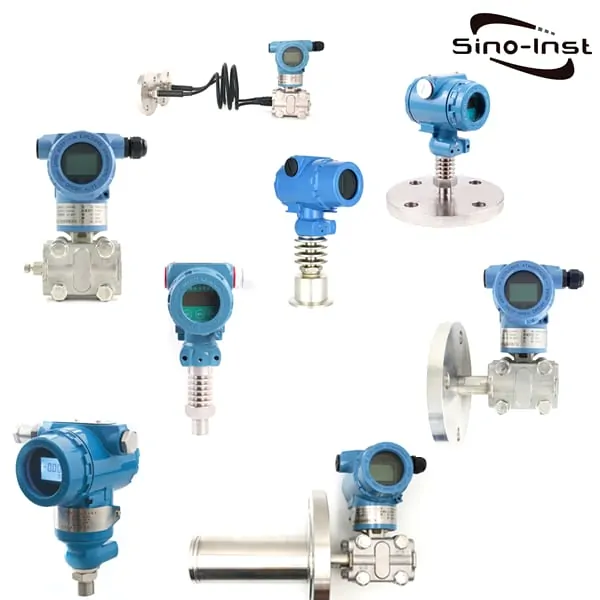
Industrial Process Pressure Transmitters
0-60 MPa range | ±0.075% accuracy | 4-20 mA HART — general-purpose process pressure measurement with IP65 housing.
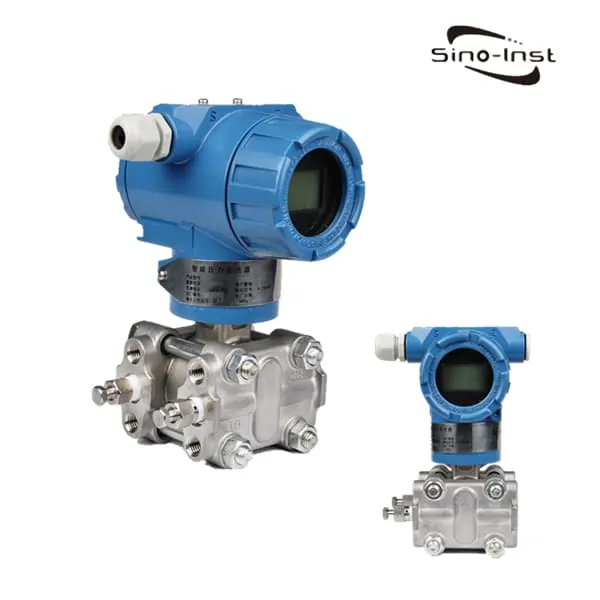
SMT3151DP Smart DP Transmitter
0-40 MPa span | ±0.05% accuracy | flow/level/DP service — 3-valve or 5-valve manifold ready.
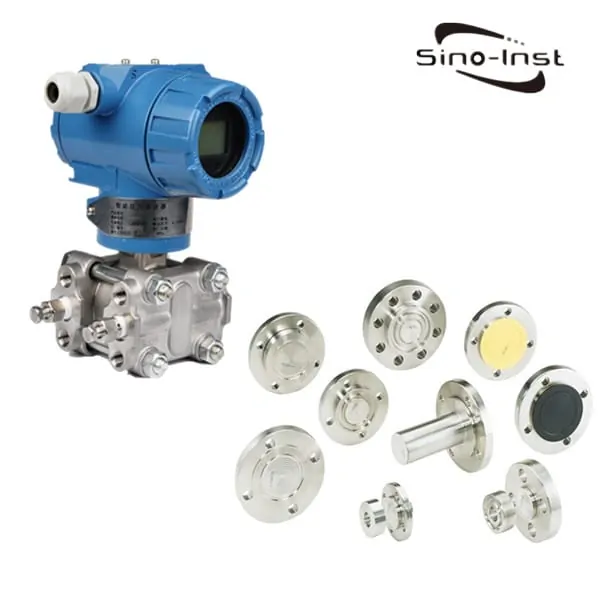
Diaphragm Seal Pressure Transmitters
For viscous, slurry, or high-temperature media. Remote seals with capillary up to 10 m, 316L wetted parts.
Frequently Asked Questions
How do you install a pressure transmitter?
Pick a tap at least 5 pipe diameters from any disturbance, mount the transmitter on a 2-inch pipe stand with a bracket, route impulse tubing with a 1:10 slope toward (liquid) or away from (gas) the transmitter, fit a 3-valve or 5-valve manifold, wire the loop with shielded twisted pair grounded only at the DCS, then run loop checkout and trim the zero with process applied.
How do you install a pressure transmitter on a liquid service?
Tap at the 3 or 9 o’clock position on a horizontal pipe so trapped gas vents back into the process. Mount the transmitter below the tap so liquid fills the impulse line and slope the tubing down at least 1:10 toward the transmitter. Verify there is no air pocket before zeroing.
What is the IEC standard for pressure transmitter installation?
IEC 62828-2:2017 covers test procedures and reference conditions for industrial-process pressure transmitters, including impulse line connection and loop checkout. ANSI/ISA-77.40 covers hookup drawings, and the ISA-5.4 standard specifies loop diagrams used during commissioning.
What is the correct wiring for a 4-20 mA pressure transmitter?
Use 2-wire loop power on most industrial transmitters: a single shielded twisted pair carries 24 V DC supply and the 4-20 mA signal. Ground the shield at the DCS end only. Confirm the transmitter has at least 10.5 V at its terminals after subtracting loop resistance — with a 250 Ω HART resistor and 1 mm² cable, that leaves about 8 V of headroom on 100 m of run.
Where should a pressure transmitter be mounted on a pipe?
Mount it at eye level on a 2-inch pipe stand, 1.3 to 1.5 m above grade, with 200 mm clearance to open the terminal cover. Keep it at least 5 pipe diameters from elbows or valves and out of direct sunlight, hot lines, and vibration sources.
Need help selecting the right pressure transmitter for your installation? Send us the line size, service, range, and accuracy and our engineers will come back with a recommendation and quote within one business day.
Request a Quote

Wu Peng, born in 1980, is a highly respected and accomplished male engineer with extensive experience in the field of automation. With over 20 years of industry experience, Wu has made significant contributions to both academia and engineering projects.
Throughout his career, Wu Peng has participated in numerous national and international engineering projects. Some of his most notable projects include the development of an intelligent control system for oil refineries, the design of a cutting-edge distributed control system for petrochemical plants, and the optimization of control algorithms for natural gas pipelines.