
Updated: April 16, 2026 | By Sino-Inst Engineering Team

Most tank level sensor guides start with the sensor — radar, ultrasonic, hydrostatic, capacitance — and tell you what each one does. That is the wrong way around. The fluid you are measuring eliminates more than half the sensor types before you even think about budget. This guide flips the lookup: pick your tank content first, and the right sensor narrows to one or two choices. Use it for new specifications or to second-guess an existing installation that keeps failing.
Contents
- Quick decision matrix: tank content to sensor
- Step 1: Define what’s in the tank
- Step 2: Continuous reading or point switch?
- Clean water and potable storage
- Fuel, diesel and lubricating oil
- Acids, caustics and corrosive chemicals
- Slurry, sludge and abrasive media
- Food, beverage and pharmaceutical
- Cryogenic and extreme temperature
- The common mistake: defaulting to ultrasonic
- Featured tank level sensors
- FAQ
Quick decision matrix: tank content to sensor
| Tank content | First-choice sensor | Backup choice | Avoid |
|---|---|---|---|
| Clean water (tower, cistern, well) | Submersible hydrostatic | Radar (80 GHz) | Capacitance |
| Diesel / fuel oil | Magnetostrictive | Servo gauge | Ultrasonic (vapor) |
| Strong acids / caustics | Guided wave radar (PFA-coated) | Bubbler / DP | Hydrostatic submersible |
| Slurry, sludge, mud | 80 GHz radar (non-contact) | DP transmitter with diaphragm seals | Float, capacitance |
| Foamy or stratified liquids | Guided wave radar | Magnetic level gauge | Ultrasonic, free-space radar |
| Hot oil / asphalt (>200°C) | Guided wave radar (HT probe) | Servo gauge | Submersible, capacitance |
| Food, beverage, pharma | Sanitary radar (3A / EHEDG) | Sanitary capacitance | Bubbler, contact float |
| LNG, LN2, cryogenic | Magnetostrictive (cryo seal) | Servo with float | Capacitance, hydrostatic |
| Solid powders / pellets | 80 GHz radar with dust shield | Guided wave radar | Ultrasonic, hydrostatic |
| Overflow / dry-run point only | Vibrating fork (tuning fork) | RF admittance, float switch | Continuous transmitter |
Step 1: Define what’s in the tank
“Liquid” is not a content category. Conductive vs non-conductive matters for capacitance probes. Dielectric constant matters for radar. Foam matters for ultrasonic. Vapor pressure matters for any non-contact tech. Before specifying anything, write down these six properties of your fluid:
- Density (kg/m³ at operating temperature)
- Dielectric constant εr (water = 80, hydrocarbons = 2-4, plastics = 1.5-3)
- Conductivity (water with salts = high, distilled water = low, oils = none)
- Viscosity at operating temperature
- Foam tendency (yes / no / sometimes)
- Vapor or condensate above the surface (steam, solvent vapor, etc.)
If you cannot get this from the SDS, ask the process engineer who designed the tank. Specifying a level sensor without these numbers is what produces the field calls we get six months later.
Step 2: Continuous reading or point switch?
Continuous transmitters give you a 4-20 mA reading anywhere in the tank’s range. Point switches just close a contact at one fixed level. They cost different orders of magnitude and they fail differently.
| Need | Use continuous | Use point switch |
|---|---|---|
| Inventory tracking | Yes | No |
| PID loop / blending control | Yes | No |
| Pump start / stop only | Optional | Yes (cheaper) |
| Overflow safety / dry-run cutout | No (use both) | Yes (SIL-rated) |
| Custody transfer | Yes (servo or magnetostrictive) | No |
| Budget under $200 | Rare (hydrostatic + display) | Yes (float, fork) |
For pump control, a continuous transmitter feeding the PLC plus an independent float switch as backup is a far more reliable arrangement than two transmitters in voting. The float switch covers the failure mode where the transmitter fails high or stuck. For pump-only switching, see our float switch wiring guide.
Clean water and potable storage
Submersible hydrostatic transmitters are the default. The probe sits at the tank bottom, measures the pressure of the water column above it, and outputs 4-20 mA proportional to depth. Accuracy is ±0.1% FS for quality units, the cable doubles as a vent (atmospheric reference), and there are no moving parts to wear out.
For potable water, choose a NSF/ANSI 61 certified probe. For elevated towers (over 15 m head), check the cable’s vent tube doesn’t sag and form condensate traps — a saturated vent tube reads erratically. The non-contact alternative is 80 GHz radar mounted on the top, which avoids any in-tank hardware but costs roughly 3x.
Fuel, diesel and lubricating oil
Magnetostrictive transmitters dominate this category because hydrocarbons have stable density, low foam, and the float-on-stem principle gives the ±1 mm accuracy that fuel inventory needs. The same probe can carry up to 8 RTDs for ATG (automatic tank gauging) compliance. For an underground or buried tank with restricted top access, the flexible-cable version of the same technology installs through a 2″ riser.
Avoid ultrasonic on diesel — vapor density above the liquid changes the speed of sound, which throws the level reading off by 1-3% as temperature swings. Use it only on water; on fuel it always disappoints in field service.
Acids, caustics and corrosive chemicals
Guided wave radar with a PFA or PTFE-coated probe is the safe specification for sulfuric acid, sodium hydroxide, hydrogen peroxide, and other aggressive chemicals. The radar pulse travels along the probe regardless of dielectric constant, vapor density, or foam. The PFA coating isolates everything but the probe end from the medium.
For storage tanks where in-tank hardware is forbidden by safety policy, fall back to a bubbler system (DP transmitter with a purge gas line). Bubblers are old technology but they are bulletproof on the most aggressive chemicals — nothing wetted is in contact with the tank except the dip tube.
Slurry, sludge and abrasive media
Anything in contact with mining slurry, raw sewage, paper pulp, or cement gets coated, eroded, or both. The default specification is non-contact 80 GHz radar mounted above the tank with a 6° narrow beam and a self-cleaning antenna. Build-up on the antenna is what kills slurry radars; the 80 GHz devices have small antenna footprints and air-purge ports for periodic cleaning.
If radar isn’t an option (sealed tank with no top opening), DP transmitters with remote diaphragm seals on the tank’s high and low pressure taps work — but every cleaning cycle becomes a maintenance event. Avoid floats and capacitance in slurry; both will be disabled within a month.
Food, beverage and pharmaceutical
3A and EHEDG certifications are non-negotiable. Sanitary radar is the dominant choice — flush-mount on a tri-clamp connection, no crevices for product to harbor in, full CIP/SIP cleanability. For low-cost agitated tanks, sanitary capacitance probes work for water-based products but struggle when fat content varies (changing dielectric).
Avoid bubblers (purge gas in product is unacceptable) and avoid contact floats (cleaning impossible).
Cryogenic and extreme temperature
Below -40°C and above 200°C is where most general-purpose level sensors quietly drift out of spec. Magnetostrictive transmitters with cryogenic seal extensions work down to liquid nitrogen temperatures. For LNG bullets, a servo gauge with a stainless float is the API standard.
For molten sulfur, asphalt, and hot oil up to 400°C, guided wave radar with a high-temperature antenna assembly is the only practical continuous solution. Hydrostatic submersibles are not rated; capacitance probes drift severely with temperature. For more on hot-tank installation specifics, see our high-temperature radar level guide.
The common mistake: defaulting to ultrasonic
Ultrasonic level transmitters are cheap, non-contact, and look like a universal solution. They are not. Ultrasonics measure the time-of-flight of a sound pulse to the liquid surface and back. Anything that disrupts the air column between the sensor and the surface throws the reading off.
- Vapor: any solvent vapor, condensing steam, or even rapid temperature gradients change the speed of sound by several percent.
- Foam: the pulse reflects off foam, not the actual liquid surface.
- Dust or fog: attenuates the signal until it reads “lost echo.”
- Stratified temperature: outdoor tanks in summer have a cool layer near the liquid and hot air at the top — a refraction lens that bends the pulse.
Ultrasonics are appropriate for clean water in open atmospheric tanks at stable temperatures. That is a small slice of real applications. When in doubt, switch to 80 GHz radar — same non-contact installation, immune to all the conditions above, costs about 1.5x.
Featured tank level sensors
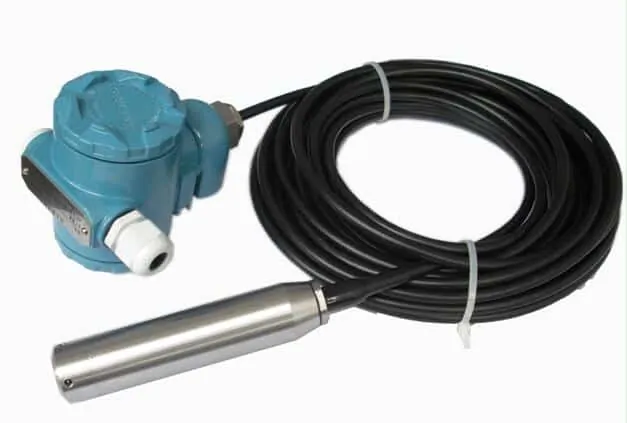
Submersible Hydrostatic (Water)
SMT3151TR submersible hydrostatic level transmitter with 316L stainless probe. Drops straight into wells, reservoirs and storage tanks — 4-20mA output for continuous level monitoring.
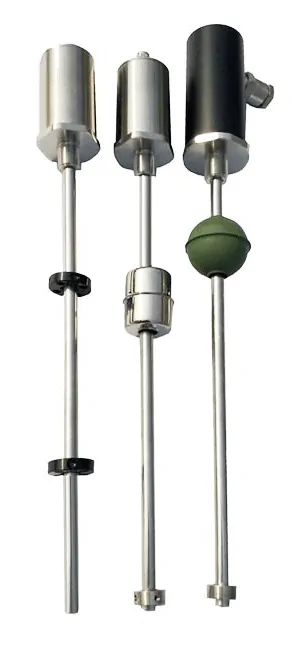
Magnetostrictive (Fuel)
Magnetostrictive level transmitter with ±1 mm resolution for high-accuracy tank gauging. Preferred choice on fuel depots, API terminals and chemical inventory measurement.
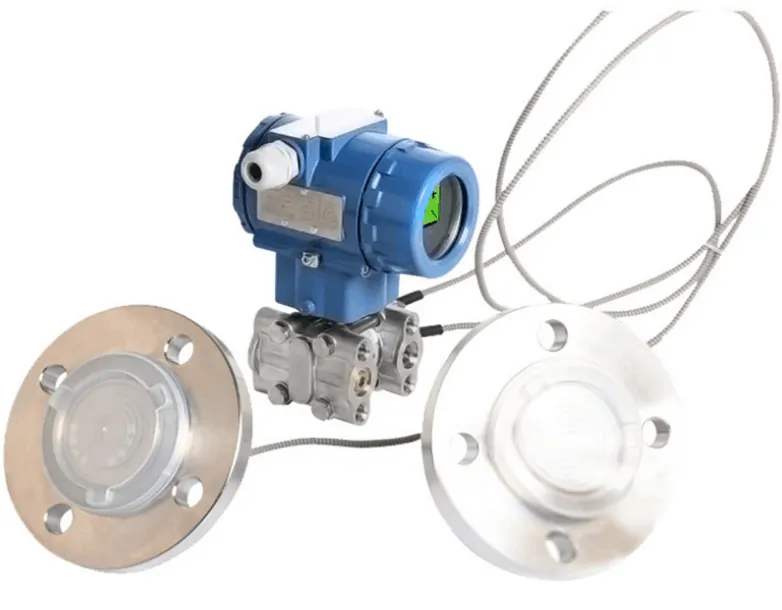
DP Transmitter (Chemical)
DP transmitters measure pressure difference across gas, liquid or steam. 4-20mA / 0-5V output drives liquid level, density and flow loops across process plants.
FAQ
What is the most accurate tank level sensor?
Magnetostrictive transmitters reach ±0.1 mm in custody-transfer configurations, the highest of any commercial tank level technology. Servo gauges (Honeywell Enraf, Endress+Hauser Proservo) match this for tall storage tanks. Hydrostatic and radar are typically ±2-5 mm at best.
What is the cheapest reliable tank level sensor?
For continuous reading on water, a basic submersible hydrostatic transmitter runs $150-300 and works for 5+ years with no maintenance. For point-only level switching, a cable-tilt float switch is under $40. Don’t pay more for fancier tech if your application doesn’t need it.
Can one sensor replace multiple float switches?
Yes. A continuous transmitter feeding a PLC can derive any number of virtual setpoints in software — high-high alarm, high pump-stop, low pump-start, low-low cutoff — from one 4-20 mA reading. The trade-off is single point of failure; most safety systems still keep one independent float switch as a backup.
Do I need radar or ultrasonic for an outdoor tank?
Radar. Ultrasonic readings drift in summer when the air column above the liquid stratifies into hot upper / cool lower zones, and they fail outright in heavy rain or fog. 80 GHz radar is unaffected by atmospheric conditions.
How do I measure level in a tank with foam on top?
Guided wave radar — the radar pulse travels along a probe into the foam and reflects off the actual liquid surface below it. Free-space radar and ultrasonic both reflect off the foam itself and read incorrectly. The other option is a magnetic level gauge with an external chamber: foam stays in the main tank, the chamber sees clean liquid.
What sensor works for solid material in tanks (powders, pellets)?
80 GHz radar with a dust-shielded antenna is the modern default. Guided wave radar with a single rope probe works for tanks under 30 m where the rope can swing freely. Avoid ultrasonic — solids have an irregular angle of repose that scatters the pulse.
How often should tank level sensors be calibrated?
Hydrostatic and DP transmitters drift slowly and benefit from annual zero/span verification. Magnetostrictive and servo gauges measure time-of-flight and don’t drift mechanically — every 2-3 years is usually enough. Radar gauges have no moving parts and need calibration only when something physically changes inside the tank (new internals, repositioned nozzle).
Need help specifying for your tank?
Send tank dimensions, fluid SDS, operating temperature/pressure, and any agitation or foam characteristics. We’ll spec a primary and a backup option, with an honest reason if the lowest-cost answer is the right one.
Request a Quote

Wu Peng, born in 1980, is a highly respected and accomplished male engineer with extensive experience in the field of automation. With over 20 years of industry experience, Wu has made significant contributions to both academia and engineering projects.
Throughout his career, Wu Peng has participated in numerous national and international engineering projects. Some of his most notable projects include the development of an intelligent control system for oil refineries, the design of a cutting-edge distributed control system for petrochemical plants, and the optimization of control algorithms for natural gas pipelines.