
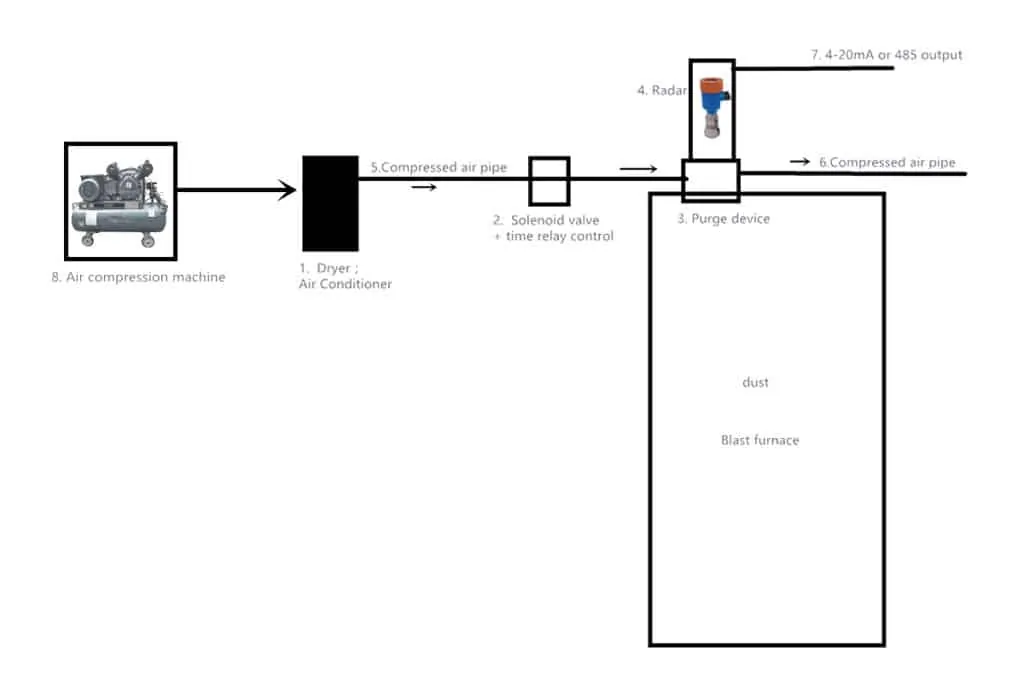
Blast furnace stockline measurement runs at 1200 °C inside, with dust, hydrogen-rich gas, and constant charging dynamics. Mechanical sounding rods and isotope sources have given way to 80 GHz FMCW radar as the standard since around 2018. This guide covers how the radar survives furnace conditions, what the purge system must deliver, and how to specify a unit for blast furnace, CDQ, BOF, and torpedo car service.
Contents
- Why Blast Furnace Level Is Hard to Measure
- Frequency Comparison: 80 GHz vs 120 GHz vs Lower Bands
- FMCW vs Pulse Radar in Furnace Service
- Mandatory Design Features for 1200 °C Service
- Purge Air and Air-Cooling Specifications
- Installation Geometry on Top of the Furnace
- Range, Accuracy, and Output Signals
- Related Products
- FAQ
Why Blast Furnace Level Is Hard to Measure
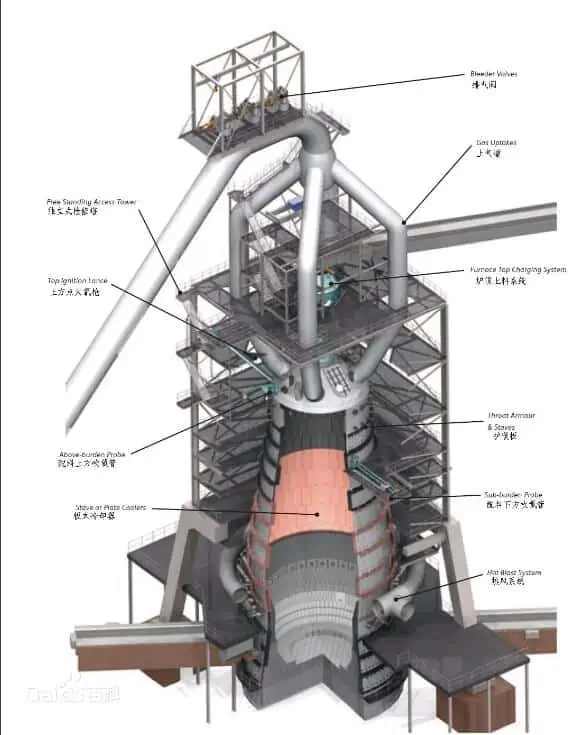
Three conditions defeat conventional level sensors. The throat sits at 200-400 °C continuous, with raw materials at 800-1200 °C below the burden line. Hot reducing gas (CO + H₂) flows upward at 5-15 m/s. And during charging, 50-100 t of coke and ore land in seconds, generating dust clouds that scatter ultrasonic and laser beams. A corrosive tank radar setup is mild by comparison — the blast furnace adds heat and impact load on top.
Radar at 80 GHz cuts through dust because the wavelength is 3.75 mm. Particle sizes that dominate in furnace dust (10-100 µm) are too small to scatter the beam significantly. Compared with 26 GHz radar (wavelength 11.5 mm), the 80 GHz beam stays focused and returns a clean echo from the burden surface.
Frequency Comparison: 80 GHz vs 120 GHz vs Lower Bands
| Frequency | Wavelength | Beam angle | Best use | Limitation |
|---|---|---|---|---|
| 6 GHz | 50 mm | 10-15° | Clean liquids, large tanks | Heavy dust scatter |
| 26 GHz | 11.5 mm | 6-8° | Bulk solids, moderate dust | Echo loss in heavy dust |
| 80 GHz | 3.75 mm | 3-4° | Blast furnace, CDQ, BOF | Higher unit cost |
| 120 GHz | 2.5 mm | 2-3° | Narrow openings, small silos | Limited model availability |
For a blast furnace throat 6-10 m wide with charging in progress, 80 GHz balances beam concentration with proven manufacturer support. 120 GHz wins only when the antenna must fire through a narrow nozzle smaller than 200 mm. Refer to the radar antenna selection guide for the matching antenna type.
FMCW vs Pulse Radar in Furnace Service
FMCW (Frequency Modulated Continuous Wave) transmits a chirp that sweeps 78-82 GHz over a few milliseconds. The return echo arrives shifted in frequency; that shift converts directly to distance. Pulse radar fires short bursts and times the round trip. For blast furnace use, FMCW dominates because the continuous chirp has lower peak power, longer averaging, and better signal-to-noise ratio against the dust background. Most modern 80 GHz blast furnace transmitters — Magnetrol Pulsar R80, Matsushima, Sino-Inst SIRD — are FMCW.
Mandatory Design Features for 1200 °C Service

- Ceramic or PTFE lens antenna with 250 °C continuous rating at the antenna face.
- Water- or air-cooled flange dropping the electronics housing to below 50 °C even when the process flange runs at 200-400 °C.
- Forced-air purge inlet at the antenna to prevent dust adhesion. Pressure 0.1-0.3 MPa, dewpoint ≤ -20 °C.
- Ball valve or knife valve isolation so the radar can be removed during planned shutdown without breaching furnace pressure.
- 4-20 mA HART or Modbus RTU output with secondary digital diagnostics for clogging detection.
- IEC 60079 (ATEX/IECEx) certification required where top-gas H₂ concentrations exceed flammability limits.
Match these features to the molten salt level service envelope — both applications share the high-temperature + flange-cooling architecture, only the dust profile differs.
Purge Air and Air-Cooling Specifications
The purge system is what keeps the antenna lens clean. Specify on the data sheet:
- Air pressure: 0.1-0.3 MPa at the radar inlet (regulated, not unregulated plant air).
- Flow rate: 5-15 Nm³/h continuous, with provision for periodic burst clearing at 30-50 Nm³/h.
- Dewpoint: ≤ -20 °C to prevent condensation when air contacts the cooler lens surface.
- Solenoid valve with time relay for cyclic purge during charging (e.g., 5 s burst every 30 s).
- Cooling air for housing: separate line, 0.05-0.1 MPa, sized to hold electronics < 50 °C ambient.
Plants that share instrument air with the purge typically learn after the first lens fouling event to dedicate a dry compressor and refrigerated dryer to radar service. The cost of a 100 L instrument-grade dryer is recovered the first time the radar avoids a manual cleaning trip.
Installation Geometry on Top of the Furnace
Modern bell-less top (BLT) charging systems present a 6-10 m diameter throat with a chute rotating during charging. The radar must mount off-axis to avoid the chute path but still cover the burden centroid. Best practice:
- Mount the antenna 1.5-3.0 m above the maximum stockline.
- Offset from center by 1.0-2.0 m to avoid charging chute interference.
- Tilt 2-3° toward the burden centroid; verify with the manufacturer beam plot.
- Use a parallel sounding rod for the first month to confirm radar reading vs mechanical reference.
On tank installations the geometry is simpler — on a blast furnace the BLT mechanics force this off-axis compromise.
Range, Accuracy, and Output Signals
| Application | Range | Accuracy | Output |
|---|---|---|---|
| Blast furnace stockline | 2-15 m | ±0.2% FS or ±5 mm (whichever greater) | 4-20 mA HART + Modbus |
| Torpedo car / BOF bath | 0.5-10 m | ±1 mm | 4-20 mA HART |
| CDQ (coke dry quench) | 2-25 m | ±0.2% FS | 4-20 mA HART |
| Raw material silo (top) | 2-30 m | ±0.2% FS | 4-20 mA HART |
The 4-20 mA HART output is the universal interface to DCS. For SCADA integration via Modbus, confirm the device supports RTU over RS-485 in addition to HART. Some plants prefer the redundancy of running both protocols in parallel; see SCADA / DCS architecture basics for how the two layers consume the same primary measurement differently.
Related Products

80 GHz Radar Level Transmitter
FMCW 80 GHz | Range 0.5-100 m | 3° beam | 4-20 mA HART — lens-antenna model rated for dust, steam, and furnace top conditions.
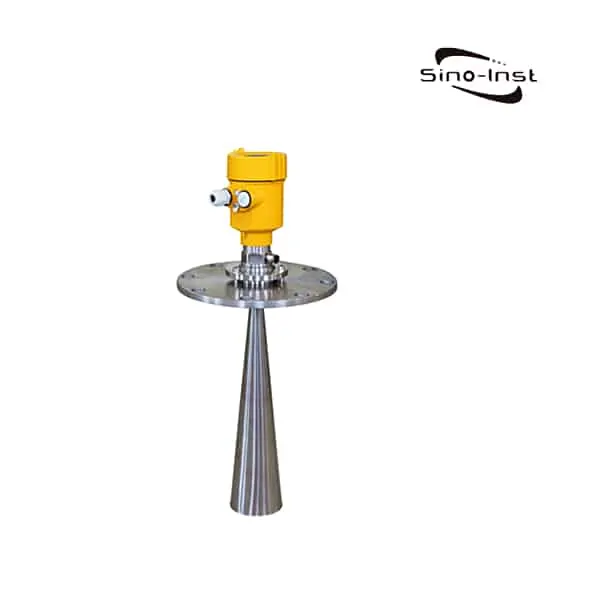
Radar Antenna Selection Guide
Horn, lens, rod, parabolic, drop antennas compared by tank diameter, dust load, and process temperature. Pick the right antenna for stockline service.
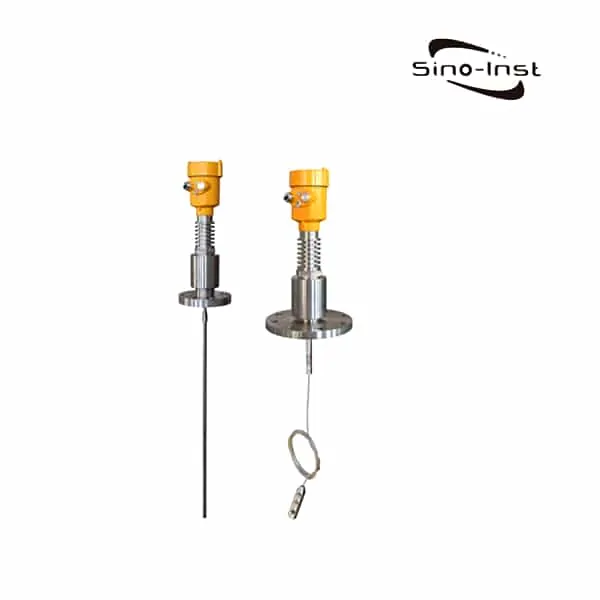
Guided-Wave Radar Calibration Guide
4-step bench calibration for high-pressure / high-temperature GWR probes. Use for hot-stove and CDQ install verification.
FAQ
What frequency radar works on a blast furnace?
80 GHz FMCW is the current standard for blast furnace stockline. The 3.75 mm wavelength cuts through furnace dust that scatters 26 GHz radar, and the 3° beam angle keeps the footprint contained on the BLT geometry. 120 GHz becomes attractive only for very narrow openings.
How is the radar protected from 1200 °C heat?
A high-temperature lens antenna (PTFE or ceramic) handles the throat temperature directly. The electronics housing sits on a cooled flange with continuous purge air, holding the housing below 50 °C even when the mounting flange reaches 250-400 °C.
What measurement range is typical for blast furnace radar?
2-15 m for stockline level on a typical mid-size blast furnace. Range extends to 25-30 m for CDQ and large raw material silos. Accuracy is ±0.2% of full scale, or ±5 mm at short range.
Does dust during charging cause measurement loss?
A properly purged 80 GHz radar tracks through charging dust. The FMCW chirp averages over the measurement window (typically 100-500 ms) and the digital signal processing rejects momentary echo loss. Burst purge timed to the charging cycle is the standard workaround.
Specifying a blast-furnace-rated radar for a new ironworks build or a hot-stove retrofit? Send the throat geometry, max stockline, and BLT type — our furnace instrumentation team replies with a sizing sheet within one business day.
Request a Quote

Wu Peng, born in 1980, is a highly respected and accomplished male engineer with extensive experience in the field of automation. With over 20 years of industry experience, Wu has made significant contributions to both academia and engineering projects.
Throughout his career, Wu Peng has participated in numerous national and international engineering projects. Some of his most notable projects include the development of an intelligent control system for oil refineries, the design of a cutting-edge distributed control system for petrochemical plants, and the optimization of control algorithms for natural gas pipelines.