
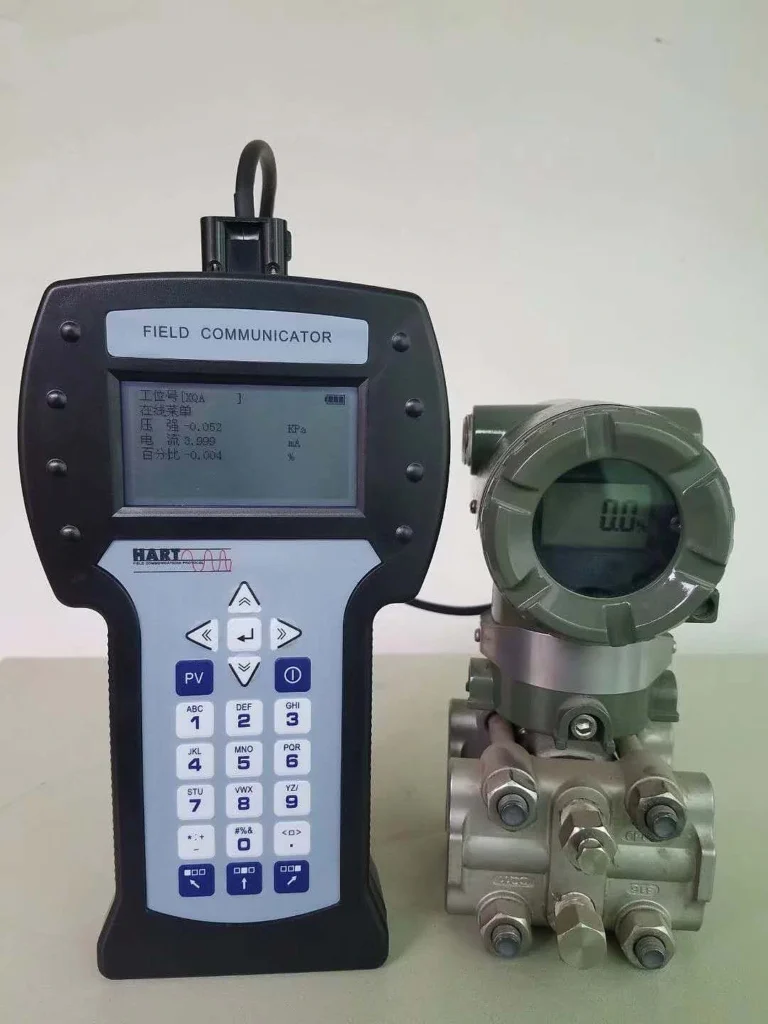
A differential pressure transmitter (DPT) measures the pressure drop across two points — across an orifice for flow, across a liquid column for level, or between two process taps for filter monitoring. Installation decides whether the published 0.075% accuracy survives in the field or drifts within a week. This guide gives the service-specific hook-up rule, concrete impulse-line slope and length numbers, manifold selection, and the post-mount zero/range procedure used by Sino-Inst commissioning engineers.
Contents
- Pre-Install Checklist for DP Transmitters
- Hook-Up by Service: Gas, Liquid, Steam, Level
- Impulse Line Routing Rules
- Manifold Selection: 3-Valve vs 5-Valve
- Zero & Range After Mounting
- Common Installation Mistakes
- Featured DP Transmitters from Sino-Inst
- FAQ
Pre-Install Checklist for DP Transmitters
Before the transmitter leaves the panel shop, three numbers should be locked down: the calibrated range (e.g. 0–250 inH₂O), the static line pressure rating, and the output type (4–20 mA HART, FF, Profibus PA). Range turndown beyond 10:1 erodes accuracy on most silicon DPTs; pick a sensor module sized closer to the working span, not the worst case. Confirm whether the service needs a wet leg or a dry leg — this drives whether you order remote-seal diaphragms or a standard process flange.
Field accessories that ship with a clean DPT installation: a process manifold (almost always required), a 2-inch pipe stand or wall bracket for direct mount, signal cable rated for the area classification, weather-tight conduit fittings, and seal/blow-down valves on each impulse leg. Pulling cable through a damp tray six weeks after pressure-testing is the most common avoidable callback. See our pressure transmitter installation guide for shared electrical practices that apply here too.
Hook-Up by Service: Gas, Liquid, Steam, Level
The single rule that decides DPT mounting position is: keep the impulse fluid in a known, stable phase. That single principle drives four very different installations. After installation, perform the 5-point calibration check before commissioning the loop.
| Service | Mount the transmitter | Tap location on the line | Why |
|---|---|---|---|
| Gas (flow / DP) | Above the process tap | Top of the pipe | Any condensate drains back to the line; the impulse legs stay full of gas at the same density |
| Clean liquid | Below the process tap | Side of the pipe (3 o’clock or 9 o’clock) | Trapped gas migrates up into the line, not into the legs; legs stay full of liquid |
| Steam | Below the tap, with condensate pots at the taps | Side of the pipe at each tap, with sealing pots installed at the same elevation | The pots fill with condensate and protect the transmitter diaphragm from live steam |
| Liquid level (open / closed tank) | At or below the lower tap (HP side) | HP on lower tank nozzle; LP on upper nozzle or vented to atmosphere | Hydrostatic head is measured directly; closed tanks need a wet or dry leg compensation |
For orifice plate flow, also enforce the upstream/downstream straight run before measurement. A DPT installed too close to an elbow reads correctly but the orifice no longer does. Our reference on flow meter straight pipe requirements lists the 10D upstream / 5D downstream rule and the exceptions by meter type. For broader sizing math, see our note on flow rate and pressure.
Impulse Line Routing Rules
Concrete numbers, not “slope properly”:
- Slope: 1:12 minimum (about 1 inch per foot, or 8 cm per meter) continuously toward either the transmitter (liquid service) or the process (gas service). No flat runs, no inverted U-bends.
- Maximum length: 50 ft (15 m). Longer runs drag dynamic response above 1 second and amplify temperature error on the legs.
- Both legs equal: within ±10% in length. Unequal legs introduce a temperature-driven zero shift you will chase forever.
- Inside diameter: 1/2 in (12 mm) for most services. Step up to 3/4 in for viscous liquids or long runs.
- Heat tracing & insulation: required when freezing, condensation, or viscosity change is possible. Trace both legs identically.
- Drain / vent valves: one drain at the low point of liquid legs, one vent at the high point of gas legs. Use these during commissioning, not just for maintenance.
If the line includes a known restriction or filter, the pressure drop in the pipe needs to be in the same range as the transmitter’s calibrated span; otherwise the signal saturates or under-resolves.
Manifold Selection: 3-Valve vs 5-Valve
The manifold is the single accessory that decides whether the field tech can safely zero a transmitter under process pressure. Three configurations are common:
- 3-valve manifold: two block valves (HP, LP) plus one equalize. Sufficient for non-hazardous, low-pressure services up to about ANSI 600. Equalize-isolate sequence: close HP block → open equalize → close LP block → vent → zero.
- 5-valve manifold: adds two vent/test ports. Required for high-static or hazardous service, and for any line where the transmitter will be re-zeroed live without draining. The extra ports let the tech bleed isolated air and verify the equalize seal before applying full DP.
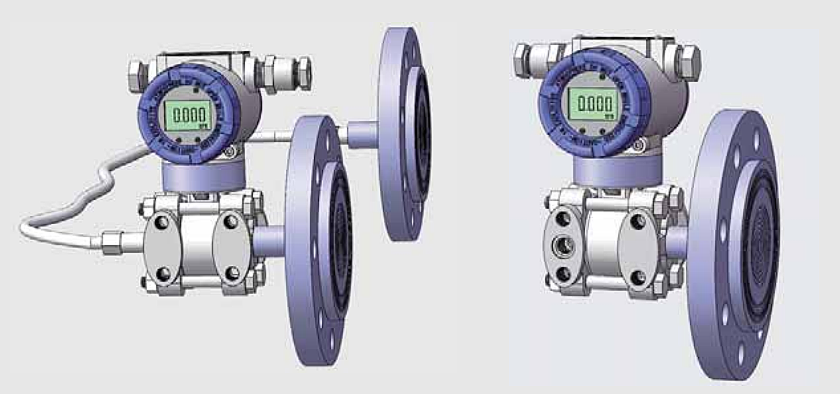
- Remote diaphragm seals: not a manifold but worth flagging here. On corrosive, hot, or viscous services, capillary-coupled seals replace impulse lines entirely. Order with matched capillary length and fill fluid suited to ambient swings.

Zero & Range After Mounting
Five steps, in this order, every time:
- Close both block valves. Open the equalize valve. The DPT now sees zero differential pressure regardless of static line pressure.
- Vent each side individually if the manifold has vent ports. Confirm legs are full of process fluid (liquid service) or process gas (gas service).
- Apply the zero command — locally via the push-button, or remotely via HART, FF, or Profibus.
- Close the equalize valve. Open the LP block, then the HP block. The transmitter is now live.
- Verify the 4–20 mA span with a pressure calibrator across at least three points (0%, 50%, 100% of range). Trim the output if needed via the digital communicator.
For closed-tank level service, apply the wet-leg correction at this stage. The LP leg holds a column of seal fluid (often glycol or silicone). The correction is ρ·g·h where ρ is the seal fluid density, g is 9.81 m/s², and h is the vertical distance between the LP tap and the transmitter. The HART or BRAIN command for “lower-range value” lets you bake the correction into the calibration without changing wiring. If you need a refresher on the wiring, the 4–20 mA loop conversion guide covers the receiving side.
Common Installation Mistakes
- Mixing HP and LP labels. Reverse polarity reads as a negative span. Verify with a manual squeeze test on each leg before energizing.
- Trapped air in liquid legs. Manifests as drift on every static line pressure change. Bleed thoroughly during commissioning; vent again after the first week.
- Condensate in gas legs. Common on saturated process gas. Slope toward the line, not the transmitter, and add a knock-out pot if the gas trips dew point seasonally.
- Capillaries exposed to direct sun. Temperature gradient across the two capillaries introduces a zero shift that tracks daylight. Sun-shield both capillaries identically.
- Mounting on a vibrating pipe. Bracket-mount to a structural support, not the pipe itself. Vibration above ~1 g RMS damages the silicon diaphragm bond over months. Our note on pressure transmitter vs gauge selection covers durability trade-offs.
- Ignoring static line pressure spec. A DPT calibrated for 250 inH₂O on a 1000 psi static line needs the static rating. Exceeding the static spec damages the sensor module silently. The static vs dynamic vs total pressure explainer shows where each value comes from.
Featured DP Transmitters from Sino-Inst
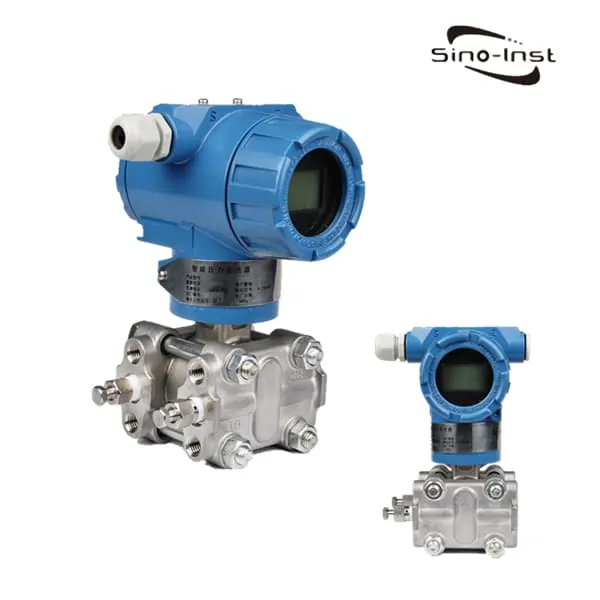
SMT3151DP Smart DP Transmitter
0.075% accuracy | 4–20 mA HART | up to 32 MPa static — single-crystal silicon sensor for flow, level, and filter DP service.
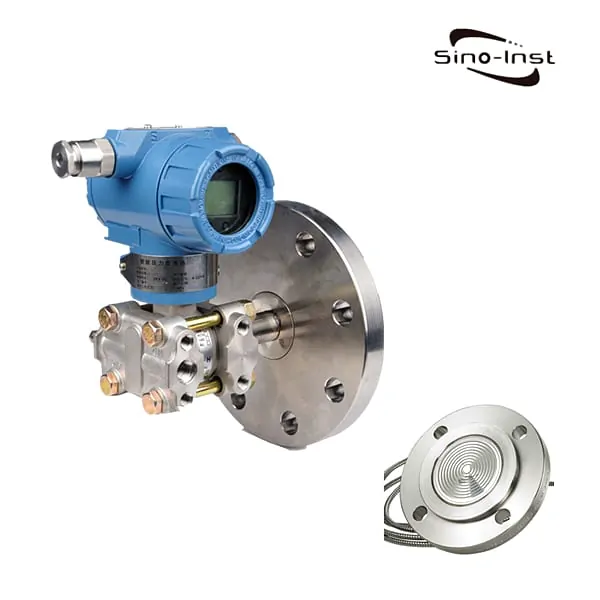
Flange-Mounted DP Transmitter
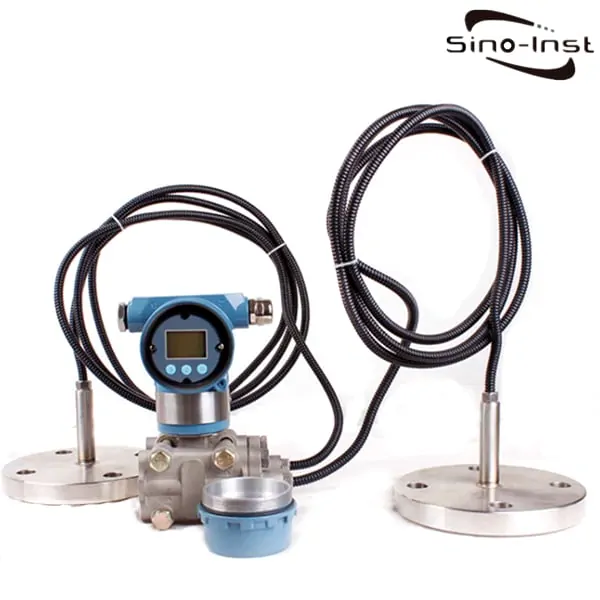
Direct flange mount with remote diaphragm seal option — eliminates impulse lines on hot, viscous, or corrosive process services.
SMT3151LT DP Level Transmitter
Hydrostatic level for open and closed tanks — built-in wet/dry-leg compensation, IP67 housing, ATEX/IECEx options.
FAQ
How do you install a differential pressure transmitter?
Mount the transmitter relative to the process per service (gas above, liquid below, steam below with condensate pots, level at or below the lower tap). Route both impulse legs at a minimum 1:12 slope toward the correct direction, install a 3- or 5-valve manifold, and finish with the equalize-zero-span sequence using a HART or 4–20 mA calibrator.
What is the difference between DPS and DPT?
A differential pressure switch (DPS) trips a discrete contact when DP crosses a set threshold. A differential pressure transmitter (DPT) outputs an analog or digital signal proportional to DP across the full range, so it feeds control loops and trending systems rather than only alarms.
Why install a DP transmitter above the tap point for gas?
On gas service, any condensate that forms in the impulse legs must drain back to the process line, not into the transmitter. Mounting above the taps, with the legs sloped downward toward the line, lets gravity remove condensate continuously and keeps both legs filled with gas at the same density.
What straight pipe is needed upstream and downstream of an orifice?
ISO 5167-2 lists upstream straight runs from roughly 5D to 44D depending on β ratio and the upstream fitting (single elbow, two elbows in different planes, reducer, valve). Downstream is generally 4D to 8D. A safe baseline on most plant configurations is 10D upstream and 5D downstream, with longer upstream runs after two elbows in different planes. See our straight pipe requirements table for the exceptions.
Need help sizing a DPT, picking between a 3-valve and 5-valve manifold, or specifying remote seals for a hot process line? Send your service conditions to our engineering team and we will quote a complete installed scope.
Request a Quote

Wu Peng, born in 1980, is a highly respected and accomplished male engineer with extensive experience in the field of automation. With over 20 years of industry experience, Wu has made significant contributions to both academia and engineering projects.
Throughout his career, Wu Peng has participated in numerous national and international engineering projects. Some of his most notable projects include the development of an intelligent control system for oil refineries, the design of a cutting-edge distributed control system for petrochemical plants, and the optimization of control algorithms for natural gas pipelines.