

A chilled water flow meter measures the flow rate of cooling fluid in an HVAC plant, district cooling loop, or industrial process chiller. The right meter type depends on pipe size, accuracy class, glycol content, and whether the reading feeds a BTU energy meter or a simple flow indicator. This guide gives the meter-type decision matrix by pipe size and accuracy, the glycol correction every chilled-water spec misses, a BTU calculation worked example, and the ASHRAE 90.1 sub-metering driver buyers should know about.
Contents
- Meter Types for Chilled Water
- Decision Matrix by Pipe Size and Accuracy
- Glycol Correction for Low-Temp Loops
- BTU Calculation Worked Example
- Install Constraints That Bite
- ASHRAE 90.1 and LEED Sub-Metering
- Recommended Chilled Water Flow Meters
- FAQ
Meter Types for Chilled Water
Five meter technologies handle chilled water reliably. Choice is driven by accuracy class, pipe size, fluid conductivity, and whether the install is new construction or retrofit.
- Electromagnetic (magmeter): obstructionless inline meter. Accuracy ±0.2% to ±0.5% of reading. Requires conductive fluid (water ≥ 5 µS/cm — chilled water always qualifies). Pipe size from DN15 to DN3000. Workhorse for new build.
- Clamp-on ultrasonic (transit-time): retrofit meter that bolts outside the pipe. Accuracy ±1% to ±2% of reading depending on installation. No process shutdown. Best when the chiller plant can’t be drained.
- Insertion ultrasonic / insertion turbine: single probe through a hot-tap valve. Lower cost than full-bore meters on large pipes (≥ DN150). Accuracy ±1% to ±2%.
- Vortex shedding: bluff body in the flow creates Karman vortices proportional to velocity. Accuracy ±0.75%. Loses accuracy below ~0.3 m/s velocity — sized carefully or it under-reads at low load.
- Turbine: mechanical rotor counts revolutions. Accuracy ±0.5%. Used in small lines (DN15 to DN50) for fan-coil branch metering.
The deep working-principle reference for the rotating-rotor family is in our flow transmitter vs flow meter note; for magmeter installation specifics see the magnetic flow meter installation guide.
Decision Matrix by Pipe Size and Accuracy
| Pipe size | Required accuracy | Best meter type | Typical price band (USD) |
|---|---|---|---|
| DN15 – DN50 | ±0.5% | Turbine or small magmeter | $300 – $1,200 |
| DN50 – DN150 | ±0.2% – 0.5% | Electromagnetic full-bore | $800 – $3,500 |
| DN150 – DN500 | ±0.5% | Electromagnetic full-bore or insertion ultrasonic | $2,500 – $8,000 |
| DN500 – DN3000 | ±1% – 2% | Insertion ultrasonic or clamp-on | $2,000 – $6,000 insertion / $1,500 – $4,000 clamp-on |
| Any size, retrofit | ±1% – 2% | Clamp-on ultrasonic | $1,500 – $4,000 |
The classic mistake is specifying a magmeter for a 600 mm chiller header. The meter works fine but the price is three times what an insertion ultrasonic delivers at the same accuracy class. Use the table above to short-list before requesting a quote. For a refresher on the underlying flow math see our flow rate and pressure reference.

Glycol Correction for Low-Temp Loops
Chilled water below 4 °C usually contains 20–50% propylene or ethylene glycol to prevent freezing in coils. Glycol raises density and viscosity enough to shift meter readings.
- Electromagnetic: velocity-based, so glycol has no effect on velocity reading. Mass flow needs density correction: ρ_glycol ranges 1,020–1,060 kg/m³ at 0 °C for 30% propylene glycol.
- Ultrasonic transit-time: sound velocity changes with glycol fraction. Programmable meters need the actual fluid table or measured sound speed; missing this introduces 2–5% error.
- Turbine: viscosity-sensitive. K-factor curves shift by 1–3% per 10% glycol. Use a fluid-calibrated K-factor or accept the error. Our flow meter K-factor reference shows how the calibration moves.
- Vortex: bluff body shedding frequency is fluid-density-corrected by most modern transmitters. Confirm the firmware handles propylene glycol specifically.
BTU Calculation Worked Example
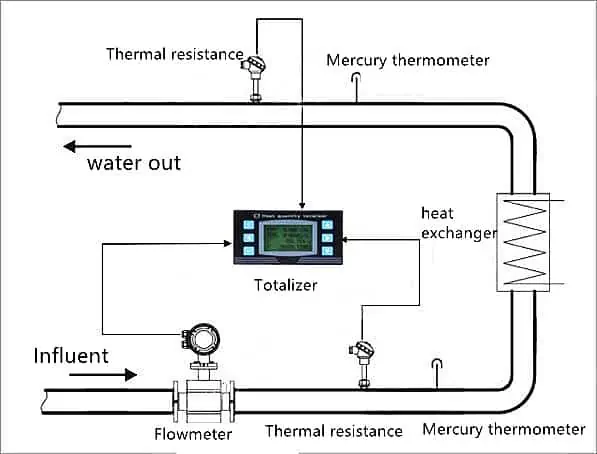
A chilled water BTU (or thermal energy) meter combines a flow meter with two RTD temperature probes (supply and return). The formula is:
Q = ṁ · cp · ΔT
Where ṁ is mass flow (kg/s), cp is fluid specific heat (4.187 kJ/kg·K for water, ~4.0 kJ/kg·K for 30% glycol), and ΔT is the supply–return temperature difference (K).
Worked example: a chiller supply at 7 °C and return at 13 °C on a 200 gpm (12.6 L/s) line. ṁ = 12.6 kg/s (treating chilled water density ≈ 1,000 kg/m³). Q = 12.6 × 4.187 × 6 = 316 kW = 89.9 ton-refrigeration = 1.08 million BTU/hr. Our what is a BTU meter explainer covers the RTD pairing and integration math; the BTU meter for chilled water page compares ultrasonic vs magnetic BTU meter platforms.
Install Constraints That Bite
- Straight pipe upstream: magmeter needs 5D upstream, 3D downstream; ultrasonic needs 10D/5D; vortex needs 15D/5D. See our straight pipe requirements for exceptions.
- Full pipe: all of these meters need the pipe completely full. Mount on the bottom of horizontal headers, never on the top.
- Air pockets: trapped air in chilled water systems is the single biggest accuracy killer for ultrasonic meters. Vent the high points before calibration.
- Cathodic protection on buried headers: magmeters need a grounding ring on each side or stray DC current corrupts the EMF signal.
- Cold-pipe condensation: chilled water lines sweat. Use IP68 sensor housings or junction boxes; PVC heat-shrink boots at cable entries on outdoor installs.
- Pipe wall thickness for clamp-on: measure the actual schedule before ordering — wall thickness within ±5% of the meter’s commissioning value or accuracy drifts by 1% per 10% wall error.
ASHRAE 90.1 and LEED Sub-Metering
ASHRAE 90.1-2019 Section 10.4 requires energy sub-metering on buildings over 25,000 ft² for HVAC systems. Chilled water plants over 500 ton typically need BTU sub-metering on each major branch. LEED v4.1 BD+C credit “Advanced Energy Metering” awards 1 point for permanent meters on chilled-water consumption greater than 10% of plant total. A specified accuracy of ±2% on the BTU meter (combined flow + temperature uncertainty) is the practical threshold for compliance reporting. Steam condensate flow metering follows similar rules on the heating side.
Recommended Chilled Water Flow Meters
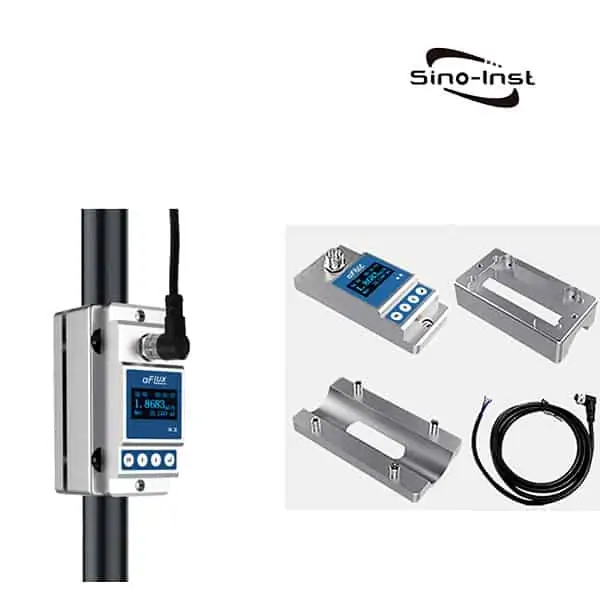
Strap-on Ultrasonic Flow Meter X3
Clamp-on ultrasonic | ±1% accuracy | DN25–DN6000 — no pipe shutdown, retrofit on operating chiller plants and district cooling loops.
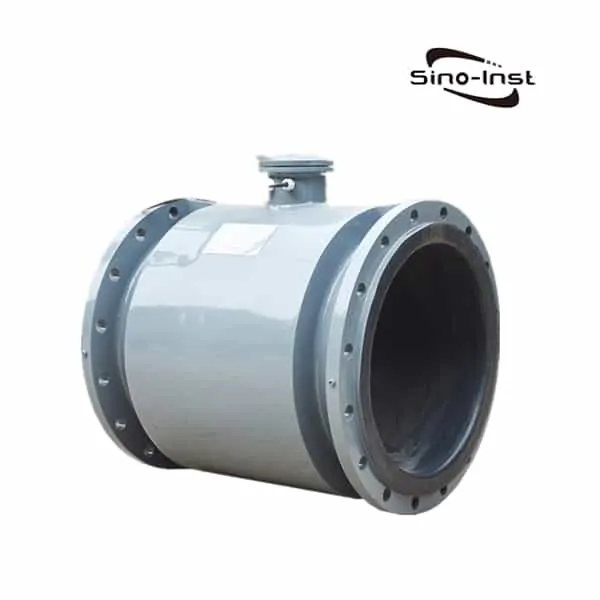
Large-Diameter Magnetic Flow Meter
±0.5% accuracy | DN150–DN3000 | flanged inline | low pressure drop — workhorse for new-build chilled water headers and pump suctions.
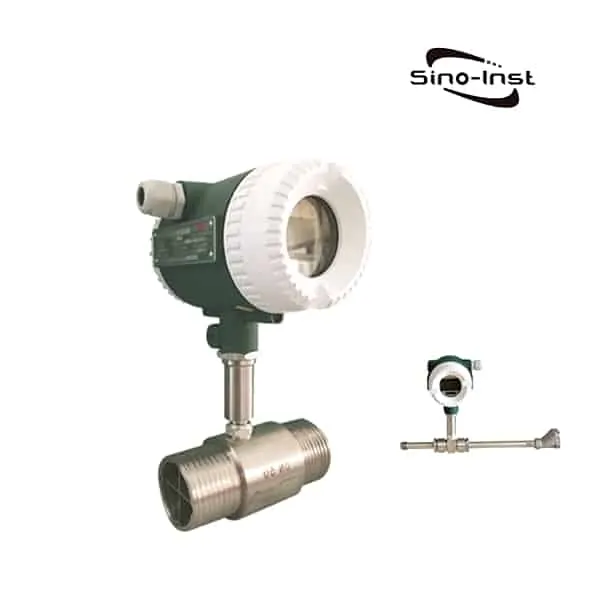
Turbine Pulse Flow Meter
±0.5% accuracy | DN15–DN50 | pulse + 4–20 mA — branch-line BTU sub-metering for fan coil units and tenant tap-offs.
FAQ
What is a flow meter in a chilled water system?
A device that measures the flow rate of chilled water moving through HVAC pipes. The reading is used to control pump speed, balance branch loads, calculate BTU energy consumption, or trigger fault alarms when flow drops below set thresholds. Common technologies are electromagnetic, ultrasonic clamp-on, vortex, and turbine.
How to check chilled water flow?
The fastest field check is a clamp-on ultrasonic meter borrowed from the commissioning kit — no pipe entry, reading in 10 minutes. Permanent monitoring needs an inline electromagnetic or insertion meter wired to the BMS. Compare the live reading against the design flow on the pump nameplate; deviations of more than ±10% indicate fouling, glycol creep, or valve issues.
What are the three main types of flow meters used for chilled water?
Electromagnetic (inline, conductive fluid, ±0.5%), ultrasonic clamp-on (retrofit, no shutdown, ±1–2%), and vortex (mid-range pipes, ±0.75%, density-corrected). Turbine handles small branches and insertion ultrasonic handles very large headers.
What is a BTU meter used for in a chilled water system?
A BTU meter combines a flow meter and two RTD temperature probes (supply and return) to compute thermal energy consumed, in BTU or kWh. Buildings use BTU meters for tenant billing, sub-metering compliance under ASHRAE 90.1 or LEED, and chiller plant performance monitoring.
Need help short-listing a meter for a specific chiller plant, district cooling header, or BTU billing site? Send the pipe size, accuracy target, glycol percentage, and number of branches to our engineering team for a sized quote.
Request a Quote

Wu Peng, born in 1980, is a highly respected and accomplished male engineer with extensive experience in the field of automation. With over 20 years of industry experience, Wu has made significant contributions to both academia and engineering projects.
Throughout his career, Wu Peng has participated in numerous national and international engineering projects. Some of his most notable projects include the development of an intelligent control system for oil refineries, the design of a cutting-edge distributed control system for petrochemical plants, and the optimization of control algorithms for natural gas pipelines.