
A magnetic flow meter (magmeter) measures conductive liquid by Faraday’s law: when fluid moves through a magnetic field generated by the meter’s coils, electrodes pick up a voltage proportional to velocity. The physics is unforgiving — an air bubble at the electrode, an unbonded grounding ring, or a swirling pipe upstream and the meter will lie to you. Most magmeter “drift” calls in the field turn out to be installation problems, not meter problems.
This guide walks the install end-to-end: required straight pipe, vertical vs horizontal mounting, flange bolt torque, grounding strategy, converter wiring, and the 10-item commissioning checklist we use on every Sino-Inst startup.
Contents
- Before You Start: What You Need
- Straight Pipe Run Requirements
- Vertical vs Horizontal Orientation
- Flange Bolt Torque and Tightening Sequence
- Grounding: Rings, Electrodes, and Earth Wire
- Converter Mounting and Field Wiring
- Pre-Commissioning Checklist (10 Items)
- Common Installation Mistakes
- Featured Magnetic Flow Meters from Sino-Inst
- FAQ
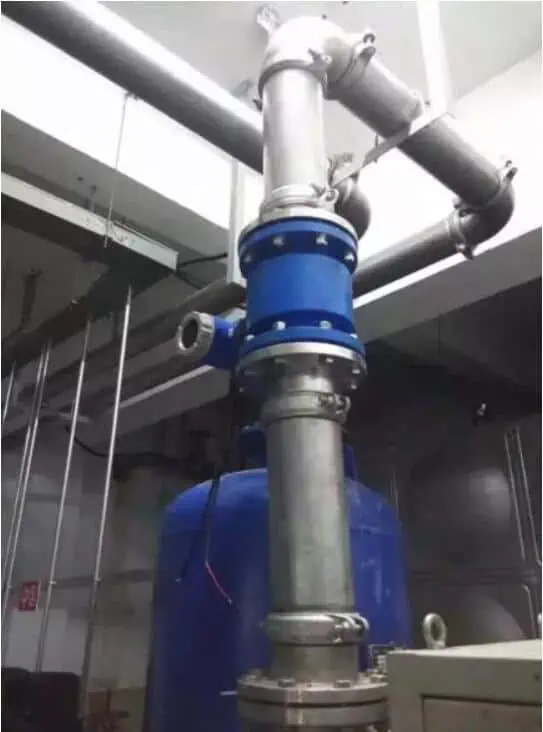
Before You Start: What You Need
- Meter, mating flanges, gaskets, and bolts sized to the flange standard (ASME B16.5 / EN 1092-1).
- Torque wrench (calibrated, suitable for the bolt size).
- Grounding rings or grounding electrodes, plus #10 AWG (6 mm²) copper bonding wire.
- Megger (insulation tester) for the post-install electrode-to-earth resistance check.
- 4-20 mA loop checker or HART communicator for converter commissioning.
- Confirm fluid conductivity > 5 μS/cm. Distilled water, hydrocarbons, and pure solvents do not work with magmeters.
Straight Pipe Run Requirements
Magmeters need a developed, axially symmetric velocity profile. Disturbances upstream — elbows, valves, pumps — distort that profile and shift the apparent flow rate. The accepted minima (ISO 6817 and the major OEM manuals):
| Upstream Disturbance | Straight Pipe Upstream | Straight Pipe Downstream |
|---|---|---|
| Single 90° elbow | 5D | 3D |
| Two 90° elbows (in plane) | 10D | 3D |
| Two 90° elbows (out of plane) | 15D | 5D |
| Reducer / expander | 5D | 3D |
| Half-open valve or pump | 20–30D | 5D |
D is the pipe inner diameter. If you cannot give 5D upstream, install a flow conditioner (a vaned plate or honeycomb) at the start of the straight run. We’ve seen claims that “modern magmeters don’t need straight run” — they do, just slightly less than turbines. Skipping straight run pulls the reading 2–6% off and there’s no software fix.
Vertical vs Horizontal Orientation
The first rule of magmeter mounting: the electrodes must always be wetted. The two measuring electrodes sit on opposite sides of the bore at the 3 o’clock and 9 o’clock positions when looking down the flow. Air at an electrode reads as zero conductivity and the meter goes blank.
- Vertical pipe, upward flow: Ideal. Pipe is always full, air rises away from electrodes, sediment passes through.
- Vertical pipe, downward flow: Acceptable only if the discharge point is below the meter so the pipe stays full. Otherwise the pipe drains and air sits at the electrodes.
- Horizontal pipe: Rotate the meter so the electrodes are at 3 and 9 o’clock, not 12 and 6. Air pockets gather at 12; sediment settles at 6. Both kill measurement at those clock positions.
- Avoid: mounting at the highest point of a pipeline, mounting immediately upstream of a free-discharge outlet, and mounting in a self-draining line.

Flange Bolt Torque and Tightening Sequence
Magmeter liners (PTFE, polyurethane, hard rubber, ceramic) crush easily. Over-torque and the liner deforms inward into the bore, distorting the magnetic field and changing the cross-section the fluid sees. Under-torque and the gasket leaks. Both ruin a $4,000 meter.
Always use the meter manufacturer’s torque table — values vary by liner, gasket, and flange class. As reference, typical Class 150 PTFE-lined meters call for these final torques:
| Nominal Size | Bolt Count | Final Torque (Class 150, PTFE) |
|---|---|---|
| DN50 (2″) | 4 | 30 N·m |
| DN80 (3″) | 4 | 50 N·m |
| DN100 (4″) | 8 | 50 N·m |
| DN150 (6″) | 8 | 75 N·m |
| DN200 (8″) | 8 | 100 N·m |
| DN300 (12″) | 12 | 150 N·m |
Tightening sequence: snug all bolts hand-tight, then tighten in a star pattern across the flange (opposite bolts in sequence — bolt 1, 5, 3, 7, 2, 6, 4, 8 on an 8-bolt flange). Apply 30% of the final torque on the first pass, 60% on the second, 100% on the third. Re-check after 24 hours; the gasket relaxes and torque drops 10–20%.
For background on bolting and gasket selection during pressure-instrument installs, see our DP transmitter installation guide.
Grounding: Rings, Electrodes, and Earth Wire
The magmeter measures microvolts. The flowing liquid carries stray currents — from VFDs, cathodic protection, or simple ground-loop voltages between pumps and tanks. Without solid grounding, those currents ride on top of the Faraday signal and the reading drifts or wanders.
- Conductive metal pipe both sides: Bond the meter housing to both upstream and downstream pipe with #10 AWG bonding wire (one strap per side, not a daisy chain). No grounding rings needed.
- Non-conductive pipe (PVC, FRP, lined steel): Install grounding rings between the meter flanges and the pipe flanges, both sides. Bond each ring to the meter housing with #10 AWG.
- Lined metal pipe with cathodic protection: Use grounding electrodes (a third electrode in the meter body) and connect to plant earth through the meter housing terminal. Do not bond the meter to the protected pipe.
- Final check: Measure resistance from meter ground terminal to plant earth with a megger. Target: < 1 Ω. Anything above 10 Ω will let stray currents corrupt the reading.
Converter Mounting and Field Wiring
Compact magmeters integrate the converter on the sensor body. Remote-mount magmeters separate them — converter on a stand, sensor in the pipe — connected by a shielded multi-conductor cable. Length limits run to 30–100 m depending on coil drive voltage; do not exceed the manufacturer spec or signal degrades.
- Mount the converter at eye level (~1.5 m), away from direct sun, vibration, and ambient above 60 °C.
- Bring the sensor-to-converter cable in its own conduit, never sharing with VFD or motor power leads.
- Use shielded twisted-pair cable — see our note on shielded twisted-pair cables for industrial instrumentation for the wiring details.
- Terminate the shield at the converter end only (single-point grounding) to prevent ground-loop currents.
- 4-20 mA output: load resistance < 600 Ω total in the loop. Use a 250 Ω resistor across the receiver input for HART communication. For analog conversion details, see our note on 4-20 mA to 0-10 V conversion.
Pre-Commissioning Checklist (10 Items)
- 1. Flow direction arrow on meter body matches actual flow.
- 2. Straight pipe minima met (see Section 3 table).
- 3. Electrodes at 3 and 9 o’clock if horizontal.
- 4. Bolt torque applied per manufacturer table, 3-pass star sequence.
- 5. Grounding strategy executed; megger reads < 1 Ω to earth.
- 6. Cable shield terminated at converter end only.
- 7. Pipe pressurized and verified full (open vent until liquid escapes).
- 8. Converter parameters set: meter size, K-factor, output scaling, damping (1–3 s typical).
- 9. 4-20 mA loop verified end-to-end with a known input via the meter’s simulation mode.
- 10. Zero check at no-flow with full pipe: reading should be within ±0.5% of full scale. If not, re-check grounding before calling support.
Common Installation Mistakes
- Installing horizontally with electrodes at 12/6 o’clock. Air or sediment kills the signal. Always rotate to 3/9.
- Skipping grounding rings in PVC piping. The meter reads but drifts unpredictably. There is no software fix.
- Sharing conduit with VFD output cable. The PWM noise couples into the electrode signal. Use separate conduits or 300 mm spacing.
- Over-torquing bolts to “make sure it doesn’t leak.” Crushes the liner, distorts the bore, voids the warranty.
- Mounting upstream of a regulating valve. Cavitation on the valve opening seeds bubbles that travel back through the meter.
For installation principles that apply to most flow meter families — including turbines and Coriolis — see our turbine flow meter installation guidelines and vertical flow meter installation do’s and don’ts by meter type.
Featured Magnetic Flow Meters from Sino-Inst
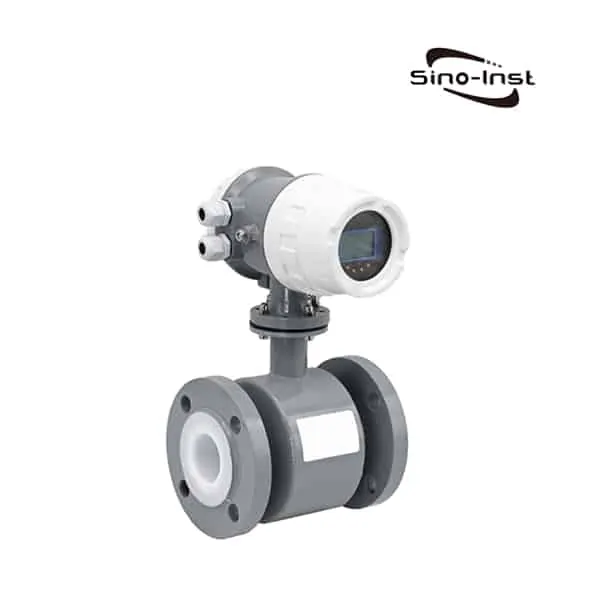
Industrial Magmeter Flow Meter
DN15 to DN3000 | ±0.5% accuracy | PTFE / rubber / polyurethane liners — water, wastewater, slurry, and acid lines.
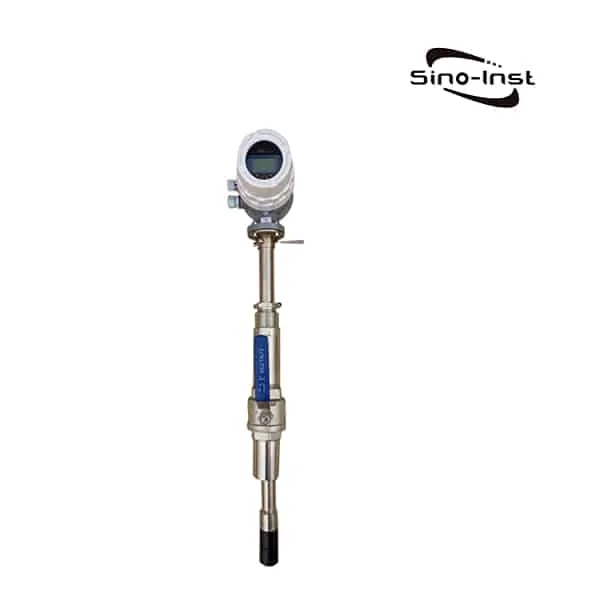
Insertion Magmeter SI-3121
Hot-tap insertion | DN80 to DN3000 | No process shutdown — for large pipes where a full-bore meter is impractical.
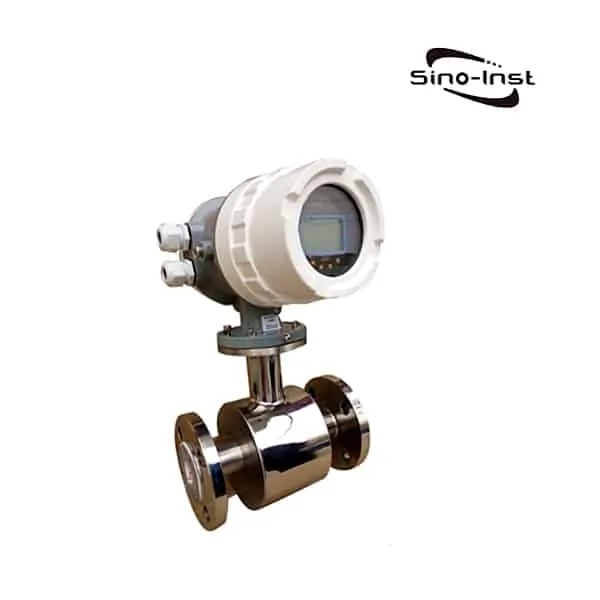
Stainless Steel Magmeter
SS304/SS316 body | Sanitary or industrial flange | CIP/SIP capable — food, beverage, pharma, and aggressive chemicals.
Send your pipe size, fluid, flow range, and process temperature/pressure to our engineers via the form below — we typically reply within one working day with a sized quote.
FAQ
How much straight pipe does a magnetic flow meter need?
For a single 90° elbow: 5 pipe diameters (5D) upstream and 3D downstream. Two elbows out-of-plane: 15D upstream. Valves and pumps: 20–30D upstream. Skipping straight run pulls accuracy 2–6% off, and no software fix exists.
Can a magnetic flow meter be installed vertically?
Yes — vertical with upward flow is the ideal mounting because the pipe stays full, air rises away from electrodes, and sediment passes through. Vertical with downward flow only works if the pipe stays full downstream of the meter.
Do I need grounding rings for a magnetic flow meter?
Grounding rings are required when the upstream or downstream pipe is non-conductive (PVC, FRP, lined steel) — one ring on each side. For continuous conductive metal pipe both sides, a simple bonding wire from meter housing to each pipe section is enough.
What is the minimum conductivity for a magnetic flow meter?
Most magmeters need 5 μS/cm minimum. A few high-impedance designs work down to 1 μS/cm. Magmeters do not work on hydrocarbons, distilled water, or non-polar solvents — use Coriolis or ultrasonic for those.
What flange bolt torque do I use on a magnetic flow meter?
Always follow the meter manufacturer’s torque table — values depend on liner material and gasket. As reference, Class 150 PTFE-lined meters call for 30 N·m at DN50 up to 150 N·m at DN300. Apply in three passes (30/60/100%) using a star pattern, then re-check after 24 hours.
Can I install a magnetic flow meter near a pump?
Always downstream, never upstream — pumps generate swirl that an upstream meter cannot resolve. Allow 20–30D of straight pipe between pump discharge and meter inlet. If space is tight, install a flow conditioner at the start of the run.
Request a Quote
Related: straight-pipe requirements for flow meter installation.

Wu Peng, born in 1980, is a highly respected and accomplished male engineer with extensive experience in the field of automation. With over 20 years of industry experience, Wu has made significant contributions to both academia and engineering projects.
Throughout his career, Wu Peng has participated in numerous national and international engineering projects. Some of his most notable projects include the development of an intelligent control system for oil refineries, the design of a cutting-edge distributed control system for petrochemical plants, and the optimization of control algorithms for natural gas pipelines.